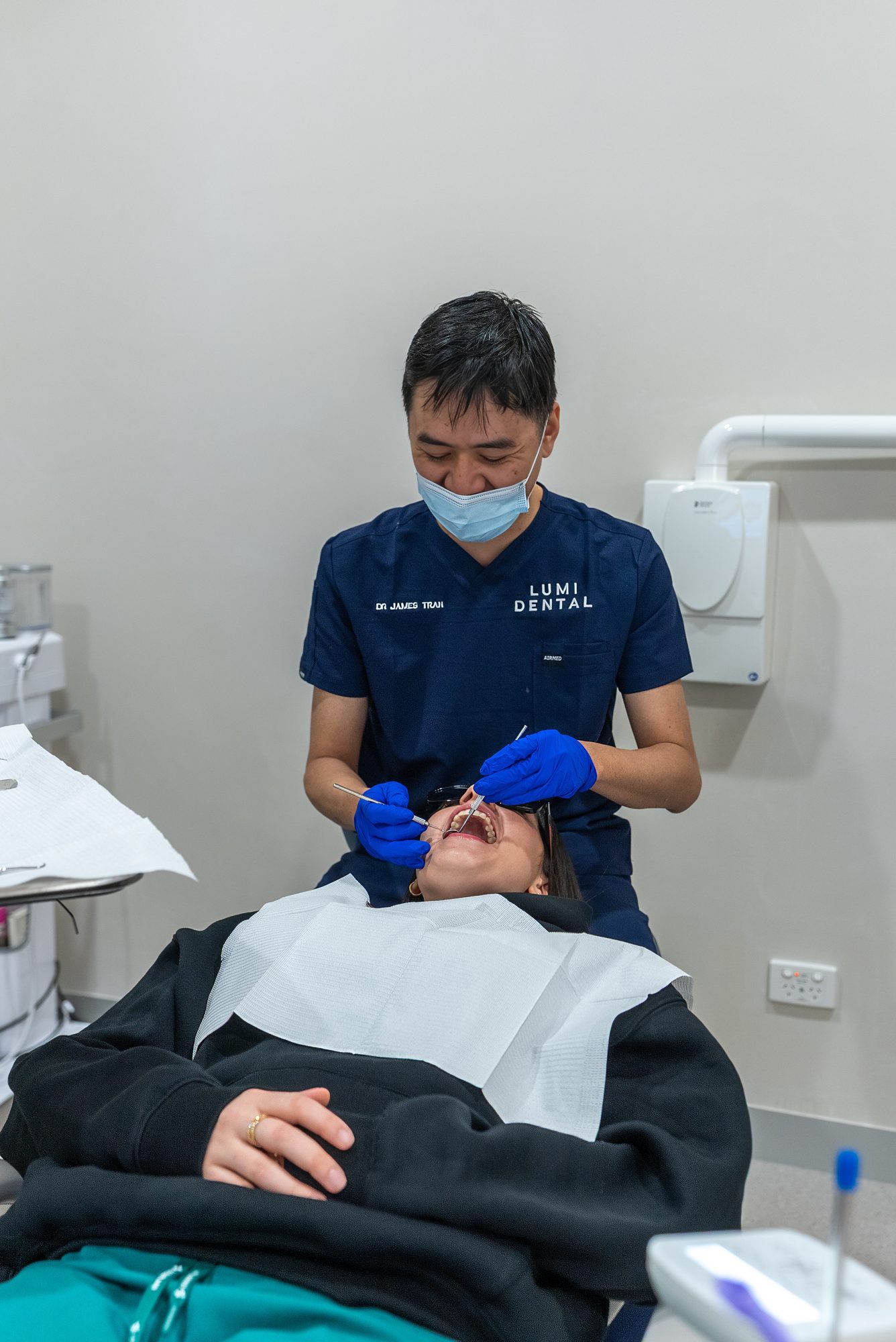

The fee for a filling is set mostly by how many surfaces of the tooth it covers and where that tooth sits. A small tooth-coloured filling on one surface of a front tooth is at the lower end. A filling that wraps around three or four sides of a molar takes longer, uses more material and costs more. Nobody can give you an exact figure until the tooth has been examined and, usually, x-rayed.
Written by Dr James Tran, dentist at Lumi Dental.
Typical fees across Australia
The most useful public benchmark is the Australian Dental Association's dental fees survey. CHOICE has published the national averages and ranges from the 2022 survey for tooth-coloured (adhesive) fillings:
| Filling | ADA item | National average, 2022 | Typical range, 2022 |
|---|---|---|---|
| Front tooth, one surface | 521 | $167 | $121 to $233 |
| Front tooth, two surfaces | 522 | $202 | $153 to $285 |
| Back tooth, one surface | 531 | $178 | $135 to $248 |
| Back tooth, two surfaces | 532 | $220 | $171 to $305 |
These are general market figures, not Lumi fees. They are national averages from 2022, so current prices are likely to be higher, and fees in Sydney often sit above the national figure. Fillings covering three or more surfaces have their own item numbers and cost more again. For current offers for new patients, see our current deals page.
Why two quotes for the same tooth can differ
Beyond the number of surfaces and the position of the tooth, a few things add time or materials. A very deep cavity may need a protective lining under the filling. A large repair sometimes needs extra support to hold it in place. Replacing an old filling means removing it first and dealing with any decay found underneath. Back teeth can also be harder to keep dry, and keeping the area dry matters for tooth-coloured materials.
What health funds and government schemes cover
Medicare does not cover routine fillings for most adults. If you have extras cover with general dental, your fund will usually pay part of the fee, depending on your policy and how much of your yearly limit you have used. Health fund claims can be processed at Lumi on the day through HICAPS.
Children in eligible families may be covered by the Child Dental Benefits Schedule (CDBS), which applies to children aged 0 to 17. In 2026 it provides up to $1,158 in benefits over two calendar years for basic services, which include fillings. It does not cover orthodontics or cosmetic work. Eligible children are bulk billed at Lumi, and our team can check eligibility before treatment.
Most fillings today are tooth-coloured
Composite resin is a tooth-coloured material that bonds to the tooth. Because it sticks to the tooth surface, the dentist usually needs to remove less healthy tooth than with older materials, and the filling can be matched to the shade of the tooth around it. It is the usual choice in Australian practices for both front and back teeth.
Amalgam, the silver-coloured mix of metals including mercury, has been used for well over a century. It is hard-wearing and was traditionally cheaper. Its use has fallen sharply, partly because of appearance and partly because of the Minamata Convention on Mercury, an international treaty that has phased down dental amalgam use. The treaty's member countries have since agreed to phase out the manufacture, import and export of dental amalgam by 2034. Existing amalgam fillings that are intact and causing no problems do not usually need to be replaced just because of the material.
For a very large cavity, the real question is often not composite or amalgam but whether a filling is enough at all. When a tooth has lost most of its structure, an onlay or a crown may protect it better. The typical market range for a crown is $1,500 to $2,500, so that is worth understanding before you decide. Our article on dental bonding compared with a filling explains a related choice for front teeth.
How a cavity is found
Early decay rarely hurts. Most cavities are found at a check-up, either by looking or on bitewing x-rays, which show the areas between back teeth that cannot be seen directly. By the time a tooth is painful, the decay has often reached deeper.
Things that may point to a cavity include sensitivity to cold or sweet foods, food catching in one spot, a rough edge your tongue keeps finding, or a dark line or hole on the tooth. Pain when biting, lingering sensitivity to heat or a throbbing ache can mean the problem has gone past a filling and the nerve may be involved. Those symptoms are worth having checked sooner rather than later.

What happens in the chair
A routine filling is usually done in one appointment, and how long it takes depends on its size and how many teeth are being treated. After a numbing gel on the gum, a local anaesthetic is given. Once the tooth is numb, the decay is removed and the cavity is shaped.
For a composite filling, the tooth surface is prepared so the material can bond to it, then the composite is placed in layers and each layer is hardened with a blue curing light. The dentist checks your bite, adjusts any high spots and polishes the filling.
Most people feel pressure and vibration, not sharp pain. Lower back teeth and teeth that are already inflamed can be harder to numb, and more anaesthetic can be given if needed, so speak up if anything feels sharp. If you are anxious about dental treatment, Lumi offers happy gas (nitrous oxide), inhaled pain relief, oral sedation and IV sedation; ask us which might suit you.
The first few days afterwards
The numbness usually wears off within a few hours. Until then, avoid hot drinks and chewing on that side so you do not burn yourself or bite your cheek.
Some sensitivity to cold or pressure is common for a few days, especially after a deep filling, and it usually fades over the following days or weeks. Call the practice if your bite feels high, if sensitivity is sharp or not improving, or if you get a throbbing ache. A high spot is quick to adjust, and our article on a bite that feels high after a filling explains why it happens. If you are flying soon after treatment, see flying after a filling or dental work.
How long fillings tend to last
There is no fixed expiry date. A meta-analysis by Opdam and colleagues in the Journal of Dental Research (2014), which pooled 12 long-term studies of composite fillings in back teeth followed for at least five years, found that the main reasons fillings failed were new decay and fracture. Fillings were more likely to fail in people at high risk of decay and when more surfaces of the tooth were filled.
In practice, a small filling in a mouth with little new decay can last many years. A large filling in someone who grinds their teeth or has frequent sugar may not. Regular check-ups let your dentist or OHT spot a worn or leaking edge before it turns into a bigger problem. If a filling has already chipped, our guide to a chipped or cracked filling explains what to do next.
Questions about fillings
Can a filling be done at the same visit as my check-up?
Sometimes, if the cavity is small and there is time in the appointment. Larger fillings, or several teeth, are usually booked as a separate visit so the work is not rushed.
Should I replace my old silver fillings?
Not just because they are silver. If an amalgam filling is intact, sealed and not causing problems, it can usually stay. Replacement makes sense when a filling is cracked, leaking or has decay around it, or when you want a different look and understand that removing it also removes some tooth.
What if the hole is too big for a filling?
When much of the tooth has gone, an onlay or a crown can protect what is left better than a very large filling. If the decay has reached the nerve, the tooth may need root canal treatment first. Your dentist will explain the options and costs before anything is done.
Will my health fund cover a filling?
Most extras policies with general dental pay part of the fee. The amount depends on your fund, your level of cover and how much of your yearly limit is left. Ask for the item numbers so you can check with your fund first.
Booking a check
If you think you might need a filling, or a filling feels rough or sensitive, a check-up with x-rays will show what is going on and what the options are. You can read more about general dentistry at Lumi Dental or book online.
About the author
Dr James Tran is a general dentist at Lumi Dental in Melrose Central, Melrose Park. He holds a Bachelor of Dentistry (BDent) from the University of Sydney and a Graduate Diploma in Oral Implants, and is a Master of the International Congress of Oral Implantologists (MICOI). You can read more about his clinical background and approach at drjamestran.com.au.
About Lumi Dental
Lumi Dental is an independent general and cosmetic dental practice at Melrose Central, Melrose Park, offering general, cosmetic, orthodontic, implant and family dentistry. We are open Monday to Saturday, until 9pm on Thursdays, with Sundays by appointment, and there is free undercover parking.
This article is general information only and is not a substitute for personalised dental advice. Costs are presented as typical ranges referenced to the ADA dental fees survey and vary by individual case. Please book a consultation for advice specific to your teeth.