
Most people who grind their teeth at night only find out second-hand. A partner hears it, a dentist points out flattened edges, or the jaw feels stiff every morning for no obvious reason. A custom night guard will not usually stop the grinding, but it can take the load off your teeth and fillings while you sleep, and the right design depends on what is actually going on.
Written by Dr James Tran, dentist at Lumi Dental.
Grinding at night is a sleep behaviour, not a bad habit
Bruxism means clenching or grinding the teeth. When it happens during the day it is usually clenching, often while concentrating or under stress, and it can be noticed and changed. Sleep bruxism is different. It is classed as a movement behaviour during sleep, so willpower does little, and the forces involved can be considerable because you are not awake to ease off.
Grinding itself is not a disease. What matters is the effect of that load over months and years on enamel, fillings, crowns, veneers and the jaw muscles.
How it shows up
The clues are often scattered, and you may only notice one or two:
- Grinding noises at night that someone else hears.
- Stiff or tired jaw muscles on waking, or tension around the temples that eases as the day goes on.
- Edges of the front teeth or canines that look flat, chipped or shorter than they used to be.
- Teeth that have become more sensitive to cold or pressure.
- A tender or clicking jaw joint, or difficulty opening wide first thing.
- Scalloped marks along the sides of the tongue, or a white ridge on the inside of the cheek where the teeth meet.
Some of these overlap with other problems. Pain when you bite on one tooth can point to a crack or a high filling rather than grinding, as we explain in why a tooth hurts when you bite. A tooth that throbs at night has a different set of causes again, covered in tooth pain at night. Sorting these out is the first job of an assessment.
Possible triggers
There is rarely a single cause. Stress and anxiety, broken or poor-quality sleep, caffeine, alcohol and smoking, and some medicines have all been linked with grinding. Snoring and sleep apnoea come up often too. Some studies suggest adults with obstructive sleep apnoea are more likely to grind, although the evidence is limited and of low quality, and it is unclear whether one causes the other (Pereira and colleagues, Sleep Medicine, 2026). If you snore loudly, wake unrefreshed or someone has noticed pauses in your breathing, raise it with your GP as well as your dentist.
The first appointment is about diagnosis
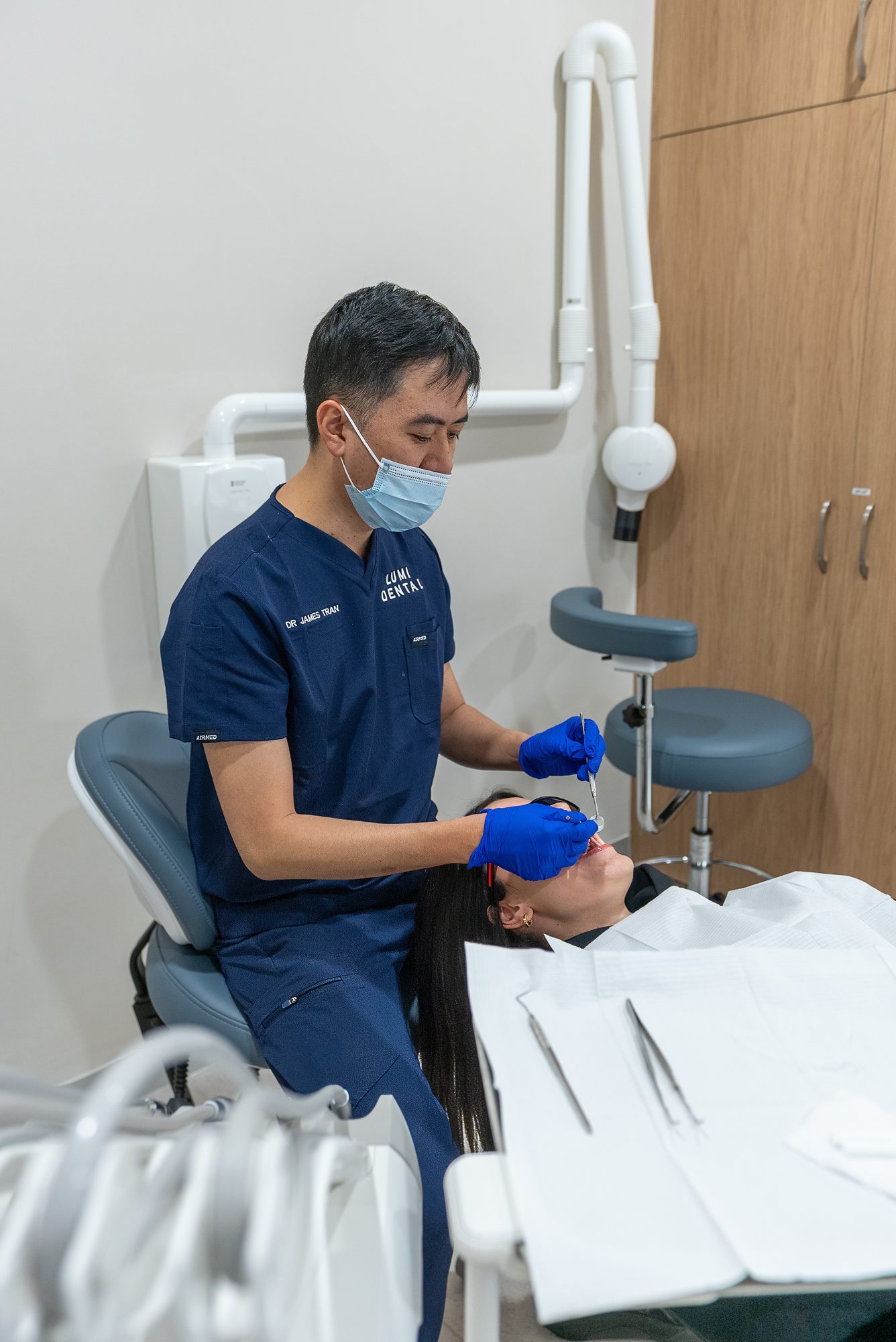
At Lumi Dental we do not jump straight to making a guard. We ask about sleep, stress, caffeine, medicines and any jaw pain. We look for wear facets, fine cracks, worn-through fillings and gum recession, feel the jaw muscles and joints, check how far you can open and listen for clicks.
Clinical photographs, and where needed a 3D scan or X-rays, record how the teeth look now so that any change can be measured at later visits rather than guessed at. If a splint is the right step, we take a digital scan of your teeth, choose the design with you, and the appliance is made in a dental laboratory. A fitting appointment follows, where the bite on the splint is adjusted so it meets evenly.
None of this is painful. If your jaw is already sore, opening wide for photos can be uncomfortable, so we go slowly and you can rest between steps.
Three appliances that are easy to confuse
| Appliance | What it is | Where it fits |
|---|---|---|
| Sports mouthguard | Thick, soft, shock-absorbing guard for contact sport | Protects against knocks; not designed for nightly grinding |
| Soft or dual-laminate night guard | Thinner guard with a soft inner layer, sometimes with a harder outer surface | May suit lighter grinders or as a short-term option |
| Hard occlusal splint | Rigid acrylic appliance adjusted so the opposing teeth meet it evenly | Usually preferred for heavier grinding and for people with jaw muscle symptoms |
For long-term grinding, a hard splint made from a scan of your teeth and adjusted to your bite tends to last longer and behave more predictably than a soft or off-the-shelf guard.
What a splint can and cannot do
A splint protects. It puts a hard, replaceable surface between the teeth so that the splint wears instead of your enamel or restorations. It does not reliably switch off grinding. A 2022 systematic review found that stabilisation splints tended to reduce the number of grinding episodes in some studies, but called for larger, longer trials before firm conclusions can be drawn (Minakuchi and colleagues, Japanese Dental Science Review).
That is why a good plan usually has several parts:
- A well-fitted splint to protect teeth, fillings, crowns and veneers. If you have veneers, protecting them matters for how long they last, which we cover in how long veneers last.
- Sleep and stress: regular sleep times, less caffeine and alcohol in the evening, and psychological support where stress or anxiety is a big factor.
- Medical review if sleep-disordered breathing is suspected. Lumi also offers mandibular advancement splints for snoring and sleep apnoea, alongside medical assessment, which is a different appliance from a grinding splint.
- Repairs where teeth are already cracked or worn, with bonding, onlays or crowns, ideally protected by a splint afterwards.
Chemist boil-and-bite guards are inexpensive and can tide you over while you wait to be seen. They tend to be bulky, can wear through quickly, and if worn for a long time a poorly fitting guard may affect how your teeth meet.
What night guards cost
Fees depend on the design, materials and laboratory, and there is no single official price list for private practices. Two reference points help:
- Hard occlusal splint: ADA item 965 "Occlusal splint". As one published benchmark, the Transport Accident Commission in Victoria pays general dentists $752.37 for this item under its fee schedule effective 1 July 2025. Private fees may be higher or lower than this.
- Examination beforehand: a check-up and clean typically costs about $200 to $400 in Sydney. This is a typical market range, not a Lumi fee.
- Adjustments later: adjusting an existing splint is a separate item (966) if it is needed at a later visit.
Medicare does not generally cover adult dental care. Private health extras policies often pay a rebate on item 965, but how much depends on your fund, your level of cover, annual limits and any waiting periods, so check with your fund before treatment. For current offers at Lumi, see our current deals page. Costs vary by individual case, and this is general information rather than a quote.
Living with your splint
A new splint should feel snug, not painful. Extra saliva and slightly tired jaw muscles are common for the first few nights, and these usually ease as you get used to it.
Each morning, brush it gently with a soft toothbrush and cool water, let it dry, and keep it in its case. Hot water can warp acrylic, so keep it away from heat.
Bring it along to your check-ups. We look at the wear marks, adjust the bite if your teeth have changed, and use the wear pattern as a guide to how hard you are grinding. A hard splint can last several years, depending on how heavily you grind. Wearing through one sooner simply shows how much force your teeth would otherwise be taking.
Common questions
Can I tell if I grind without a partner noticing?
Morning jaw stiffness, headaches that fade during the day, new sensitivity and flattened front teeth are all clues. A dental examination can confirm the wear pattern.
Will a night guard make me stop grinding?
Usually not completely. Its job is to protect the teeth and spread the load. Some people find their muscle symptoms ease over time.
Is a chemist guard good enough?
In the short term it is better than nothing. For ongoing grinding, a custom splint fits better, lasts longer and can be adjusted to your bite.
About the author
Dr James Tran is a dentist at Lumi Dental and practises general, cosmetic and restorative dentistry in Melrose Park, Sydney. He has a particular interest in conservative, evidence-based care for patients with tooth wear, cracked teeth and jaw-related symptoms. You can read more about his background and clinical interests at drjamestran.com.au.
About Lumi Dental
Lumi Dental is an independent general and cosmetic dental practice at Melrose Central, Melrose Park NSW 2114. The team provides general, cosmetic, orthodontic, implant, emergency and family dentistry, with IV sedation available for nervous patients. The centre has free undercover parking and lift access.
If grinding, jaw tension or worn teeth are worrying you, you are welcome to book an assessment at Lumi Dental.
This article is general information only and is not a substitute for personalised dental advice. Individual diagnosis, treatment options and costs depend on your specific circumstances and should be discussed at a clinical consultation.