

Implants are often described as the best way to replace a missing tooth, but "best" depends on the gap, the health of the teeth beside it, your bone, your budget and how soon you want it done. For a single missing tooth with healthy neighbours and enough bone, an implant is often the strongest long-term choice. For several missing teeth, limited bone or medical reasons to avoid surgery, a bridge or a partial denture can be the more sensible answer.
An implant stands on its own
An implant is a small titanium post placed in the jaw, which the bone grows onto over a few months. A crown is then fitted on top. Because it does not lean on the teeth beside it, nothing has to be done to those teeth, and the implant keeps the bone in that spot loaded in a similar way to a natural root.
Implants also hold up well over time. A 2024 meta-analysis by Kupka and colleagues in Clinical Oral Investigations, which looked at implants followed for 20 years, found survival of about 88% to 92% in the included studies, or about 78% under the most cautious statistical assumptions. That is a good record, but it also shows that implants need regular reviews and good gum care to last.
The downsides are surgery, the need for enough healthy bone (or grafting), a timeline of several months from placement to final crown, and the highest upfront cost of the three options.
A bridge borrows support from the teeth beside the gap
A conventional bridge crowns the teeth on each side of a gap and joins a false tooth between them. There is no surgery and it is usually finished in two or three visits. The trade-off is that the neighbouring teeth must be trimmed for crowns, which cannot be undone, and the bone under the false tooth is not loaded and may continue to shrink.
A systematic review by Tan and colleagues in Clinical Oral Implants Research (2004) estimated that about 89% of conventional bridges were still in place after 10 years. The complications behind failures included loss of retention, decay under the crowns and fractures of a supporting tooth or of the bridge material.
A partial denture is the least invasive starting point
A partial denture is a removable plate carrying one or more false teeth, held by clasps or by its fit against the gums and remaining teeth. It needs no surgery or drilling, can replace several teeth at once and costs the least up front. It does have to come out for cleaning, can feel bulky, may move when eating, and does not slow bone loss. Dentures also need relining or replacing over the years as the gums change. For people with several missing teeth, implants can also be used to hold a denture firmly; our guide to implant-supported dentures and regular dentures explains that middle ground.
Typical market costs
These are general Australian market ranges, not Lumi fees. Your own cost depends on the number of teeth, grafting and materials.
| Option | Typical market range | Surgery | Neighbouring teeth |
|---|---|---|---|
| Single implant with crown | $4,000 to $7,000 | Yes | Untouched |
| Three-unit bridge | $3,500 to $6,500 | No | Trimmed for crowns |
| Partial denture | Usually the lowest of the three | No | May carry clasps |
An implant costs more at the start, but because it does not involve the neighbouring teeth and tends to last, the gap between the options can narrow over many years. That depends on the person, so it is worth comparing a written treatment plan with fees for each option.
Matching the option to the situation
If one tooth is missing, the neighbours are healthy and the bone is adequate, an implant is usually the first option to consider. If the neighbouring teeth already need crowns, a bridge can make sense because those teeth are being treated anyway. If many teeth are missing, money is tight, or surgery is not advisable for medical reasons, a partial denture or an implant-retained denture may suit better. When a whole arch is involved, our comparison of dentures and All-on-X full-arch implants covers the larger decision, and implant, bridge or denture goes into more detail on single gaps.
Talk it through with us
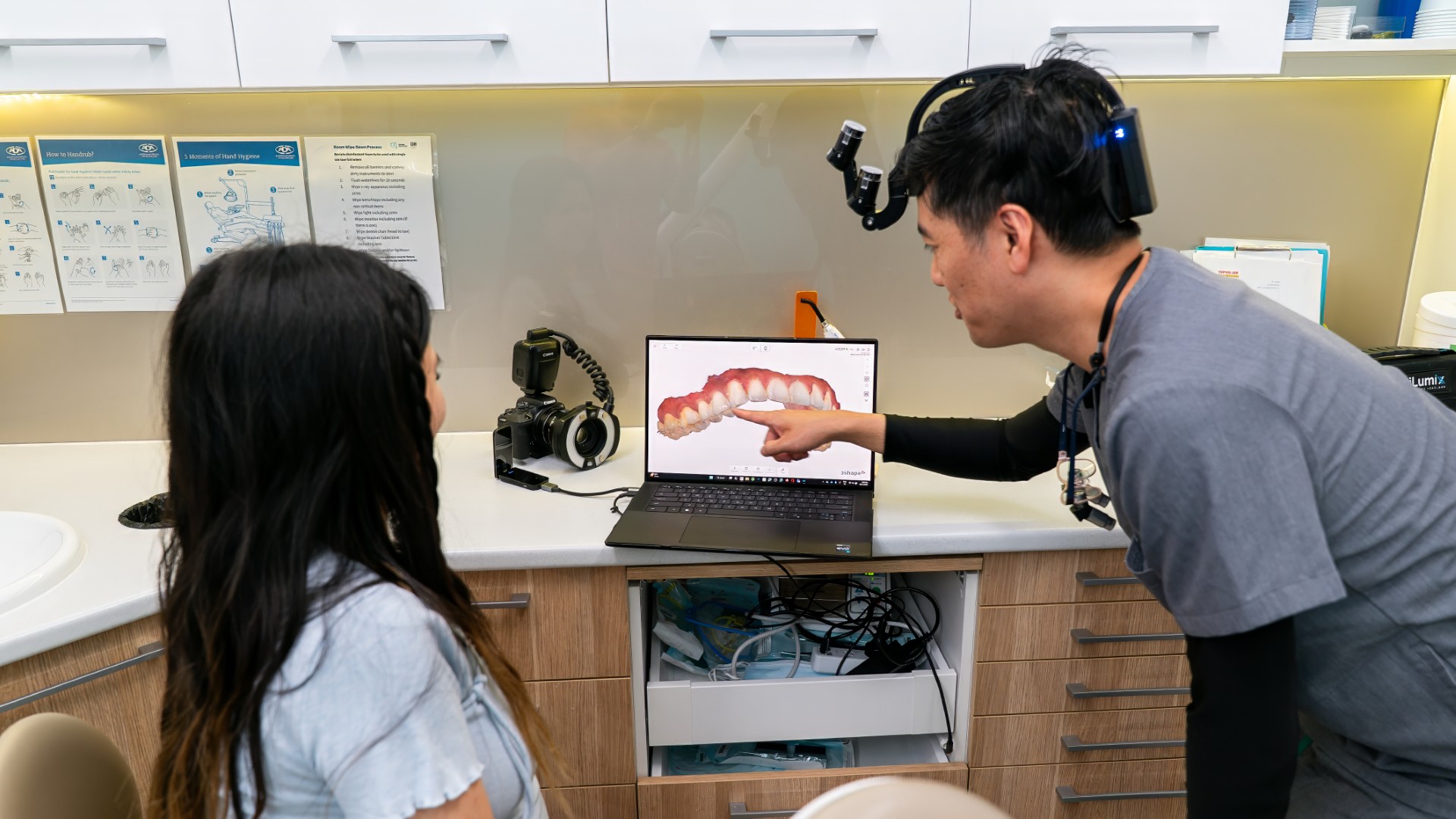
At a consultation, a dentist examines the gap and the teeth around it, takes a 3D X-ray if an implant is being considered, and talks through each suitable option, with no pressure to go ahead. You will usually receive a written treatment plan afterwards, often by email. Free consults are available for implant treatment; see current offers, read about dental implants and general dentistry at Lumi Dental, or book online at our Melrose Park practice.







