
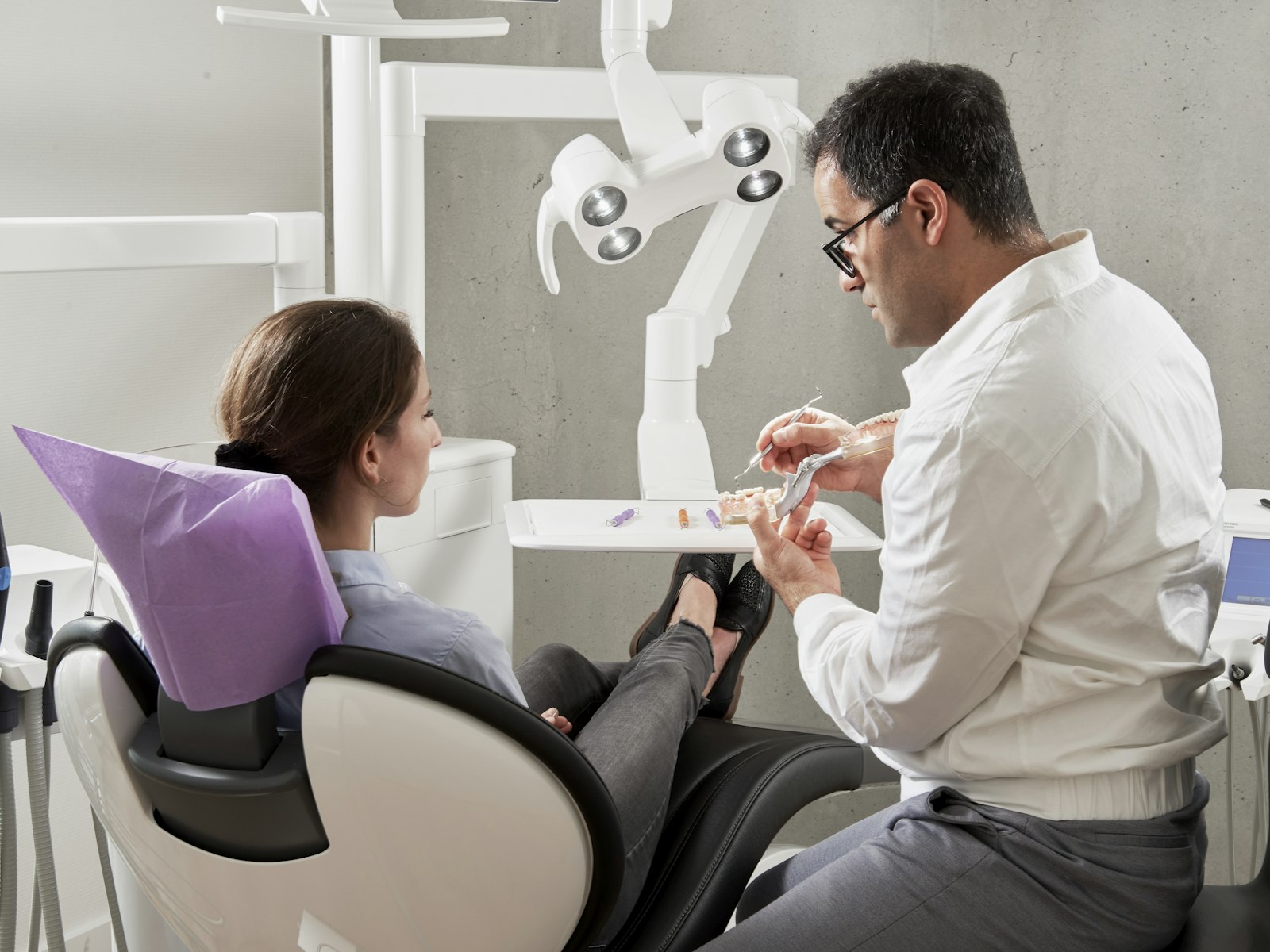

Numbness in the hours after implant surgery is expected local anaesthetic, but numbness that is still present beyond about 48 to 72 hours should be reviewed that same week. That is the single rule worth remembering about numbness after dental implant surgery, because early action gives the best chance of recovery. Waiting to see whether it settles on its own is the one approach that consistently costs people options. This is an uncommon complication, and it is one that is planned around routinely, but the response time matters.
Key takeaways
- Numbness for a few hours after surgery is normal local anaesthetic wearing off.
- Altered sensation lasting beyond 48 to 72 hours should be reviewed within that week.
- Lower jaw implants carry more of this risk than upper, because of the nerves running through the mandible.
- Permanent nerve injury is uncommon, reported at well under 1 per cent of cases in experienced hands.
- Prevention is mostly planning: a CBCT scan, safety margins commonly around 2 mm, and guided surgery.
- Many temporary cases settle over weeks to a few months, and recovery can continue for up to about 12 months.
The anatomy behind the risk
Three nerves explain almost all of this. The inferior alveolar nerve runs through a canal inside the lower jaw and supplies the lower lip, chin and lower teeth. It exits through the mental foramen near the premolars as the mental nerve, which is why numbness often shows up in the lip and chin on one side. The lingual nerve runs closer to the inner surface of the lower jaw and supplies the tongue.
Implants placed in the lower back region sit closest to these structures. Upper jaw implants have their own anatomical considerations, mainly the sinus, but the nerve supply up there is far less vulnerable, which is why lower jaw cases attract more planning attention. Where bone height above the canal is limited, the options are a shorter implant, a graft to build height, or a different position entirely. Bone grafting and sinus lifts explains how those decisions get made.
What can cause it
Altered sensation after implant surgery generally traces back to one of the following:
- An implant placed too close to or into the canal. Direct contact or encroachment on the nerve.
- Drilling beyond the planned depth. The drill passing further than intended during preparation.
- Pressure from swelling or bruising. Fluid or a haematoma near the nerve compressing it, which often resolves as the swelling settles.
- Heat or vibration. Drilling close to the nerve without adequate irrigation can cause thermal irritation.
- The anaesthetic injection itself. Uncommon, but a nerve block can occasionally irritate the nerve independently of the surgery.
The distinction matters clinically. Pressure from swelling usually improves on its own. An implant sitting in the canal will not improve while it stays there, which is why imaging early is so useful.
How common is it, really
Worth being precise here, because the numbers get quoted badly in both directions. Permanent nerve injury from implant surgery is uncommon, reported at well under 1 per cent of cases in experienced hands. Temporary altered sensation is reported far more often, in some studies in up to 40 per cent of cases, though most of that resolves.
Published permanent injury rates across studies range from 0 to around 13 per cent, and that spread mostly reflects differences in the populations studied, the complexity of the cases and how carefully sensation was tested. Studies that formally test sensation pick up subtle changes patients never noticed. Studies relying on patient reports find far fewer. Neither figure is wrong, they are measuring different things.
The practical reading is this: a small change in sensation for a while is not rare, a permanent one is.
What it feels like and how to describe it
People describe it in different ways, and all of these are worth reporting:
- Complete numbness, an area that feels like it is still asleep.
- Tingling or pins and needles.
- A burning or stinging feeling.
- Reduced sensation, where touch registers but feels muffled or distant.
- Heightened or unpleasant sensation to light touch.
Practical signs often come first. Dribbling when drinking, biting the lip without feeling it, food collecting in one side of the mouth, difficulty judging where a razor is on the chin, or lipstick applied unevenly. If you notice any of these more than two or three days after surgery, that is your prompt to ring.
A useful thing to do at home is map the affected area with a fingertip and note its borders, then check again in a few days. Whether the numb patch is shrinking is one of the most informative pieces of information you can bring to a review. Our guide to how long dental numbness normally lasts gives the baseline to compare against, and nerve numbness after extractions covers the same nerves in a different context.
Timeline: what to do and when
| Time since surgery | What is expected | What to do |
|---|---|---|
| 0 to 8 hours | Numb lip, chin or tongue from local anaesthetic | Normal. Avoid hot drinks and take care not to bite the lip or cheek |
| 8 to 24 hours | Sensation returning, possibly patchy | Still within the usual range for longer acting anaesthetic |
| 24 to 48 hours | Sensation should be largely back | Note the borders of any numb area and monitor |
| 48 to 72 hours | Persistent numbness or tingling | Ring the practice and arrange review that week |
| 1 to 4 weeks | Gradual improvement in many cases | Continue review, imaging if not already done, referral considered |
| 1 to 12 months | Slow ongoing recovery possible | Specialist follow up, sensory testing to track change |
| Beyond 12 months | Further improvement less likely | Focus shifts to managing any residual symptoms |
Alongside numbness, watch for pain that is escalating rather than settling, spreading swelling or fever, since those point to different problems needing their own attention.
Prevention is mostly planning
Almost everything that reduces this risk happens before the drill is picked up.
Imaging
A CBCT 3D scan maps the nerve canal in three dimensions. A standard OPG X-ray gives a flattened two dimensional view that cannot reliably show how far the canal sits towards the tongue or cheek side. For lower back implants, 3D imaging is the standard of care rather than an optional extra.
Safety margins
Planned clearance above the canal is commonly around 2 mm. That buffer absorbs small variations in drill angle and depth, plus the limits of image resolution.
Guided surgery and implant selection
A surgical guide, printed from the planning software, controls the angle and depth of the drill rather than leaving it to freehand judgement. Where bone height is short, choosing a shorter implant, angling the placement, or grafting first are all preferable to squeezing a longer fixture into the available space. Implant length is a planning variable, not a performance measure, and the parts of a dental implant explains how the components work together.
What happens at a review
The first step is establishing what is affected and how much, usually by mapping the area and testing response to light touch, sharp touch and temperature. That gives a baseline to compare against later.
Imaging follows, to check the implant position relative to the canal. If the implant is impinging on the nerve, backing it out slightly or removing it early is often considered, and timing matters here. Anti inflammatory medication may be used to reduce pressure around the nerve. If sensation has not improved over the expected period, referral to an oral and maxillofacial surgeon or a specialist in orofacial pain is appropriate.
Removing an implant does not mean the plan has ended. The site can usually be restored later once things have settled, and implant restorations are replaceable components over a lifetime anyway, as how often implant crowns need replacing sets out.
Frequently asked questions
How long should numbness last after implant surgery?
Local anaesthetic usually wears off within a few hours, sometimes up to eight with longer acting agents. Numbness still present beyond 48 to 72 hours should be reviewed that week.
Will the feeling come back?
In many temporary cases sensation improves over weeks to a few months, and nerve recovery can continue for up to about 12 months. After that, further improvement is less likely, which is why early assessment matters.
Is this more likely with lower jaw implants?
Yes. The inferior alveolar, mental and lingual nerves all run in the lower jaw, so implants in the lower back region sit closest to them. Upper jaw implants carry considerably less of this particular risk.
Does the implant always have to come out?
No. If the cause is swelling or bruising pressing on the nerve, it often settles without removing anything. Removal or backing the implant out is considered mainly when imaging shows it is impinging on the canal.
Can I still have an implant if I have already had nerve numbness once?
Often yes, with careful planning. It usually means 3D imaging, generous safety margins, a guided approach and sometimes a different site or a shorter implant. It is a conversation to have in detail beforehand.
Should I ask for a CBCT scan before my implant?
For lower back implants it is reasonable to expect one. It is the only imaging that shows the nerve canal in three dimensions, and it is the main tool for planning safe clearance.
The takeaway
Numbness for a few hours after implant surgery is the anaesthetic doing its job. Numbness that is still there after two or three days is a signal to be reviewed that week, not something to wait out. Permanent nerve injury is uncommon, most altered sensation is temporary, and the strongest protection is thorough planning with 3D imaging, sensible safety margins and a guided approach where the anatomy is tight.
If you are considering treatment and want to understand how your case would be planned, or you have had surgery and something does not feel right, the team at Lumi Dental offers a complimentary implant consult to talk it through. You can read more about dental implants at Melrose Park, or contact the team to arrange a time. We are open Monday to Saturday, with Sunday by appointment.


