Somewhere around their sixth birthday, most children get their first adult molars, quietly, behind the last baby teeth. Those molars have to last a lifetime, yet the first few years after they appear are when they are most likely to decay. For many children, sealing the grooves on top of these teeth is worth doing, and the research supporting it is among the stronger evidence in children's dentistry.
Decay in children often starts in the grooves
Look closely at the chewing surface of a molar and you will see a pattern of pits and fissures. Some are shallow. Others are so narrow that a single toothbrush bristle is wider than the gap. Plaque settles at the bottom, sugars from food feed the bacteria in it, and acid starts to dissolve the enamel where nobody can see.
Newly erupted molars are particularly exposed. Their enamel is still maturing, they sit at the back of a small mouth, and for months they are only partly through the gum, so brushing tends to skip right over them. This is why so much of the decay found in school-age children sits on the biting surfaces of the molars rather than on the front teeth.
A sealant is a thin layer of flowable resin that bonds into those fissures and sets hard. Once it is in place, the groove becomes a smooth surface that a brush can clean and that plaque has trouble holding onto.
The research supports sealing healthy molars
The most cited summary is a Cochrane systematic review by Ahovuo-Saloranta and colleagues (2017), which pooled trials in children and teenagers aged 5 to 16. It found moderate-certainty evidence that resin sealants on the permanent molars reduce decay compared with leaving them unsealed. Over two years the difference was large, and the benefit still showed at four years, although fewer studies followed children that long and the evidence at that point was less certain.
Two practical points come out of that work. First, the absolute benefit is greatest in children who are more likely to get decay to begin with. Second, a sealant only helps while it stays on, so checking it at routine visits matters as much as placing it. Earlier figures quoting a single exact percentage reduction can be misleading, because results vary with a child's risk, the type of sealant and how long they were followed.
Which teeth and at what age
The first permanent molars usually come through between about 6 and 7 years of age, and the second permanent molars between about 11 and 13. The most useful time to seal each set is soon after the chewing surface is fully exposed and can be kept dry, before plaque has had years in the grooves.
Not every tooth needs one. A dentist or OHT looks at how deep the fissures are, whether there are early white or brown changes in the enamel, the child's diet and brushing, and any decay already present elsewhere in the mouth. Shallow, self-cleaning grooves in a low-risk child may simply be monitored. Deep fissures in a child who has already had fillings are a stronger case.
Baby molars are sealed less often, but it can make sense for a young child at high risk of decay. If a groove already has a cavity, a sealant is not the right treatment. That tooth needs a filling, and our guide to how cavities start and how to prevent them explains why early treatment matters.
A short visit with no needle and no drill
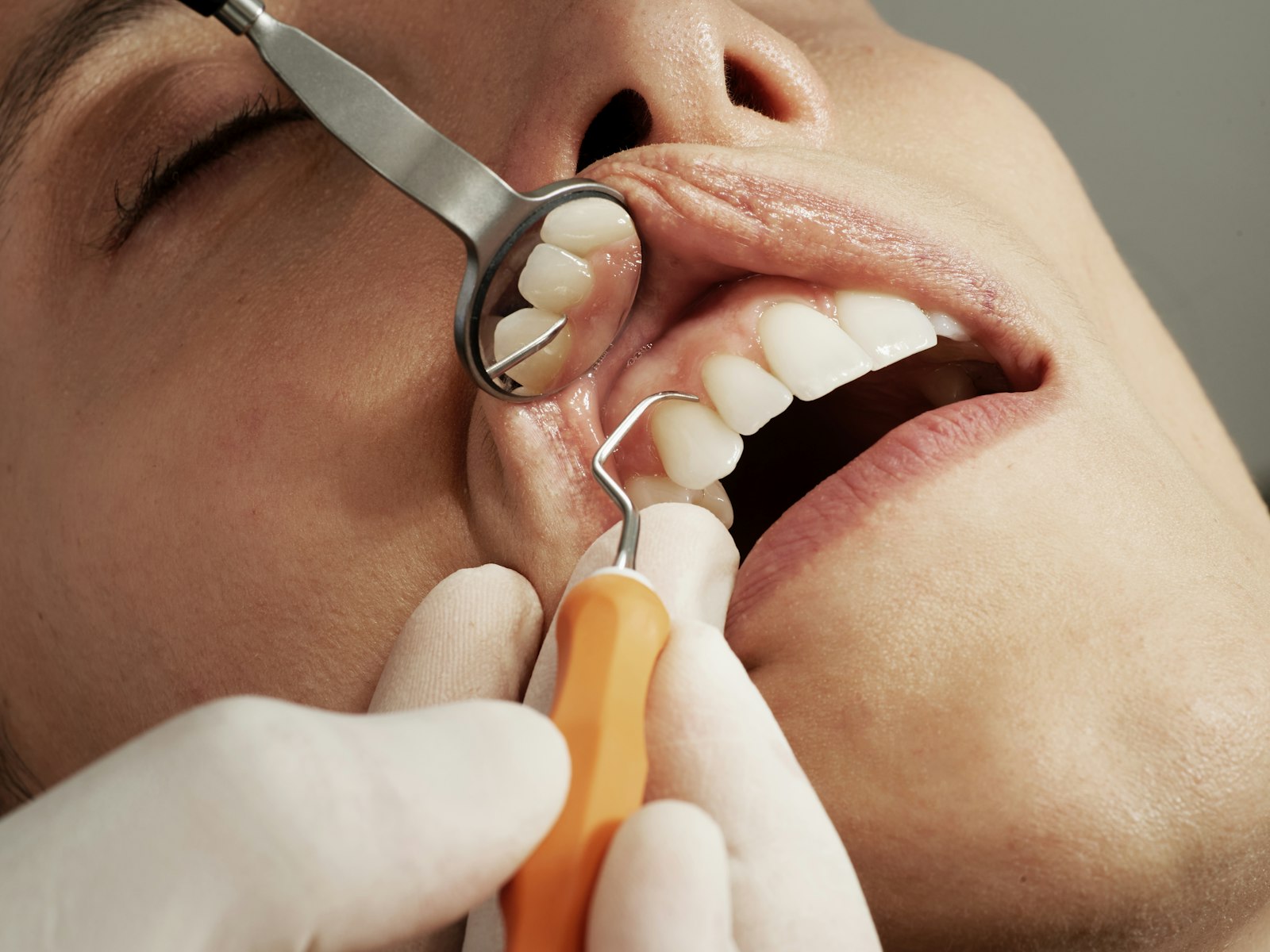
For a child who is wary of the dentist, sealing is a gentle introduction. The tooth is polished, a mild etching gel is placed for a short time, then rinsed off. Cotton rolls keep the tooth dry while the liquid resin is painted into the grooves, and a blue curing light sets it in well under a minute. The bite is checked and the child can eat normally straight away.
Most of the time the hardest part is keeping a wriggly tongue and saliva away from the tooth. If your child has not sat in a dental chair before, our guide to a first dental visit has ideas for preparing them.
What a sealant will not do
A sealant only covers the biting surface. It does nothing for the sides of the tooth or the contacts between teeth, which is where a different pattern of decay develops as children get older. Fluoride toothpaste twice a day, cleaning between teeth once the back teeth touch, and keeping sugary food and drinks to mealtimes all still apply. Our article on fluoride and its safety covers the enamel-strengthening side of prevention.
Sealants also wear. Some lose small pieces within the first year or two, and a partly lost sealant protects less. At each check-up the dentist or OHT looks at every sealed tooth and repairs or reapplies the coating if needed. With that maintenance, sealants commonly last several years.
Funding through the Child Dental Benefits Schedule
Fissure sealants are one of the services that can be claimed under the Child Dental Benefits Schedule, the Medicare program for eligible children aged 0 to 17 whose families receive certain government payments. It provides a capped benefit for basic dental care over two calendar years. Our CDBS explainer sets out who qualifies and what is covered.
At Lumi Dental, eligible children are bulk billed under the CDBS, and our oral health therapists Sabrina Tran and Jennifer Nguyen see children for check-ups, prevention and sealants. For families not covered by the scheme, see our current deals page or contact us and we can explain the options before anything is done.
Questions parents ask
Do sealants contain BPA?
Some resin sealants can release a very small trace of BPA in the period after placement. A 2019 systematic review found urine BPA levels rose briefly after dental treatment, and in the one study that followed patients longer they were back to baseline within two weeks. There is no agreed safety threshold, so dentists take simple precautions such as wiping or rinsing the surface after the sealant sets. If this worries you, ask which material is being used.
Can my child feel the sealant?
Usually only for a day or so. The coating is very thin, and once the bite has been checked most children forget it is there.
Are sealants only for children?
They are mostly placed in children and teenagers, because that is when the molars are new and most at risk. An adult with deep, decay-free grooves may occasionally be offered one.
Booking a check for your child
If your child's six-year or twelve-year molars have recently come through, a check-up is a good time to ask whether sealing them suits their teeth. Our general dental team in Melrose Park can examine the molars, explain what we see and check CDBS eligibility at the same visit.