

Usually not. Most health funds regard teeth whitening as cosmetic, so many extras policies pay nothing towards it, while some higher-level policies pay a modest, capped amount. Having "dental cover" does not answer the question; what matters is what your policy pays on the specific whitening item numbers, and the only reliable answer comes from your fund.
Written by Dr James Tran, BDent (University of Sydney), MICOI, GradDip (Oral Implants), general dentist at Lumi Dental in Melrose Park.
Funds pay by item number, and whitening has three of its own
Every dental service in Australia is described by a three-digit item number in the Australian Dental Association's Schedule of Dental Services and Glossary. Health funds use these numbers to decide what to pay. For whitening, the relevant items are:
- 117, bleaching, internal (per application): lightening the discoloured crown of a tooth that has had root canal treatment, from the inside. It is done in the surgery.
- 118, bleaching, external (per tooth): changing the colour of a tooth with treatment applied to the outside, done in the surgery. Because it is charged per tooth, it may appear several times on one quote.
- 119, bleaching, home application: the clinical advice, risk advice, instructions and supervision for whitening at home. Custom trays and the whitening material are charged under separate items, 926 (where custom trays are made) and 927.
So a take-home whitening quote can include three different item numbers, and a fund may pay on some and not others. Our comparison of in-chair and take-home whitening costs explains how the options differ.
Why most policies leave whitening out
Extras cover (general treatment cover) is designed by each insurer, and funds generally group dental into general, major and sometimes orthodontic categories. Whitening is usually seen as improving appearance rather than treating disease, so many funds exclude it or pay on it only at higher levels of cover, sometimes from a separate limit. The rebate itself is set by the insurer, not the dentist, as the ADA's consumer site points out.
Medicare does not help here either. The ADA notes that Medicare covers dental care only in certain limited situations, and whitening is not one of them.

Finding out what your policy pays
Three checks will settle it:
- Read your policy's Private Health Information Statement. Every policy has one, available from your fund or privatehealth.gov.au. It lists covered services, waiting periods and limits. If whitening is not clearly listed, assume it may be excluded and ask.
- Ask for a written treatment plan with fees and item numbers. After an examination you will usually receive a written treatment plan, often by email, listing each item number and fee.
- Call your fund and quote the item numbers. Ask whether the policy pays on 117, 118, 119, 926 and 927, how much for each, and which limit the money comes from. Note the date and the name of the person you speak to, and ask for the answer in writing if you can.
If a benefit does apply, it can usually be claimed at the practice on the day. Our explainer on HICAPS claiming at the dentist shows how that works.
Waiting periods and limits still apply
Even where whitening is covered, three things affect what you receive. Waiting periods for extras are set by each insurer; the Commonwealth Ombudsman gives two months as a typical example for general dental and 12 months for major dental, and periods vary between funds. The benefit usually comes out of a yearly dental limit, or a smaller sub-limit, so earlier treatment in the year can leave little room. And funds may pay a fixed amount per item or limit how often an item can be claimed. Our article on how dental extras limits reset explains the timing.
Reasons a whitening claim is declined
- The policy excludes cosmetic treatment, which is the most common reason.
- The fund pays on one item number but not another, for example the supervision item but not the trays.
- The waiting period has not been served, or an upgrade has not taken effect yet.
- The yearly limit or sub-limit has already been used.
- The whitening was done outside a dental practice, so there is no provider number or dental item number to claim against.
If a claim is refused, ask your fund for the reason in writing. Our article on why a health fund declines a dental claim covers the next steps.
A single dark tooth is a different question
A tooth that has darkened after root canal treatment or an injury is not the same as wanting a lighter smile overall. Internal bleaching of that tooth is item 117, and some funds assess it differently from cosmetic whitening. Ask about 117 by number rather than asking whether "whitening" is covered. Our guide to internal bleaching for a dark tooth explains the treatment.
Whitening at Lumi, and what to budget for
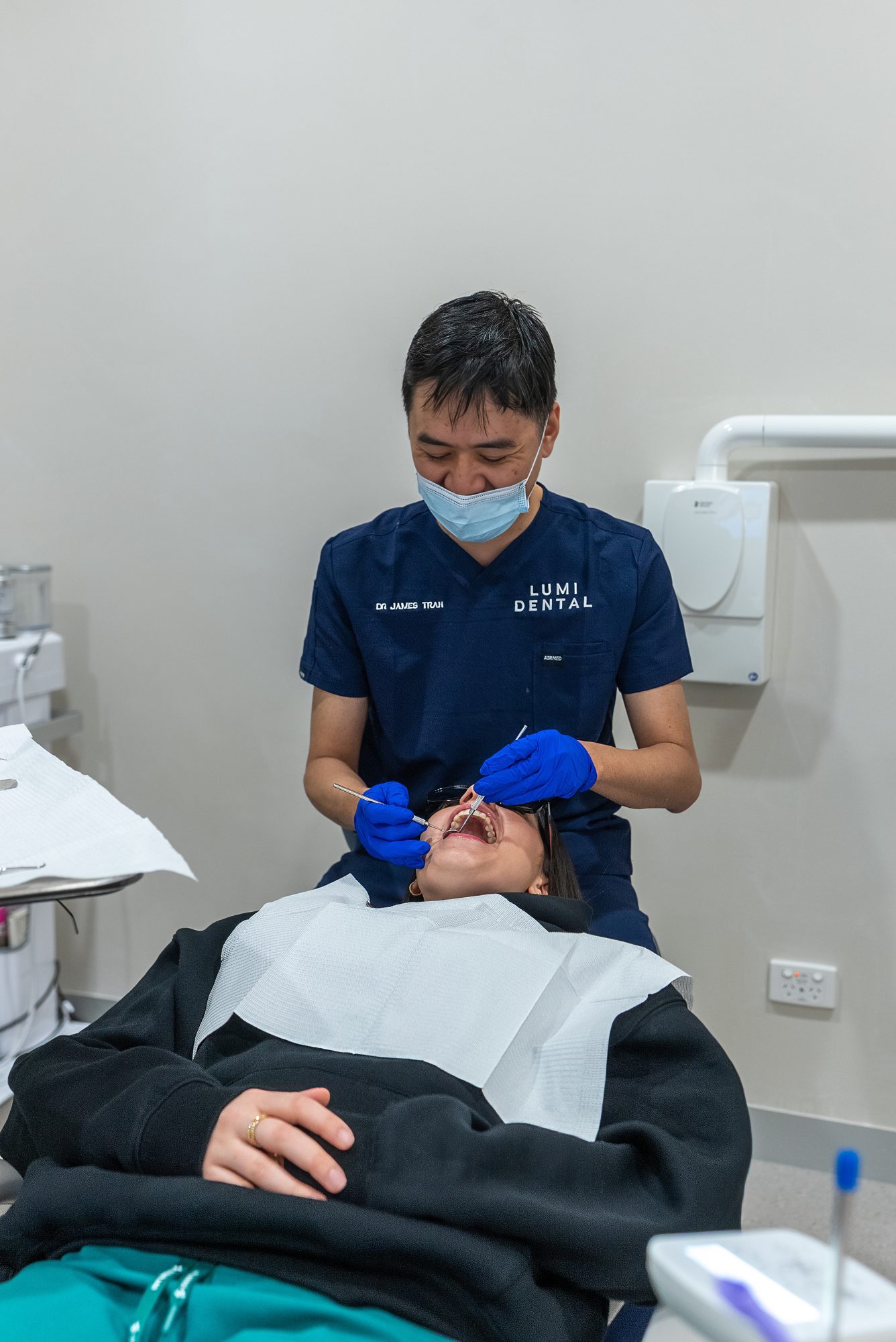
At Lumi Dental, a dentist examines your teeth before any whitening, because decay, leaking fillings or gum disease should be treated first. Our whitening options are Lumi Home (take-home trays), Lumi Refresh and Lumi Radiance (in-chair whitening with take-home gel), all using dentist-supplied Boutique take-home gel. Results vary between people, and we do not promise a particular shade.
As a general market guide, dentist-supervised take-home whitening in Australia typically costs about $300 to $700. This is a market range, not a Lumi fee. It is safest to budget as if your fund will pay nothing and treat any confirmed benefit as a bonus. See our current deals and the teeth whitening page for more.
Common questions
Which health funds cover teeth whitening?
It depends on the policy level rather than the fund's name, and policies change. Check your own policy information and call your fund with the item numbers.
What item number is in-chair whitening?
External bleaching in the surgery is item 118, charged per tooth. Home whitening supervision is item 119, and internal bleaching of a root-treated tooth is item 117.
Can whitening be claimed through HICAPS?
Only if your policy pays on the items being charged. If it does, the benefit is deducted on the spot; if not, the claim simply returns no benefit.
Get an itemised whitening plan
If you would like to know what your fund will contribute, the team at Lumi Dental in Melrose Park can examine your teeth and give you a written plan with every item number listed. Book a free cosmetic consult, or read more about teeth whitening at Lumi Dental.
Sources
- Australian Dental Association: The Australian Schedule of Dental Services and Glossary
- Australian Dental Association (teeth.org.au): Private health insurance
- Commonwealth Ombudsman: Waiting periods
- privatehealth.gov.au: Private Health Information Statements
About the author

Dr James Tran is a general dentist at Lumi Dental in Melrose Park. He holds a BDent from the University of Sydney and a Graduate Diploma in Oral Implants, and is a Master of the International Congress of Oral Implantologists (MICOI).
This article is general information only and is not a substitute for an examination and individual advice from a registered dental practitioner. Suitability for any treatment varies from person to person.







