Zirconia has a reputation as a material that dental cement does not stick to. That is only partly true. Zirconia contains no glass, so the routine used to bond glass-based ceramics such as e.max does not suit it, but laboratory research and a small number of long-term clinical cases suggest it can be bonded durably when the inside of the crown is roughened and a primer or cement containing a phosphate monomer, such as 10-MDP, is used.
This article explains what happens on the inside of a zirconia crown before it goes in, what the studies show about bonding versus conventional cementing, and why a crown occasionally comes loose.
Zirconia needs a different routine from e.max
Porcelain and lithium disilicate (e.max) are silica-based ceramics. For these materials, a 2018 review by Blatz and colleagues in the Journal of Dental Research describes resin bonding as the long-standing gold standard for these low- to medium-strength ceramics, although it needs several pretreatment steps on the bonding surface. In a 2022 clinical trial of thin e.max restorations, for example, the inside surfaces were etched with hydrofluoric acid and then treated with silane before bonding.
Zirconia is an oxide ceramic. Kern and Gläser, writing in the Journal of Esthetic and Restorative Dentistry in 2023, describe alumina and zirconia as non-retentive oxide ceramics. In a 2024 network meta-analysis of 77 laboratory studies, Li and colleagues found that adding silane did not improve the bond to zirconia in those tests. A different approach is needed.
Two steps the research keeps returning to
The first is air abrasion, sometimes called sandblasting: a fine stream of alumina particles roughens and cleans the inside of the crown. The second is a primer or resin cement containing 10-MDP, a phosphate monomer that bonds chemically to zirconia.
Li and colleagues (Japanese Dental Science Review, 2024) found that adhesives containing 10-MDP outperformed other acidic monomers. Finer particles (25 to 53 micrometres) gave higher bond strength straight away than coarser ones (110 to 150 micrometres), with no significant difference after artificial ageing. Ageing weakened 91.2% of the bonds they analysed, but less so after air abrasion or silica coating. An earlier review of 52 laboratory studies by Özcan and Bernasconi (Journal of Adhesive Dentistry, 2015) found that, after physical conditioning (mainly air abrasion), MDP-based cements tended to give higher bond strengths than other resin cements in tensile tests, and that results were significantly influenced by the surface treatment, cement, test method and ageing.
Laboratory bond strength is not the same as a crown staying on in a mouth for years. Some of the longest clinical follow-up comes from bonded bridges, which have very little mechanical grip. Kern and Gläser reported on single-wing, porcelain-veneered zirconia and alumina bridges replacing front teeth, bonded with a phosphate monomer resin after air abrasion with 50 micrometre alumina at low pressure (0.25 MPa). Their original case was followed for 26 years, and the restorations replacing incisors in the cases they report did not come off. The authors concluded that bonding to zirconia is not a problem when adequate methods are used. This is three cases from one group, so it shows what is possible rather than what every restoration will do.

Does bonding make a full crown last longer?
For a full crown on a tooth with enough height, the answer from clinical studies is not clear-cut.
| Study | What it looked at | What it found |
|---|---|---|
| Maroulakos and colleagues, Journal of Prosthetic Dentistry, 2019 | 17 clinical studies, 2,436 zirconia and lithium disilicate crowns | Survival of bonded zirconia crowns ranged from 83.3% to 100%, and of conventionally cemented crowns from 82.0% to 100%. The authors judged the two comparable, from poor-quality evidence. |
| Blatz and colleagues, Journal of Dental Research, 2018 | Narrative review of long-term clinical evidence on high-strength ceramics | Porcelain-veneered zirconia crowns had high long-term survival with conventional cements, though most studies recommended resin bonding. At the time there were no long-term clinical data on bonding monolithic zirconia. |
| Ma and colleagues, Journal of Dentistry, 2026 | 66 clinical studies of zirconia restorations on natural teeth | Pooled survival of single crowns ranged from 92.9% to 98.7% at up to 10 years. Chipping and debonding were the most common mechanical problems. Restorations treated with air abrasion and 10-MDP had favourable short-term results (98.6% survival for single crowns). Certainty was graded very low. |
| Rohr and colleagues, Clinical Oral Investigations, 2025 | Laboratory study: translucent zirconia crowns bonded to extracted human teeth, tested before and after ageing in two chewing simulators | Two primer-based bonding protocols each gave a mean retention strength of about 7.0 MPa, compared with 4.9 MPa when one of the same cements was used self-adhesively without its primer. The authors recommended a primer-based protocol. This measures retention in the lab, not survival in patients. |
Put together, conventionally cemented zirconia crowns have a good clinical track record in the studies available, and bonding has not been shown to clearly improve survival for full crowns, although the evidence is of low quality. Bonding matters most where the restoration has little to hold it mechanically. Blatz and colleagues note that it is critical for resin-bonded bridges and for partial-coverage restorations such as onlays and veneers. That is why single-wing bonded bridges, described in our article on one-wing and two-wing resin-bonded bridges, depend so much on how the zirconia surface is prepared.
Why a zirconia crown can come loose
In the Ma review, debonding was one of the two most common mechanical complications of zirconia restorations, alongside chipping. The Rohr study also found that retention varied between the two sites that made the specimens, even with a strict protocol, and the authors noted that results may differ between operators. Laboratory studies point to saliva contamination of the crown surface and the cement and primer used as factors, and, as Blatz and colleagues note, bonding matters more when the tooth gives the restoration little mechanical hold.
If a crown does come off, keep it and avoid chewing on that side. Our guide to what to do when a crown falls off covers the first steps and what a dentist checks before refitting it.
For dentists: clean after try-in with air abrasion, not phosphoric acid
Saliva contact during try-in contaminates the intaglio surface. In a meta-analysis of 11 in vitro studies with ageing, Silva and colleagues (Journal of Adhesive Dentistry, 2022) found air abrasion with alumina was the most effective cleaning method for saliva-contaminated zirconia, and a commercial cleaning paste also beat water rinsing, while alcohol and phosphoric acid were not significantly different from water rinsing. A 2026 laboratory study by Yeşil and colleagues (BMC Oral Health), testing zirconia and cobalt-chromium specimens, found that all decontamination methods improved shear bond strength over contaminated controls, but only air abrasion gave significantly higher values than the others; the authors suggested a cleaning solution as an alternative. On particle size, the Li meta-analysis favoured finer particles for immediate bond strength, with no significant difference after ageing, and the Kern bridges were abraded with 50 micrometre alumina at 0.25 MPa. All of this is laboratory bond strength, not clinical retention, so follow the cement manufacturer's protocol and treat these findings as a guide.
Zirconia and e.max at Lumi
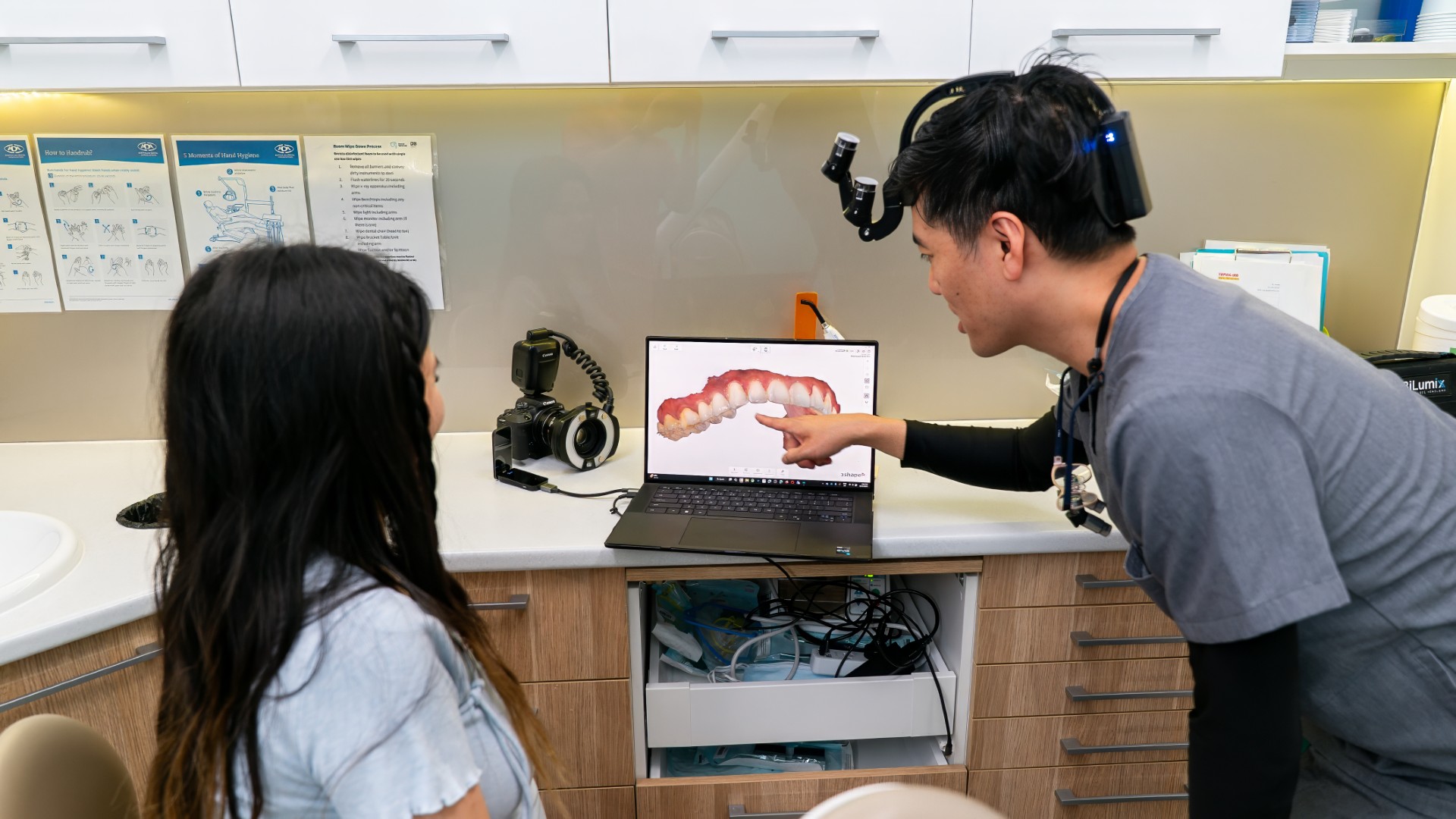
Lumi uses e.max (lithium disilicate) and offers zirconia as a choice for crowns. The practice has a 3D intraoral scanner and an in-house lab. Which material and which method of fitting suit a particular tooth depends on how much tooth is left, where it sits and how the bite works, and this is discussed at an examination. More about the options is on our crowns and bridges page, and our article on zirconia grades and translucency explains how the different types of zirconia compare.
Common questions about fitting zirconia crowns
Is a self-adhesive cement enough for zirconia?
In the Rohr laboratory study, a self-adhesive cement used without its primer gave lower retention than primer-based protocols on translucent zirconia crowns. Clinical reviews comparing bonded and conventionally cemented full crowns have not shown a clear difference in survival, so the choice usually depends on the tooth and the restoration.
Is zirconia the same as e.max?
No. e.max is a lithium disilicate glass-ceramic, while zirconia is an oxide ceramic with no glass phase. They are prepared for fitting in different ways, and our article comparing ceramic and zirconia crowns covers how they differ in appearance and strength.
Sources
- Blatz MB, Vonderheide M, Conejo J. The effect of resin bonding on long-term success of high-strength ceramics. Journal of Dental Research, 2018. PubMed 28876966
- Maroulakos G, Thompson GA, Kontogiorgos ED. Effect of cement type on the clinical performance and complications of zirconia and lithium disilicate tooth-supported crowns: a systematic review. Journal of Prosthetic Dentistry, 2019. PubMed 30885580
- Özcan M, Bernasconi M. Adhesion to zirconia used for dental restorations: a systematic review and meta-analysis. Journal of Adhesive Dentistry, 2015. PubMed 25646166
- Li X and colleagues. Different surface treatments and adhesive monomers for zirconia-resin bonds: a systematic review and network meta-analysis. Japanese Dental Science Review, 2024. PubMed 38938474
- Kern M, Gläser R. Single-retainer all-ceramic resin-bonded fixed dental prostheses: long-term outcomes in the esthetic zone. Journal of Esthetic and Restorative Dentistry, 2023. PubMed 36579757
- Ma Y and colleagues. Clinical outcomes of zirconia dental restorations: a systematic review and meta-analysis. Journal of Dentistry, 2026. PubMed 42575241
- Rohr N and colleagues. Translucent zirconia crown retention: effect of preparation, bonding and aging protocol. Clinical Oral Investigations, 2025. PubMed 40593330
- Silva NRD and colleagues. Which zirconia surface-cleaning strategy improves adhesion of resin composite cement after saliva contamination? A systematic review and meta-analysis. Journal of Adhesive Dentistry, 2022. PubMed 35416445
- Yeşil Z and colleagues. Effect of saliva contamination and decontamination procedures on bond strength to framework materials. BMC Oral Health, 2026. PubMed 41491949
- Schlichting LH and colleagues. Ultrathin CAD-CAM glass-ceramic and composite resin occlusal veneers for the treatment of severe dental erosion: an up to 3-year randomized clinical trial. Journal of Prosthetic Dentistry, 2022. PubMed 35750501
If you have a zirconia crown that feels loose or has come off, or you are weighing up crown materials, you can book an appointment at our Melrose Park practice.
This article is general information only and is not a substitute for an in-person assessment by a dental professional.