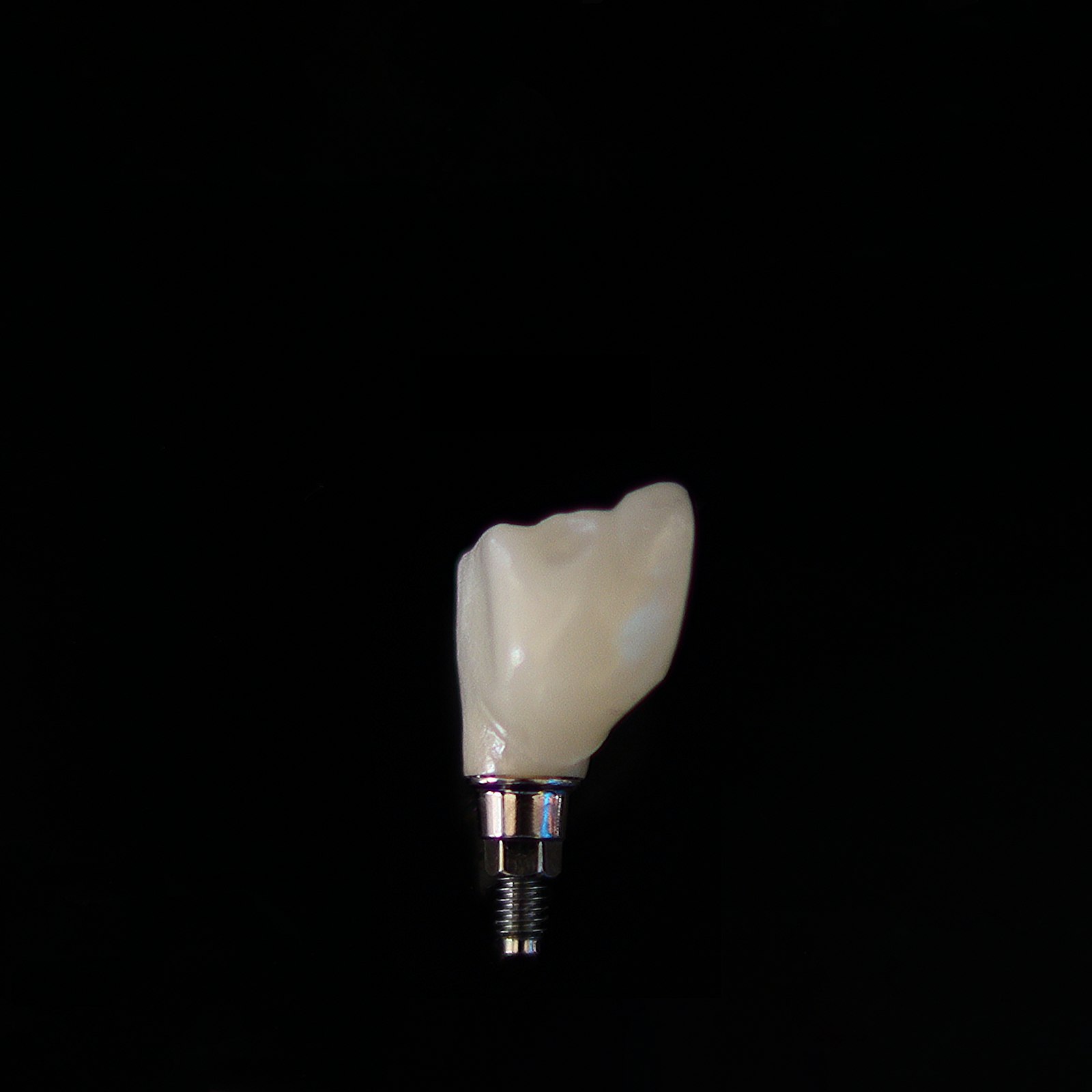

A lower denture has very little to hold onto. The tongue pushes it, the ridge under it shrinks over the years, and many wearers end up using adhesive and still avoiding crusty bread. Mini dental implants were developed largely for this problem: a few narrow posts, usually under 3 mm wide, placed in the lower jaw so the denture can clip onto them.
They are not a smaller copy of a standard implant for every job, though. Where they work well, and where a wider implant is the better choice, depends mostly on what you need the implant to do.
Mini implants are mainly for holding a denture, not for single teeth
The narrow width that makes a mini implant easier to place also limits how much chewing force it can take on its own. That is why most of the research, and most of their use, involves four or so mini implants sharing the load of a lower overdenture. Each implant carries a small ball or similar attachment, and a matching housing inside the denture snaps over it.
If the goal is a fixed crown on one missing tooth, especially a back tooth, a standard-width implant is usually the more reliable long-term option. If the goal is a removable denture that stays put when you talk and eat, mini implants can be a reasonable choice for suitable people. Our guide to implant-retained overdentures explains how clip-on dentures work with either type.
What the studies show for the lower jaw
A systematic review by Jawad and Clarke in the International Journal of Oral and Maxillofacial Implants (2019) pooled 17 studies covering 1,715 mini implants in 475 patients. Over follow-up periods of 6 to 84 months, the overall survival rate was about 95.6%, which the authors described as excellent in the short to medium term.
A larger review by Mohammadi and colleagues in Clinical Oral Investigations (2025) took in 39 studies and 3,787 mini implants. It estimated a seven-year survival rate of about 91.4%, with lower survival in the upper jaw than the lower jaw, and better results when four mini implants rather than two supported a lower denture. The same review found a high rate of mechanical problems, such as worn attachment parts and fractured dentures, so regular maintenance visits should be expected.
Most of these studies followed people for a few years rather than decades, so long-term evidence is still thinner than it is for standard implants.
Why the upper jaw is a different story
Bone in the upper jaw is usually softer, and an upper denture also behaves differently because it covers the palate and already gains some suction. Survival of mini implants has been reported to be lower there. For people who want an implant-supported upper denture, wider implants, or a different design altogether, are often discussed instead.
Who tends to be considered for them
Mini implants are often discussed with people who:
- have a loose lower denture and want it to stay in place
- have a narrow jaw ridge and would prefer to avoid a bone graft
- would find a longer surgical procedure difficult because of health or age
Placement is usually done under local anaesthetic, often through small openings in the gum rather than a full flap. In many cases the denture can be fitted onto the implants on the same day, either your existing denture once it has been adapted or a new one, depending on its fit and condition. The article on same-day implants covers immediate loading in more detail.

A scan decides whether there is enough bone
Even narrow implants need healthy bone of adequate height and density. At Lumi Dental the assessment includes an examination of your gums, ridge and bite, and a 3D X-ray on our Orthophos unit to measure the bone where the implants would go. That scan, together with how your current denture fits, guides whether mini implants, standard implants or another approach is likely to suit you.
Looking after mini implants
The attachments inside the denture wear with daily use and usually need replacing from time to time. The implants and the gum around them also need cleaning every day, and regular reviews let your dentist check the bone and the fit of the denture. Our guide to implant aftercare covers home care for both mini and standard implants.
Cost compared with standard implants
Mini implants are generally less costly than standard implants for a denture, because placement is usually shorter and grafting is less often needed. The total depends on how many implants are placed and whether a new denture is made. We do not list fees in our articles; current offers are on our current deals page.
Common questions about mini implants
Do mini implants hurt?
They are placed under local anaesthetic, and because the procedure is usually less invasive than standard implant surgery, many people manage afterwards with over-the-counter pain relief. Some tenderness for a few days is normal.
Can my current denture be used?
Sometimes. If it fits well and is in good condition, housings can often be added to it. If it is worn or poorly fitting, a new denture is usually the better base.
Are mini implants a permanent fix?
The implants themselves can last for years with good care, but the denture and its attachments need ongoing maintenance and occasional replacement parts.
If your lower denture moves when you eat or speak, a free implant consult at Lumi Dental in Melrose Park is a chance to find out whether mini implants or standard implants are worth considering. You can read more on our dental implants page or book a time. This article is general information and not a substitute for personal dental advice.