


Teeth whitening does not darken or lighten your gums, but whiter teeth can make naturally dark gums look more noticeable by contrast. For most people with darker gums the colour is normal melanin pigmentation, the same pigment found in skin, and it is not a sign of gum disease. A review of oral pigmentation notes that melanin in the gums has been reported in up to all participants in some studies of people of African background, and in about 30% to 98% of people in studies from Asian populations.
Written by Dr James Tran, BDent (University of Sydney), MICOI, GradDip (Oral Implants), general dentist at Lumi Dental in Melrose Park.
The short version
- Darker gums are common across many skin tones and are usually healthy. They do not need treatment.
- Whitening gel changes tooth colour only. A white patch on the gum after whitening is brief irritation, not a change in pigment.
- Lighter teeth increase the contrast with gum colour. The gum has not changed; the eye is comparing the two.
- The simple rule: any new, changing or single dark spot is checked before cosmetic treatment. Our article on oral melanotic macules explains how dentists assess one.
- Choosing a natural shade helps teeth and gums look balanced.
- Gum depigmentation is an optional cosmetic procedure, and the colour can return.
Why gums can be darker
Gum colour comes mostly from melanin, made by pigment cells in the gum lining. People differ in how active those cells are, in the same way skin tones differ. A clinical study on gum pigmentation describes it as a genetic trait in many populations, physiologic, and not a medical problem. In my experience it usually shows as an even brown band along the gum on both sides, present for as long as the person can remember.
Not every dark area is inherited pigment, though. The oral pigmentation review mentioned above lists other causes worth checking before cosmetic work.
Smoking
Smoker's melanosis is a brown pigmentation linked to tobacco smoke stimulating the pigment cells. The review reports that it may occur in up to one in five smokers, and more often in women taking hormonal contraception or hormone replacement.
Amalgam tattoo
Small particles from old silver fillings can become trapped in the gum during dental work, leaving a single blue-grey patch. The review calls this one of the most common causes of pigmentation in the mouth, usually on the gum or the lining next to it. It is harmless, but it can look like other spots, so it is worth having confirmed. Lumi Dental is mercury-free and does not place amalgam, but many adults have older fillings from elsewhere.
Medicines
The review lists several groups of medicines that can darken the gums or palate, including some hormonal medicines, some antimalarials, some antibiotics and some cancer treatments. If you take a regular medicine and notice a colour change, tell your dentist and your doctor. Do not stop a medicine on your own.
Why whiter teeth can make gum colour stand out
Your eye judges colour by comparing it with what sits next to it. When teeth are lighter, the difference between tooth and gum is larger, so a brown band can look darker than it did before, even though the gum is exactly the same. This is the same contrast effect that makes teeth look whiter against a tan, which our article on skin tone and how white your teeth look explains.
The effect is usually modest. It tends to show most when the upper lip lifts high enough to show a lot of gum, or when the teeth are taken to a very bright shade.
Whitening gel and the gums
Whitening gel is designed for teeth. Teeth.org.au, the consumer site of the Australian Dental Association, warns that strong peroxide gel can cause chemical burns if it touches the gums, lips or tongue. Gel that touches the gum can turn the edge white and tender for a short time. That is irritation of the surface, not lightening of the pigment, and the colour returns as it settles. Our article on gum irritation after whitening explains what to do if it happens. Using gel on gums to try to lighten them is not safe.
The simple rule: check any new, changing or single dark spot first
If a dark area is new, has changed in size, shape or colour, or sits on its own rather than as an even band, have it looked at before whitening or any other cosmetic treatment. Most turn out to be harmless. The oral pigmentation review notes, though, that melanoma can occur in the mouth, and lists the same warning features used for skin spots, such as asymmetry, an irregular border, uneven colour and larger size. A spot that has been the same for years and matches the other side is far less likely to need anything, but your dentist is the right person to say so.
An even, long-standing band of pigment on both sides does not need to delay whitening.
| Cause of darker gum | Typical look | Does whitening change it? | What may help |
|---|---|---|---|
| Physiologic melanin pigmentation | Even brown band, often on both sides, present for many years | No | Nothing is needed; a natural shade choice; optional depigmentation if it bothers you |
| Smoker's melanosis | Brown patches, often on the front gum, in people who smoke | No | Stopping smoking; a check if patches are uneven or new |
| Amalgam tattoo | Single blue-grey spot, often near an old filling | No | Confirmation by a dentist, sometimes with an X-ray; usually left alone |
| Grey line at a crown edge | Thin dark line where an older crown meets the gum | No | Crown assessment; replacement can be matched after whitening |
| Medicine-related pigmentation | Grey, brown or blue-black areas on gum or palate | No | Tell your dentist and doctor; do not stop the medicine yourself |
| New, changing or single spot | Any colour, recent or growing | No | Examination before cosmetic treatment, and a biopsy if needed |
Dark lines around crowns are a separate issue
A dark rim where a crown meets the gum is often the metal inside an older crown, or a grey shadow showing through thin gum. Whitening gel does not change crowns, as teeth.org.au notes, so whitening the teeth around one can make that rim and the crown look more obvious. Our article on the dark line at the gum around a crown explains the options, and why whitening usually comes before any replacement crown is shade matched.

Choosing a shade that suits your teeth and gums
Whitening is a choice about how far to go, not only whether to start. With darker gums, a shade a few steps lighter than your current colour often looks bright and natural, while the very whitest shades can raise the contrast more than people expect. I usually suggest looking at the result in daylight, in a relaxed smile, before deciding whether to continue. Our article on whether teeth can be too white covers how to pick a stopping point.
Take-home trays let you whiten gradually and stop when the balance looks right.
Gum depigmentation, if you want to go further
Some people decide, after whitening, that they would like lighter gums. Depigmentation removes the pigmented surface layer of the gum, by scalpel or laser, so lighter tissue heals in its place. It is purely cosmetic and entirely optional, and many people with dark gums never consider it.
The colour can return. In a small clinical study of 20 people followed for nine months after surgical depigmentation, some repigmentation appeared in most people with medium or darker complexions, although the gums stayed lighter than before surgery. A case report on laser treatment of smoker's melanosis adds that smoking may make recurrence more likely. Our article on gum depigmentation explains the procedure in more detail.
The order that makes sense for most people is: have the gums checked, whiten, then decide whether gum colour still matters to you once you have seen the result.

How we approach this at Lumi Dental
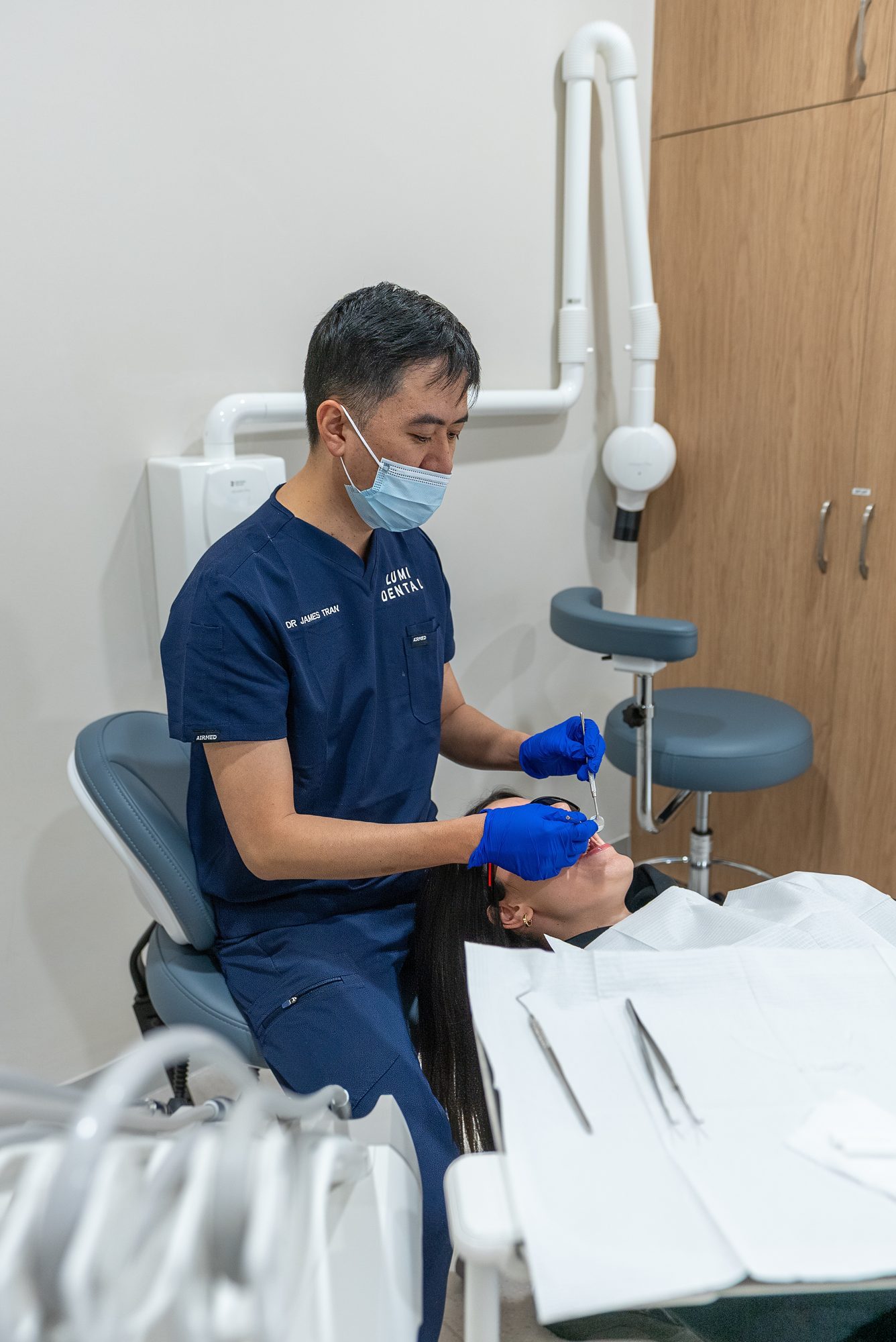
At Lumi Dental the dentist examines the gums and soft tissues at the start of any whitening plan, notes the pattern of any pigmentation and asks how long it has been there. An even, long-standing band is recorded and whitening can go ahead. A single, new or changing spot is assessed first, and if it needs a closer look, a referral to an oral medicine or other registered specialist may be arranged. Depigmentation is not something the team performs; if you want to explore it, a referral to a registered periodontist can be discussed. Routine checks are part of general dentistry at Lumi Dental, and the whitening options are named Lumi Home, Lumi Refresh and Lumi Radiance.
Questions patients ask
Are dark gums a sign of gum disease?
Usually not. Even brown pigment is normal melanin and is common in many populations. Gum disease tends to show as redness, swelling and bleeding, not as an even brown colour.
Will teeth whitening make my gums lighter?
No. Whitening gel is designed for teeth and does not change gum pigment. Gel on the gum can cause a short-lived white patch, which is irritation and fades.
Why do my gums look darker after whitening?
Because the teeth are lighter, so the contrast between tooth and gum is greater. The gum itself has not changed colour.
Can I whiten my teeth if I have a dark spot on my gum?
If the spot is long-standing and part of an even pattern, usually yes. If it is new, changing or on its own, have it examined first.
Should I lighten my gums or whiten my teeth first?
Whiten first. Seeing the new tooth shade helps you decide whether gum colour still bothers you. A complimentary cosmetic consult is a good place to talk it through.
Thinking about whitening? Complimentary cosmetic consult in Melrose Park
If you have darker gums and are thinking about whitening, the team at Lumi Dental can check the gums, talk through shade choices and plan a result that looks balanced. Book a complimentary cosmetic consult at Melrose Central in Melrose Park, or read more about teeth whitening at Lumi Dental. Patients visit from Ryde, Parramatta, Ermington and Rydalmere, with on-site parking.
Sources
- PMC: Oral pigmentation: A review
- PMC: Duration of reappearance of gingival melanin pigmentation after surgical removal, a clinical study
- PMC: Aesthetic Depigmentation of Gingival Smoker's Melanosis Using Carbon Dioxide Lasers
- Australian Dental Association (teeth.org.au): Teeth whitening
About the author

Dr James Tran is a general dentist at Lumi Dental in Melrose Park. He holds a BDent from the University of Sydney and a Graduate Diploma in Oral Implants, and is a Member of the International Congress of Oral Implantologists (MICOI).
This article is general information only and is not a substitute for an examination and individual advice from a registered dental practitioner. Suitability for any treatment varies from person to person.








