


If a tooth holding up a dental bridge breaks or decays, the bridge itself is usually fine, but the tooth underneath decides what happens next. Small problems at the edge of the bridge can sometimes be repaired with it left in place. Larger ones usually mean removing the bridge, treating the tooth, and then either making a new bridge or replacing the teeth another way.
It is rarely an emergency on the day unless there is swelling or strong pain, but it is worth booking in soon. Decay under a bridge is hidden and can spread quietly, and the sooner the supporting tooth is assessed, the more likely it is to be kept.
Signs a supporting tooth has a problem
A conventional bridge is cemented onto crowns over the teeth either side of a gap. Those supporting teeth are called abutments. Problems with them often show up as:
- a bad taste or smell from one end of the bridge, even after brushing
- floss or a floss threader that catches or shreds at the edge of a crown
- one end of the bridge that feels slightly loose, or a click when you bite
- sensitivity to cold or sweet food near one end
- a dark line or a visible gap at the gum edge
- a sharp edge, a crack in the porcelain, or a piece of tooth that has come away
- pain on biting, a gum pimple or swelling, which can mean the nerve is involved
What to do today
Leave the bridge where it is. Pulling on a loose end can break the tooth holding the other end. Do not glue it with household or chemist adhesives, which can trap decay underneath and make it harder to remove cleanly later.
Keep the area clean with a soft brush, rinse with warm salty water after meals, and chew on the other side. Over-the-counter pain relief taken as labelled can help in the meantime. If the whole bridge has come off, keep it in a clean container and bring it with you, since it can sometimes be cleaned and cemented again.
Go to a hospital emergency department instead of waiting for a dental appointment if swelling is spreading towards your eye or down your neck, you have trouble swallowing or breathing, or you have a fever with facial swelling. Otherwise, a same-day emergency dental appointment is the right place to start.
Why the supporting teeth are where bridges usually fail
Porcelain and zirconia do not decay. The natural tooth under the crown does, and the weak point is the margin, the line where the crown meets the tooth near the gum. Plaque that sits on that edge can start decay that spreads up under the crown, out of sight.
A bridge also links two or more teeth together. If the cement fails on one end, the other end can still hold the bridge firmly in place, so it does not feel loose. Saliva and bacteria then leak under the free end and decay can progress for months without pain. This is one reason a bad taste from one end is worth checking, even when nothing hurts.
Teeth that have had root canal treatment are another common weak point. They have lost much of their internal structure and are more likely to crack, especially at the end of a long bridge that takes heavy biting forces. Over the years, gums can also recede and expose root surfaces that decay more easily, which we cover in what changes with a dental bridge over the years.
How the tooth is assessed
The dentist checks each end of the bridge separately. They look and feel along the margins, press on each end to see if it moves, test for tenderness on biting, and take X-rays to show decay under the crown edges and the health of the bone around each root. Sometimes the full extent of decay can only be seen once the bridge is removed, and removing it carefully is part of the diagnosis rather than a sign that it has failed.
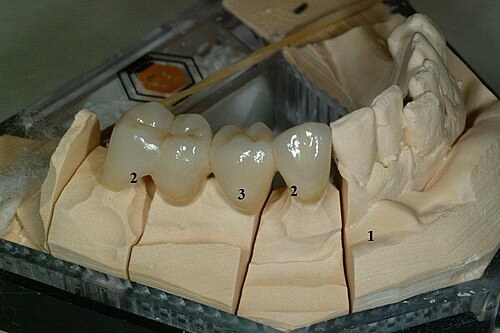
What can be done, depending on the problem
| What is found | What may be possible |
|---|---|
| Small decay at an exposed edge of the crown | A filling at the margin with the bridge left in place, then closer monitoring |
| The nerve of a supporting tooth is inflamed or infected | Root canal treatment through the top of the crown, then sealing the access hole |
| One end has come unstuck but the tooth is sound | Removing the bridge, cleaning both ends and cementing it again, if it still fits well |
| Decay or a break under the crown that can still be repaired | Removing the bridge, rebuilding the tooth (sometimes with a post and core or crown lengthening) and making a new bridge |
| A cracked root or decay well below the gum and bone | Removing the tooth and choosing a new way to fill a now larger gap |
When a supporting tooth has broken down to gum level, the questions are the same as for any badly broken tooth: is there enough firm tooth above the bone to hold a new crown? Our articles on a post and core before a crown and whether a tooth broken at the gum line can be saved explain how that decision is made.
If the supporting tooth cannot be kept
Losing a supporting tooth changes the gap. A three-unit bridge that replaced one tooth may now need to replace two, and the remaining teeth may not be strong enough to carry that load. The usual options are a longer bridge onto further teeth, one or more implants, an implant-supported bridge, or a partial denture. Our page comparing an implant, a bridge or a denture sets out how they differ, and the dental implants page explains what implant treatment involves.
As a general guide in Australia, a three-unit bridge is commonly $3,500 to $6,500, a single implant with its crown is commonly $4,000 to $7,000, and root canal treatment is roughly $1,000 for a front tooth to $3,000 for a molar. These are market ranges, not a quote. Our dental bridge cost guide breaks down what affects the fee, and the crowns and bridges page explains how a new bridge is planned. For current offers, see the current deals page, and ask for a written quote once the tooth has been assessed.
Looking after the supporting teeth
Most bridge problems start with plaque at the margins and under the false tooth. Cleaning under the bridge once a day with a floss threader, super floss or a small interdental brush makes a real difference, and our guide to floss threaders and super floss shows how. Fluoride toothpaste, spitting rather than rinsing after brushing, and regular check-ups with X-rays help pick up decay at the margins while it is still small.
Questions we are often asked
Can a bridge be repaired without taking it off?
Sometimes. Small decay at a margin that can be reached, or root canal treatment through the crown, can often be done with the bridge in place. Decay that has spread under the crown usually needs the bridge removed.
Can the same bridge be cemented back on?
If it comes off in one piece, the supporting teeth are sound and it still fits well, it can often be cleaned and cemented again. If a tooth needed rebuilding, a new bridge is usually made to fit the new shape.
How long do dental bridges usually last?
A systematic review by Tan K, Pjetursson BE, Lang NP and Chan ESY in Clinical Oral Implants Research in 2004 found that about 89% of conventional bridges were still in place after 10 years. Decay of a supporting tooth and problems with the nerve were among the most common reasons for failure.
Is a loose bridge an emergency?
Not usually on its own, but it should be seen within days rather than weeks, because decay can progress under a loose end. Swelling spreading to the eye or neck, trouble swallowing or breathing, or fever needs a hospital emergency department.









