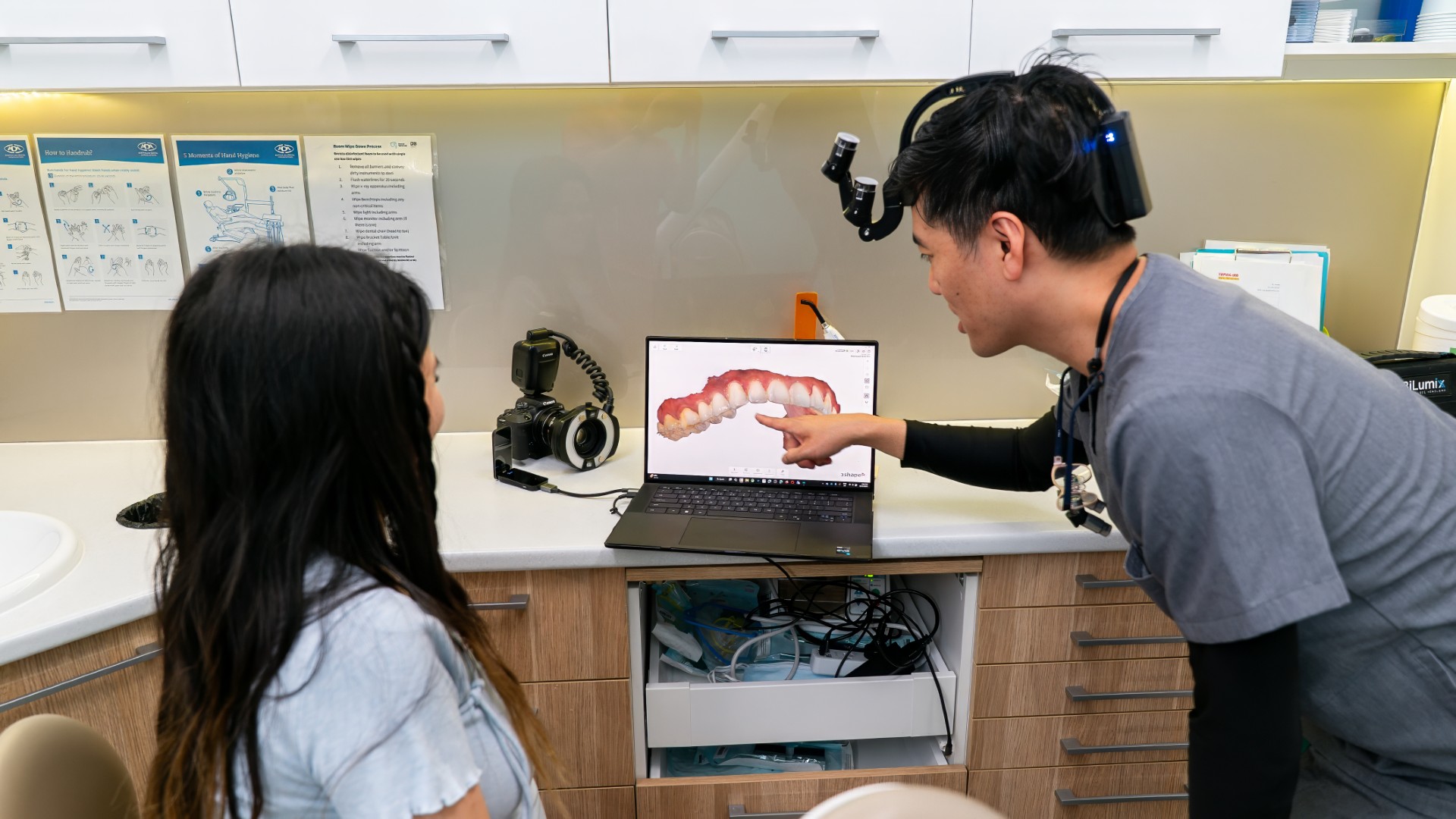
A printed veneer sits somewhere between a composite veneer shaped by hand and a porcelain veneer made in a laboratory. It is designed on a computer from a scan of the teeth, then built up layer by layer in a 3D printer, most often from a tooth coloured resin. The appeal is a thin, closely fitting veneer made directly from a digital design. The research so far is mostly laboratory testing. It describes printed resin that fits well but has lower colour stability than milled CAD/CAM materials and, in one fatigue study, failed sooner than milled lithium disilicate ceramic.
Lumi Dental does not currently offer 3D-printed veneers or crowns as final restorations. This article sets out what has been tested, what has not, and how printed resin compares with the veneer materials in everyday use.

Printed veneers can be resin or ceramic
Many printed veneers are made from resin-based materials, the same broad family as the composite used for bonding. Researchers have also printed zirconia and lithium disilicate veneers. A 2026 scoping review, which found that most of its included studies were laboratory studies, reported that printed zirconia and lithium disilicate veneers performed well. A 2025 proof-of-concept report described six printed lithium disilicate veneers made for and tried in on a single patient. That is a starting point, not a track record. This article focuses on printed resin, which is the material tested in most of the studies below.
They can be printed very thin and fit closely
Accuracy is where printing does well. A 2024 systematic review by Alghauli and Alqutaibi included 17 studies of printed inlays, onlays and veneers, made from a range of materials including ceramics and resins. It found that restorations under 0.2 mm thick could be produced, and that printed laminate veneers and inlays had better trueness and fit than milled ones, while noting that the material and the shape of the preparation can change the result.
Thickness still matters. In a 2024 laboratory study by Çakmak and colleagues, 30 printed resin veneers were made at 0.5 mm or 0.7 mm. The 0.7 mm veneers matched their digital design more closely, and the edges on the front (lip) side had the poorest margin quality at both thicknesses.
Staining is a known weakness
The same 2024 review concluded that printed resin restorations need to become less prone to staining before they can be widely used. A 2023 laboratory study compared printed veneers with two types of prefabricated composite veneer after seven days in coffee or tea. Every material changed colour, became rougher and lost gloss. The printed veneers showed colour changes (measured as ΔE) of about 10 in both drinks, the highest of the three materials, although the differences from the prefabricated veneers were small. Polishing and in-office bleaching reduced the staining but did not fully reverse it, and both had an adverse effect on surface roughness and gloss.
A 2026 umbrella review in the Journal of Dentistry, which brought together the findings of 14 systematic reviews, reached a similar conclusion across printed resins generally: lower colour stability and higher sorption and solubility (water uptake and loss of material in water) than milled CAD/CAM materials.
In one fatigue test, printed veneers had the lowest survival
A 2026 laboratory study tested veneers bonded to 30 extracted upper central incisors, ten per material, under repeated loading of 200 N for up to one million cycles after artificial ageing. Milled lithium disilicate veneers lasted longest, with 80% surviving the full million cycles and a mean survival of about 954,000 cycles. Printed resin veneers had the lowest mean survival, about 135,000 cycles, and failed in several different ways. Composite veneers made with an injection moulding technique sat in between, about 460,000 cycles, and failed only by fracture at the biting edge. One author reported research grants and speaking fees from two dental material companies.
The umbrella review found a similar pattern across printed resins: lower strength, stiffness and fatigue resistance than milled CAD/CAM materials, with fit usually within clinically acceptable limits but strongly dependent on washing, curing and the angle the restoration was printed at.
Clinical evidence is short term
Laboratory tests cannot fully show how a veneer behaves in a mouth over years. The 2026 umbrella review found short-term clinical results, over 6 to 24 months, that were encouraging for printed inlays, onlays, overlays, crowns and veneers, but not enough to judge long-term behaviour. A 2026 scoping review of 30 studies on CAD/CAM and printed inlays, onlays and veneers found most were laboratory studies and called for clinical trials to confirm long-term outcomes.
The established materials have a longer clinical record, as the table shows. The figures come from different types of study and are not a direct head-to-head comparison.
| Veneer material | Clinical evidence found | What the studies point to |
|---|---|---|
| Ceramic (feldspathic porcelain, leucite-reinforced glass ceramic, lithium disilicate) | 29 clinical studies; pooled survival at about 10 years of 96.1% (feldspathic), 93.7% (leucite-reinforced) and 96.8% (lithium disilicate) (Klein and colleagues, 2025) | High survival; lithium disilicate had the lowest complication rates over the long term |
| Composite resin (direct or lab-made) | 7 studies including 3 randomised trials; pooled survival in the trials of 88%, with mean follow-up of 24 to 97 months (Lim and colleagues, 2023) | Rough surfaces, colour mismatch and staining at the edges were the most reported problems; direct veneers had higher survival than indirect ones |
| 3D-printed resin | Short-term clinical data of 6 to 24 months, across several types of printed restoration (Dascanio and colleagues, 2026) | Fit usually within clinically acceptable limits; lower colour stability and fatigue resistance than milled CAD/CAM materials in laboratory testing |
For more on how the ceramics differ, see e.max, zirconia and feldspathic veneers compared. The same evidence gap applies to printed crowns, covered in 3D-printed permanent crowns: what the evidence shows.
Where printed resin fits today
The umbrella review authors described printed resins as viable for temporary restorations and selected indirect restorations, with long-term durability still uncertain. Printed temporaries are a separate topic, explained in printed, milled or chairside temporary crowns.
For a permanent change to the front teeth, the options with a longer clinical record than printed resin are composite veneers, placed as composite bonding, and porcelain veneers. As a guide, typical Australian market ranges are about $250 to $800 per tooth for composite bonding and $1,500 to $2,500 per tooth for porcelain veneers. These are general market ranges, not Lumi fees. We could not find a verified market range for printed veneers.
Questions worth asking if you are offered printed veneers
- What material are the veneers printed from, and is it intended for permanent use?
- What clinical evidence is there for that material, and over how many years?
- How will staining be managed, and what happens if a veneer chips or wears?
- How would the result compare with composite bonding or porcelain veneers for your teeth?
For dentists: thickness, margins and post-processing
Three practical points come from the studies above. First, Çakmak and colleagues found 0.7 mm printed resin veneers matched their design more closely than 0.5 mm ones, and the authors suggested 0.7 mm veneers may need less adjustment. The labial margins had the poorest quality at both thicknesses, so the labial margin deserves a careful check before bonding. Second, the umbrella review found fit and properties depended strongly on washing, curing and print orientation. That suggests these steps should follow a consistent, validated protocol, such as the resin manufacturer's instructions, rather than being shortened, although the review did not test any specific protocol. Third, in the fatigue study, printed resin veneers failed in several ways, while injection-moulded composite failed only at the incisal edge, which the authors described as more repairable. The limits are real: the Çakmak data come from one urethane-based resin on two prepared teeth in the laboratory, the fatigue study used ten specimens per group under a single loading protocol, and the umbrella review rated most of its included reviews as low or critically low in quality.
Talk to us about veneers
If you are weighing up veneers, a free cosmetic consult at our Melrose Park practice is a good place to start. We can explain what composite bonding and porcelain veneers could each involve for you, and a written treatment plan is usually provided afterwards, often by email. You can also see our deals page. If you are travelling from interstate, our guide to planning dental treatment in Sydney may help.
Sources
- Alghauli MA and Alqutaibi AY. 3D-printed intracoronal restorations, occlusal and laminate veneers: clinical relevance, properties, and behavior compared to milled restorations; a systematic review and meta-analysis. Journal of Esthetic and Restorative Dentistry, 2024. PubMed 38551205
- Çakmak G and colleagues. Fabrication trueness and marginal quality of additively manufactured resin-based definitive laminate veneers with different restoration thicknesses. Journal of Dentistry, 2024. PubMed 38490323
- Daghrery A. Color stability, gloss retention, and surface roughness of 3D-printed versus indirect prefabricated veneers. Journal of Functional Biomaterials, 2023. PubMed 37888157
- Rojas-Rueda S and colleagues. Fatigue survival of lithium disilicate, 3D-printed composite, and injection-molded direct composite veneers. Journal of Esthetic and Restorative Dentistry, 2026. PubMed 42261659
- Dascanio R and colleagues. How durable are 3D-printed dental resin-based composites? An umbrella review. Journal of Dentistry, 2026. PubMed 41819275
- Basheer SN and Peeran SW. Advances in digital restorative dentistry: evaluation of clinical outcome parameters of CAD/CAM and 3D-printed inlays, onlays, and veneers. Scoping review. International Journal of Dentistry, 2026. PubMed 42064823
- Unkovskiy A and colleagues. 3D-printed ultra-thin non-prep lithium disilicate veneers: a proof-of-concept clinical case. Journal of Esthetic and Restorative Dentistry, 2025. PubMed 39888218
- Klein P and colleagues. Survival and complication rates of feldspathic, leucite-reinforced, lithium disilicate and zirconia ceramic laminate veneers: a systematic review and meta-analysis. Journal of Esthetic and Restorative Dentistry, 2025. PubMed 39523553
- Lim TW and colleagues. Survival and complication rates of resin composite laminate veneers: a systematic review and meta-analysis. Journal of Evidence-Based Dental Practice, 2023. PubMed 38035903