

Two people can brush just as carefully, drink the same amount of coffee and still end up with clearly different coloured teeth. Part of that difference is likely settled before the adult teeth even come through, by how thick and clear the enamel is and how yellow the dentine underneath is. The yellowing that builds up over the years from food, drink, smoking and wear sits on top of that starting shade, and that added layer is the part whitening tends to shift most.
Written by Dr James Tran, BDent (University of Sydney), MICOI, GradDip (Oral Implants), general dentist at Lumi Dental in Melrose Park.
Enamel lets the colour of dentine show through
Teeth are layered. The enamel on the outside is hard and highly mineralised, but it is also partly see-through. Light travels into it, reflects off the dentine below and comes back carrying some of the dentine's colour. Dentine is naturally yellowish, ranging from pale cream in some people to a deeper honey tone in others.
So the colour you see is a blend of the two layers. Where enamel is thick and opaque, it hides more of the dentine. Where it is thin or very translucent, more yellow shows. Dental erosion shows the same effect: as acid thins the enamel, more of the yellow dentine shows through and teeth can look darker. People born with thinner or clearer enamel simply start out further along that scale.
The parts of tooth colour that run in families
How thick and how clear the enamel is
Enamel is laid down in childhood by cells working to a genetic blueprint, and its thickness and structure vary from family to family. That may be one reason a parent and child often share a similar shade. Bite patterns and tooth shape, which affect how teeth wear, also tend to be shared.
The shade of the dentine
The underlying dentine colour is a large part of what people mean by a family shade. Dentine also continues to be laid down slowly through adult life, which is one reason teeth gradually look more yellow with age even in people who avoid strongly coloured food and drink.
Yellowing that is added later
Most of the change adults notice over time is not inherited. It builds on the base shade, and each cause looks a little different.
| Cause | What it tends to look like | Runs in families? | Likely response to whitening |
|---|---|---|---|
| Stain from coffee, tea, red wine or smoking | Darkest between teeth and near the gum line | No | Good, usually after a professional clean removes surface build-up |
| Gradual thinning of enamel with age | Slow, even yellowing across the smile | Possibly, through how teeth wear | Usually good, though thinner enamel can mean more sensitivity |
| Acid erosion or wear | Yellow or see-through edges, flattened or cupped surfaces | No; linked to diet, reflux or grinding | Partial; the cause needs addressing and exposed dentine may stay sensitive |
| Tetracycline taken while teeth were forming | Yellowish or brownish colour across several teeth | No | Slow and often incomplete; veneers are sometimes considered |
| Fluorosis from too much fluoride in early childhood | White or discoloured spots or flecks | No | Variable; see our article on fluorosis marks |
| One tooth darkened after a knock or root canal | A single grey or yellow tooth | No | Poor from the outside; internal whitening or a veneer may be needed |
The Better Health Channel notes that tetracycline taken while permanent teeth are developing can give them a yellowish or brownish colour, and that too much fluoride can leave white or discoloured spots. Because brothers and sisters may have shared the same medicine or water supply, these can look like a family trait when they are not.
When the family shade comes with weak or pitted teeth
A useful rule of thumb: an even shade on teeth that are smooth, strong and not chipping is normal variation. Teeth that are pitted, grooved, rough, chipping, wearing quickly or sensitive from early in life deserve an examination before anyone thinks about whitening, because a small number of inherited conditions change how enamel or dentine forms.
Amelogenesis imperfecta
This group of conditions affects enamel formation. MedlinePlus Genetics describes teeth that may be unusually small, discoloured, pitted or grooved, and lists variants in more than 20 different genes as possible causes. How often it occurs depends on the population, from about 1 in 700 people in northern Sweden to about 1 in 14,000 in the United States. The form with thin enamel is the one most easily confused with ordinary yellow teeth; StatPearls notes the crowns can look yellow or light brown because the enamel is thin.
Dentinogenesis imperfecta
Here the problem lies in the dentine. StatPearls describes an autosomal dominant pattern of inheritance, which means a parent with the condition has a one in two chance of passing it on to each child. The teeth may look amber, brownish or bluish, or opalescent brown. Bonding, veneers or crowns, rather than whitening, are the usual ways to improve the appearance.
Clues that point to an examination first
- Pits, grooves or a rough, mottled surface on several teeth
- Chipping or wear that seems out of step with age, or sensitivity that started young
- Baby teeth that were also discoloured; our article on why new adult teeth can look yellow covers what is normal in children
- A patch or band on only a few teeth, which is more often enamel hypoplasia linked to something in early childhood than an inherited condition
Whitening acts on the dentine, so inherited yellow can respond
Peroxide whitening gels pass through the enamel and break down coloured molecules, particularly in the dentine. Because an inherited yellow shade comes mostly from that layer, it is often a reasonable candidate for whitening. Thin enamel does not stop the gel working, but sensitivity may be more likely, so a gentler gel used over more sessions can suit some people. How much any one person's teeth lighten varies and cannot be predicted exactly; our article on why whitening results differ goes through the reasons.
There are limits. Whitening does not thicken enamel or make a translucent edge less see-through, and it does not change the colour of fillings, crowns or veneers, so an older filling on a front tooth may stand out more afterwards. Where whitening cannot reach the result someone is hoping for, porcelain veneers or composite bonding change the outer surface instead.
Starting with an examination and a clean
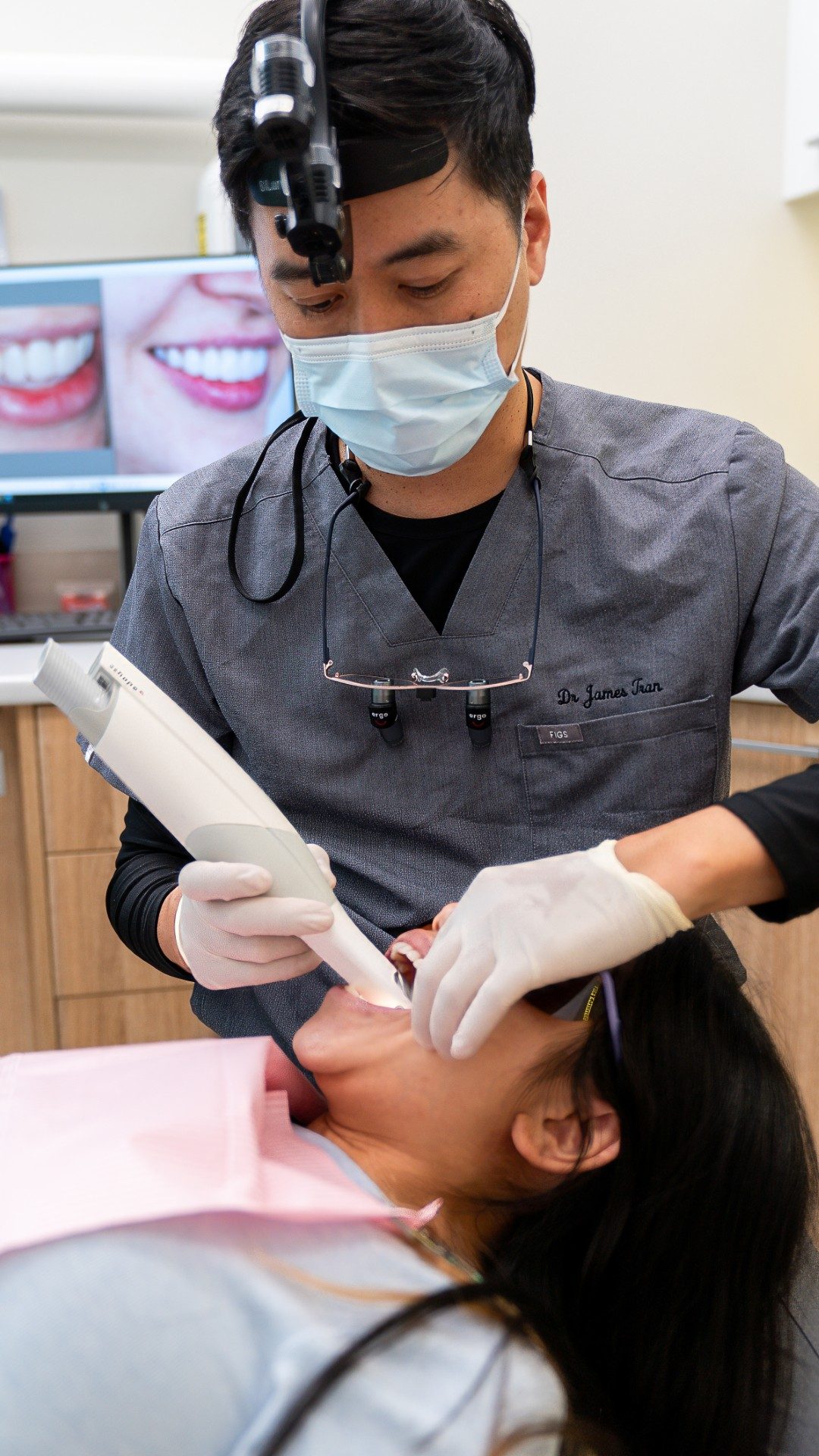
At Lumi Dental, a question about inherited colour begins with a dentist's examination, because the plan is different for normal variation, stain, erosion and a developmental condition. Clinical photographs record the starting shade, and a 3D intraoral scan is used when custom trays are needed. One of our oral health therapists can remove surface stain with a scale and clean first, which on its own sometimes changes how the teeth look.

Whitening options are Lumi Home, Lumi Refresh and Lumi Radiance, and the teeth whitening page explains how a consult works. Where an inherited enamel or dentine condition is suspected, we may refer to a registered specialist.
What people ask about inherited tooth colour
How can I tell inherited yellow from poor cleaning?
Inherited colour is even across the teeth, stays after a professional clean and is often shared with a parent. Yellow from build-up tends to be heaviest between the teeth and along the gums, and a scale and clean removes much of it.
Can genetically yellow teeth be whitened?
Often, because the colour sits in the dentine, which is where peroxide works. People with thin enamel may need a gentler approach; our article on whether whitening damages enamel looks at the evidence. The rare inherited conditions above are the main exception.
I brush twice a day. Why are my teeth still yellow?
Brushing removes plaque and surface film. It cannot reach the colour of the dentine under the enamel, which comes from your inherited shade, age and any wear.
Do teeth keep getting more yellow with age?
For most people, gradually, as enamel wears and more dentine is laid down. Whitening can be considered at any adult age, but worn edges, older fillings and gum recession all need to be checked first.
Finding out how far your natural shade can lighten
If you share a parent's shade and want to know what is realistic, a dentist can examine your teeth, record the starting colour and talk through the options. Book a free cosmetic consult at Lumi Dental in Melrose Park, or read more about teeth whitening.
Sources
- MedlinePlus Genetics: Amelogenesis imperfecta
- StatPearls (NCBI Bookshelf): Developmental Disturbances of the Teeth, Anomalies of Structure
- Better Health Channel: Teeth and medication
- Joiner A. The bleaching of teeth: a review of the literature. Journal of Dentistry, 2006
About the author

Dr James Tran is a general dentist at Lumi Dental in Melrose Park. He holds a BDent from the University of Sydney and a Graduate Diploma in Oral Implants, and is a Master of the International Congress of Oral Implantologists (MICOI).
This article is general information only and is not a substitute for an examination and individual advice from a registered dental practitioner. Suitability for any treatment varies from person to person.








