

If your child bit their lip or cheek after a numbing injection, the swollen lip and the white patch that appears a day or two later are usually a healing bite wound, not an infection, and most heal on their own within about two weeks with cold compresses, pain relief and soft food. Lip and cheek biting after dental local anaesthetic is common in children: a large review of dental records from two university clinics found it in about 6 per cent of children aged 4 to 12, and earlier research reported rates of up to 18 per cent in children under four.
Written by Dr James Tran, BDent (University of Sydney), MICOI, GradDip (Oral Implants), general dentist at Lumi Dental in Melrose Park.
The short version
- Watch your child closely until full feeling has returned. One clinical paper puts typical numbness at 3 to 5 hours, longer than most procedures take.
- The lips are the most common site, followed by the cheek and the tongue.
- A white, tender patch on the lip a day or two later is the usual look of a healing bite. It shrinks over the following week.
- Cold compresses, paracetamol or ibuprofen given per the label and your child's weight, and soft cool food are the main treatment.
- See the dentist or GP for fever, spreading redness, pus, a child who will not drink, or a sore that has not healed after two weeks.
- Our article on a numb lip after dental work explains what normal numbness feels like.
Why children bite a numb lip
Local anaesthetic blocks feeling but not movement. The lip feels thick, tingly and strange, and a child who cannot feel it may chew, suck or pick at it without any pain to tell them to stop. A case report on the problem notes that some children do it without realising, and others do it out of curiosity about the odd sensation.
Age makes a clear difference. In the study most often quoted on this topic, 13 per cent of children aged 2 to 18 developed a soft tissue injury after a lower numbing injection, with 18 per cent under four, 16 per cent at four to seven, 13 per cent at eight to eleven and 7 per cent at twelve and older. A larger records study of children aged 4 to 12 reported a lower overall rate of 5.9 per cent, again higher in younger children, with the lips involved in about 70 per cent of injuries. Longer-lasting numbness and higher doses were linked with more severe injuries. Children under about four, and children who may not understand or remember the instruction to leave the lip alone, need the closest watching.
How long the numbness lasts
Feeling returns gradually. The lower lip and chin stay numb after a lower injection, and the upper lip and cheek after an upper one. A clinical paper on numbness reversal describes typical soft tissue numbness of 3 to 5 hours, even though most children's procedures take well under an hour. See our guide to how long dental numbness lasts.

The single rule: supervise until the numbness wears off, then expect a healing ulcer
If your child has had a numbing injection, keep them in sight until they can feel their lip normally, and if they have bitten it, treat the white patch the next day as a healing wound unless there are signs of infection. A case report describes a four-year-old who returned two days after a filling with a raised, tender white patch about 1 by 2 centimetres on the lower lip; with ice, salt water rinses and paracetamol it had healed by day ten. The authors note that parents are often alarmed by how the lesion looks during healing, even though it is not serious.
What to do at the time
If the lip or cheek is bleeding, the Royal Children's Hospital Melbourne advises pressing firmly with a sterile dressing or clean cloth, or a damp tissue for a cut lip, until the bleeding stops. Healthdirect says bleeding from a mouth cut should stop within 10 minutes of constant pressure.
- Hold a cold compress or a wrapped ice pack against the outside of the lip to limit swelling.
- Offer cool water to sip, and hold off on hot drinks and chewy food until feeling has fully returned.
- Give paracetamol or ibuprofen if needed, following the label and your child's weight. The RCH notes that teething gel is unlikely to be strong enough for pain from a mouth injury.
- Do not leave cotton wool or a cotton roll in a young child's mouth at home. The records study above points out that cotton rolls carry a risk of being inhaled or swallowed.
For bites to the tongue or cheek in older children and adults, our first aid guide for a bitten tongue, lip or cheek covers the same steps.
Call 000 or go to the nearest emergency department if your child has trouble breathing, is swallowing a lot of blood, or their tongue or throat is very swollen.
Day 1 to day 14: what healing usually looks like
The day after a bite, the lip is usually puffy and sore and a white or pale patch forms over the wound. That patch is the surface of a healing ulcer. It often looks worse than it is. Healing is gradual, and the records study above describes these injuries as generally self-limiting, healing within two weeks without lasting effects.
| Day after the bite | What it usually looks like | What helps |
|---|---|---|
| Day 0, still numb | Swollen lip, bite marks, some bleeding; often little complaint | Pressure if bleeding, cold compress, close watching until feeling returns |
| Days 1 to 3 | Swollen, tender lip with a raised white patch | Pain relief per label and weight, soft cool food, salt water rinses for children who can spit |
| Days 4 to 7 | Patch shrinking, swelling easing, edges turning pink | Keep it clean, gentle brushing, avoid salty or acidic food |
| Days 7 to 14 | Small pink area, then normal lip | No treatment usually needed; see the dentist if it is not healing |
For children old enough to rinse and spit, healthdirect suggests a warm salt water rinse, one teaspoon of salt in a cup of water, a few times a day to ease pain and reduce the chance of infection.

When to call the dentist or GP
Healthdirect lists the signs of a mouth wound that may be infected: a mouth or tongue that becomes very swollen or painful, discharge from the wound, fever, or feeling unwell. Contact your dentist or GP if you notice any of these, and also if:
- your child is refusing to drink or has far fewer wet nappies or toilet trips than usual
- redness is spreading onto the skin of the face or chin
- the sore has not clearly healed after two weeks
- a soft, bluish lump appears on the lip after the ulcer has healed
Preventing it next time
In my experience the most useful steps are simple ones.
- Tell your child what to expect. The lip will feel big and funny for a while, and it must not be bitten.
- Book earlier in the day. I usually suggest a morning visit so the numbness wears off while you are with them, not at school lunch.
- Tell the teacher or carer if your child goes back to school or day care while still numb.
- No food until feeling returns. Water is fine; lunch can wait.
- Ask the dentist about the plan. The records study found that the type of injection and the anaesthetic used both influenced how often injuries happened, so it is reasonable to ask what will be used and how long it should last.
A reversal injection, phentolamine mesylate, has been studied as a way to shorten numbness, but it means a second injection, which young children may not tolerate well. Our guide to a child's first filling covers the rest of the visit.
How we approach this at Lumi Dental
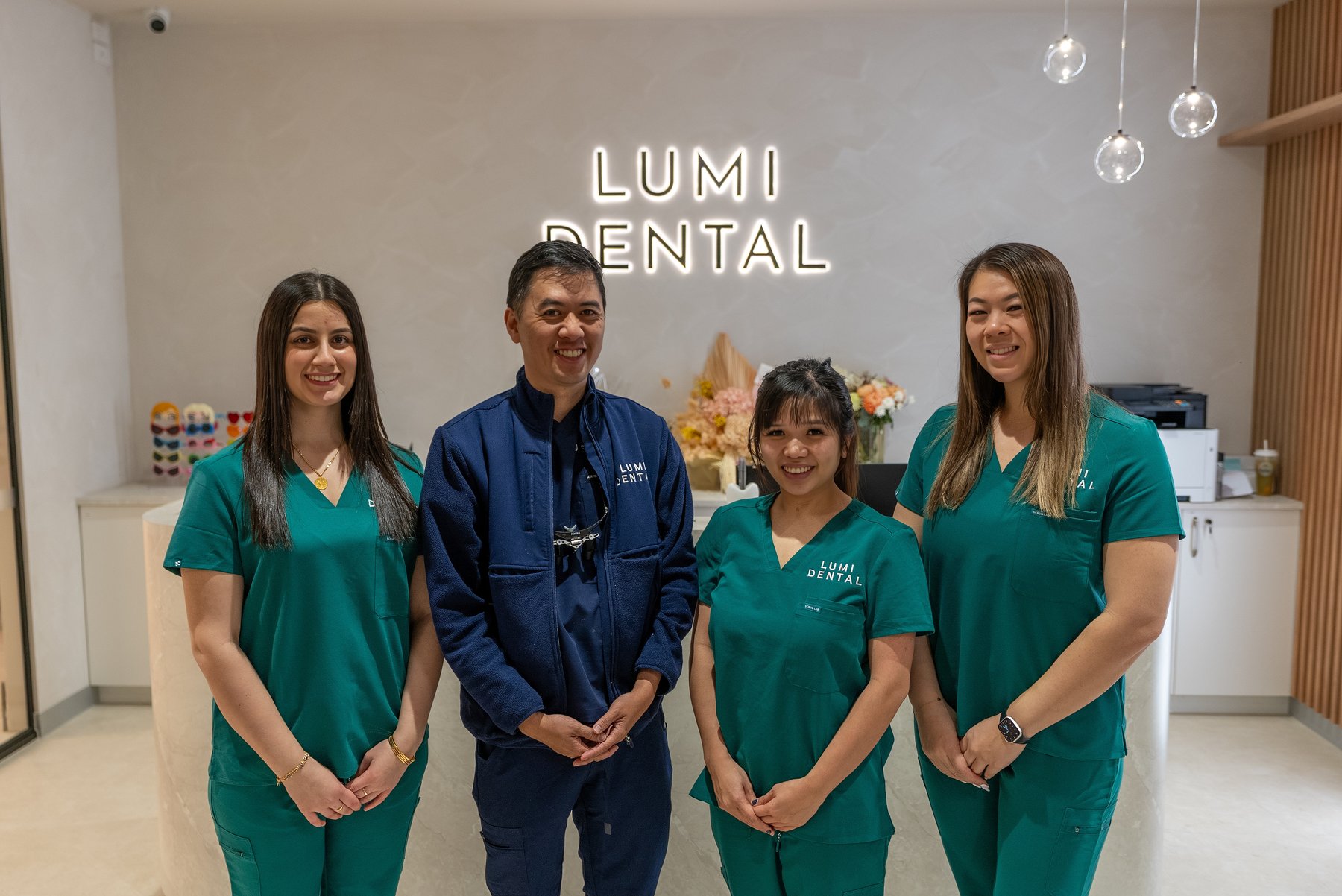
Before a numbing injection, the team at Lumi Dental explains to parents how long the numbness is likely to last and what to watch for on the way home. If a child bites their lip, parents can call the practice for advice or a review. Children who need specialist care, or treatment that cannot be done comfortably in the chair, are referred to a paediatric dentist or hospital service. The whole practice accepts the Child Dental Benefits Schedule for eligible children; see children's dentistry at Lumi Dental.
Questions patients ask
Is it normal for my child's lip to turn white after biting it?
Yes. A white, slightly raised patch a day or two after a bite is how a healing ulcer usually looks. It shrinks over the next week and usually heals within two weeks.
How do I know if a bitten lip is infected?
Watch for swelling that increases rather than settles, pus, spreading redness, fever, or a child who is unwell or not drinking. Any of these is a reason to see the dentist or GP.
Can my child eat after a numbing injection?
Wait until the feeling has fully returned before giving food, because children often chew the numb lip or cheek without noticing. Sips of cool water are fine while they are still numb.
Why does my child have a lump on the lip weeks after biting it?
A soft, painless, bluish bump that appears after a lip injury may be a mucocele, a small blocked saliva gland. Our article on mucoceles in children explains what happens next.
Should my child see a paediatric dentist after a lip bite?
Usually not. Most bites heal at home and a general dentist can review the area. Our comparison of a paediatric dentist and a family dentist explains when a referral helps.
Children's dental care in Melrose Park
If your child has bitten their lip after a visit, or you would like a calm first filling or check-up, the team at Lumi Dental at Melrose Central sees families from Melrose Park, Ryde, Parramatta, Ermington and Rydalmere, with on-site parking. Read about children's dentistry at Lumi Dental, check whether your child is eligible under the Child Dental Benefits Schedule, or contact the practice to book.
Sources
- The Royal Children's Hospital Melbourne, Kids Health Info: Mouth injuries and dislodged teeth
- Healthdirect Australia: Mouth and tongue cuts
- Pain management and parafunctional activity secondary to local anesthesia in children 4 to 12 years old: a retrospective study (PMC)
- A traumatic ulcer caused by accidental lip biting following topical anesthesia: a case report (PMC)
About the author

Dr James Tran is a general dentist at Lumi Dental in Melrose Park. He holds a BDent from the University of Sydney and a Graduate Diploma in Oral Implants, and is a Member of the International Congress of Oral Implantologists (MICOI).
This article is general information only and is not a substitute for an examination and individual advice from a registered dental practitioner. Suitability for any treatment varies from person to person.








