A large cavity on the side of a back tooth can reach below the gum line. That deep edge is hard to keep dry, hard to reach and hard to bond to, and it is the edge an onlay or crown has to seal against. Deep margin elevation is one way of dealing with it: the dentist first builds up the deepest part of the cavity with a bonded composite layer, so that the edge of the final restoration can sit above the gum. The other main option is crown lengthening surgery, which moves the gum and bone down instead.
Why a margin below the gum causes trouble
A 2022 review by Samartzi and colleagues in the Dentistry Journal sets out the problem. Margins below the gum are difficult to reach, the rubber dam tends to slip over them, and saliva, fluid from the gum and blood can leak into the area. Bonded restorations such as ceramic onlays depend on a clean, dry surface, so a deep edge makes bonding harder.
The traditional ways to reach a deep edge were surgical: exposing it by removing gum and bone (crown lengthening), pulling the tooth up with orthodontic extrusion, or both. These can work well, and our article on crown lengthening explains that procedure. Deep margin elevation was proposed as a less invasive step for edges that are below the gum but not too close to the bone.
What happens during deep margin elevation
Eggmann and colleagues, in a 2023 review in the Journal of Esthetic and Restorative Dentistry, describe deep margin elevation as relocating the edge of a cavity from below the gum to above it with a direct restoration, so that rubber dam isolation, impressions or scans, and bonding of an indirect restoration become easier. In practice, a matrix band is placed around the tooth to shape and seal the deep part of the cavity, a layer of composite is bonded there, and the new, higher edge is then prepared for the onlay, inlay or crown that follows. The approach is also called cervical margin relocation or proximal box elevation.
The final restoration can be an onlay made in ceramic or composite. If that term is new, see what a dental onlay is.
When it is not the right choice
Samartzi and colleagues list three conditions that should be met before deep margin elevation is used. The working area has to be fully isolated. The matrix has to seal the edge accurately. And the procedure must not invade the connective tissue that attaches the gum to the tooth just above the bone.
That last point refers to what is now called the supracrestal tissue attachment, the band of gum attachment that used to be called the biologic width. The 2017 World Workshop on periodontal and peri-implant diseases (Jepsen and colleagues, Journal of Clinical Periodontology, 2018) stated that placing restoration margins within this attached connective tissue is associated with inflammation or loss of the supporting tissues. To judge where that edge sits, the review recommends measuring probing depths, sounding to the bone and taking periapical X-rays before treatment. If decay or a crack reaches too close to the bone, surgery or extrusion may be the better option. Our article on a tooth broken off at the gum line covers that wider decision.
How long restorations over an elevated margin last
The clinical evidence is growing but is still limited: most clinical studies are small, and few are randomised trials. These are the larger and more recent studies.
| Study | Teeth and follow-up | Finding |
|---|---|---|
| Bresser and colleagues, Journal of Dentistry, 2019 | 197 partial indirect restorations in 120 patients, up to 12 years (average about 58 months) | Cumulative survival 95.9%. Indirect composite restorations showed more deterioration than ceramic ones, and root-filled teeth had more fractures. |
| Adson and colleagues, Journal of Dentistry, 2026 | 100 endocrowns on root-filled back teeth, half with elevated margins, 24 months | Survival 96% with elevated margins and 98% with margins already above the gum, a difference that was not statistically significant. |
| Bourgi and colleagues, Frontiers in Dental Medicine, 2026 | Systematic review of 10 clinical studies, about 623 teeth | Restoration survival ranged from 93% to 100% over 6 months to 12 years. |
| Mugri and colleagues, Materials, 2021 | Systematic review comparing crown lengthening and deep margin elevation (six studies, two of them on deep margin elevation) | Teeth treated with deep margin elevation showed high survival, but most included studies had a high risk of bias and no high-quality trial compared the two directly. |
Crown lengthening has its own limitation: the gum tends to grow back. In a 12-month study of 84 teeth by Pontoriero and Carnevale (Journal of Periodontology, 2001), the gum margin between the teeth moved back up by an average of 3.2 mm after surgery. Mugri's review also described this rebound and linked it to the person's gum type.
What it means for the gum
Several studies have looked at how the gum responds to composite placed below it. The findings are mostly reassuring, with one recurring caution.
Bertoldi and colleagues (Clinical Oral Investigations, 2020) took gum tissue samples from 29 people three months after deep margin elevation and found inflammation next to the composite at a similar level to gum next to the natural root. Muscholl and colleagues (Journal of Adhesive Dentistry, 2022) examined 63 patients with restorations placed below the gum an average of 2.7 years earlier and found no increase in inflammation compared with a sound tooth, and daily use of interdental brushes was linked with less gum inflammation. A 2026 meta-analysis by ElHaddad and colleagues in Quintessence International found that margin relocation did not worsen probing depth or bleeding in people whose gums were healthy or already stabilised.
The caution is bleeding on probing. In a 12-month trial of 35 back teeth by Ferrari and colleagues (Journal of Dentistry, 2018), bleeding on probing was recorded at 53.0% of sites with relocated margins against 31.5% of sites with conventional shoulder preparations. The abstract calls this difference significant but reports p = 0.10, so it should be read with care. The authors concluded that more bleeding can be expected where margins sit at or within 2 mm of the bone. Bourgi's 2026 meta-analysis also found more bleeding on probing at relocated margins, although the increase was modest. Eggmann's review summarises it in the same way: bleeding may be more common at these sites, though the evidence is not consistent.
For patients, the practical message is the same one healthdirect gives for preventing decay: brush twice a day with fluoride toothpaste and clean between the teeth with floss or interdental brushes every day, and keep up regular check-ups so the edge of the restoration can be checked.
For dentists: check the elevation on a bitewing and keep clear of the bone
Samartzi and colleagues, drawing on Magne and Spreafico's 2012 description of the technique, describe a post-operative bitewing radiograph as essential to confirm there are no gaps or overhangs at the elevated margin before final preparation and scanning. Before starting, probe, sound to bone and take a periapical to estimate the distance from the planned margin to the crest. Ferrari and colleagues concluded that more bleeding on probing can be expected where relocated margins sit at or within 2 mm of the bone crest. That trial had 35 teeth and 12 months of follow-up, the 2 mm distance was measured on radiographs, and the abstract reports p = 0.10 for the overall difference in bleeding while calling it significant, so treat the figure as a guide for case selection rather than a fixed threshold.
Questions about deep margin elevation
Is deep margin elevation a replacement for crown lengthening?
Not in every case. It is an option when the edge is below the gum but can still be isolated and sealed without reaching the attached tissue above the bone. Deeper defects may still need surgery or orthodontic extrusion.
Will the filling under the gum cause gum disease?
Two studies, one examining gum tissue under the microscope and one examining patients about three years later, found no more inflammation next to the composite than next to natural tooth. Some studies have found that the gum bleeds on probing more often around elevated margins, especially when the margin is very close to the bone. Daily cleaning between the teeth is important.
Can it be used under a crown as well as an onlay?
It can be. Studies have placed onlays, inlays, endocrowns and crowns over elevated margins. Your dentist can explain which type of restoration suits the tooth.
Talking about a deep filling or broken back tooth
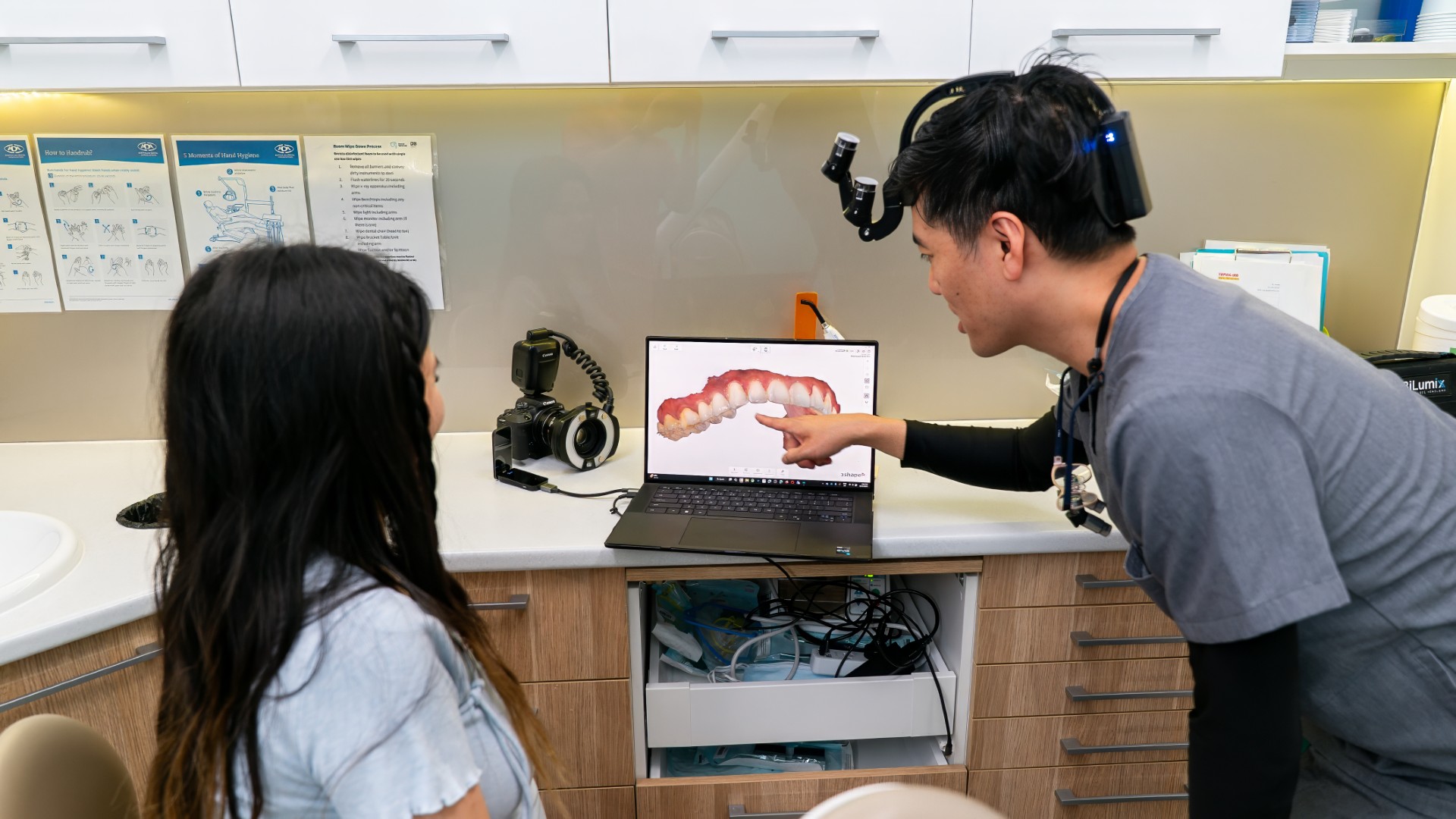
If you have been told a back tooth has decay or a break below the gum, an examination that includes X-rays can help show where the edge sits in relation to the bone. Lumi has an Orthophos 3D X-ray and a 3D intraoral scanner. You can read about crowns at Lumi or book an examination at our Melrose Park practice.
Sources
- Samartzi TK, Papalexopoulos D, Ntovas P, Rahiotis C, Blatz MB. Deep margin elevation: a literature review. Dentistry Journal, 2022. PubMed 35323250
- Eggmann F, Ayub JM, Conejo J, Blatz MB. Deep margin elevation: present status and future directions. Journal of Esthetic and Restorative Dentistry, 2023. PubMed 36602272
- Jepsen S and colleagues. Periodontal manifestations of systemic diseases and developmental and acquired conditions: consensus report of workgroup 3 of the 2017 World Workshop. Journal of Clinical Periodontology, 2018. PubMed 29926943
- Bresser RA and colleagues. Up to 12 years clinical evaluation of 197 partial indirect restorations with deep margin elevation in the posterior region. Journal of Dentistry, 2019. PubMed 31697971
- Adson O, Sarikaya TY, Bolay S. Clinical evaluation of deep margin elevation in CAD/CAM indirect restorations: a 24-month follow-up study. Journal of Dentistry, 2026. PubMed 41643925
- Bourgi R and colleagues. Polymer-based restorative outcomes following deep margin elevation: a systematic review and meta-analysis. Frontiers in Dental Medicine, 2026. PubMed 42466197
- Mugri MH and colleagues. Treatment prognosis of restored teeth with crown lengthening vs. deep margin elevation: a systematic review. Materials, 2021. PubMed 34772259
- Pontoriero R, Carnevale G. Surgical crown lengthening: a 12-month clinical wound healing study. Journal of Periodontology, 2001. PubMed 11495130
- Bertoldi C and colleagues. Clinical and histological reaction of periodontal tissues to subgingival resin composite restorations. Clinical Oral Investigations, 2020. PubMed 31286261
- Muscholl C and colleagues. Retrospective clinical evaluation of subgingival composite resin restorations with deep-margin elevation. Journal of Adhesive Dentistry, 2022. PubMed 35983705
- ElHaddad SA and colleagues. Periodontal and restorative outcomes of cervical margin relocation: a systematic review and meta-analysis. Quintessence International, 2026. PubMed 41631460
- Ferrari M and colleagues. Influence of cervical margin relocation (CMR) on periodontal health: 12-month results of a controlled trial. Journal of Dentistry, 2018. PubMed 29061380
- Healthdirect Australia. Tooth decay. healthdirect.gov.au
This article is general information only and is not a substitute for an in-person assessment by a dental professional.