
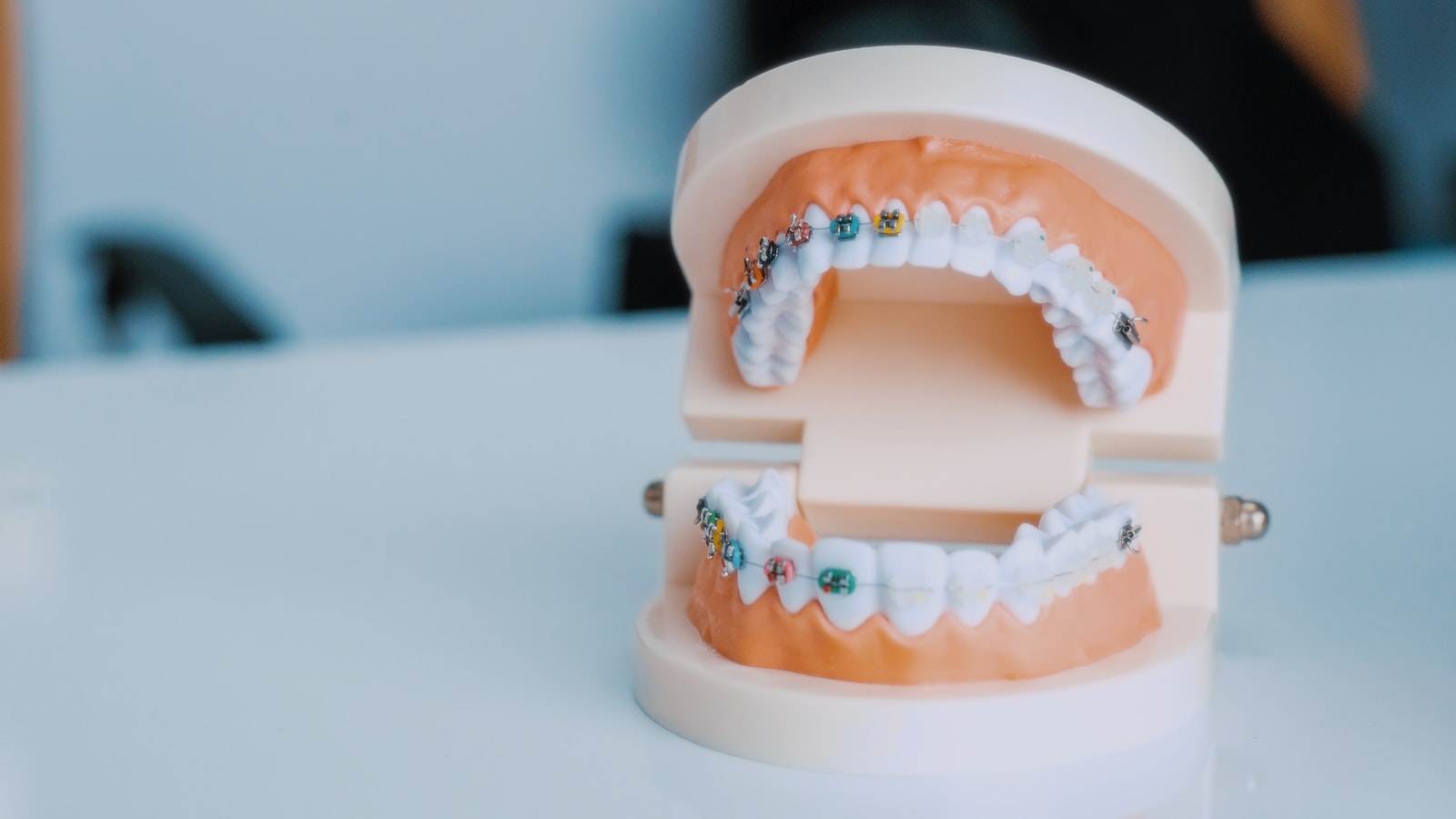

A dental pontic is the false tooth in a dental bridge, the part that fills the gap where a natural tooth used to be. It is held in place by crowns cemented onto the teeth on either side, or by dental implants. A pontic has no root of its own. It rests against the gum rather than sitting in it, and the way its underside is shaped changes both how natural it looks and how easily you can clean around it.
Key takeaways
- A pontic is the suspended replacement tooth in a bridge. The crowns holding it are called retainers, and the teeth or implants beneath them are the abutments.
- There are four main pontic designs: ridge lap, modified ridge lap, ovate and sanitary. Each one trades appearance against cleanability.
- Modified ridge lap is the usual choice for front teeth and premolars, because it looks natural and still lets floss pass underneath.
- The older full ridge lap design is largely out of use, since the tissue under it cannot be cleaned and often stays irritated.
- Cleaning under a pontic with superfloss, an interdental brush or a water flosser is what keeps a bridge healthy over the long term.
- As a general market range in Australia, a three unit bridge often sits somewhere around $3,000 to $6,000, varying widely with material and case complexity.
What a pontic is and where it sits
Patients often ask me what the word on their treatment plan actually means, so it is worth being plain about it. A conventional bridge is made as one piece. The teeth on either side of the gap are prepared for crowns. Those crowns are the retainers. The false tooth joined between them is the pontic.
The parts, named
The abutment is the tooth or implant that carries the load. The retainer is the crown that fits over it. The pontic is the span in the middle. A three unit bridge means two retainers and one pontic. Longer spans are possible, but they ask a great deal more of the supporting teeth, and the risk of the bridge debonding or a supporting tooth failing rises with length.
Why a pontic has no root
Once a tooth is removed, the socket heals and the bone ridge shrinks somewhat over the first year. Our guide to tooth extraction healing stages covers that process in more detail. A pontic does not replace the root. It sits on top of the healed ridge, which is why the shape of its underside is a genuine design decision rather than an afterthought.
The four pontic designs
Ridge lap
The full ridge lap laps over both the cheek side and the tongue side of the ridge, rather like a saddle. It looks acceptable from the front, but nothing can be passed underneath it. Plaque collects in that dead space and the gum beneath is often red and tender. For that reason the design is largely obsolete in modern practice.
Modified ridge lap
The modified ridge lap contacts only the front, or facial, surface of the ridge and is relieved on the tongue side. From the front it looks as though the tooth emerges from the gum. From underneath there is enough clearance for superfloss or a small interdental brush. It is the common choice for upper front teeth and premolars.
Ovate
An ovate pontic has a rounded, convex base that sits into a slight hollow in the gum. It gives the most natural emergence, and the illusion of a tooth growing out of the tissue. It usually needs the ridge to be shaped first, or preserved at the time of the extraction, so it works far better when planned early. It is generally reserved for the visible front region.
Sanitary or hygienic
A sanitary pontic sits clear of the gum entirely, with an open space underneath. Nothing traps and cleaning is straightforward. It looks obviously artificial, so it is used for lower back teeth where appearance matters least and hygiene access matters most.
| Pontic design | Appearance | Cleanability | Typical position |
|---|---|---|---|
| Ridge lap | Reasonable from the front | Poor, no access underneath | Largely obsolete, rarely used now |
| Modified ridge lap | Natural, tooth appears to emerge from gum | Good, floss and interdental brushes pass through | Upper and lower front teeth, premolars |
| Ovate | Most natural emergence of the four | Good if the hollow is shallow and well polished | Visible front region, planned in advance |
| Sanitary or hygienic | Obviously artificial, gap visible | Very good, fully open underneath | Lower back teeth, low visibility areas |
Which one a dentist will suggest
Position drives the decision. Front teeth lean towards modified ridge lap or ovate. Lower molars lean towards sanitary. Gum health, ridge shape, how high your lip rises when you smile and how much cleaning you can realistically manage all feed into the choice. Ask to see a diagram before you agree, because the design is not easy to change once the bridge is made.

What pontics are made from
Porcelain fused to metal
A metal substructure with porcelain baked over it. It is strong and has decades of clinical history behind it. The trade off is a metal margin that can show as a dark line if the gum recedes, and porcelain that can chip away from the metal.
All ceramic and zirconia
Zirconia is now widely used for bridges. It is strong, has no metal core and can be shaded to sit reasonably well against natural teeth. Layered ceramics can look more lifelike in the front but are a little more prone to chipping. Your dentist will weigh appearance against the biting forces in that part of your mouth.
Tooth supported versus implant supported pontics
A tooth supported bridge relies on the teeth either side. Those teeth have to be reduced for crowns, which is a real cost if they are otherwise healthy and untouched. An implant supported bridge places the load on implants instead, leaving the neighbouring teeth alone.
Ridge shape and grafting
Implant options sometimes need bone rebuilt first, particularly in the upper back jaw. Our article on bone grafts and sinus lifts for dental implants explains when that comes up. It is also worth knowing that the crowns and pontics on implants are serviceable parts, as covered in our guide to how often an implant crown needs replacing. If you want to discuss implant options, the team can talk you through dental implants at Lumi Dental.
Cleaning under a pontic
This is the part that decides whether a bridge lasts. You cannot floss between a retainer and a pontic in the usual way, because they are joined. You have to thread underneath instead.
Superfloss and floss threaders
Superfloss has a stiff end that threads under the pontic and a spongy section that wipes the underside and the sides of the abutment teeth. Once a day is enough. Most people find it awkward for the first week and routine after that.
Interdental brushes and water flossers
A small interdental brush pushed through the space works well where there is room. A water flosser is a useful addition, though it does not replace physical wiping of the surfaces. Professional cleans matter too, and the difference between a routine clean and gum focused care is explained in our piece on periodontal maintenance versus a regular clean.
What a bridge with a pontic typically costs
As a general guide to the Australian market, and not a quote, a three unit bridge with a single pontic often falls somewhere around $3,000 to $6,000. Material, laboratory, the number of units, whether the abutment teeth need root canal treatment or build ups first, and the complexity of the case all shift that figure considerably. Private health insurance with major dental cover usually contributes a portion.
Bridges are not the only way to fill a gap. Implants and removable partial dentures each have their place, and the honest comparison depends on the neighbouring teeth, the bone and your own priorities. The team at Lumi Dental can set out the options and put a written quote in front of you before anything starts. You can also check the current new-patient offers.
Frequently asked questions
What is the difference between a pontic and a crown?
A crown covers an existing tooth root. A pontic replaces a missing tooth and has nothing underneath it, so it is suspended between the crowns either side.
How long does a dental bridge with a pontic last?
Published survival figures commonly sit around ten to fifteen years, with many lasting longer. The usual reasons for failure are decay or gum disease at the supporting teeth rather than the pontic itself.
Does a pontic touch the gum?
Most designs rest lightly against the gum without pressing into it. A sanitary pontic does not touch at all, and an ovate pontic sits into a shallow hollow that has been shaped for it.
Can you floss under a pontic?
Yes, using superfloss or a floss threader to pass under the false tooth. Ordinary floss cannot be snapped down between the units, because they are joined together.
Is a pontic the same as a false tooth on a denture?
The idea is similar, but a bridge pontic is fixed and cannot be taken out. A denture tooth sits on a removable plate.
Does the gum under a pontic ever cause problems?
It can. Redness, bleeding or a persistent odour under a pontic usually points to plaque sitting undisturbed, and sometimes to a design that leaves too little access. Have it looked at rather than brushing harder.
Talk it through with the team at Lumi Dental
If you have a gap you are thinking about, or a bridge that has started to feel or smell different, the team at Lumi Dental in Melrose Park is happy to take a look and explain the choices in plain language. Have a look at our current new-patient offers, or read more about general dentistry at Lumi Dental. We are open Monday to Saturday, with Sunday by appointment, and a written quote is always provided before treatment begins.
This article is general information only and is not a substitute for personal dental advice. Every mouth is different, so please see a dentist for advice about your own teeth.


