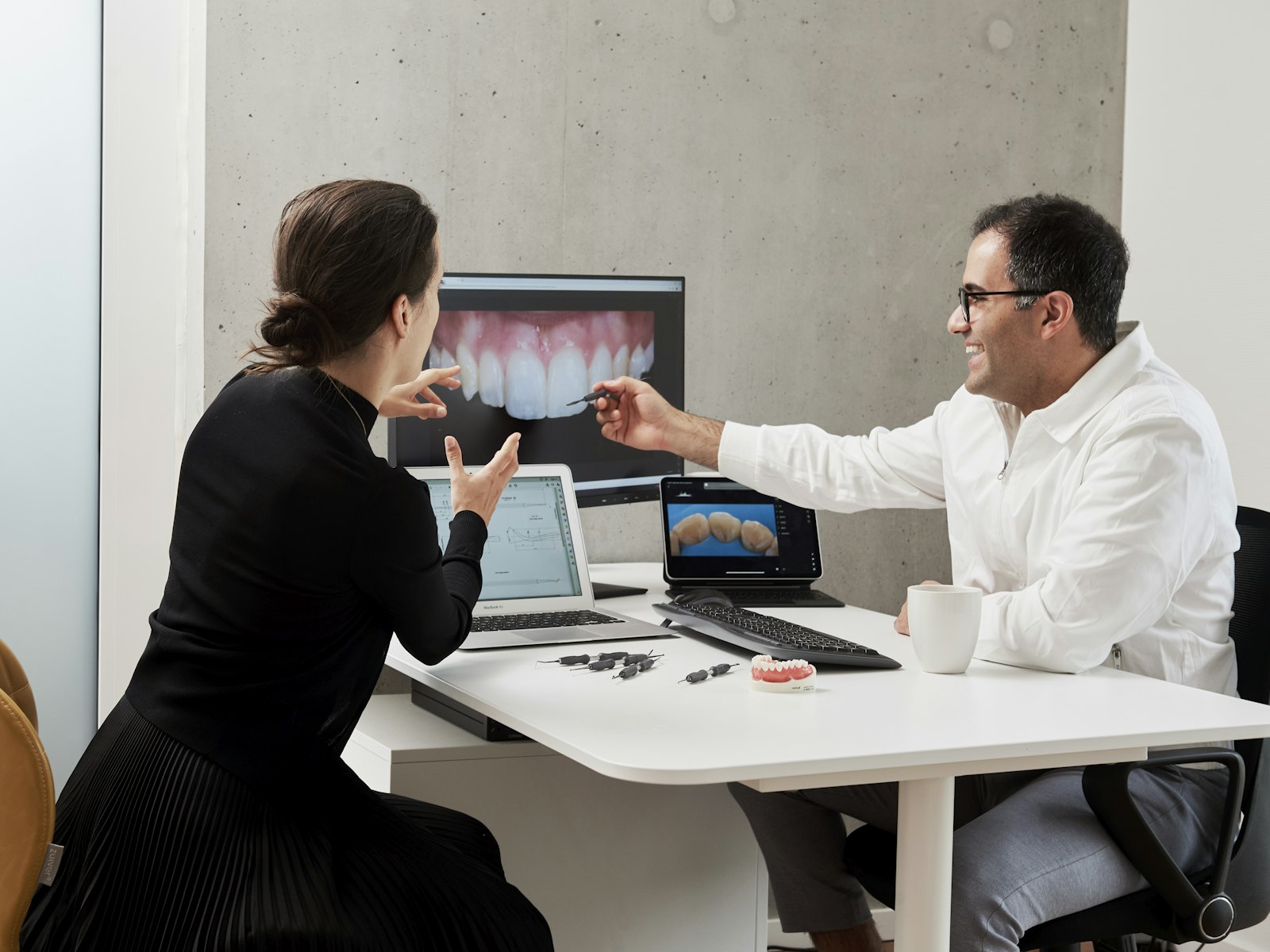

A six-monthly check-up does not mean six-monthly X-rays. For an adult with healthy teeth and no recent decay, the gap between routine bitewing X-rays is often two to three years. For someone with active decay or gum disease it may be much shorter. The timing is set by how likely something is to be hiding, not by the calendar.
And the dose involved in each image is small enough that the real question is not whether X-rays are dangerous, but whether a particular image is needed.
Most of what an X-ray finds cannot be seen in the chair
A visual examination shows the biting surfaces, the fronts and backs of the teeth and the gum line. It cannot show the surfaces where two teeth touch, the bone around the roots, or the tip of a root sitting inside the jaw. Those are exactly the places where early decay, bone loss from gum disease and root infections tend to start.
Finding a small cavity between two molars on a bitewing usually means a small filling. Finding the same cavity two years later because it has started to ache often means a larger restoration, and sometimes root canal treatment. That trade, a tiny dose now against a bigger problem later, is why X-rays are part of good dental care when they are justified.

Your risk sets the interval
Current guidance does not give everyone the same timetable. The selection criteria developed by the American Dental Association and the US Food and Drug Administration, which are widely used as a reference, base the timing of routine bitewings on each person's risk of decay. Your dentist weighs up things such as:
- how many new cavities or fillings you have had in recent years
- your gum health and any history of bone loss
- diet, especially how often you have sugary food or drinks
- dry mouth, which can come with some medicines and medical conditions
- crowns, bridges, implants or large fillings that need monitoring
- symptoms such as pain, swelling or a tooth that has changed
- what your last X-rays showed and how long ago they were taken
A stable mouth with no new problems earns longer gaps. An active picture earns shorter ones, until things settle.
Typical gaps between routine bitewings
The figures below come from the ADA and FDA criteria and are a starting point that your dentist adjusts for you. They apply to routine checks of the back teeth when there are no symptoms. An X-ray to investigate pain, swelling or an injury is taken when it is needed, whatever the date of the last one.
| Who | Lower risk of decay | Higher risk of decay |
|---|---|---|
| Children with baby or mixed teeth | Every 12 to 24 months | Every 6 to 12 months |
| Teenagers | Every 18 to 36 months | Every 6 to 12 months |
| Adults with their own teeth | Every 24 to 36 months | Every 6 to 18 months |
For children, and for teenagers at higher risk, the criteria add that bitewings are suggested only when the contact points between the back teeth cannot be seen or checked directly. Children and teenagers are on the shorter end because decay can move quickly through baby teeth and young permanent teeth.
A panoramic X-ray (OPG) is not a routine yearly image. It is usually taken for a specific reason, such as checking wisdom teeth or the whole jaw, planning orthodontic or implant treatment, or when you are new to a practice and there are no recent images. A first visit often includes a baseline set for that reason, as described in our guide to your first adult dental visit.
The dose behind each image
The International Atomic Energy Agency lists typical effective doses of about 1 to 8 microsieverts for a single small X-ray inside the mouth and about 4 to 30 microsieverts for a panoramic image. ARPANSA, Australia's radiation safety agency, puts natural background radiation at about 1.7 millisieverts a year for the average Australian, which works out to around 4 to 5 microsieverts a day. A bitewing is therefore in the range of a day or so of ordinary life, and a panoramic image up to about a week.
Those figures are why X-ray frequency is a question of benefit rather than danger. If an image will not change a decision, it should not be taken, however small the dose.
Ways to avoid repeat images
If you have had X-rays at another practice in the last couple of years, ask for them to be sent across before your visit. Recent images can often be used for comparison, and new ones taken only where something has changed. If you are pregnant or might be, tell your dentist; routine images can often wait, although X-rays needed to diagnose a problem can be taken at any stage, as our guide to dental X-rays in pregnancy explains.
You are always welcome to ask why an X-ray is being suggested, what it is looking for and when the last one was taken.
Common questions
I had X-rays last year. Do I need them again?
Not necessarily. If your teeth and gums are stable and there are no new concerns, your dentist may suggest waiting. If something has changed, a new image may be worthwhile.
Do digital X-rays need less radiation?
Generally, yes. Studies comparing digital sensors with film have found that digital systems can reduce patient dose, which is one reason modern dental imaging is so low dose.
Why would a child need X-rays more often than me?
Baby teeth have thinner enamel and decay can spread through them faster, so a child at higher risk may need bitewings more often than a low-risk adult.
If you are due for a check-up or would like a second look at when you last had X-rays, our team can go through it with you. See our current offers or book with a general dentist in Melrose Park.
The radiation figures here are general estimates for context and can vary with equipment and technique.