

A sharp tooth edge that keeps cutting your tongue or cheek is usually caused by a chip, a worn or cracked filling or a rough restoration, and it can normally be smoothed or repaired quickly in the chair. Patients often describe the same pattern: the tongue keeps finding one spot, the cheek is sore on one side and there is a small ulcer that never quite settles. Healthdirect reports that most mouth ulcers heal in one to two weeks, so an ulcer that keeps returning in the same place suggests something is still rubbing. This guide explains what causes a sharp tooth edge cutting the tongue, what you can do at home in the meantime and when to book in.
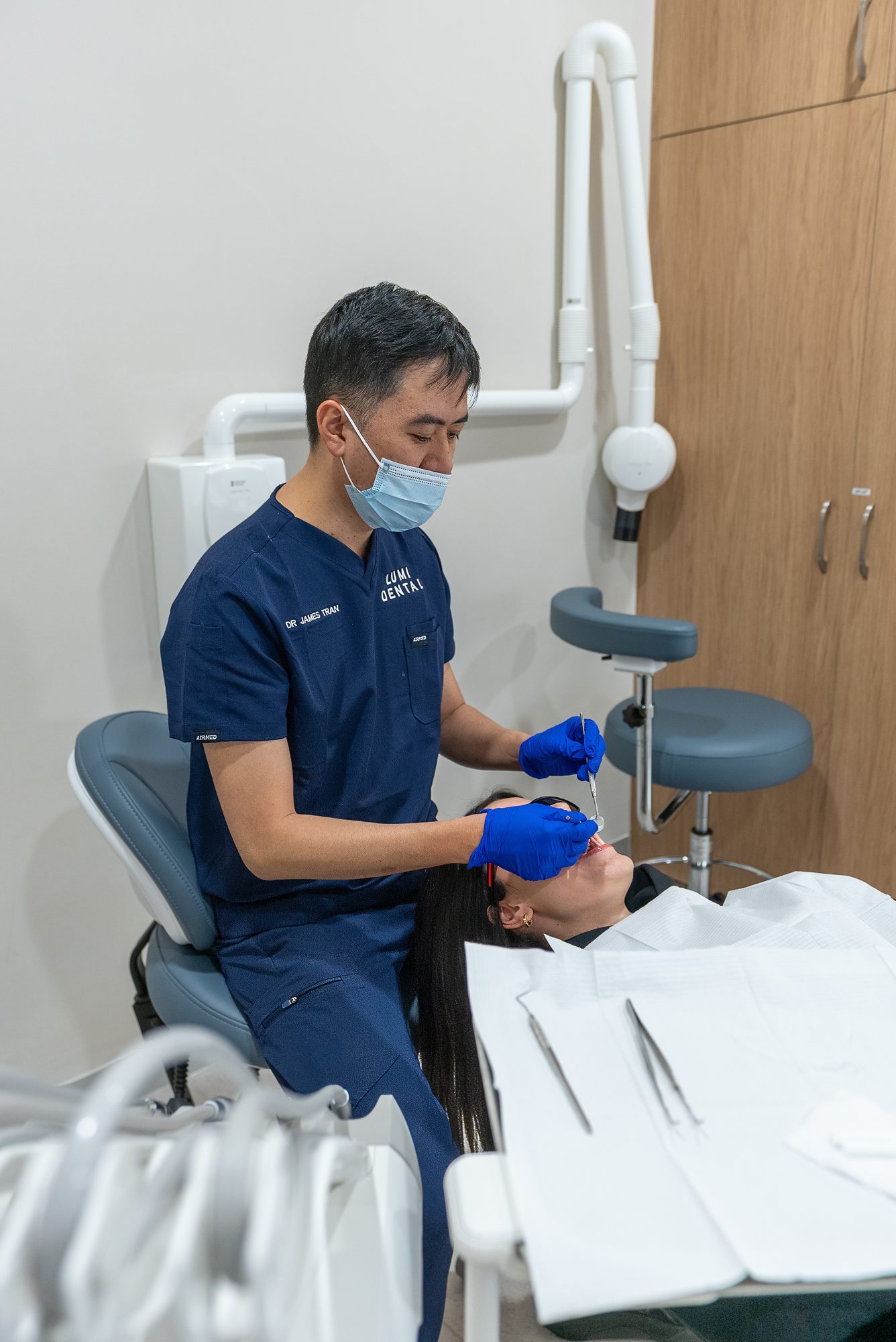
By Dr James Tran, general dentist at Lumi Dental, Melrose Park. BDent (University of Sydney), Graduate Diploma in Oral Implants.
The short version
- The most common causes are a chipped tooth, a broken or worn filling, a cracked cusp and a rough crown or denture edge.
- A small chip with no pain can still be sharp enough to cut soft tissue, and our article on chipped teeth that do not hurt explains why it still deserves a look.
- Dentists can often smooth a rough edge in minutes, or rebuild the tooth with a filling or bonding when more has been lost.
- Temporary measures such as orthodontic wax or sugar-free gum on a sharp spot may reduce the irritation until your appointment.
- An ulcer that lasts beyond about two to three weeks, or one that is unusually large, should be reviewed rather than watched.
- Habits such as cheek biting and grinding can look similar, so a proper examination matters.
What is actually sharp?
Enamel is hard but brittle. When a piece breaks off, it often leaves a thin, glassy edge that the tongue notices at once. The tongue is very sensitive and much more mobile than the rest of the mouth, so a tiny roughness can feel enormous to you and look like nothing in a mirror. In my experience, patients are often surprised that the edge responsible is only a fraction of a millimetre high.
Sharp edges tend to come from one of the following.
A chipped or fractured tooth
Chewing on hard foods, ice or an unlucky bite on a seed can break a corner or cusp. Our guides on chipping a tooth on ice and repairing a chipped front tooth cover the common scenarios.
A worn, chipped or broken filling
Fillings do not last forever, and the margin where the filling meets the tooth can chip or open up. A cracked filling or a filling that has partly broken away can leave a ridge. If it comes out completely, see what to do with a broken filling.
A crack in the tooth
A cracked cusp can have a ragged edge, and some cracks also cause pain when biting or releasing. These need an examination because the treatment is different from smoothing a chip.
A crown, bridge or denture edge
An older crown can wear or chip at the margin, and a denture can develop a rough spot or flange. These are often easy to adjust.
A new filling or a bite that feels high
After dental work, a slightly raised filling can concentrate force on one tooth. This is a separate issue from a sharp edge, but it may feel similar, and we discuss it in a bite that feels high after a filling.
Is it the tooth, or is it a habit?
Not every sore cheek is caused by a sharp edge. Chronic cheek biting is common, and the tissue can become swollen, which makes it easier to bite again. Grinding and clenching can leave a scalloped edge on the tongue or a white ridge along the cheek. Our articles on chronic cheek biting and a scalloped tongue help to separate these. A dentist can usually tell the difference by checking the shape of each tooth against the position of the sore. If the ulcer sits exactly where a tooth edge lines up, the edge is the more likely culprit.
What you can do at home until your appointment
These steps are comfort measures only. They do not repair the tooth.
- Cover the sharp spot with orthodontic wax, or a small piece of sugar-free chewing gum, if you can find it with your finger.
- Rinse gently with warm salt water, which is a common self-care suggestion for mouth ulcers.
- Avoid spicy, salty, acidic and rough foods while the area is sore, as Better Health Channel suggests.
- Use a soft toothbrush and avoid brushing hard over the ulcer.
- Do not file the tooth yourself or use sharp tools, as this can damage the tooth and the gum.
If you bit your tongue or cheek badly and it is bleeding, our first aid guide for a bitten tongue, lip or cheek is a useful read.
How a dentist fixes a sharp edge
The right fix depends on what is causing the edge and how much tooth is involved. The table below summarises the common approaches.
| Cause | Typical approach | What to expect |
|---|---|---|
| Tiny chip or rough enamel | Smoothing and polishing | Often quick, and may need no anaesthetic |
| Larger chip | Rebuilding with composite bonding or a filling | Usually completed in one visit |
| Worn or broken filling | Replacing the filling | Local anaesthetic is commonly used |
| Cracked cusp | Assessment, then a filling, onlay or crown where needed | May need more than one visit |
| Rough crown or denture edge | Adjustment or repair | Sometimes made or adjusted in a laboratory |
For a chip that needs rebuilding, composite bonding can restore the shape of the tooth in many cases. Our article on the difference between bonding and a filling explains how they compare.

A simple rule for when to book
If a sharp edge has been cutting your tongue or cheek for more than a few days, book a check. Do not wait for it to hurt. A tooth edge that is catching soft tissue every day keeps the tissue inflamed, and a repair is usually simpler when the damage is small. If the tooth is also painful, broken in half or has a swelling beside it, book urgently.
When a persistent ulcer needs review
Most ulcers caused by an edge heal within a week or two once the cause is smoothed. Healthdirect advises seeing a doctor if an ulcer lasts longer than two weeks or keeps recurring, and the NHS suggests seeing a GP or dentist if it lasts longer than three weeks. Better Health Channel adds that an ulcer that has lasted more than two weeks should not be ignored, especially in people who use tobacco or drink alcohol regularly.
Practically, that means:
- Have the edge fixed first, then expect healing over the following week or two.
- If the ulcer is still there after about two to three weeks, have it looked at, whatever the cause seems to be.
- Book sooner if it is unusually large, bleeds, feels hard or you have similar sores elsewhere.
Long-lasting ulcers can occasionally indicate something more serious, including oral cancer, which is why a dentist or doctor will want to check them. Our guides on when to worry about mouth ulcers and mouth ulcers and canker sores go into more detail. Where a sore needs further investigation, referral to an oral medicine specialist, oral surgeon or your doctor may be recommended.
How we approach this at Lumi Dental
The team at Lumi Dental sees sharp tooth edges regularly. We examine the tooth under good light, check the existing fillings and crowns, and look at the bite so the cause is found and not only the symptom. We may use the in-house 3D intraoral scanner to record the tooth, and most small edges can be smoothed or rebuilt at the same visit. Lumi Dental offers emergency appointments, and where a problem is outside general dentistry we refer to a registered specialist. Lumi Dental uses no amalgam, so older silver fillings that have chipped are replaced with tooth-coloured materials where it is appropriate.
Questions patients ask
Why does one tooth keep cutting my tongue?
It is usually a chip, a worn filling margin or a rough restoration on that tooth. The tongue is highly sensitive, so even a very small edge is noticeable.
Can a sharp tooth edge be smoothed?
Often yes. Small rough areas of enamel can be polished in a short visit, while larger defects may need a filling or edge bonding.
Is a sharp edge a dental emergency?
Usually not, but it should be seen within days rather than weeks. Book urgently if the tooth is painful, broken in half, or swollen around, or if there is bleeding that will not stop.
How long does a mouth ulcer from a sharp tooth take to heal?
Most mouth ulcers heal in one to two weeks, and healing generally starts once the edge is no longer rubbing. If it lasts beyond two to three weeks, have it checked.
Can I use wax or gum to cover a sharp tooth?
Yes, as a short-term measure. Orthodontic wax is designed for this, but it is a stop-gap, and the tooth still needs to be examined and repaired.
Book a Check at Lumi Dental
If a tooth edge keeps catching your tongue or cheek, the team at Lumi Dental in Melrose Park can find the cause, explain the options and give you a written quote before any treatment begins. See our current deals for appointment options, or learn about general dentistry at Lumi Dental. Patients visit from Ryde, Parramatta, Ermington, Rydalmere and nearby suburbs.
Sources
About the author

Dr James Tran is a general dentist at Lumi Dental in Melrose Park. He holds a BDent from the University of Sydney and a Graduate Diploma in Oral Implants, is a member of the International Congress of Oral Implantologists (MICOI) and teaches on a General Dental Residency program. He sees chipped teeth, worn fillings and soft tissue problems in general practice, and refers to registered specialists when a sore needs further investigation.
This article is general information only and does not replace advice from your own dentist or a registered specialist who has examined you.