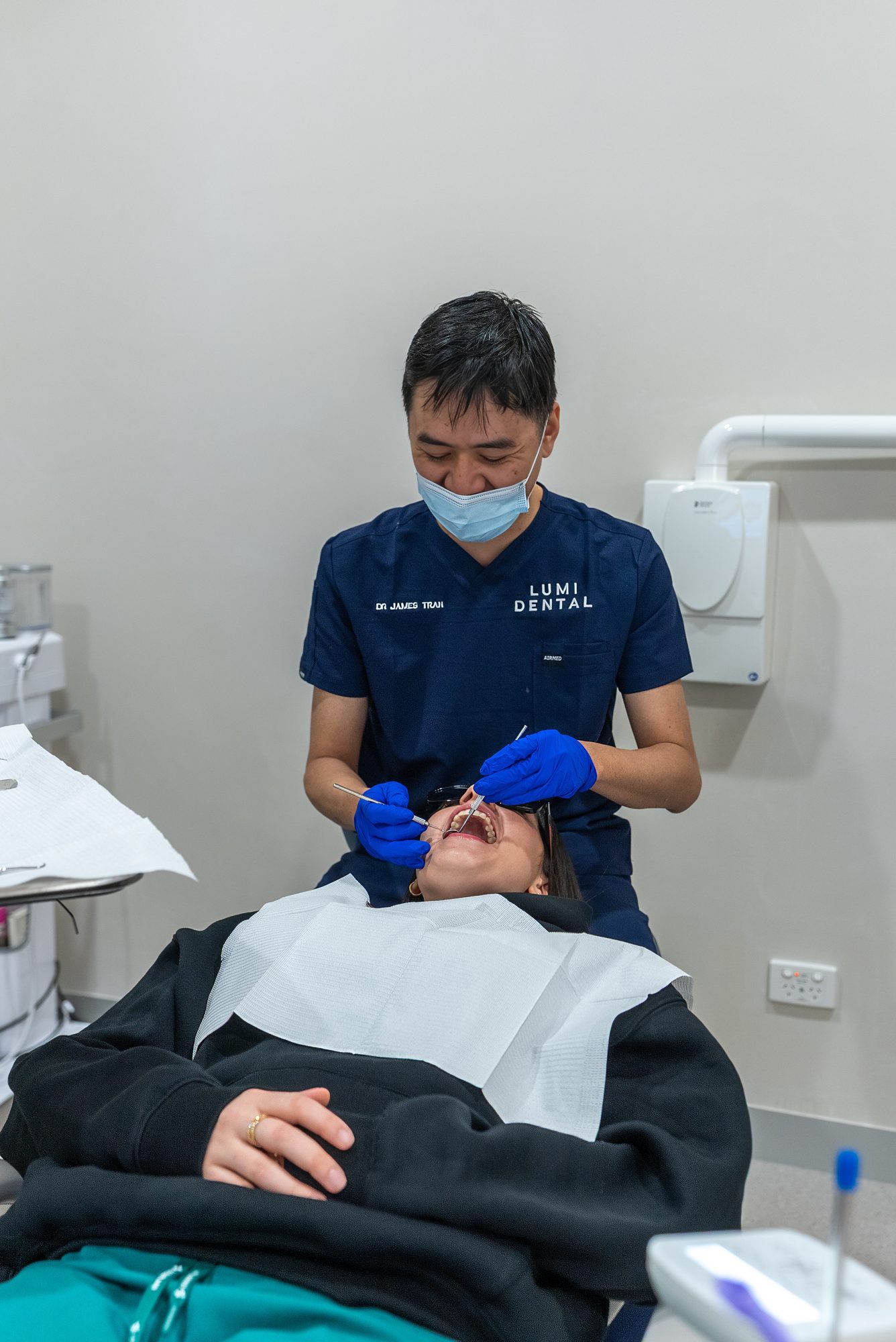

No: teeth whitening should wait until any cavity or active decay has been treated, because peroxide gel does nothing for decay and can pass through a hole in the enamel toward the nerve. Whether you can whiten teeth with cavities comes up at cosmetic consults often, usually from someone who has been putting off a filling and wants the brighter shade first. Healthdirect lists cracks or holes in your teeth and untreated dental problems among the situations where teeth whitening is not recommended, and reports that around 1 in 3 Australian adults over the age of 15 has tooth decay that has not been treated. Many have no idea, which is why the examination comes first.
Written by Dr James Tran, BDent (University of Sydney), MICOI, GradDip (Oral Implants), general dentist at Lumi Dental in Melrose Park.
The short version
- Peroxide lightens enamel. It does not remove bacteria, rebuild lost tooth structure or stop a cavity growing.
- A cavity is a breach in the enamel. Gel that reaches the dentine underneath, and the nerve beyond it, can cause sharp or lingering pain rather than mild sensitivity.
- Decayed areas do not whiten: brown decay stays dark and chalky white spots can look more obvious straight after a course, so the result looks patchy.
- The sensible order is examination, treat the decay, then whiten. On a front tooth, the final filling is often placed after whitening so it matches the new shade.
- Early decay that has not yet formed a hole can sometimes be remineralised with fluoride, after which whitening is reconsidered.
- Not sure how a cavity forms? Our guide to the causes and prevention of tooth decay covers the basics.
If there is a cavity, treat the decay first, then whiten
That rule holds for in-chair whitening and take-home trays alike. Both use hydrogen peroxide or carbamide peroxide in a gel that sits against the enamel and breaks down stain molecules inside it. Nothing in that process touches the bacteria living in a cavity or puts back the mineral they have dissolved. Better Health Channel's advice on cosmetic dentistry is to see a dentist to check the whole mouth first and treat any disease before planning cosmetic work. In my experience the patients who whiten over a known cavity end up with two problems instead of one: a tooth that hurts, and a filling that still has to be done, now against a shade that has moved.
What peroxide gel does to a tooth with a hole in it
Enamel has no nerve supply of its own. Beneath it sits dentine, threaded with microscopic tubules that run toward the pulp, where the nerve and blood vessels live. On an intact tooth, whitening gel must work its way through enamel before any of it reaches dentine, which is why most people feel only mild, short-lived sensitivity.
A cavity changes that. The enamel is already broken and the dentine beneath is softened, so gel pooling in the hole has a direct route into the tubules. Healthdirect warns that whitening bleach could cause pain or further damage if you have any cracks in your teeth, and a cavity is a bigger breach than a crack. The pain patients describe is not the fleeting zing of ordinary whitening sensitivity; it is a sharp, lingering ache, and if the decay is close to the nerve that irritation is the last thing the pulp needs.
Why the result looks patchy
The second problem is cosmetic. Better Health Channel lists tooth decay, fillings, crowns, bridges, veneers and some types of discolouration among the things that do not whiten. Active brown or black decay stays dark while the enamel around it lightens, so the contrast gets stronger, not weaker. Early decay behaves differently: a chalky white spot is porous and dries out faster than the enamel around it, so straight after a session it can stand out as a brighter patch on a tooth that has only partly lightened. Fillings, bonding and crowns keep their original colour as well, which is why sequencing matters most on the teeth people see.
Front tooth or back tooth: the order changes
Back teeth
For molars and premolars the plan is simple: fill the tooth, then whiten once it has settled, usually within a couple of weeks. Nobody sees the exact shade of a filling on a back tooth, so there is no reason to wait.
Front teeth
Front teeth take more thought, because a tooth-coloured filling will not change shade with whitening. Where the cavity is small and not painful, I usually clear the decay and place a provisional filling, whiten, and then place the final composite matched to the new shade. Composite is not bonded immediately after whitening: research reports that residual oxygen from the bleaching agent interferes with the setting of the bonding resin and lowers bond strength, with waiting periods from 24 hours to 4 weeks reported. Many dentists wait around one to two weeks. If the cavity is larger, painful or close to the nerve, it is treated straight away and the shade is matched at a later visit. Our guide to whitening teeth that already have fillings or bonding covers the matching question.

Early white spots: remineralise first, then reconsider
Not every patch of decay needs drilling. Healthdirect explains that decay which has not yet made a hole can be treated by a dental professional with fluoride paste or varnish, alongside fluoride toothpaste and changes to diet, to stop it becoming a cavity. Better Health Channel describes early decay as reversible. In practice a white spot near the gum line is often managed with high-fluoride toothpaste, a varnish in the chair and a review a few months later. Once the surface has hardened, whitening is reconsidered. Some white spots fade as the surrounding enamel lightens; others remain and may be better treated with resin infiltration or a little composite bonding. Our article on whether a cavity can be reversed explains where that line sits.
What usually happens first: a quick guide
| What the examination finds | What usually happens first | When whitening fits in |
|---|---|---|
| No decay, healthy gums | Routine clean, X-rays if due | Straight away, in-chair or take-home |
| Early white spot, no hole | Fluoride varnish, home fluoride, diet review, recheck | Once the spot has hardened; reassessed after whitening |
| Small cavity on a back tooth | Filling | Once the tooth has settled, often within a couple of weeks |
| Cavity on a front tooth | Decay removed, provisional filling placed | Whiten, then final composite matched after about one to two weeks |
| Decay under an old filling | Old filling and decay removed, tooth rebuilt, sometimes crowned | Often whiten before a final crown so the ceramic can match |
| Deep decay with pain | Urgent treatment of the tooth, possibly root canal treatment | Only after the tooth is comfortable and stable |
Why a chemist kit or salon cannot check for decay
Healthdirect notes that early tooth decay has no symptoms, and Better Health Channel adds that X-rays are often needed to find it because decay can sit where the eye cannot see, such as between the teeth or under an existing filling. A supermarket kit skips that step, and so does a salon: healthdirect points out that whitening is sometimes offered by unregulated, unqualified operators, and that only registered dental professionals can use products containing more than 6% hydrogen peroxide. Lower-strength products are less likely to cause harm, but they cannot tell you whether there is a hole between two molars. Our article on what a dental X-ray shows that a visual exam cannot explains why bitewing X-rays belong in a proper whitening assessment.

How we approach this at Lumi Dental
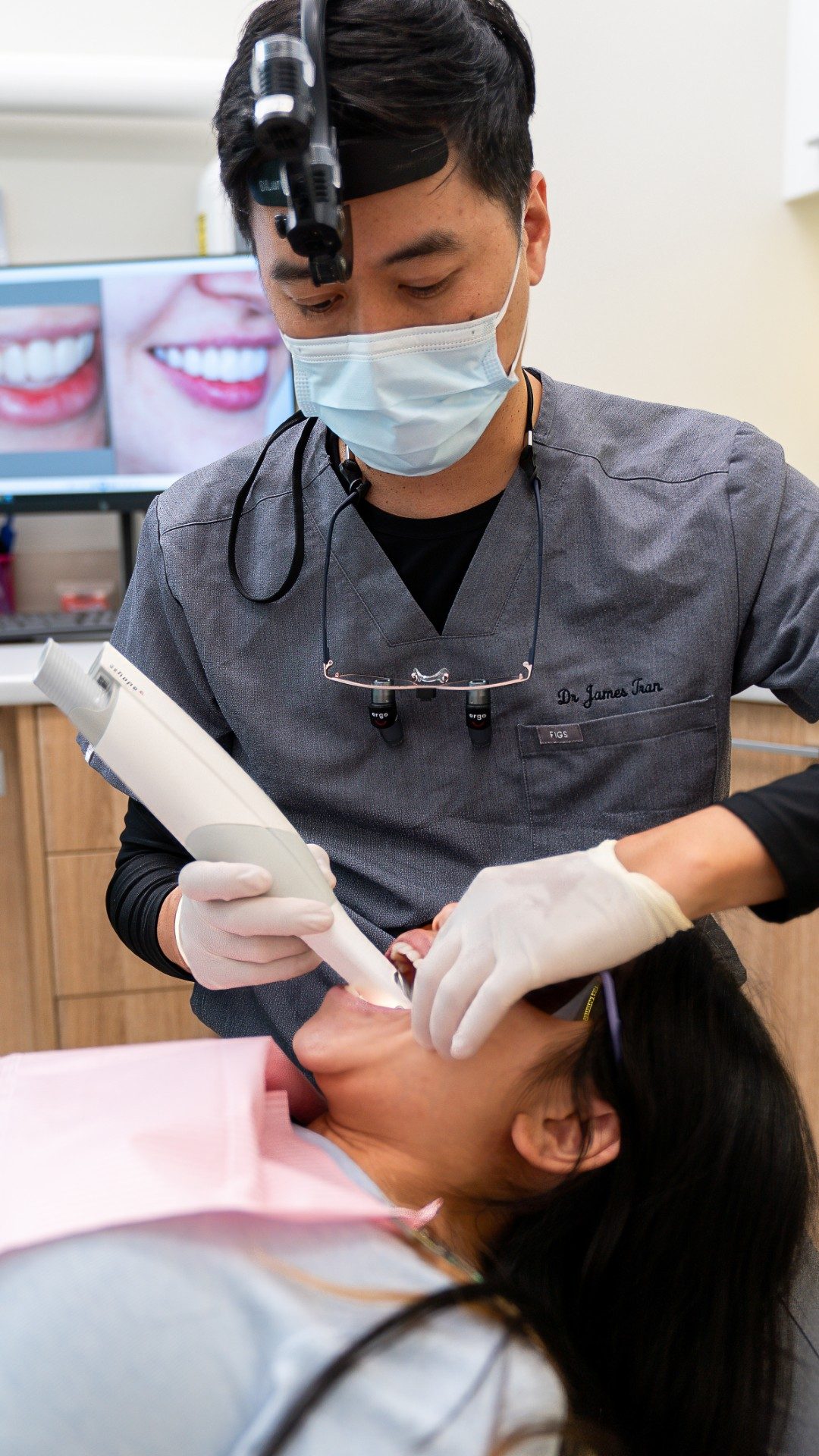
At Lumi Dental in Melrose Park, a whitening enquiry begins with an examination by a dentist, including bitewing X-rays where they are due and a 3D intraoral scan that doubles as the record for take-home trays. If the teeth are sound, whitening is planned at the same visit, in-chair or take-home. If decay is found, the dentist treats it first with mercury-free tooth-coloured materials, and the timing of the final filling on a front tooth is planned around the whitening so the shade can be matched. The hygiene team of oral health therapists looks after cleans and whitening maintenance. Your general dentist at Lumi Dental coordinates each step.
Questions patients ask
Can I whiten my teeth if I have a small cavity?
Not until it has been treated. A small cavity is still a breach in the enamel, and gel reaching the dentine underneath can cause sharp pain. A small filling is a short appointment, and whitening can usually follow within a couple of weeks.
Does teeth whitening make cavities worse?
Whitening does not cause decay, but it can inflame the nerve of a tooth that already has a cavity, and it can hide the problem by brightening the enamel around it while the decay keeps growing. Our article on whether whitening damages enamel separates what peroxide does from what it does not.
Why does one tooth hurt so much after whitening?
Mild cold sensitivity for a day or two is common, and healthdirect advises a check with your dental professional if it continues for longer. Sharp or throbbing pain in a single tooth suggests a cavity, a crack or a leaking filling, and that tooth needs to be examined. Our guide to whitening sensitivity and how to relieve it covers the ordinary kind.
Will whitening hide a brown spot or a cavity?
No. Decay does not whiten, so a brown spot usually looks more obvious once the enamel around it lightens. If a brown mark is surface staining rather than decay, a professional clean often removes it, and whitening can then lift the shade of the whole tooth.
Is it better to whiten before or after fillings are replaced?
For fillings on front teeth, whiten first and have the final filling placed about one to two weeks later so it can be matched to the new shade. For back teeth, have the filling done first. Your dentist plans the order after the examination.
Check first, then whiten: complimentary cosmetic consult in Melrose Park
If you are thinking about whitening and not sure whether a cavity is hiding somewhere, the team at Lumi Dental in Melrose Park can examine your teeth, take any X-rays due and tell you plainly whether to whiten now or treat first. Book a complimentary cosmetic consult, or read more about teeth whitening at Lumi Dental. Patients visit from Ryde, Parramatta, Ermington, Rydalmere and nearby suburbs.
Sources
- healthdirect: Teeth whitening
- healthdirect: Tooth decay
- Better Health Channel: Cosmetic dentistry and teeth whitening
- PMC: Effect of antioxidants on the shear bond strength of composite resin to enamel following extra-coronal bleaching
About the author

Dr James Tran is a general dentist at Lumi Dental in Melrose Park. He holds a BDent from the University of Sydney and a Graduate Diploma in Oral Implants, and is a Member of the International Congress of Oral Implantologists (MICOI).
This article is general information only and is not a substitute for an examination and individual advice from a registered dental practitioner. Suitability for any treatment varies from person to person.