When decay or a break on a back tooth runs below the gum, the edge of the new restoration can be hard to reach, keep dry and seal. Two ways around this are to raise that edge with a bonded layer of composite, called deep margin elevation, or to move the gum and some bone further down the root with surgery, called crown lengthening. The two are not interchangeable. Which one fits depends on several factors, including how close the damage sits to the bone and whether the area can be kept dry while bonding.
The deciding measurement is the distance to the bone
Above the bone, the gum attaches to the tooth in a narrow band. The 2017 World Workshop on the classification of periodontal diseases replaced the older term "biologic width" with "supracrestal tissue attachment" for this band, made up of the junctional epithelium and the connective tissue above the bone (Jepsen and colleagues, Journal of Periodontology, 2018). The consensus report states that placing restoration margins within the supracrestal connective tissue attachment is associated with inflammation or loss of supporting tissue, while noting it is not clear whether that is caused by plaque, trauma, the materials or a combination.
That is why the planning starts with measurements. A 2022 review of deep margin elevation by Samartzi and colleagues (Dentistry Journal) describes measuring pocket depths, sounding down to the bone and taking periapical X-rays before treatment, to judge how far the final margin would sit from the bone crest. Citing a 2017 paper by Dablanca-Blanco and colleagues on deep cavities in molars, the same review describes a rough sequence:
- damage that reaches into the gum crevice, as far as the junctional epithelium, may suit deep margin elevation;
- damage that reaches into the connective tissue attachment points towards crown lengthening;
- damage at bone level, on a tooth that can still be restored, may need both.
The review sets three conditions for deep margin elevation: the area must be fully isolated, the matrix band must seal the margin accurately, and the matrix must not invade the connective tissue part of the attachment. Where these cannot be met, the review indicates the treatment plan needs to be reconsidered, which may mean surgery.
What each approach involves
Deep margin elevation adds a layer of composite resin over the deepest edge of the cavity so that the margin of the final restoration can sit higher, where it is easier to isolate, record and bond. The review describes it being used under both onlays or crowns and direct fillings. Our earlier article on deep margin elevation explains the steps and the gum response in more detail, and our guide to dental onlays covers the restoration that often goes on top.
Crown lengthening is periodontal surgery. Gum and some supporting bone are reshaped so that more tooth sits above the gum. A systematic review by Pilalas and colleagues (Journal of Clinical Periodontology, 2016) included five clinical trials, only one of them randomised, and found a high risk of bias. Across the studies, average gains in crown length at six months ranged from 1.4 to 3.3 mm, and the gum margin may creep back up the tooth ("rebound") afterwards, mostly in the first three months. The authors concluded that technical factors, such as flap position, bone removal and root preparation, mainly influence the outcome, with gum type (periodontal biotype) a secondary factor. Our article on crown lengthening describes the procedure itself.
A third option is to pull the root up slowly with orthodontic forces (orthodontic extrusion). A systematic review of front teeth with fractures below the gum after trauma included 13 studies: one randomised trial, one prospective study, two retrospective cohort studies and nine case series. It reported a mean extrusion rate of 1.5 mm a week within a four to six week treatment period, followed by a period of holding the tooth in place, and found that root resorption did not seem to be a relevant side effect (Reichardt and colleagues, 2021). That review did not look at back teeth.
What the studies show
Only one of the studies below compared the two approaches directly, and the evidence overall is limited. The table summarises the studies read for this article.
| Study | Design and size | What it found |
|---|---|---|
| Farouk and colleagues, 2023 | Randomised trial comparing elevation with crown lengthening, 20 deep cavities in root-filled back teeth, 12 months | Both approaches were considered clinically successful. Pockets were deeper after crown lengthening at 9 and 12 months, and attachment levels differed significantly between the groups from 3 months on. Bleeding and bone level did not differ significantly. |
| Mugri and colleagues, 2021 | Systematic review of 6 studies (4 crown lengthening, 2 deep margin elevation) | Most studies had a high risk of bias. The gum margin changed after crown lengthening, with rebound linked to gum type. Deep margin elevation showed high survival. No high-quality long-term trials compared the two. |
| Aziz and colleagues, 2025 | Retrospective multicentre practice-based study, 426 lithium disilicate crowns (153 with elevation) in 380 people, 10 years | Survival was 95.8% with deep margin elevation and 94.7% without it. Gum measurements did not differ significantly between the groups. |
| Aksaka and colleagues, 2025 | Prospective controlled study, 42 molars with indirect composite restorations and elevation on one side, 3 years | No significant differences in gum measurements between the elevated side and the opposite, unrestored side of the same tooth. The authors considered it acceptable even where the margin sat close to or slightly within the attachment. Only 30 teeth were examined at 3 years. |
| ElHaddad and colleagues, 2026 | Systematic review and meta-analysis of margin elevation | In people with healthy or stabilised gums, elevation did not worsen pocket depths or bleeding. |
On the surgical side, a 2023 meta-analysis of four controlled trials (182 procedures in 111 people) found no significant differences in supracrestal tissue attachment, bone level or pocket depth between treated and neighbouring sites at three or six months, although clinical attachment level changes at six months favoured the neighbouring teeth (Smith and colleagues, Saudi Dental Journal). A separate review of four case series, all at high risk of bias, found that crown lengthening also changed measurements on the teeth next to the treated site (Nobre and colleagues, Clinical Oral Investigations, 2017). The authors of both reviews called for more or better evidence.
In these studies, deep margin elevation appeared to be well tolerated by the gums when used within its limits, although most of the evidence is small or short to medium term. The authors of the Farouk trial describe crown lengthening as a gold standard for re-establishing the attachment where margins are beyond what elevation can reach.
Lower molars add a complication: the space between the roots
On a lower molar, the roots divide at a point called the furcation. Dibart and colleagues note that if bone removal for crown lengthening is not carefully planned, it may result in furcation involvement of teeth with more than one root. In their retrospective study (Journal of Periodontology, 2003), they compared 26 lower molars that had crown lengthening before a crown with 24 crowned lower molars that did not. Comparing bitewing X-rays taken before treatment with those taken five years after the crown, 10 of the 26 lengthened molars (38.5%) showed signs of furcation involvement, and none of the control teeth did. The Samartzi review also notes that lengthening a molar crown as far as the damage extends may expose the furcation, and recommends combining the two approaches in such cases. Our article on bone loss between the roots of a back tooth explains why that matters for the tooth's outlook.
For dentists: check the distance to the furcation before taking bone on a lower molar
From their five-year data, Dibart and colleagues proposed a critical distance from the furcation of 4 mm, below which crown lengthening surgery on a lower molar carried a very high chance of later furcation involvement. Before referring or planning osseous surgery on a lower molar, it may help to assess how close the furcation sits to the bone crest and the deepest margin, using radiographs alongside probing and bone sounding as Samartzi and colleagues describe. If there is little room, elevation or a combined approach may avoid taking bone down to the furcation.
The limits are real. Dibart's study was retrospective, involved 26 test teeth, relied on bitewing X-rays, and the 4 mm figure was derived from the same data rather than tested in a separate group. The abstract does not state exactly which landmarks the 4 mm is measured between, so check the full paper before applying it. Treat it as a planning prompt, not a rule.
Planning this at Lumi
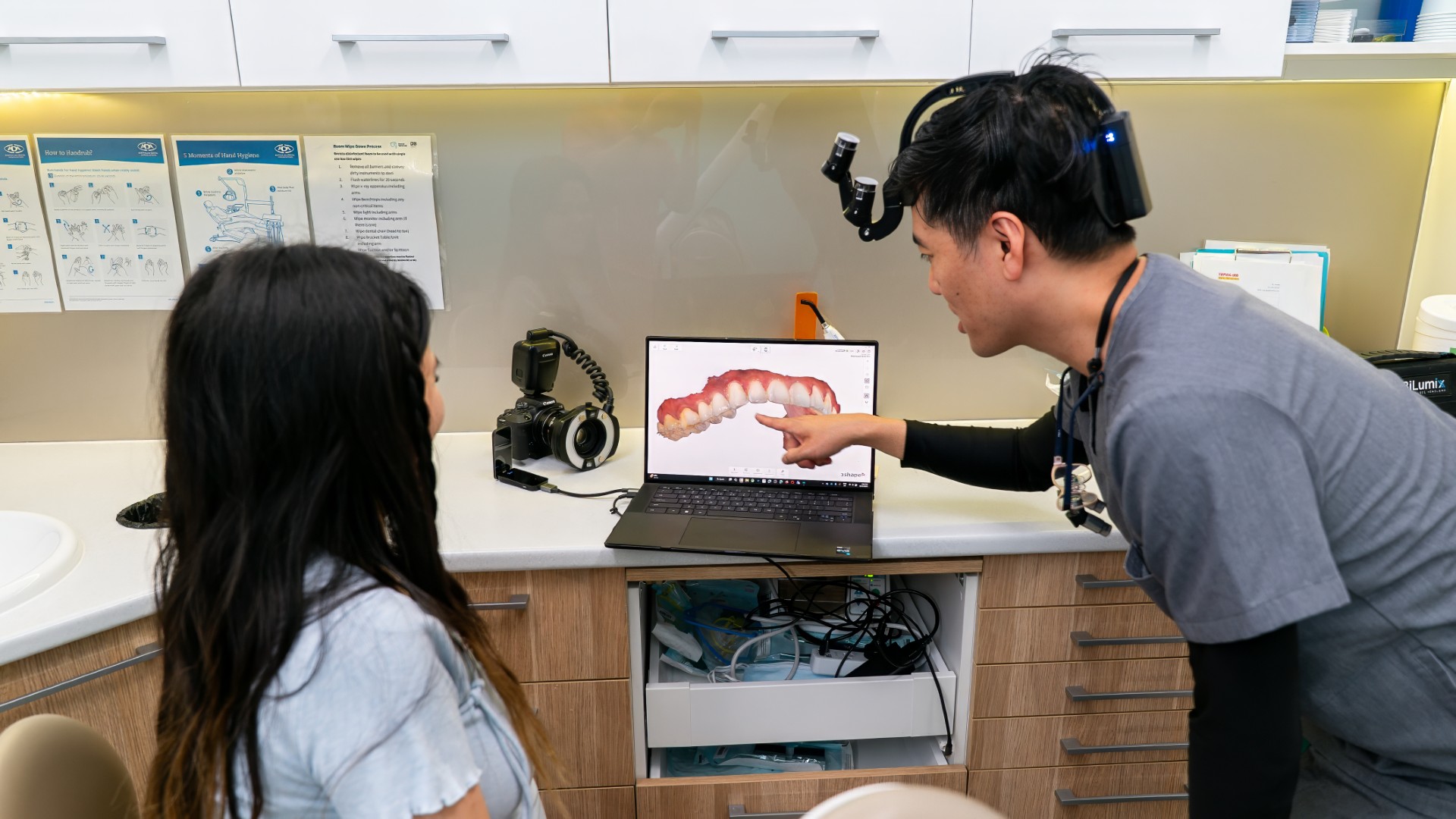
Lumi provides deep margin elevation where it is suitable. Lumi has an Orthophos 3D X-ray for OPG and 3D scans and a 3D intraoral scanner, and after your examination you will usually receive a written treatment plan, often by email. You can read about crowns and onlays at Lumi or book an examination at our Melrose Park practice.
Questions about raising a margin or lengthening a crown
Is deep margin elevation just a filling under the gum?
It uses a filling material, but its purpose is different. The composite layer moves the edge of the cavity higher so that the final restoration, often an onlay or crown, can be isolated, recorded and bonded more easily. It is only suitable within the limits described above.
Can both be used on the same tooth?
Yes. Where damage reaches the bone but the tooth can still be restored, the review by Samartzi and colleagues describes combining crown lengthening with deep margin elevation, rather than lengthening the crown all the way to the depth of the damage, which on a molar may expose the furcation.
Is this the same as crown lengthening for a gummy smile?
No. Crown lengthening can also be done on front teeth for appearance, and that is planned differently. Our article on aesthetic crown lengthening and the bone level covers that version.
Sources
- Jepsen S and colleagues. Periodontal manifestations of systemic diseases and developmental and acquired conditions: consensus report of workgroup 3 of the 2017 World Workshop. Journal of Periodontology, 2018. PubMed 29926943
- Samartzi TK and colleagues. Deep margin elevation: a literature review. Dentistry Journal, 2022. PubMed 35323250
- Pilalas I, Tsalikis L and Tatakis DN. Pre-restorative crown lengthening surgery outcomes: a systematic review. Journal of Clinical Periodontology, 2016. PubMed 27535216
- Reichardt E and colleagues. Orthodontic forced eruption of permanent anterior teeth with subgingival fractures: a systematic review. International Journal of Environmental Research and Public Health, 2021. PubMed 34886307
- Farouk AT and colleagues. Biological evaluation of indirect restorations in endodontically treated posterior teeth with deeply located proximal margins following deep margin elevation versus surgical crown lengthening: a randomized controlled trial. Clinical Oral Investigations, 2023. PubMed 38147139
- Mugri MH and colleagues. Treatment prognosis of restored teeth with crown lengthening vs. deep margin elevation: a systematic review. Materials, 2021. PubMed 34772259
- Aziz AM and colleagues. Clinical and radiographical evaluation of CAD-CAM crowns with and without deep margin elevation: 10-year results. Journal of Prosthetic Dentistry, 2025. PubMed 38724338
- Aksaka N, Gozetici-Cil B and Ozcan M. Periodontal status of indirect resin composite restorations with proximal box elevation: 3-year clinical results. Clinical Oral Investigations, 2025. PubMed 41317197
- ElHaddad SA and colleagues. Periodontal and restorative outcomes of cervical margin relocation: a systematic review and meta-analysis. Quintessence International, 2026. PubMed 41631460
- Smith SC and colleagues. Periodontal tissue changes after crown lengthening surgery: a systematic review and meta-analysis. Saudi Dental Journal, 2023. PubMed 37251724
- Nobre CM and colleagues. A systematic review and meta-analysis on the effects of crown lengthening on adjacent and non-adjacent sites. Clinical Oral Investigations, 2017. PubMed 27515522
- Dibart S and colleagues. Crown lengthening in mandibular molars: a 5-year retrospective radiographic analysis. Journal of Periodontology, 2003. PubMed 12886991