If you have just fallen on a station platform, tripped on a footpath or been thrown forward on a bus and hurt your mouth, deal with the teeth before anything else. A knocked-out adult tooth has the best chance when it goes back in within minutes, while the paperwork can wait an hour. It cannot wait weeks, though, because some of the evidence about what happened disappears quickly.
This guide follows that order: first aid, then where to be seen, then the reports, footage and records that help if you later want to ask who is responsible.
Call 000 first if the injury is more than a dental one
A blow hard enough to break teeth can also injure the head, neck or jaw. Call 000 or go to a hospital emergency department if the person has trouble breathing or swallowing, is bleeding heavily, has severe swelling of the mouth or tongue, was knocked out or is confused or vomiting, or cannot close their jaw or bring their teeth together normally. Those problems come before any tooth.
If none of those apply, treat it as a dental emergency and move on to the steps below.
A knocked-out adult tooth: replant it if you can
Pick the tooth up by the crown, the white part you chew with, and keep your fingers off the root. If it is dirty, rinse it briefly in milk or saline. Do not scrub it, wipe it or leave it soaking. Then push it gently back into the socket the right way round and bite softly on a clean cloth or tissue to hold it there while you travel.
Replanting on the spot is unpleasant for a bystander to do, but it protects the thin layer of living cells on the root that lets the tooth reattach. The international dental trauma guidelines (Fouad and colleagues, Dental Traumatology, 2020) are built around keeping those cells alive, and the longer a tooth sits dry outside the mouth, the poorer its outlook.
If the tooth cannot go back in, keep it moist. Put it in a small container of milk, or saline if you have it, or have an adult or older child hold it in the mouth inside the cheek. Avoid water, and never wrap a tooth in a tissue or let it dry out. Australian health advice, such as WA Health's, is to see a dentist immediately, ideally within 30 minutes, because teeth replanted in that time have the best chance. Bring the tooth even if more time has passed, because the dentist can still assess what is possible.
Our separate articles explain first aid for a knocked-out tooth step by step and why milk is a good place to keep one.
Baby teeth, broken pieces and loosened teeth
A knocked-out baby tooth should never be put back, because doing so can harm the adult tooth developing underneath. Take the child and the tooth to a dentist as soon as possible so the dentist can check that the whole tooth came out. If you are not sure whether a tooth is a baby or adult one, keep it in milk and let the dentist decide.
If a corner or edge has snapped off, collect the fragments and bring them with you, kept moist. A dentist may be able to bond a piece back on, and even when that is not possible it shows how much tooth was lost. A tooth that has been pushed out of line or is wobbly needs to be seen promptly too, even if it looks minor. Damage to the root or nerve is often not visible on the day.
Getting seen on the day
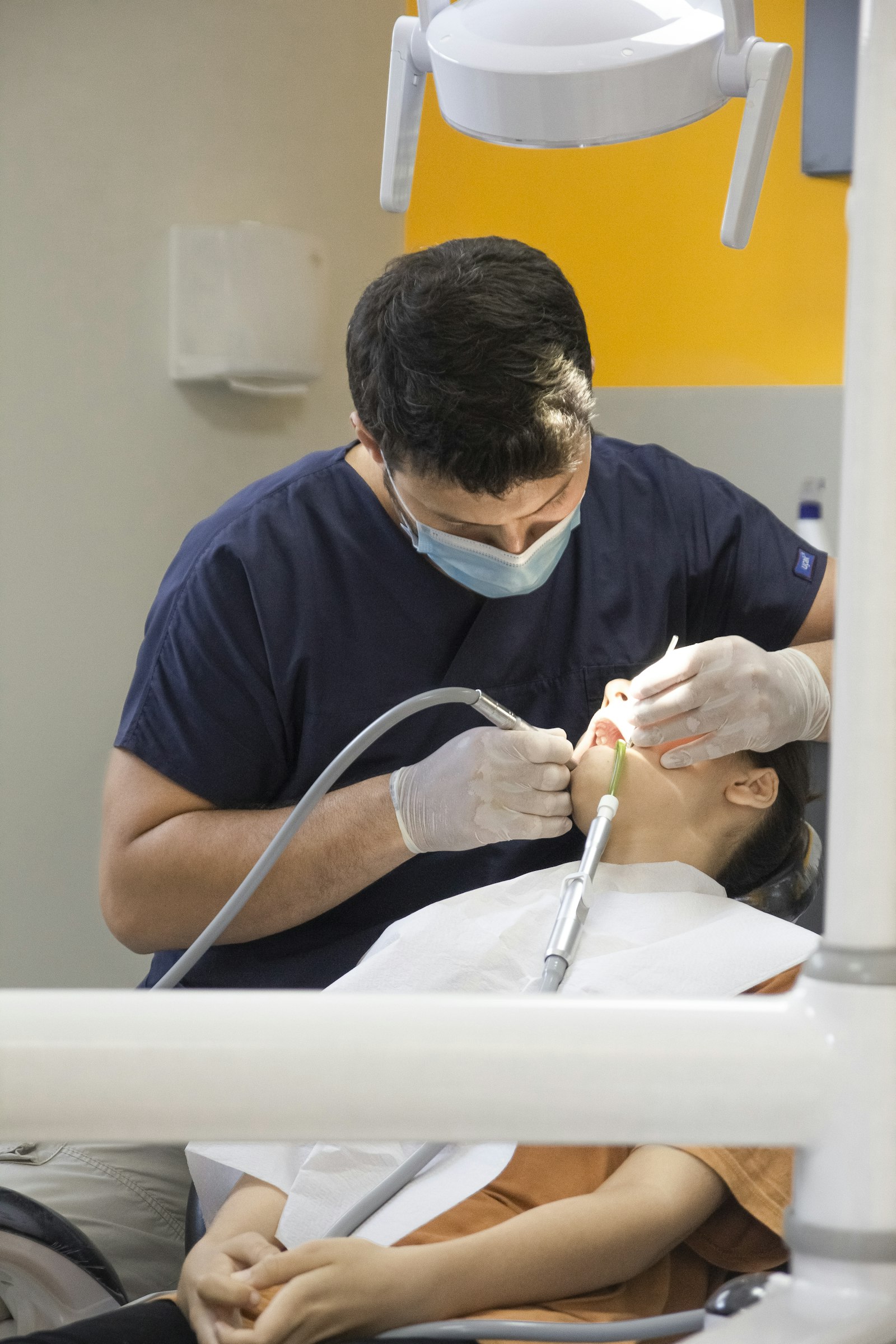
In business hours, phone a dental practice and say plainly that a tooth has been knocked out or broken in a fall. Many practices try to make room for dental trauma. If you cannot reach a dentist, or the injury involves the face, jaw or head, a hospital emergency department is the right place. Our guide on what to do in a dental emergency covers how to decide where to go.
Being hurt in public is frightening, and some people find emergency treatment hard to face. Lumi Dental does not provide general anaesthetic, but happy gas (relative analgesia), inhaled pain relief, oral sedation and IV sedation are available, so ask about them when you call.
The day of the injury is rarely the end of treatment. A replanted or badly displaced adult tooth often needs root canal treatment and several reviews over the following months, so expect follow-up visits.
Before you leave the scene, make a record
Once the tooth is sorted, or while someone else is looking after it, spend a few minutes on the things that are hard to recreate later.
Tell someone in charge. Report what happened to station staff, the bus driver, a centre manager or the shop supervisor and ask for an incident report to be made. Write down the name of the person you spoke to and the time. A report does not decide fault, but it places the injury at a particular time and place in someone else's records.
Photograph the cause, not only your mouth. The spill gets mopped and the loose tile gets fixed, sometimes within the hour. Take photos of whatever you slipped or tripped on, wide enough that the location can be recognised, and note the platform, carriage, bus route, stop, aisle or street address.
Take witness details. A name and phone number from anyone who saw the fall can matter later, and people disperse quickly.
Station and train footage is kept for a short time
Transport for NSW says that, unless a particular incident has been identified, most of its CCTV footage is retained for one to two weeks only. If you think footage could help, ask for it to be kept as soon as possible. Transport for NSW asks for a written request to information@transport.nsw.gov.au with as much detail as you can give about the time, location and incident, and says it will endeavour to save and retrieve relevant footage. Its website also has a form to request that CCTV footage be preserved.
Keeping the footage and getting a copy of it are two separate steps. Formal access to government information runs under the Government Information (Public Access) Act 2009 (NSW). There are fees, and Transport for NSW notes that agencies have 20 working days to decide an application, which can be extended. The preservation request is the urgent part.
Bus footage works differently. Transport for NSW says requests for CCTV from buses should go directly to the bus company that runs the service, and it lists the operators' contact numbers on its access to information page. Work out the operator from the bus livery or route number and contact them in writing quickly.
A bus injury and a platform injury follow different rules
Where you were hurt affects which scheme may apply. Injuries in a motor vehicle crash in NSW, including those to passengers and pedestrians, fall under the compulsory third party (CTP) scheme regulated by the State Insurance Regulatory Authority (SIRA). Service NSW says you need a police event number, available from the Police Assistance Line on 131 444, and a Certificate of Fitness/Capacity completed by your treating doctor or GP to lodge a CTP claim. CTP Assist on 1300 656 919 helps people with the process. Whether a particular incident on a bus counts as a motor crash is a question to put to CTP Assist or a lawyer.
A fall on a station platform, in a shopping centre or on a footpath is usually a public liability matter instead, decided under the ordinary law of negligence. Whether anyone else is responsible depends entirely on the facts, and no article can tell you that. If you were working at the time, there may also be a workers compensation claim, which we explain in our article on dental injury at work. For crashes involving cars, see dental injury in a car accident.
Time limits apply to every kind of claim and they differ between schemes. Rather than rely on a deadline quoted online, get legal information early and check the limit that applies to you.
Your dental notes are part of the record
A dental record made on the day of the injury notes which teeth were hurt, how badly, how loose they were and what was done. Clinical photographs show fracture lines, and X-rays can show root fractures, displacement and changes in the bone that cannot be seen in the mouth. Together they show the injury existed on that date, independent of anyone's memory.

Dental trauma also has delayed effects. A tooth can darken, lose its nerve or develop resorption months later, and records from the first visit help link those problems back to the injury. Keep every invoice, referral and report together. If your child was hurt on the way to or from school, the reporting steps differ again, and our article on dental injury at school sets them out.
A dental practice records and treats the injury. It cannot decide who is at fault or advise on a claim; that is a job for a lawyer.
Where to get legal information
LawAccess NSW is Legal Aid NSW's legal information and referral service for anyone with a legal problem in NSW. It can be reached on 1300 888 529 between 9am and 5pm, Monday to Friday, excluding public holidays, and also offers web chat. Legal Aid NSW provides free legal advice to eligible people.
Questions people ask after a fall in public
Should I report the fall even if I feel fine apart from my tooth?
Yes, if you can. A report made at the time, with a staff member's name and the exact place, is far more useful than one made weeks later. Follow it up in writing through the operator's or venue's own feedback channel once you have been treated.
Is it too late to ask for station footage after a week?
Possibly not, but it is getting close. Transport for NSW says most footage is kept for one to two weeks unless an incident has been identified, so send a written preservation request straight away.
Who pays for the dental treatment in the meantime?
Usually you, or your health fund if you have extras cover, at least at first. Treatment should not wait for a claim to be resolved. Keep receipts and records so the costs can be shown later if a claim goes ahead.
Can a knocked-out tooth still be saved after an hour?
It may be harder, but bring the tooth in anyway, kept in milk or saline. The dentist will look at how long it was out and how it was stored before advising what is possible.
If you need to be seen
Our team at Lumi Dental in Melrose Park can assess a dental injury, take photographs and X-rays, and record what we find. Read about emergency dental care, check our current offers, or book online. We are open Monday to Saturday. If there is a head injury, breathing difficulty or heavy bleeding, go to a hospital emergency department first.
This article is general information only. It is not legal advice and it is not a substitute for an examination and individual dental advice. Whether any person or organisation is legally responsible for an injury depends entirely on the facts of the case, and time limits apply and differ by scheme. For free legal information in NSW, contact LawAccess NSW on 1300 888 529.