When a back tooth has had root canal treatment and lost most of its walls, a common approach has been a post in the root, a core built on top and a crown over the lot. An endocrown takes a different route. It is a single piece of ceramic or resin that sits on the remaining tooth and reaches down into the empty pulp chamber, so it uses the pulp chamber and the remaining tooth for retention instead of a post in the root. Clinical studies so far suggest it can perform about as well as a conventional crown on back teeth, although the evidence is still limited.
What makes an endocrown different from a crown
One of the early clinical reports came from Bindl and Mörmann in 1999. Their preparation used a butt margin running around the tooth at about gum level and a central retention cavity made from the whole pulp chamber, and the one-piece ceramic restoration was bonded into it. In their early series of 19 endocrowns in 13 patients, followed for an average of about two years, one molar endocrown failed, from recurrent decay.
A conventional crown needs a core to sit on. When little tooth is left, that core is often held by a post placed into a root canal, and Govare and Contrepois note in a 2020 systematic review that post-retained restorations have been questioned because of concern that they may weaken the tooth. An endocrown leaves the root canals alone and uses the pulp chamber, which is already open after root canal treatment, as its anchor. Govare and Contrepois stress that a particular preparation design and a rigorous bonding protocol need to be followed.
A root-filled tooth still needs something on top after the canals are sealed. healthdirect describes this step plainly: after root canal treatment the tooth is restored with a filling or a crown to protect it and restore function. For more on that decision, see whether a tooth needs a crown after root canal treatment, and for the traditional approach, what a post and core involves.

How endocrowns compare with conventional crowns in studies
The clinical studies are few and mostly small, so the reviews that pool them are cautious. These are the main findings.
| Study | What was studied | Main finding |
|---|---|---|
| Al-Dabbagh, Journal of Prosthetic Dentistry, 2021 | Systematic review with a meta-analysis of 3 clinical studies | Estimated 5-year survival 91.4% for endocrowns and 98.3% for conventional crowns; success 77.7% and 94%. The differences were not statistically significant. |
| Niakou and colleagues, International Journal of Prosthodontics, 2025 | Meta-analyses of all-ceramic endocrowns and all-ceramic crowns, with or without post and core | No significant difference in success at 5 years (420 endocrowns, 458 crowns) or 7 years (277 endocrowns, 246 crowns). Only five clinical studies qualified, and four were pooled. |
| Morimoto and colleagues, Journal of Prosthetic Dentistry, 2025 | Overview of 9 systematic reviews | Ceramic and indirect resin endocrowns had high survival or success at 5 years, similar to crowns. Loss of retention was the main cause of failure. Most reviews were of low or critically low methodological quality, and the authors said firm conclusions were not possible. |
| Belleflamme and colleagues, Journal of Dentistry, 2017 | Retrospective study of 99 endocrowns, mostly on molars and premolars, mean follow-up about 45 months | Survival 99.0% and success 89.9%. The 10-year estimates were 98.8% survival and 54.9% success. |
| Otto and Mörmann, International Journal of Computerized Dentistry, 2015 | 25 feldspathic endocrowns and 40 crowns in 55 patients in private practice, up to 12 years | 12-year survival estimate 90.5% for molar endocrowns and 75% for premolar endocrowns, compared with about 95% for crowns. The differences were not statistically significant. |
Survival and success are reported separately, and in these studies the success figures sit lower than the survival figures, particularly over longer follow-up. In Belleflamme's series, for example, the 10-year estimate was 98.8% for survival but 54.9% for success.
Molars are where the evidence is strongest
Govare and Contrepois concluded that endocrowns are a reliable alternative to post-retained restorations for molars and that they seem promising for premolars. For premolars the picture is less settled: Otto and Mörmann's premolar endocrowns tended to show a higher risk of failure, although the difference was not statistically significant, while the 2025 overview reported similar failure rates for molars and premolars. Neither finding is conclusive.
For front teeth, a 2025 systematic review by Mously and colleagues in the International Dental Journal looked at laboratory studies. In most of them, endocrowns resisted load about as well as post and core crowns. Endocrowns without a ferrule came loose more often but had more repairable failures, while post and core crowns resisted fracture better when a ferrule was present but failed more catastrophically. These were laboratory studies, not studies in patients, so they do not show how front endocrowns last in the mouth.
Which material is used
Govare and Contrepois found that lithium disilicate glass-ceramic and nanofilled composite resin stood out among the materials studied. In Belleflamme's series, 84.8% of endocrowns were lithium disilicate. Resin-based endocrowns have had a mixed record: in a 5-year study by Vervack and colleagues of 23 patients with resin-based nanoceramic endocrowns, 87.5% of restorations survived, but the authors described the complication rate as high, with chipping, fractures and debonding.
Zirconia has less evidence behind it as an endocrown material. The 2025 overview found evidence for zirconia and metal endocrowns limited. A 36-month retrospective study by Kamli and colleagues compared 24 lithium disilicate endocrowns with 5 zirconia endocrowns and found better colour match and retention with lithium disilicate, though the zirconia group was very small. The choice between materials for crowns more generally is covered in ceramic vs zirconia crowns.
How endocrowns fail
The 2025 overview named loss of retention as the main cause of failure. In Belleflamme's 99 cases, the ten failures were gum disease (3), debonding (2), minor chipping (2), recurrent decay (2) and one major fracture. Nearly half of those patients (48.4%) had risk factors in their bite, such as grinding, and the authors still considered endocrowns a reliable approach in that group, although there were too few failures to test for links with these factors statistically.
healthdirect notes that during root canal treatment a rubber sheet, called a dam, may be placed over the tooth to keep it clean and dry. The reasons are explained in why dentists use a rubber dam. Gum disease and recurrent decay were among the failures in Belleflamme's series, which is a reminder that the tooth and gum around an endocrown can still be affected by these problems.
Endocrowns at Lumi
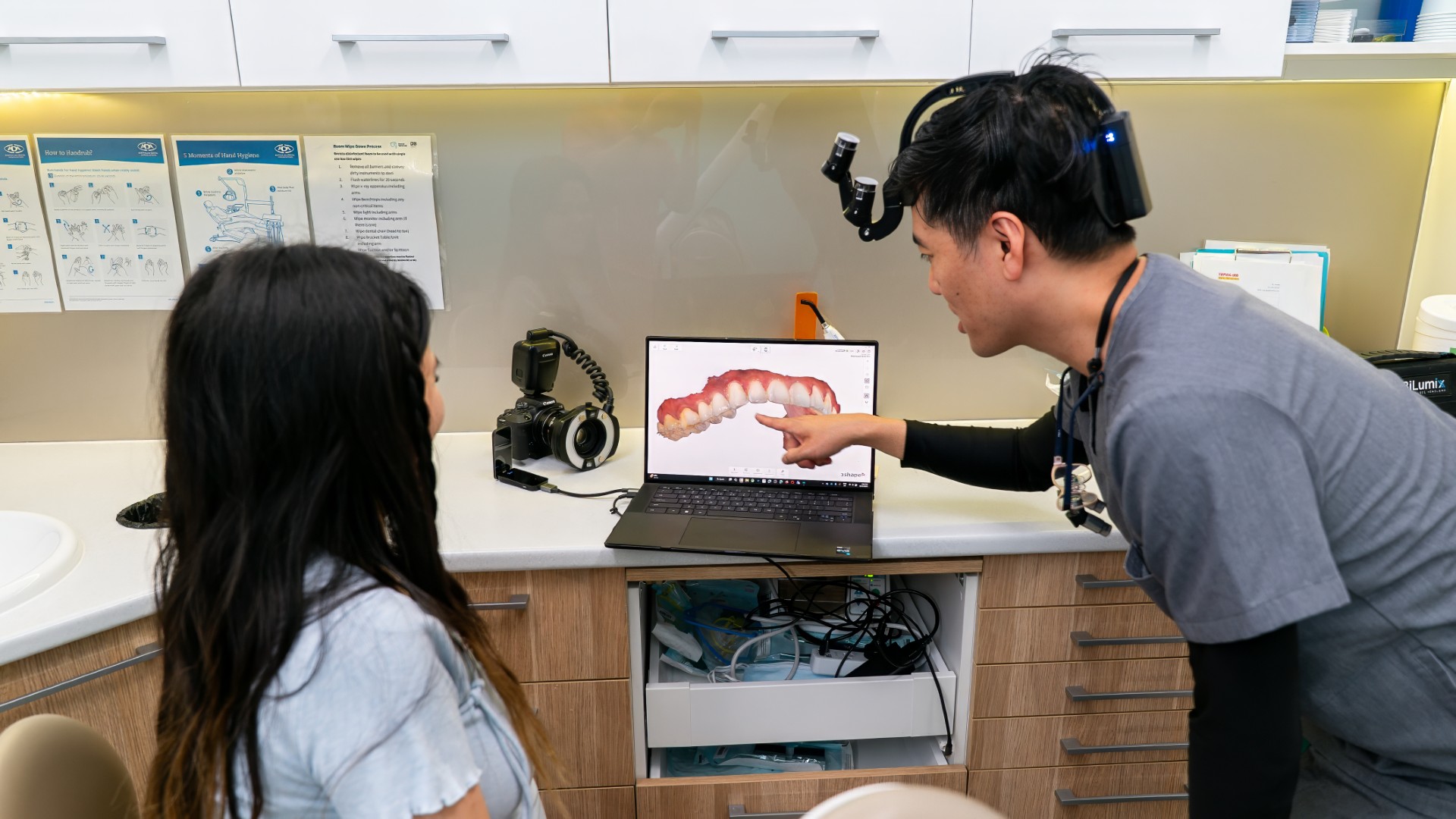
Lumi does endocrowns, using e.max (lithium disilicate), with zirconia offered as a choice. The practice has an Orthophos 3D X-ray, a 3D intraoral scanner and an in-house lab. Whether an endocrown suits a particular tooth is something a dentist can assess at an examination. You can read more about crowns at Lumi.
For dentists: treat the bond as the critical step, and be cautious with premolars
The 2025 overview reported loss of retention as the main cause of failure, and Govare and Contrepois stress that a rigorous adhesion protocol must be respected along with the preparation design. Belleflamme and colleagues used immediate dentin sealing in their series and reported very good results, but the study had no comparison group without it, so it does not show what immediate dentin sealing added on its own. A 2026 meta-regression of 25 laboratory studies by Fraga and colleagues found no difference in load to fracture between endocrowns and post and core crowns, and the type of tooth, ferrule and restorative material did not significantly change the result; luting material and load angle did, with resin composite luting giving higher values than conventional resin cement and oblique loading giving lower values. These are laboratory findings, so they suggest where to take care rather than predicting clinical outcomes.
Chamber depth is less clear than it is sometimes presented. Dartora and colleagues (Journal of Endodontics, 2018) found statistically significant differences in fracture load that favoured deeper extension into the chamber (5 mm, then 3 mm, then 1 mm), while Hayes and colleagues (Operative Dentistry, 2017) found the highest fracture resistance in the 2 mm and 4 mm groups, with the 3 mm group similar to the 2 mm group. Hayes and colleagues saw nearly universal catastrophic fractures in the 3 mm and 4 mm groups and nonrestorable root fractures in half of the 2 mm group, but noted that the fracture forces were higher than normal chewing forces, so the results may not be clinically significant. Both were small laboratory studies on lower molars. For premolars, the evidence is thinner: Otto and Mörmann's premolar endocrowns had a 12-year survival estimate of 75% in a small sample, not significantly different from crowns, and Govare and Contrepois described premolars as promising rather than established, so a conventional crown may also be worth discussing.
Questions people ask about endocrowns
Is an endocrown weaker than a normal crown?
The clinical comparisons so far have not found a statistically significant difference in survival or success between endocrowns and conventional crowns on back teeth, but there are only a handful of studies and most are small. A 2026 review of laboratory studies found similar load to fracture for endocrowns and post and core crowns.
Does an endocrown need a post?
No. The point of the design is that the pulp chamber and the remaining tooth provide the retention, so no post is placed into the root canals.
Can any root-filled tooth have one?
Not every tooth suits one. The evidence is strongest for molars, and Al-Dabbagh described endocrowns as an option for selected patients. Some teeth may be better served by a conventional crown.
Sources
- Bindl A, Mörmann WH. Clinical evaluation of adhesively placed Cerec endo-crowns after 2 years: preliminary results. Journal of Adhesive Dentistry, 1999. PubMed 11725673
- Govare N, Contrepois M. Endocrowns: a systematic review. Journal of Prosthetic Dentistry, 2020. PubMed 31353111
- Al-Dabbagh RA. Survival and success of endocrowns: a systematic review and meta-analysis. Journal of Prosthetic Dentistry, 2021. PubMed 32197821
- Niakou A and colleagues. Complications and survival rates of endocrowns vs. crowns: a systematic review and meta-analysis. International Journal of Prosthodontics, 2025. PubMed 41100150
- Morimoto S, Arakaki Y, Raggio DP, Özcan M. One-piece endodontic crowns in posterior teeth: an overview of systematic reviews. Journal of Prosthetic Dentistry, 2025. PubMed 39384464
- Belleflamme MM and colleagues. No post-no core approach to restore severely damaged posterior teeth: an up to 10-year retrospective study of documented endocrown cases. Journal of Dentistry, 2017. PubMed 28456557
- Otto T, Mörmann WH. Clinical performance of chairside CAD/CAM feldspathic ceramic posterior shoulder crowns and endocrowns up to 12 years. International Journal of Computerized Dentistry, 2015. PubMed 26110927
- Mously HA and colleagues. Anterior endocrowns as an alternative to core crown restorations: a systematic review. International Dental Journal, 2025. PubMed 39306490
- Vervack V and colleagues. A completely digital workflow for nanoceramic endocrowns: a 5-year prospective study. International Journal of Prosthodontics, 2022. PubMed 35727259
- Kamli EA and colleagues. Clinical performance of one-piece molar endocrowns fabricated from different ceramic materials: a 36-month retrospective clinical study. Clinical, Cosmetic and Investigational Dentistry, 2025. PubMed 41446345
- Fraga S and colleagues. Mechanical behavior of endocrown vs. post-and-crown: a systematic review and meta-regression analysis. Brazilian Dental Journal, 2026. PubMed 41538498
- Dartora NR and colleagues. Effect of intracoronal depth of teeth restored with endocrowns on fracture resistance: in vitro and 3-dimensional finite element analysis. Journal of Endodontics, 2018. PubMed 29866407
- Hayes A and colleagues. Effect of endocrown pulp chamber extension depth on molar fracture resistance. Operative Dentistry, 2017. PubMed 28467258
- Healthdirect Australia. Root canal treatment. healthdirect.gov.au
This article is general information only and is not a substitute for an in-person assessment by a dental professional.