

Food gets stuck around a dental implant crown for one of four reasons: the shape of the crown, a contact with the neighbouring tooth that has opened, a black triangle where the gum does not fill the space, or bone and gum that have changed since the crown was made. The fix depends on the cause, so find that first rather than reaching for a stronger floss. A systematic review of implant crowns next to natural teeth found the contact between them loosens in a sizeable share of cases, more so the longer the crown has been in the mouth. Patients I see with a food trap around an implant crown are often surprised that the crown has not moved; the tooth beside it has.
Written by Dr James Tran, BDent (University of Sydney), MICOI, GradDip (Oral Implants), general dentist at Lumi Dental in Melrose Park.
The short version
- A food trap around an implant crown is common and usually fixable. On its own it rarely means the implant is in trouble.
- Four usual causes: crown shape, an open contact from the neighbouring tooth drifting, a black triangle under the contact, and bone or gum change.
- Natural teeth keep moving slowly for life. An implant does not, so a tight contact can open years later.
- Superfloss, sized interdental brushes and a water flosser all work around implants. See our guide to cleaning dental implants at home.
- A troublesome gap may need the crown reshaped, added to or remade. Screw-retained crowns can be removed for the laboratory, which makes this simpler.
- Red, puffy gum that bleeds when you clean around the crown may be peri-implant mucositis, which is generally reversible when caught early.
Why food catches around an implant crown and not your other teeth
Natural teeth sit in a ligament that lets them drift slowly over the years. An implant is fused to bone and does not move. The contact with the next tooth is snug on the day the crown is fitted; that tooth then tips forward by a fraction of a millimetre at a time while the crown stays put, and a gap can open. The same review reported that the front-facing (mesial) contact opens most often, which fits with the way natural teeth drift forward.
The four usual causes
1. Crown shape and emergence profile
The curve a crown follows from the gum to the contact point is called the emergence profile. A crown that is too narrow at the gum leaves a wedge-shaped space on each side where food lodges; one that bulges just above the gum traps food under the bulge instead. Both are design problems; if the trapping started within weeks of fitting and has not changed, shape is the likely cause.
2. An open contact from natural tooth drift
This one appears later: the crown was snug, then a year or several years on, food starts wedging between it and the tooth in front. The literature calls it interproximal contact loss. The systematic review of 19 studies reported it in 11 to 30% of cases in studies under two years, 13 to 65% at two to five years, and 29 to 83.3% beyond five years, the ranges partly reflecting different definitions of an open contact. It is common, it increases with time, and it is nobody's fault.
3. A black triangle below the contact
Even with a tight contact, the gum may not fill the space up to the contact point, leaving a small dark triangle that collects fibrous food. Gum beside an implant often sits a little lower than gum between two natural teeth. Our article on black triangles between teeth explains why.
4. Bone or gum change around the implant
Gum that has receded, or bone that has remodelled since fitting, exposes more of the narrow neck of the crown and creates a new undercut. A little bone change in the first year is expected; continuing loss with inflamed gum can point to peri-implantitis, which needs treatment rather than a crown adjustment.
If the gap is new, have the contact checked before you change anything else
That is the single rule I give patients. Trapping that has only just started around a crown that used to be fine means something has changed. Better cleaning keeps the area healthy while you wait, but it will not close a gap, and floss forced into an open contact can flatten the gum further.
Cause to fix at a glance
| Cause | How it usually shows | Home measures | What the dentist may do |
|---|---|---|---|
| Crown shape or emergence profile | Trapping from the first weeks; a ledge or bulge you can feel | Sized interdental brush; water flosser | Reshape and polish the crown, or remake it |
| Open contact from tooth drift | Starts months or years after fitting; floss slides through freely | Clean the gap daily | Add to the crown or neighbouring tooth, or remake the crown |
| Black triangle | Tight contact but a dark space below it | Interdental brush or superfloss | Reshape the crown; sometimes bonding on the neighbour |
| Bone or gum change | More of the neck is visible; gum may be red or bleed | Gentle daily cleaning; book a review | Assess for peri-implant disease first, then consider a new crown |
Home cleaning aids that work around implants
The Australian Dental Association advises caring for an implant much like a natural tooth: brush twice a day down to where the crown meets the gum, and clean between the implant and its neighbours every day with floss, interdental brushes or a water flosser. Healthdirect gives the same list.
- Floss, superfloss or a threader. Ordinary floss suits a tight contact. Where there is space under the contact, superfloss has a spongy section for the gap and a stiff threading end; see our guide to floss threaders and superfloss.
- Interdental brushes. The most useful tool for a visible gap or black triangle. It should slide in with light resistance, and a plastic-coated wire avoids scratching the implant.
- A water flosser. Flushes loose debris from under a flared crown. In my experience it suits people who find threading floss under a molar crown awkward.
- A single-tuft brush for the back corner of a last molar crown.
When the crown should be reshaped or remade
Minor shape problems can often be fixed in the chair: a ledge polished, a bulge reduced, a small open contact closed with composite resin on the neighbouring tooth or, in some cases, the crown. A crown is usually remade when the gap is large, the emergence profile is wrong along its whole length, or the first fix did not hold.
Why screw-retained crowns are easier to adjust
An implant crown is either screwed directly to the implant through a small sealed access hole, or cemented onto an abutment. A screw-retained crown can be unscrewed, reshaped or added to in the laboratory, and screwed back on. A cemented crown has to be cut or tapped off, which usually destroys it. Our comparison of screw-retained and cement-retained implant crowns covers the trade-offs. Retrievability is one reason I favour screw retention for back teeth, where contact loss is most likely.
Warning signs of peri-implant mucositis
Trapped food feeds plaque, and plaque around an implant causes the same inflammation it does around a tooth. The early stage is peri-implant mucositis: by the accepted case definition, redness and swelling with a line or drop of bleeding on gentle probing, but no bone loss beyond the early healing changes. Implants cannot decay, as the ADA notes, but they can develop gum disease, and untreated mucositis can progress to peri-implantitis, where bone is lost.
Signs worth a review within a couple of weeks: gum around the crown that looks redder or puffier than its neighbours, bleeding when you brush or floss there, or a bad taste or smell. Mucositis is generally reversible with professional cleaning and better home access.
How we approach this at Lumi Dental
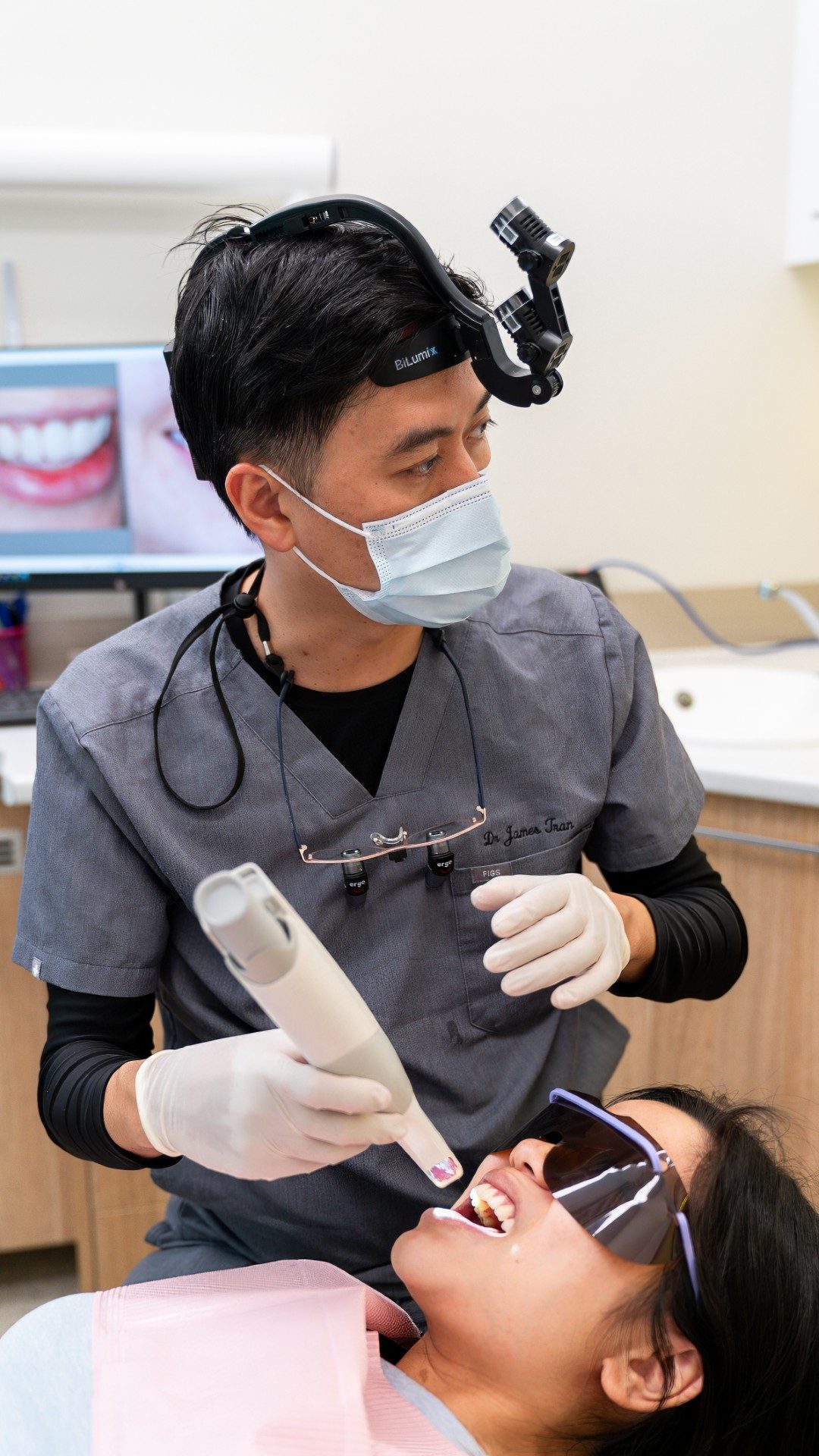
At Lumi Dental in Melrose Park, a food trap around an implant crown starts with an examination by a dentist: floss through the contact, a probe around the gum and a small X-ray of the bone level and crown fit. Where the crown's shape is in question, a 3D intraoral scan helps the team plan any remake with the laboratory; the 3D scanning and 3D X-ray at Lumi Dental are in-house. The oral health therapists then fit the cleaning aids to the actual gap, and gum therapy is arranged if mucositis has set in. Advanced bone loss may be referred to a registered specialist.
Questions patients ask
Why does food keep getting stuck around my dental implant?
Most often because a gap has opened between the implant crown and the natural tooth beside it, or because the crown's shape leaves a space at the gum. An examination will show which it is.
Is food getting stuck around an implant crown normal?
It is common, and research suggests contact loss beside an implant crown becomes more likely the longer it has been in place. Common is not the same as harmless, so have it checked.
Can the gap between an implant crown and my tooth be closed?
Usually, yes. Small gaps can be closed by adding to the crown or bonding to the neighbouring tooth; larger gaps or a poorly shaped crown generally mean a new crown.
Could trapped food mean my implant is failing?
Trapping on its own does not; it is far more often a crown or contact issue. If it comes with gum that bleeds, swells or shows pus, or the crown feels loose, book promptly and read our guides to a loose implant crown and peri-implantitis treatment.
What is the best way to clean around an implant crown?
Brush down to the gum line twice a day and clean between the crown and the next tooth daily with the tool that fits the space. Your oral health therapist can size an interdental brush for you.
Food trapping around an implant? Complimentary implant review in Melrose Park
If food keeps catching around an implant crown, the team at Lumi Dental in Melrose Park can work out which of the four causes is behind it and talk through the options. Book a complimentary implant review, or read more about dental implants at Lumi Dental. Patients visit from Ryde, Parramatta, Ermington, Rydalmere and nearby suburbs.
Sources
- Australian Dental Association (teeth.org.au): Dental implants
- healthdirect: Dental implant procedure
- PubMed: Proximal contact loss between implant prostheses and adjacent natural teeth, a qualitative systematic review
- PubMed: Peri-implant health, peri-implant mucositis, and peri-implantitis, case definitions and diagnostic considerations
About the author

Dr James Tran is a general dentist at Lumi Dental in Melrose Park. He holds a BDent from the University of Sydney and a Graduate Diploma in Oral Implants, and is a Member of the International Congress of Oral Implantologists (MICOI).
This article is general information only and is not a substitute for an examination and individual advice from a registered dental practitioner. Suitability for any treatment varies from person to person.







