

The most honest thing anyone can tell you about singers and dental work is that there is almost no primary research on singers specifically, so the sensible advice is borrowed from studies of dentures, aligners and jaw surgery. Those studies are decent. They consistently show that changes to the palate and the front teeth disturb particular speech sounds, and that most people adapt within days to weeks. What they do not tell you is how a trained voice, which is a far more demanding instrument than conversational speech, responds to the same changes. Any page that gives you confident numbers for singers is making them up.
If you play a wind or brass instrument rather than sing, the mechanics are different enough to need their own page, and our article on wind instruments, braces and teeth is the companion piece. This one is about the voice.
Key takeaways
- No primary literature on singers and dental treatment was located. The advice below is extrapolated from denture, aligner and orthognathic speech research.
- Sibilants and the alveolar and palatal consonants are the sounds most disrupted, because they depend on precise tongue to palate clearance.
- A systematic review of clear aligners and speech reports transient articulation errors, with most people recovering in 7 to 14 days and a minority taking 30 to 60 days.
- Palatal contour is a key variable in denture speech, and functional contouring of the palatal vault has been shown to improve clarity and shorten adaptation compared with conventional forms.
- Jaw surgery shifts formant frequencies, the resonances that shape vocal colour, and speakers adjust articulation to accommodate the new position.
- Plan elective dental work into a gap in the performance schedule, not the week before a concert.
Why the mouth matters to a trained voice
It helps to separate two things that often get muddled. The vocal folds make the sound. The vocal tract, meaning the throat, tongue, palate and lips, shapes it. Dental work does not touch the vocal folds. It changes the resonating space above them, and the surfaces the tongue uses to form consonants.
Both of those are trainable, which is the reassuring part. Singers have precise tongue control and very good ears, so they usually notice a change earlier than other patients and correct for it faster. The unreassuring part is that they notice at all, and an error a general patient would never register can be obvious to a soloist.
The sounds at risk are predictable. Sibilants, the s and z and sh family, are made by directing a narrow jet of air along a groove in the tongue towards the front teeth. Change the thickness of the palate behind those teeth by even a millimetre and the jet changes. Alveolar and palatal consonants, t, d, n, l, r, y, depend on the tongue meeting the palate at exactly the right place. These are the same sounds the denture and aligner literature identifies as most disrupted.
Dentures and the palate
Removable dentures are the biggest intervention on this list, because a conventional upper complete denture covers the whole palate. A systematic review comparing speech with implant supported and removable complete dentures found that speech is affected by denture design, with palatal contour as a key variable. It is not simply that a denture is present. It is what shape it is.
That finding has a practical counterpart. An in vivo study found that functional contouring of the maxillary complete denture palatal vault, shaping it to the tongue's actual movement rather than to a conventional form, improved clarity of speech sounds and shortened adaptation time. For a singer that is worth knowing before the denture is made. Ask for speech adjustment appointments to be built in, and bring recordings of yourself singing.
Practical care matters too, since a denture that moves is a denture that will not let you sing freely. Our guides to denture adhesives and to denture care and relines cover fit and stability, which is the foundation everything else sits on.
Aligners and braces
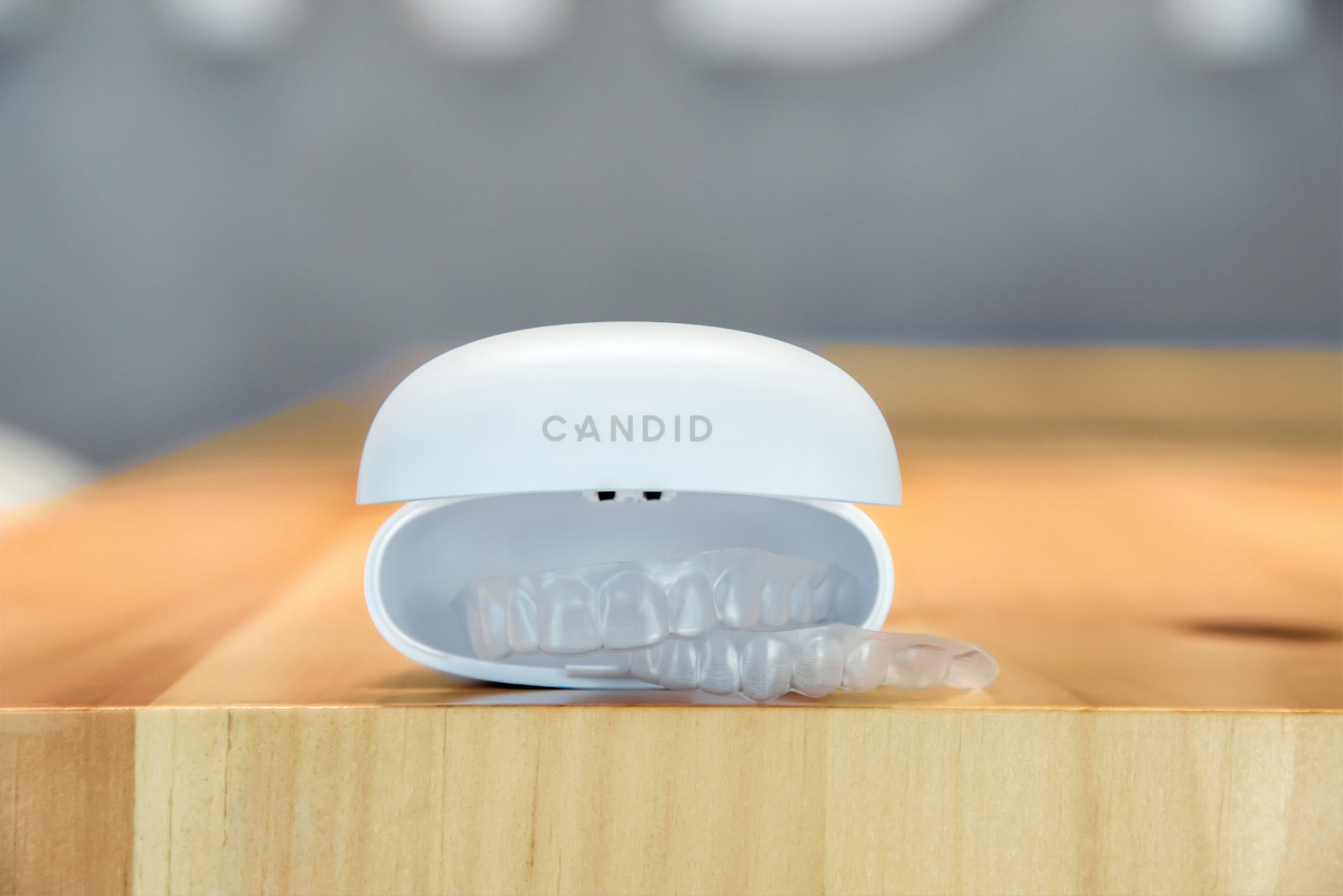
Clear aligners cover the teeth in a thin shell, and the upper aligner adds a small amount of thickness at the very place sibilants are formed. A systematic review on clear aligners and speech reports transient articulation errors on exactly those sounds, with most patients recovering within 7 to 14 days, and a minority taking 30 to 60 days.
Fixed braces are different. There is no palatal coverage with standard labial braces, but there is bulk on the front surfaces of the teeth, and the lips have to work around it. Lingual braces, fitted on the tongue side, are the harder case for a singer, because they sit precisely where the tongue needs a clean surface. Our article on a lisp from braces or aligners covers what to expect and how to work through it.
The useful trick with aligners is that they come out. Most orthodontists ask for around 22 hours of wear a day, and removing them for a performance has a negligible effect if it is occasional. Agree that at the planning stage, not the night before.
| Treatment | What usually changes | Typical adaptation time | How to plan around a performance |
|---|---|---|---|
| New complete denture | Palatal thickness and contour alter sibilants and tongue to palate clearance | Weeks, shorter where the palatal vault is functionally contoured | Start well clear of commitments, allow several speech adjustment visits, keep the old denture as a backup |
| Partial denture | Clasps and connectors change tongue pathways, usually less than a full palate does | Days to a few weeks | Ask for a design that keeps the palate as open as possible |
| Clear aligners | Thin shell over the upper front teeth affects s, z and sh sounds | Most recover in 7 to 14 days, a minority take 30 to 60 days | Begin a new set after a performance block, and discuss removing them for performances |
| Fixed braces | Bulk on the tooth surfaces, lip and tongue irritation early on | Usually a few weeks, longer for lingual braces | Fit them in a quiet period, use orthodontic wax, and expect the first fortnight to be the worst of it |
| Anterior crowns or veneers | Small changes to length, thickness and edge position of the front teeth alter sibilants | Days for most, sometimes longer if the length changed noticeably | Live in provisional restorations, sing with them, and approve the shape before the final work is made |
| Implant supported prosthesis | Palatal coverage is reduced compared with a removable denture, but bulk and emergence still shift airflow | Weeks, spread across the surgical and restorative stages | Plan the whole sequence around the calendar, since it runs over many months |
| Orthognathic surgery | Skeletal position, vocal tract resonance and formant frequencies all change | Months, with articulation adjusting as swelling and function settle | Treat it as a season out, and involve a speech pathologist and your singing teacher in the recovery |
Crowns and veneers on the front teeth
This is the most common scenario in practice, and the easiest one to manage well. Changing the length, thickness or edge position of the upper front teeth changes where the air jet for sibilants goes. A tooth lengthened by a millimetre can produce a whistle or a slushy s that was not there before.
The way around it is provisional restorations. Temporary crowns or a mock up let you live with the proposed shape for a week or two before anything permanent is made. Speak with them, sing with them, record yourself, and report back specifically. Saying the s sounds sharp on high notes is far more useful to your dentist than saying it feels strange. Adjusting a provisional is easy. Adjusting bonded porcelain is not, so that trial stage belongs in the plan as a matter of course.
Jaw surgery, and the deeper kind of change
Orthognathic surgery is the one intervention on this list that changes the instrument rather than the fingering. Moving the upper or lower jaw alters the dimensions of the vocal tract itself. Formant frequencies, the resonances that give a voice its colour, shift after bimaxillary surgery, and speakers adjust their articulation to accommodate the new skeletal position.
The speech outcome data is more encouraging than that might sound. A systematic review and meta-analysis in the European Journal of Orthodontics found that most studies report improved intelligibility and articulation at final review, while several report no lasting statistically significant change. In other words, speech generally ends up the same or better. But intelligibility of speech and the specific timbre of a trained singing voice are not the same measurement, and no study has looked at the second one.
If you sing professionally and jaw surgery is proposed, that uncertainty deserves a frank conversation with your surgeon before you consent, along with a plan involving a speech pathologist and your singing teacher during recovery. Jaw surgery of this kind is done in hospital under general anaesthetic. Lumi Dental does not provide general anaesthetic, and for patients who find dental treatment difficult the available options are set out on our page about IV sedation.
The jaw joint, and what performing does to it
There is no prevalence data on jaw disorders in singers. There is data on wind instrumentalists, and it is worth looking at as the nearest available comparison. A systematic review and meta-analysis of 13 studies gave a pooled temporomandibular disorder prevalence of 52.8 percent in wind players, and a separate study found 51.4 percent with disc displacement present in 34.2 percent.
Read that carefully. Those figures describe wind players, whose jaws hold an embouchure under sustained load, not singers, whose jaws are relatively relaxed. Extending the number to vocalists would be wrong. It is included here because it establishes that performing at a professional level can place real demand on the chewing system, and because performance stress and clenching are common in every discipline. If your jaw aches, clicks or tires during long rehearsals, our guide to jaw pain and its causes is the place to start.
What we genuinely do not know
No primary study of singers and dental treatment was found in preparing this article. Everything above is inference from adjacent populations, and inference has limits. Denture wearers are typically older, aligner patients are assessed on conversational speech, and orthognathic studies use intelligibility scores rather than any measure of vocal quality.
The wind player figures have their own weakness. The 13 studies in that meta-analysis used different diagnostic criteria, so the pooled 52.8 percent is softer than a clean single number implies.
What all of this supports is a planning approach, not a set of promises. Allow time. Use trial restorations. Record yourself before and after. Tell your dentist you sing at the first appointment, not once the work is finished.
Common questions
Will braces change my singing voice?
Braces are more likely to affect articulation than tone, particularly consonants formed at the front of the mouth. Most people adapt within a few weeks, and lingual braces take longer because they sit where the tongue works. There is no study on singers specifically, so plan for a settling period rather than assuming there will be none.
How long does it take to get used to a denture when you sing?
Expect weeks rather than days, and expect sibilants to be the last thing to settle. Palatal contour is a key variable, and functional contouring of the palatal vault has been shown to improve clarity and shorten adaptation. Ask for speech adjustment appointments to be built into the plan.
Can I take my aligners out to perform?
Usually yes, if it is occasional. Aligners are typically worn around 22 hours a day, and removing them for a performance and replacing them straight afterwards has little effect on progress. Agree it with your orthodontist in advance rather than deciding on the night.
Will veneers give me a lisp?
They can, if the length or thickness of the upper front teeth changes noticeably, because sibilants are formed against those exact surfaces. The way to avoid it is to live in provisional restorations first, sing with them, and only approve the final shape once it sounds right to you.
Should I tell my dentist that I sing?
Yes, at the first appointment. It changes how treatment is sequenced, how much trial time is built in, and how conservative the shaping of any front teeth should be. It also lets appointments be planned around your performance calendar.
Booking an appointment
If you sing and you are thinking about orthodontics, crowns, veneers or a denture, the team at Lumi Dental sees patients Monday to Saturday at Melrose Park, with Sunday appointments by arrangement. Mention your work when you book, so time is set aside for trial stages and speech checks. New patients can see the current first visit offer on the current deals page.
This article is general information only and is not a substitute for personal dental advice. Individual results vary, and any treatment plan should be discussed with your own dentist.