

If you have TMJ or jaw pain, teeth whitening is usually still possible, but take-home trays worn for shorter sessions tend to suit a sore jaw better than one long in-chair appointment, and a jaw that is flaring is best settled first. The whitening gel works on the teeth. What a temporomandibular disorder (TMD) notices is the mouth position: a jaw held wide open for a long time, or teeth clenched on a tray. Jaw problems are common, too. Healthdirect notes that nearly half of all people experience jaw dysfunction at some stage of life.
Written by Dr James Tran, BDent (University of Sydney), MICOI, GradDip (Oral Implants), general dentist at Lumi Dental in Melrose Park.
The short version
- Whitening does not cause or cure TMD. The strain on the jaw comes from how long the mouth stays open and from clenching on trays.
- Long dental appointments with wide opening are a recognised aggravating factor for jaw pain. Our guide to TMJ jaw pain causes and treatment covers the condition itself.
- If long appointments leave your jaw sore, take-home trays worn for shorter daytime sessions are usually the gentler place to start.
- An in-chair session can still work for many people if breaks are planned between gel rounds.
- Jaw clicking on its own is not a reason to avoid whitening. Locking, a recent jaw injury or a painful flare are reasons to wait.
- Tooth sensitivity from whitening and jaw muscle ache feel different, and telling them apart helps you decide what to change.
Why a long appointment can upset a sore jaw
Dental treatment asks the jaw to stay open, fairly wide, for a long stretch without a rest. For a healthy jaw that is a nuisance at most. For tender muscles or a joint with a displaced disc, it can bring on an ache that lasts a few days.
Hospital patient information reflects this. The Leeds Dental Institute's TMD leaflet lists long dental appointments, along with jaw injuries, as things that can sometimes cause short-term jaw muscle pain, and notes that this usually settles by itself. University College London Hospitals advises people in a TMD flare to avoid activities that involve wide opening, such as yawning or prolonged dental treatment, until the pain has reduced.
Research is limited but points the same way. A small study of 80 patients whose root canal sessions ran longer than two hours found more pain around the joint a week later, and the authors suggested breaking long appointments into shorter intervals so patients can close and rest. Whitening is not root canal treatment, but the principle carries over.
The single rule: if long appointments hurt your jaw, start with trays
If your jaw tends to ache after long dental visits, start with take-home trays worn for shorter sessions rather than one long in-chair appointment. If your jaw is flaring right now, settle it first and whiten later.
This rule is about comfort, not results. Take-home whitening spreads the work over many shorter sessions with your mouth closed. In my experience, people with a jaw problem already know whether long visits bother them, and that history is the best guide we have. If you feel fine after a long clean or a filling, an in-chair session with planned breaks is often reasonable too.
In-chair whitening when your jaw is sensitive
An in-chair session holds the lips and cheeks back with a retractor while a strong gel is placed on the front teeth in rounds. One clinical trial found a 35% hydrogen peroxide gel worked better in three 15-minute applications than in one 45-minute application. Add gum protection, shade records and clean-up, and it becomes a long appointment: the NHS describes laser whitening at a dental surgery as usually one appointment of around 1 to 2 hours. Our article on what to expect at in-chair whitening walks through the steps.
Breaks can be planned
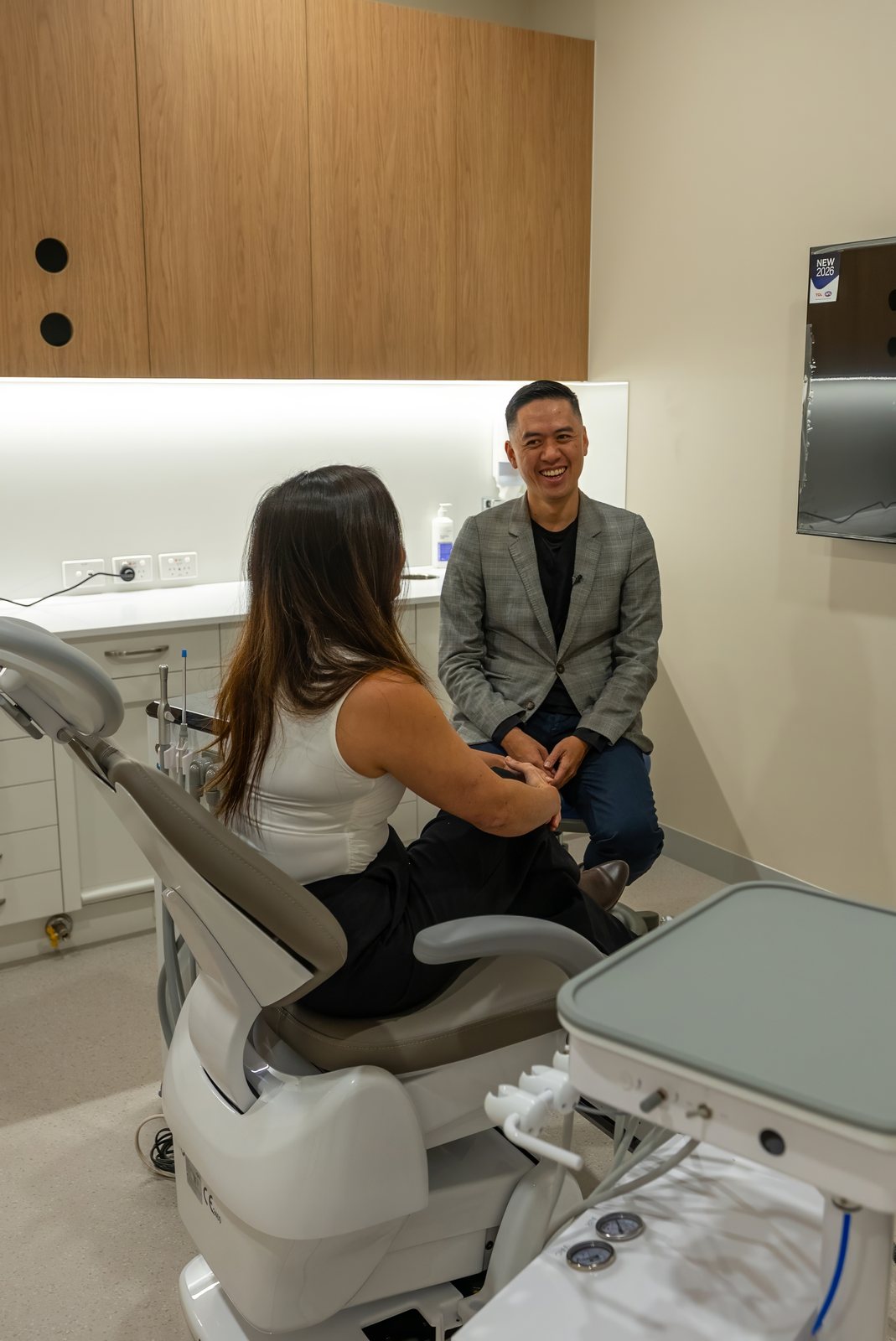
The gap between gel rounds is a natural place to pause. With the gum barrier still in place, the retractor can often be eased so you can close your lips, swallow and let the muscles relax. Mention your jaw before you start, so pauses are planned rather than requested halfway through.
Other things that may help in the chair
- Some people find a soft bite support more comfortable than holding the mouth open with their own muscles. Ask whether one can be used.
- A warm, damp face cloth on the jaw muscles afterwards may help. The Leeds leaflet suggests heat for 10 to 15 minutes twice a day for sore jaw muscles.
- Keep to softer foods if the jaw feels tired.
Take-home trays: shorter sessions, mouth closed
Take-home whitening uses thin custom trays and a lower-strength gel, worn at home for around 2 to 6 weeks according to the NHS. For a sore jaw, each session happens with your mouth closed, and you can stop whenever you like.
Do not bite down on the trays
Trays sit over the biting surfaces, and some people clench on them without noticing, as they might on a pen. Clenching squeezes gel onto the gums and works muscles that are already sore. Seat the tray with gentle finger pressure, then let your teeth rest slightly apart, the resting posture TMD self-care leaflets describe.
Tray design matters
A published clinical report by Robinson and Haywood described a patient whose jaw joint became painful shortly after starting tray whitening. The tray was trimmed so that the back teeth could meet normally in the bite, and the patient completed the two-week course without further jaw symptoms. It is a single case, but a useful reminder that a tray which props the bite open can be adjusted.
Daytime or overnight
Daytime wear makes clenching easier to notice. Our articles on wearing trays overnight or during the day and whitening if you grind your teeth and wear a night guard cover the overlap with a splint.
| Whitening option | How long the mouth is open | What it asks of the jaw | Tips that may help |
|---|---|---|---|
| In-chair session | A long appointment, with the retractor in place for most of it | Sustained wide opening | Plan breaks between gel rounds; ask about a bite support |
| Take-home trays, daytime | Mouth closed; shorter wear sessions | Keeping the jaw relaxed and not clenching on the trays | Seat with fingers; teeth slightly apart; stop if the jaw tires |
| Take-home trays, overnight | Mouth closed for hours while asleep | Any night clenching happens on the trays | Often less suited to grinders or splint wearers |
| In-chair start, then trays | One long visit, then shorter home sessions | Both of the above | Consider only if long visits are usually comfortable |
Clicking, locking and flares: when to whiten and when to wait
Clicking alone
Painless clicking is very common. The Leeds leaflet explains that it usually comes from a small cartilage disc slipping back into place, and that for most people it stays the same over time. On its own, it is not a reason to avoid whitening. Our article on jaw clicking when you open your mouth explains it in more detail.
Reasons to delay
- The jaw is locking, or you cannot open as far as usual.
- You have had a recent jaw, head or neck injury.
- Pain is severe, constant or getting worse.
- You are in the middle of a flare.
Healthdirect advises urgent care if jaw symptoms come with vision problems, difficulty eating or drinking, or frequent and severe headaches. For ongoing jaw pain, a GP, a physiotherapist or a referral to a specialist may be the right next step, and whitening can wait.
Sensitivity and jaw ache feel different
Whitening sensitivity is felt in the teeth: a short, sharp twinge, often set off by cold, that usually passes. Our article on how long sensitivity lasts after whitening covers the usual pattern.
TMD pain is usually a dull ache in the jaw muscles, in front of the ear or at the temples, often worse with chewing or wide opening. I usually ask patients to point to where it hurts. A finger on one tooth suggests sensitivity. A flat hand on the side of the face suggests muscle. If it is muscle, the fix is shorter sessions, less clenching or a pause, not a different gel.

How we approach this at Lumi Dental
Whitening at Lumi Dental starts with an examination by the dentist. For someone with jaw pain, that includes how long appointments usually feel, how far the mouth opens comfortably and any grinding wear, as well as the usual check for decay and gum problems. Trays are made from an in-house 3D intraoral scan, described on our technology page, so there is no long impression to hold. The whitening options are named Lumi Home, Lumi Refresh and Lumi Radiance, and the team can plan breaks within an in-chair session or suggest starting at home.
Questions patients ask
Can teeth whitening make TMJ pain worse?
It can, though not because of the gel. A long appointment with the mouth held open, or clenching on trays, can aggravate sore jaw muscles, and shorter sessions with planned breaks usually help.
Can I whiten my teeth if my jaw clicks?
Usually, yes. Painless clicking is very common. If it comes with pain or locking, have the jaw checked first.
Is take-home or in-chair whitening better for TMJ?
Take-home trays tend to suit a sensitive jaw better, because sessions are shorter and the mouth stays closed. An in-chair session with breaks can suit people who manage long visits well. A complimentary cosmetic consult is a good place to talk it through.
Can I wear my splint and whitening trays together?
No. Most people whiten during the day and keep the splint for sleep.
Why does my jaw ache after a long dental appointment?
Holding the mouth open for a long time tires the jaw muscles and can irritate a sensitive joint. This usually settles by itself; see your dentist or GP if it does not.
Thinking about whitening? Complimentary cosmetic consult in Melrose Park
If jaw pain has put you off whitening, the team at Lumi Dental can look at your teeth and jaw together and plan comfortable sessions. Book a complimentary cosmetic consult at Melrose Central in Melrose Park, or read more about teeth whitening at Lumi Dental. Patients visit from Ryde, Parramatta, Ermington and Rydalmere, with on-site parking.
Sources
- Healthdirect: Temporomandibular joint (TMJ) dysfunction
- Leeds Teaching Hospitals NHS Trust: Temporomandibular disorders (TMD)
- PubMed: Effect of lengthy root canal therapy sessions on temporomandibular joint and masticatory muscles
- PubMed: Bleaching and temporomandibular disorder using a half tray design, a clinical report
About the author

Dr James Tran is a general dentist at Lumi Dental in Melrose Park. He holds a BDent from the University of Sydney and a Graduate Diploma in Oral Implants, and is a Member of the International Congress of Oral Implantologists (MICOI).
This article is general information only and is not a substitute for an examination and individual advice from a registered dental practitioner. Suitability for any treatment varies from person to person.








