


Tooth shade matching is the process of comparing your teeth against a standardised tooth shade guide, and it has to be done before the tooth is prepared or kept dry, because a dehydrated tooth temporarily looks lighter and whiter than it really is. That single detail explains most crowns that come back from the laboratory looking too dark. Colour in dentistry is far less about picking a favourite white and far more about controlling the conditions in which the decision is made.
Key takeaways
- Shade is described by three properties: hue, which is the colour family, chroma, which is the saturation, and value, which is how light or dark it is.
- Clinically the selection order is value first, then chroma, then hue, because the eye judges lightness more reliably than colour.
- The shade must be taken before preparation and before isolation, since teeth lighten as they dry out and rebound over the following hours.
- Daylight or a daylight-corrected lamp is used rather than the operating light, viewed for a few seconds at a time to avoid eye fatigue.
- A tooth is not one flat colour, so laboratories work from a shade map and photographs, not a single tab.
- Whitening should be completed and allowed to settle for about two weeks first, because crowns and veneers do not whiten later.
What a tooth shade actually describes
Hue, chroma and value
Hue is the basic colour family, and natural teeth sit in a narrow band of yellows, browns and greys. Chroma is how concentrated that colour is, so a strongly yellow tooth has high chroma. Value is how light or dark the tooth reads, and it is the property the human eye picks up first, particularly in peripheral vision. A restoration with the wrong hue often passes unnoticed. A restoration with the wrong value stands out immediately.
Why value comes first
Because of that, the practical order used chairside is to establish value, then narrow to a chroma within that group, then confirm the hue. Squinting slightly is a genuine technique here, since it reduces colour information and lets you compare lightness alone.
The VITA classical shade guide
The VITA classical guide has 16 tabs arranged in four hue families. It has been in use for decades, and while newer systems such as the VITA 3D-Master organise tabs more logically by value, the classical A1 to D4 language is still what most dentists, technicians and patients use day to day.
What the letters mean
Each letter is a hue family and each number is a step of chroma within that family, so A3 is the same colour family as A1 but more saturated. Most natural adult teeth fall somewhere in the A group.
| Shade family | Hue it represents | Tabs | The kind of natural tooth it typically suits |
|---|---|---|---|
| A | Reddish brown | A1 to A4 | The most common family by a wide margin, covering warm teeth from light to deeply saturated |
| B | Reddish yellow | B1 to B4 | Lighter, more yellow teeth, often seen in younger patients and after whitening |
| C | Grey | C1 to C4 | Teeth with a flatter, greyer look, more common with age or after certain types of staining |
| D | Reddish grey | D2 to D4 | Teeth with a grey cast but a warm undertone, the smallest of the four groups |
Getting the conditions right
Timing is the most important rule
Teeth lose water when they are kept dry under a rubber dam, retracted for a long appointment, or reduced for a crown. As they dehydrate they become opaque and appear lighter, and it can take several hours for the true colour to return. If the shade is chosen at that moment, the laboratory builds a restoration to match a temporarily bleached-looking tooth, and it looks too dark once the neighbours rehydrate. Shade is therefore taken at the very start of an appointment, before any isolation.
Lighting
Colour cannot be judged under the operating light, which is deliberately bright and pushes everything towards white. Natural indirect daylight or a standardised daylight-corrected lamp gives a far more reliable reading. Coloured walls, tinted windows and warm ceiling lights all shift what you see, which is why a shade checked in two different lights can look like two different shades.
How long to look, and at what distance
The tab is held next to the tooth at roughly 25 to 30 cm, at eye level, and viewed for only a few seconds at a time. The eye fatigues quickly when it stares at a saturated colour, so short glances with a rest looking at a neutral grey or blue surface in between give more consistent decisions than one long stare.
What you wear matters
Bright lipstick, a bold scarf or a strongly coloured top all reflect onto the teeth and bias the reading. Lipstick is usually removed and a neutral bib placed. It sounds fussy, but colour perception is relative, and everything around the tooth is part of the comparison.
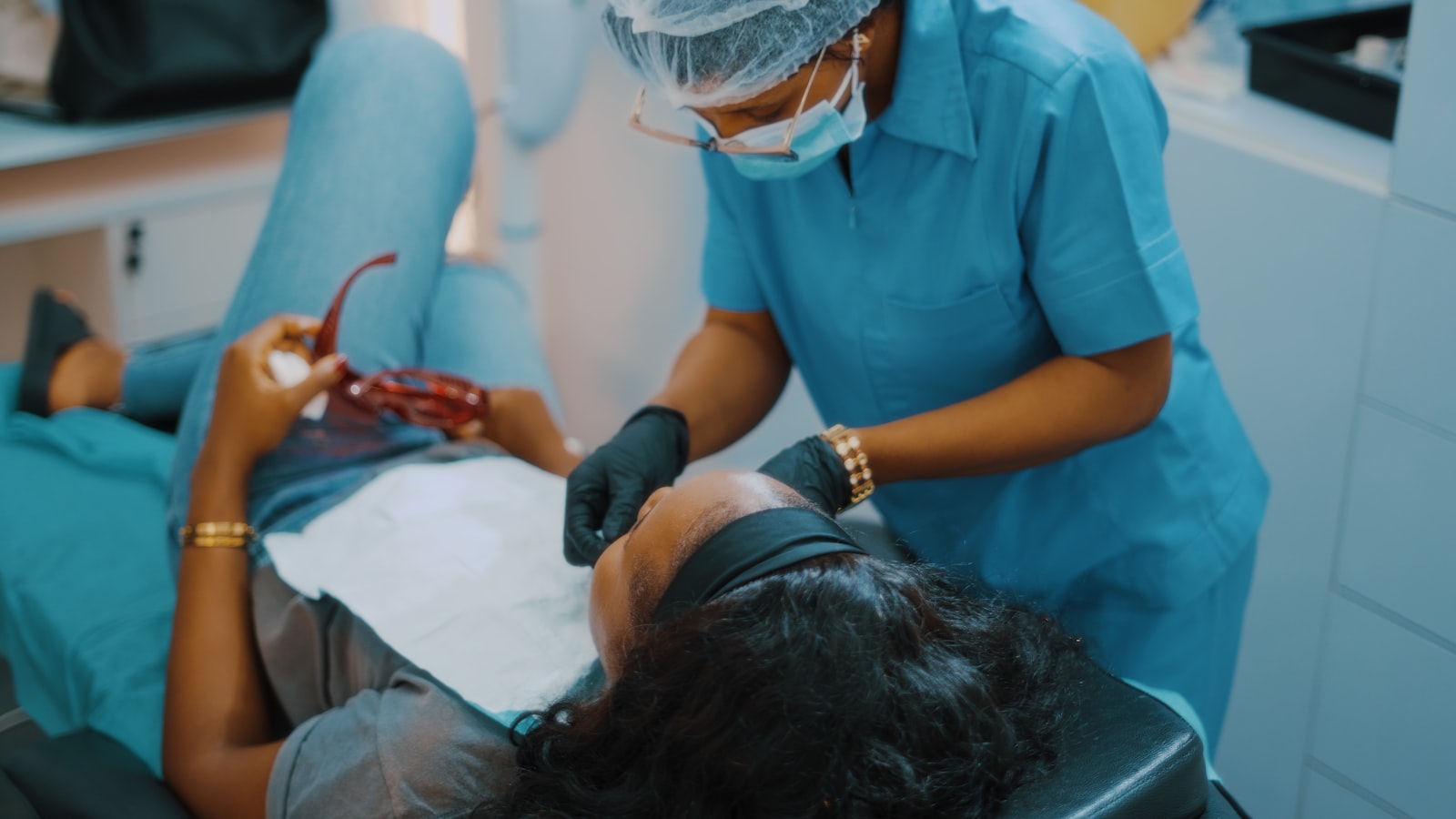
Why a tooth is never one flat colour
Three zones, three characters
Look closely at a front tooth and you will see the neck near the gum is more saturated, because the enamel is thinner there and more dentine colour shows through. The middle third, called the body, is the reference area most shade tabs are matched against. The incisal edge is largely enamel with no dentine behind it, so it is translucent and can read grey, blue or almost clear, sometimes with fine white flecks or a halo along the very edge.
Shade maps and photographs
Rather than sending one shade name, a dentist will often send the laboratory a shade map, which is a simple diagram of the tooth divided into zones with a shade written on each, plus photographs with the shade tabs held in the same frame as the tooth. That gives the technician the layering information they need for translucency, surface texture and any characterisation such as craze lines or the white markings covered in our article on white spots on teeth.
Why one front crown is the hardest match in dentistry
The single central incisor
Matching a single upper central incisor to the one beside it is the most demanding restoration there is, because the two teeth sit side by side under the same light and any difference is obvious. There is no target to aim at other than an existing natural tooth with its own translucency, texture and internal characterisation. Managing expectations honestly is part of the job here, and a very close match is realistic while a perfect one may not be.
Why a full set is easier
By contrast, a full set of veneers is easier to control, because you choose one target shade for everything and there is no adjacent natural tooth to disagree with. The challenge shifts from matching to design: proportion, edge position and how the result sits with the lips and gums, which is a related consideration in veneers and gum recession. Sometimes only a small amount of tooth reshaping is needed instead of a restoration at all.
Digital shade taking
Spectrophotometers and colorimeters
Handheld devices measure the light reflected from the tooth and report a shade with a numerical value, removing much of the variation between operators, lighting and eyesight. They are useful as an objective second opinion, though they read a small area and cannot on their own capture the layering and character of a tooth.
Cross-polarised photography
A cross-polarising filter cuts surface reflections so the camera records the colour coming from inside the tooth. The resulting images show internal structure, white markings and translucency in a way the naked eye struggles with, and they travel to the laboratory with the case. Combined with a shade tab in the frame for calibration, this is now a routine part of careful cosmetic work.
Whitening comes first
Porcelain and composite do not respond to whitening gel. If you whiten after a crown or veneer is fitted, your natural teeth lighten and the restoration stays where it was, so a previously good match drifts. If whitening is part of the plan, it is done first, then the shade is left to stabilise for around two weeks before it is locked in, because the shade immediately after whitening is usually lighter than where it settles. The same sequencing applies when an existing restoration is being replaced, as discussed in our guide to repairing or replacing a porcelain veneer.
Frequently asked questions
Why did my crown come back too dark?
The most common reason is that the shade was taken after the tooth had dried out and temporarily lightened. Other causes include judging colour under the operating light, or a change in the underlying tooth colour after the shade was chosen.
Can a crown be lightened after it is made?
Porcelain does not respond to bleaching gel. Minor surface adjustments are sometimes possible, but a significant change usually means remaking the restoration, which is why the shade appointment is worth taking seriously.
What is the whitest natural-looking shade?
There is no single answer, because a shade that suits one face and skin tone can look artificial on another. Very high value shades read as bright, and the natural translucency at the edge is often what keeps a light shade believable.
Should I bring someone with me to choose a shade?
Many people find it helpful. A second opinion from someone who knows your smile can be useful, and it is easier to be confident about a decision made together.
Do teeth change colour over time?
Yes. Enamel thins gradually and dentine darkens, so most teeth become a little more saturated with age. A restoration matched perfectly today may look slightly lighter than its neighbours in ten or fifteen years.
Is digital shade matching more accurate than the eye?
It is more repeatable, which is not quite the same thing. Devices remove operator variation, but a skilled clinician and technician working from photographs and a shade map still bring judgement that a single reading cannot.
Talk it through at a complimentary cosmetic consultation
If you are weighing up a crown, a veneer or a change in the colour of your smile, the team at Lumi Dental in Melrose Park offers a complimentary cosmetic consultation where shade, sequencing and what is realistic for your teeth can be discussed before anything is started. You are welcome to bring photographs of what you like and what you do not.
This article is general information only and is not a substitute for personal dental advice. Suitability for any cosmetic treatment depends on an assessment of your own teeth, gums and bite.


