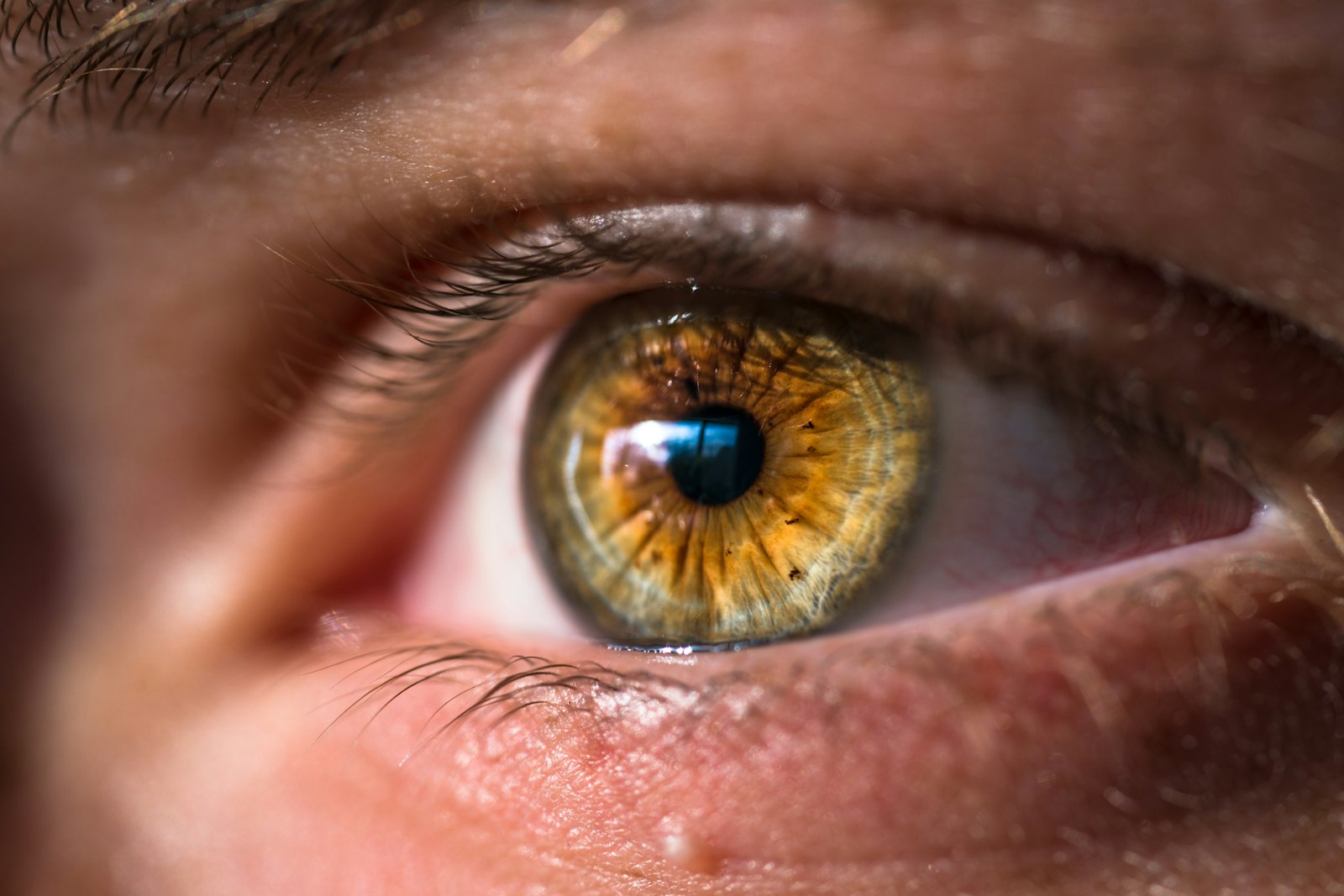

The whites of your eyes are the reference point your brain uses to judge how white your teeth look. The sclera is the brightest dependable pale surface in the human face, so a viewer reads tooth colour relative to it rather than in isolation. The same teeth can look brighter or duller depending on the eyes above them and the light in the room, with nothing at all happening to the enamel.
This sits next to two articles already on the site, so it is worth saying what it does not cover. The guide to tooth shade matching explains how shade is measured, what the shade tabs and digital readers do, and how value, chroma and hue are separated. The article on ring lights, colour temperature and tooth shade explains how the light source distorts that reading. This one claims something narrower. The strongest reference point in the whole exercise is not the tab and not the lamp. It is a surface already in the picture, a few centimetres above the smile.
Key takeaways
- The sclera is the brightest dependable white in the face, so the brain uses it as a local white reference when it judges tooth colour.
- Scleral colour is never neutral white, and carries a faint blue, grey, yellow or red cast that varies with the person, their age, sleep, hydration and general health.
- Simultaneous contrast means the same tooth reads brighter against dark lips and skin, and duller against a bright surround.
- Clinical convention treats the whites of the eyes as a rough upper bound for tooth brightness, because teeth brighter than the sclera tend to read as artificial rather than clean.
- Shade should be recorded early in the appointment, with the patient sitting upright, in daylight, before the teeth dehydrate and lighten temporarily.
- Iris colour matters far less than most people assume, and a trial smile settles the how white is too white question better than any argument about it.
What the whites of your eyes actually are
The white you see is not one layer. The sclera is the tough outer coat of the eyeball, and it is covered at the front by a thin, transparent membrane called the conjunctiva that carries its own fine blood vessels. What reaches the viewer is the sclera seen through that membrane, plus whatever those vessels are doing at the time. That is why the whites of the eyes shift so much between people and within the same person from one week to the next.
Scleral tissue is dense collagen, and collagen is not a neutral white. In a young person the sclera is relatively thin, so a little of the darker choroid underneath shows through and gives a faint blue or grey cast. That is the look people describe as bright, clear eyes, and it is partly an optical effect of thickness rather than cleanliness. With age the sclera changes character, fatty and pigmented deposits accumulate, and the cast drifts warmer. A yellowish tinge in an older adult is often unremarkable. A yellowish tinge that appears quickly in a younger adult is a reason to see a general practitioner rather than a dentist, because the eye is one of the places liver problems become visible early. healthdirect is a sensible first stop for that sort of question.
Then there are the short term changes. Tiredness, dry air, alcohol, allergy and a poor night of sleep all dilate the surface vessels and add a pink or red wash. None of these are dental problems, but each one changes the number your brain assigns to your teeth that day.
Simultaneous contrast, without the jargon
Simultaneous contrast is the reason the same colour looks different depending on what surrounds it. The standard demonstration is a grey square printed twice, once on a white background and once on a black one. The square is physically identical in both cases. On white it looks dark and slightly dirty. On black it looks pale and clean. Nothing changed except the neighbour.
A smile is that demonstration, running live. Your teeth sit inside a busy surround made of lips, gums, skin, the shadow of the mouth and the whites of the eyes above. Each of those neighbours pushes the reading. Dark lipstick and deeper skin tones raise apparent tooth brightness. A pale, washed out lip lowers it. Red, inflamed gums add contrast and can briefly flatter a tooth shade in a way that healthy pink gums do not, which is one of the quieter reasons a shade taken before treatment and a shade taken after a clean are not always comparable.
The sclera is the most useful neighbour of the lot because it is the only one the viewer treats as a fixed white. Skin varies enormously. Lips are painted, bitten, chapped and changed. Gums vary with health. The whites of the eyes are the closest thing the face has to a built in white card, and the visual system is very good at using local white references to work out what everything else must be.
The whites of your eyes as a rough upper bound
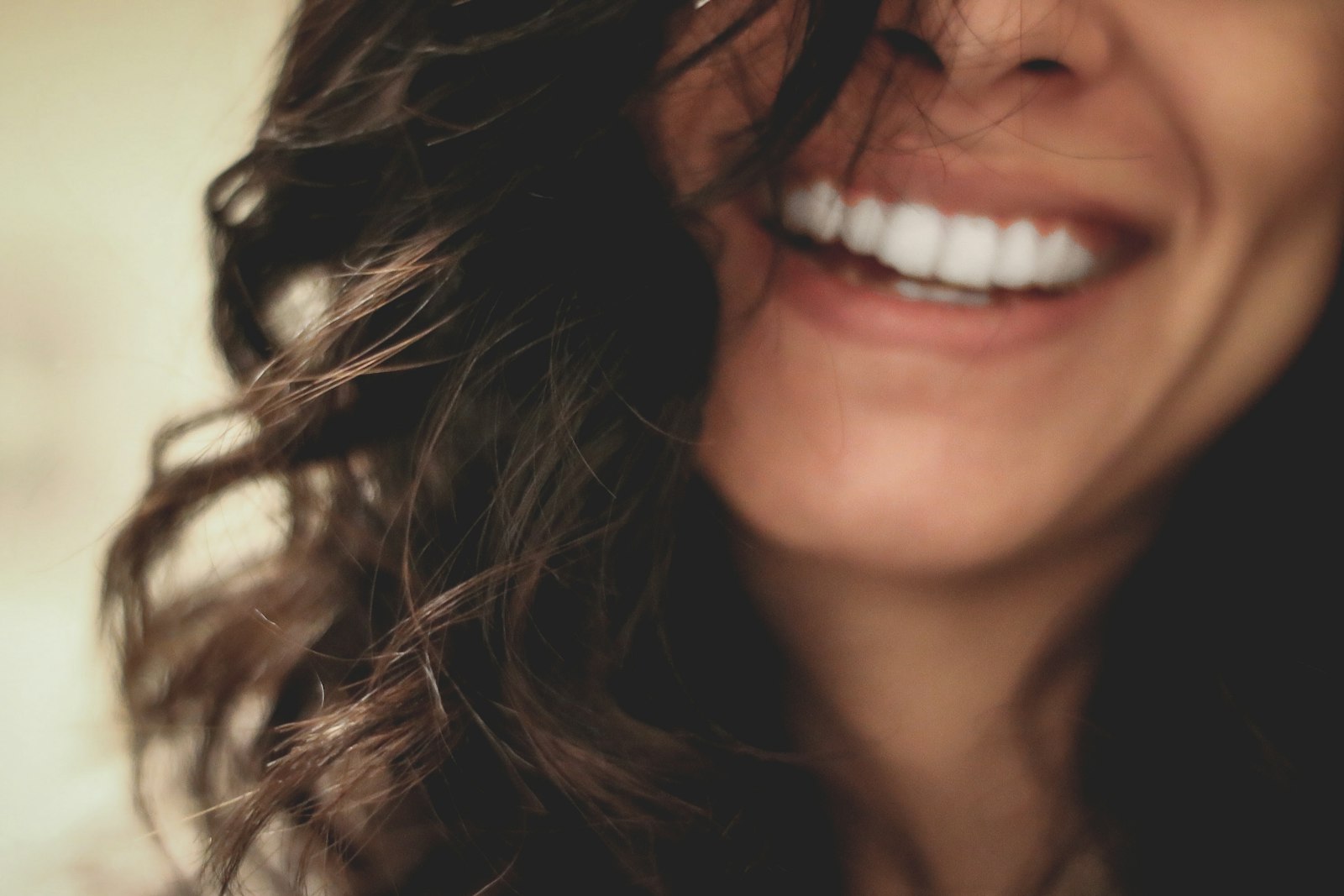
The working convention among clinicians who do a lot of cosmetic work is simple: do not make the teeth brighter than the whites of the eyes. It is not a law, it is not written into any standard from the Dental Board of Australia, and it has never been proven in the way a clinical outcome can be proven. It is a piece of aesthetic judgement that has survived because it keeps producing results people describe as natural.
The reasoning behind it is the contrast argument again. When teeth are brighter than the sclera, the hierarchy of the face inverts. In a normal face the eyes lead and the smile follows. Push the teeth past the eyes and the smile starts pulling attention first, which is exactly the reading people mean when they say a smile looks fake, or that they can tell someone has had work done. They are usually not detecting the shape of the teeth at all. They are detecting a brightness order that faces do not normally have.
In my experience the patients who are happiest a year later are the ones who chose a shade a step or two short of the brightest option available. The ones who chose the brightest thing on the tab often come back asking why it looks so obvious in photographs. Photographs make it worse, because a flash adds a specular highlight to enamel that the sclera does not return in the same way.
There is an honest caveat. This is convention and clinical judgement, not measured fact. Preferences differ, professions differ, and some people genuinely want a brighter than natural result and are pleased with it. The point of the rule is not to forbid anything, it is to give you a reference you can actually see in the mirror before you commit.
Where make-up fits in
Make-up moves the same dial from the other direction, and it moves it in seconds. Lip colour is the biggest single lever, and the way blue toned and red toned lipsticks change apparent tooth brightness is covered properly in the article on whether lipstick makes teeth look whiter. The same trick applies to the eyes: anything that reduces redness in the sclera raises the perceived brightness of the teeth below, at no cost and with no appointment.
What actually shifts how white your teeth look
Most of the variables that change the answer are not on the teeth. Sorting them out honestly is useful, because it tells you which ones are worth treating and which ones are worth simply managing.
| Variable | Direction of the effect | Can you change it | Where it is decided |
|---|---|---|---|
| Cast in the whites of the eyes | A yellow or red sclera makes teeth read warmer and duller; a cool, clear sclera makes the same teeth read brighter | Only indirectly, through sleep, hydration and general health | In the face, before any dental decision |
| Skin tone and tan | Deeper or warmer surrounding skin raises apparent tooth brightness | Changes on its own over time | In the face |
| Lip colour | A cooler or deeper lip raises apparent brightness; a warm orange or beige lip lowers it | Yes, in seconds | At the make-up bag |
| Light colour temperature | Warm indoor light pushes teeth yellow; cool light pushes them grey | Yes, by choosing where you look | In the room |
| Gum colour and health | Red, inflamed gums raise contrast and can flatter tooth colour; healthy pink gums give a more honest reading | Yes, through hygiene and treatment | At the dental appointment |
| Enamel hydration | Teeth dry out under retraction and lighten temporarily, then return | No, it reverses on its own | During the appointment |
| Enamel thickness and dentine colour | Thinner enamel lets more dentine colour through, so the tooth reads darker | Not directly | Inherited, then changed slowly by wear |
| Surface stain | Extrinsic stain lowers brightness and flattens the reflection | Yes, with a professional clean | At the hygiene appointment |
| Whitening | Raises brightness by lifting internal colour, within limits | Yes | At the whitening appointment |
How the whites of your eyes change with age
The sclera drifts warmer and busier with age, and that quietly raises the ceiling on how bright teeth can look before they read as artificial. In children and young adults the sclera is thin and often carries a faint blue cast, which sets a very high reference. Teenagers with unremarkable teeth often look like they have brilliant ones, partly for this reason.
Through adulthood several things accumulate. Small yellowish deposits called pingueculae can appear on the exposed part of the sclera, usually on the nasal side, and are strongly associated with sun and wind exposure. In Australia they are common. Lipid and pigment changes give a general warm shift. Blood vessels become more visible. The overall effect is that the reference white in the face slowly stops being white.
Teeth are doing something similar over the same period. Enamel thins with wear and acid exposure, dentine lays down secondary layers and becomes darker and more opaque, and decades of tea, coffee, red wine and curry deposit surface stain. So both halves of the comparison are drifting warm at once, and the relationship between them stays more stable than either one alone.
The practical consequence is a shade expectation that changes with age. A shade that looks clean and unremarkable at twenty five can look conspicuously bright at sixty five, because the surround has moved and the teeth have not. This is not an argument for accepting dull teeth. It is an argument for choosing the target against your own face rather than against a photograph of somebody else's.
Running a shade appointment properly
Shade should be taken in the first few minutes of the appointment, before anything has dried the teeth out or fatigued the eye. Everything else in this section follows from that one rule.
Position and light
Sit the patient upright, not reclined. A reclined patient is looking at the ceiling light, the operator is looking down at wet enamel from an unnatural angle, and neither view resembles the way anyone will actually see that smile. Move to a window if there is one. Daylight is not perfect, but it is the light the result has to survive in, and it is a lot more honest than an operating light.
Clear the field
Take the bib off, or move it out of the visual field. A bright bib under the chin acts as a large coloured surround and shifts the reading. The same goes for a strongly coloured top, lipstick, and a phone screen glowing in the patient's lap.
Use the eyes as the calibration
This is the part that is specific to this article. Look at the whites of the patient's eyes first, decide what cast they carry today, and then look at the teeth. It costs nothing and it gives you an in-face white reference in the same light, at the same distance, through the same camera or the same pair of eyes. If a proposed shade would sit brighter than that reference, say so out loud and show the patient in a mirror.
Look in short bursts
The eye fatigues quickly when it stares at a colour. Five seconds, then look away at something neutral and grey, then look back. Long staring produces afterimages that push the judgement the wrong way. Take two or three separate readings rather than one long one, and record what you found before you start work.
Why teeth look whiter at the end of a long appointment
Teeth dehydrate under retraction and rubber dam, and dehydrated enamel scatters light differently, so it looks lighter and chalkier than it really is. The shade you see at the end of a long procedure is not the real one. It can be several steps off, and it will drift back over the following hours as the enamel rehydrates.
This matters in two directions. If a shade is chosen at the end of an appointment, the target will be set too bright, and the finished work will look dark once the natural teeth rehydrate around it. If a whitening result is judged at the chair immediately after treatment, it will look better than it is going to look the next day. Neither is anyone behaving badly. The fix is to record the shade before the work and review the result later.
It is also why a sensible whitening review is scheduled a week or two out rather than on the day. If you want the longer version of how whitening results settle and fade, the article on how long teeth whitening lasts covers the timeline.
Does your eye colour change what shade suits you?
The honest answer is that iris colour matters far less than the sclera, and the evidence for iris based shade advice is weak. You will find plenty of confident content pairing blue eyes with cooler shades and brown eyes with warmer ones. It reads well and it is largely invention. The iris is small, patterned, and far enough from the teeth that it is not a direct contrast neighbour.
What does travel with eye colour is the rest of the colouring. People with very light irises often have lighter skin and a thinner sclera, and those two things do change the read. Attributing the effect to the iris is a shortcut that happens to land near the right answer for the wrong reason.
If someone tells you that your eye colour dictates your shade, treat it as a preference being dressed up as a rule. The variables worth taking seriously are the whites of your eyes, your skin, your lips, your gums and the light you spend your life in.
How white is too white, and how to settle it
You settle it by seeing it, not by discussing it. A trial smile places a temporary version of the proposed result directly in your own face, in your own light, against your own eyes, and the question usually answers itself within about ten seconds of the mirror. The article on the smile mock-up and trial smile process walks through how that appointment runs and what it can and cannot show.
For whitening specifically, the same logic applies more gently, because whitening is gradual and reversible in the sense that it fades. You can stop when you like it rather than committing to an end point in advance. The comparison of supervised and take home approaches is covered in the article on professional versus at home teeth whitening, and the practical detail sits on the teeth whitening page.
Realistic expectations help more than anything else. Whitening lifts internal colour within a range set by your dentine and your enamel thickness. It does not repaint teeth. Existing crowns, veneers and white fillings do not change colour with whitening, which means a shade goal has to account for restorations you already have. And the whole thing is being judged inside a face that changes with sleep, health and light, so the result will look slightly different on different days. That is normal, and it is not a failure of the treatment.
Frequently asked questions
Can teeth actually be too white?
They can look too white, which is a perception problem rather than a health problem. The usual signal is that the teeth are brighter than the whites of the eyes, which inverts the normal brightness order of the face and reads as artificial. Judging a proposed shade against your own sclera in a mirror is a quick, free way to check before committing.
Why do my teeth look whiter in some photos than others?
Because the surround changed. Warmer indoor light pushes teeth yellow, cooler light pushes them grey, and a flash adds a bright highlight that lifts apparent brightness. Lip colour, tan, clothing colour and how red your eyes are on the day all move the reading too. The teeth themselves are almost never the variable that changed between two photos taken a week apart.
Do tired or red eyes really make teeth look duller?
Yes, and the effect is larger than most people expect. Redness in the conjunctival vessels warms the reference white in the face, and a warmer reference makes the teeth beside it read warmer and duller by comparison. It is one of the reasons a smile can look flat in a photo taken after a long flight or a poor night of sleep.
Should I whiten my teeth to match the whites of my eyes?
Matching is a reasonable rough target, and staying at or just under that brightness is the convention most clinicians work to. It is a guide rather than a measurement, and it is judgement rather than proven fact. The useful part is that it gives you a reference you can see for yourself instead of relying on a number on a shade tab.
Does yellowing of the whites of my eyes mean anything medical?
It can. A gradual warm shift over decades is common and usually unremarkable, particularly with high sun exposure. A yellow tinge that appears over weeks, especially in a younger adult or alongside other symptoms, should be checked by a doctor rather than a dentist, because the eye is one of the earliest places some liver and blood conditions show. healthdirect and your general practitioner are the right first steps.
When is the best time in an appointment to choose a shade?
In the first few minutes, before the teeth dry out. Dehydrated enamel looks lighter and chalkier than it really is, so a shade chosen at the end of a long appointment will be set too bright and the finished work will look dark once everything rehydrates. Sitting upright, in daylight, with the bib out of the way, gives the most honest reading.
If you are weighing up whether the answer for you is whitening, a change of shade target, or nothing dental at all, the Lumi Dental team offers a complimentary cosmetic consultation where we look at your teeth against your own face, in daylight, and tell you honestly what would and would not change. You can book a complimentary cosmetic consultation online, and any current offers are listed on the deals page.
This article is general information only and is not a substitute for personalised advice from a registered dental practitioner who has examined you.