

A ring light changes how white your teeth look, not how white they are. Ring light teeth colour is a lighting effect rather than a dental one, and that is exactly why a selfie is useless for tracking whitening progress. Swap the bulb, walk into another room, switch on a filter, and the same teeth can read as two or three different shades inside a minute. The enamel has not moved. The light landing on it has, and so has the software deciding what to do with that light.
This article is about the light source itself: what colour temperature means, how well a light renders colour, and why the reference condition used when a dentist takes a shade is not something any lamp in your house reproduces.
Key takeaways
- Cooler, bluer light increases the perceived contrast against the natural yellow undertone in enamel, so teeth look whiter. The tooth itself has not changed.
- CIE Standard Illuminant D65, about 6500K, is the internationally defined reference for colour measurement, set out in ISO 10526 and CIE S005 as average daylight, and it underpins colour measuring instruments including dental spectrophotometers.
- Dental shade matching literature separately cites about 5500K, described as a bright cloudy day at noon, as the practical clinical target. D65 and that clinical target are related but distinct, and treating them as the same number is a common online error.
- A 2025 study in Dentistry Journal on the effectiveness of lighting conditions on shade matching accuracy among dental students gives 5500K to 6500K with a colour rendering index of at least 90 as the condition for correct shade selection.
- Metamerism means a natural tooth and a restoration can match under one light and visibly mismatch under another, which is why shade is ideally checked under more than one light source.
- Phone cameras apply automatic white balance, and beauty filters commonly brighten teeth separately from skin, so the tooth colour in a selfie may be partly or wholly an app artefact.
Where this article fits
This article is about the bulb, not the camera, the mirror or your skin. There are already four related articles on this site and each answers a different question. Why teeth look different in photos deals with lens choice, shooting distance and the way a still image flattens shape. Why teeth look different in the mirror deals with the reversed image and how used to your own face you are. Why teeth look different on video calls deals with webcam sensors, compression and the glow coming off your screen. Skin tone, tan and how white your teeth look deals with the background your teeth are judged against, and whether lipstick makes teeth look whiter is the same contrast idea in a different form.
None of those articles pull apart the light source in detail, and that is the gap this one fills: colour temperature, colour rendering, and the reason a clinical shade is taken under a defined condition rather than under whatever happens to be switched on.
Colour temperature in plain English
Colour temperature describes whether a light source looks warm and orange or cool and blue, and it is measured in kelvin. The scale runs the opposite way to how people use the words. A low number such as 2700K is a warm, yellow, cosy light. A high number such as 6500K is a cool, blue-white light that most people describe as harsh. Candlelight sits near the bottom, a typical bedside lamp is a little above it, an office ceiling panel is somewhere in the middle, and open shade under a blue sky sits well above the top of most lighting ranges.
Every one of those conditions casts a different tint across your teeth. Enamel is not a flat white surface. It is translucent, layered over dentine that has a yellow to orange-brown undertone, and it picks up whatever colour cast is in the room. A warm bulb pushes that undertone forward. A cool bulb pushes it back. Neither one is showing you the truth, because there is no single truth without a defined reference light.
The reference used for colour measurement is a defined standard
Colour measurement has an agreed reference light and it is not a lamp you can buy for a desk. CIE Standard Illuminant D65 is the internationally defined reference for colour measurement, sitting at roughly 6500K and specified in ISO 10526 and CIE S005 as a representation of average daylight. It is not a product. It is a defined spectral distribution that instruments are calibrated against, and it sits behind colour measuring equipment used in dentistry, including dental spectrophotometers used to read a tooth shade objectively.
D65 and the 5500K clinical target are not the same number
Separately from D65, dental shade matching literature has long cited about 5500K as the practical target for taking a shade chairside, often described as the light on a bright cloudy day around noon. These two reference points are related but distinct. D65 is a metrological standard for measuring colour. The 5500K figure is a practical clinical target for a human eye comparing a shade tab to a tooth. Plenty of online writing rolls the two into one number, and that is an error worth naming, because it makes clinical lighting sound simpler and more codified than it is.
Colour rendering index matters as much as the temperature
Colour temperature only tells you the tint of the light. Colour rendering index, or CRI, tells you how faithfully that light lets a surface show its real colours across the spectrum. A light can sit at the right kelvin number and still render colour badly, because it is missing chunks of the spectrum. A 2025 study in Dentistry Journal on the effectiveness of lighting conditions on shade matching accuracy among dental students gives correct shade selection lighting as 5500K to 6500K with a CRI of at least 90. Both halves of that condition have to be met.
Real surgeries often fall short of it
Research on operatory lighting finds that typical dental surgery lighting often sits below the ideal colour temperature, with an average CRI frequently under 90. Standard ceiling LEDs of the kind used in most buildings can sit below 80, which is low enough to visibly distort colour perception. That is a useful thing for a patient to know, because it explains why careful practitioners check a shade in more than one place, near a window as well as under the chair light, rather than trusting one lamp.

Light source and perceived tooth colour
The table below sets out the common light sources people judge their teeth under, and whether any of them can be relied on to tell you if whitening has worked. The short version is that almost none of them can.
| Light source | Approximate colour temperature | Effect on how your teeth look | Reliable for judging real whitening progress? |
|---|---|---|---|
| Direct midday sun | About 5000K to 5500K | Bright and fairly neutral, but strong glare washes out surface detail and can flatten shade differences | No. Intensity changes hour to hour and cloud cover changes the tint |
| Shaded daylight under open sky | Often 7000K and above | Distinctly blue cast, which suppresses the yellow undertone and can make teeth look whiter than they are | No. Highly variable with weather, time of day and what is nearby reflecting light |
| Warm indoor bulb | About 2700K to 3000K | Adds a yellow cast, which usually makes teeth look more yellow or duller | No. Low colour temperature and often low colour rendering |
| Cool white LED ceiling light | About 4000K to 5000K | Looks neutral to the eye, but colour rendering is often poor, which can shift how enamel and any restorations read | No. Standard ceiling LEDs can sit below a colour rendering index of 80 |
| Ring light on its warm setting | About 2700K to 3200K | Yellow cast, so teeth typically look more yellow than under the same light on cool | No |
| Ring light on its cool setting | About 5500K to 6500K | Blue-leaning cast plus very even frontal fill, so teeth typically look brighter and whiter | No. The kelvin number may be in range but the colour rendering is usually unpublished and unverified |
| Phone camera with automatic white balance | The camera chooses, and it can change between shots | The camera re-neutralises the whole scene, so tooth colour is set relative to whatever else is in frame | No. You are not controlling the variable that matters |
| Phone camera with a beauty filter on | Not a light source at all | Teeth are commonly detected and brightened separately from skin smoothing, so the shade shown may be generated rather than captured | No |
| A shade matching light used clinically | Commonly targeted at 5500K to 6500K with a colour rendering index of at least 90 | Designed to let the eye compare a shade tab against a tooth with minimal distortion | Closest available, and even then a shade is ideally confirmed under a second light source |
Metamerism, or why a restoration can match here and not at home
Metamerism is the reason two things that match perfectly in one room can obviously clash in another. Two surfaces, for example a natural tooth and a ceramic restoration, can reflect light in genuinely different ways across the spectrum and still look identical under one particular light, because the eye adds up what it receives into a single impression. Change the light and the underlying difference is no longer hidden. The match falls apart.
The practical consequence is easy to picture. A veneer or crown shade matched under one light can look slightly different in your own kitchen, different again in a bathroom with a warm bulb over the mirror, and different again in daylight on the way to work. Nothing has gone wrong with the restoration. The materials simply do not share the same reflectance behaviour as enamel, and one particular light was flattering the difference.
Mixed light sources in a single room make this worse, because part of the tooth may be lit by one spectrum and part by another. A room with a warm pendant, a cool downlight and a window all contributing at once is close to the hardest possible condition for a colour match to hold up. This is why a shade taken carefully is often checked twice, under two different sources, before anything is made.
Why cool light makes teeth look whiter
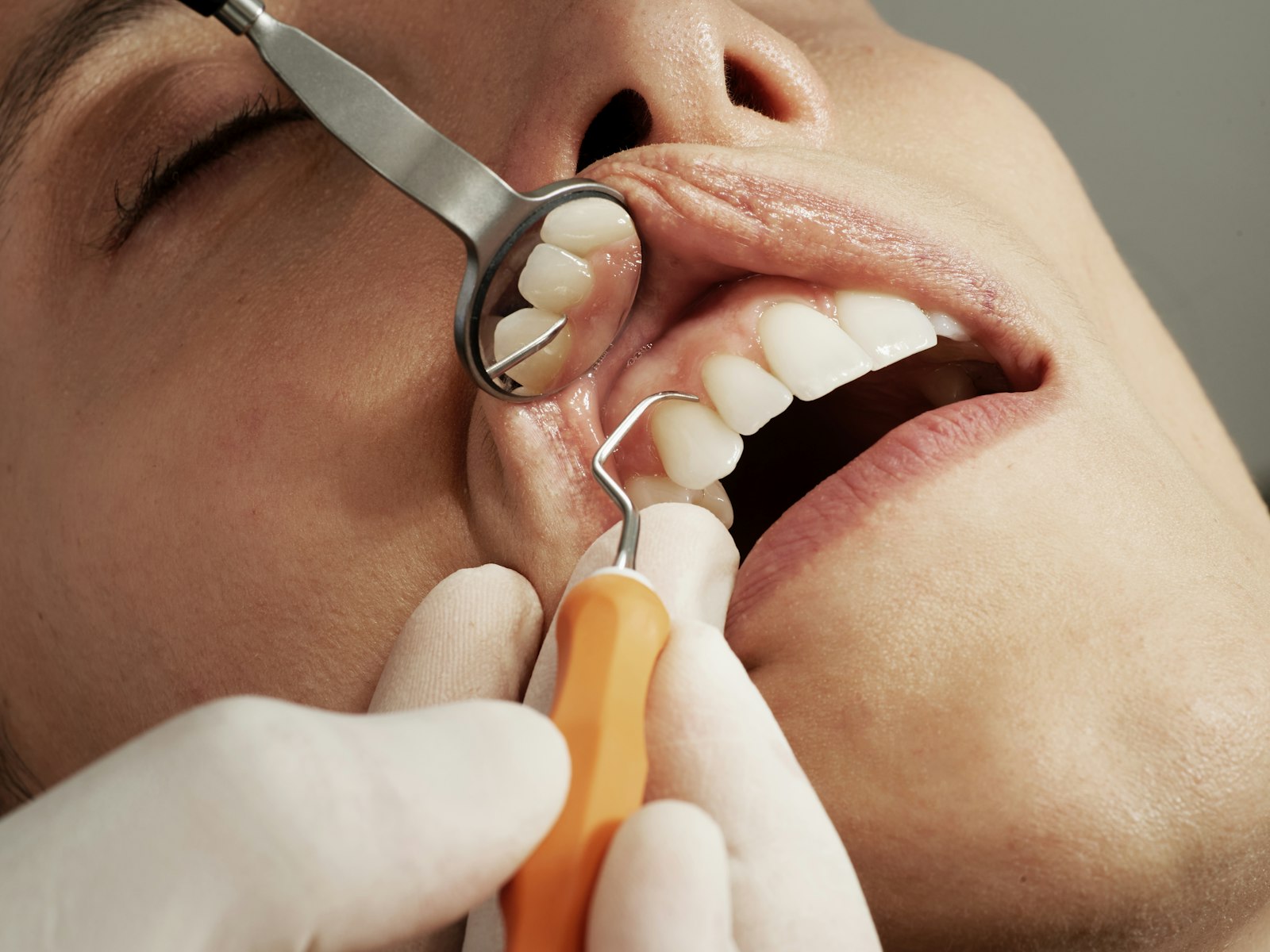
Cool light makes teeth look whiter because of contrast, and the effect is real rather than marketing. Enamel is translucent over dentine that carries a yellow undertone. Blue-leaning light at the cooler end of the scale sits opposite that yellow on the colour wheel, so it visually cancels part of it and lifts the apparent brightness. Warm light around 2700K to 3500K does the reverse. It reinforces the yellow and the same teeth read as duller.
This is why a ring light on its cool setting is so flattering, and why the very same device on warm can be dispiriting. It is also why some cosmetic marketing photographs look the way they do. Understanding the mechanism is not a reason to distrust every image you see, but it is a good reason not to draw conclusions about your own enamel from one.
What your phone does before you see the photo
Your phone has already made decisions about tooth colour before the image reaches your eye. Automatic white balance analyses the whole scene and shifts the colours to make what the camera guesses is white look white. If you are wearing a cream top, standing near a warm wall, or lit half by a window and half by a lamp, that guess changes, and your teeth move with it.
On top of that, beauty filters and AI photo tools commonly use neural network based algorithms that detect teeth within the frame and brighten them separately from any skin smoothing being applied. That processing can be on by default in some camera modes and social apps. The result is that the tooth colour in a selfie may be partly, or in some cases entirely, an app artefact rather than anything the sensor recorded. There is no reliable way to tell by looking.
How to check whether whitening is actually working
The only meaningful way to track a change in shade is a recorded shade taken in the surgery under controlled conditions, using the same shade guide, the same position and the same light each time. That is what a shade record is for. It is not glamorous and it does not photograph well, but it is comparable from one visit to the next in a way that a phone image is not.
Home photos cannot substitute for that, even if you keep the room, the time of day and the pose identical, because white balance and image processing still vary between shots and neither is under your control. If tracking a change matters to you, ask for the shade to be recorded at the start and revisited later. You can read more about the process on the teeth whitening page.
What the evidence does not settle
There are two honest gaps worth stating. First, no single ISO standard specifically mandates 5500K with a colour rendering index of 90 for clinical shade taking. That combination recurs across recent literature as strong clinical consensus rather than as codified law, and anyone presenting it as a legal requirement is overstating it.
Second, no study has isolated a consumer ring light and quantified how far its shade reading drifts from a clinical one. The reasoning in this article is extrapolated from established colour science, from what is known about colour rendering in ordinary lighting, and from documented camera and filter behaviour. It is a well grounded extrapolation, but it is an extrapolation, and it should be read that way.
Common questions
Why do my teeth look whiter in some photos than others?
Because the light source, the camera white balance and any processing are different in each photo. Cooler light suppresses the yellow undertone in enamel and makes teeth look brighter, warmer light does the opposite, and the camera re-neutralises the whole scene on top of that. The teeth are typically unchanged between the two images.
Does a ring light make your teeth look whiter?
On its cool setting it usually does, by increasing the contrast against the yellow undertone in enamel and filling the face evenly from the front. On its warm setting it often does the opposite. Either way it changes appearance only, not the actual shade of the tooth.
Can I trust a selfie to check if whitening worked?
No. A selfie combines an uncontrolled light source, automatic white balance and possible filter processing, and any one of those can move apparent tooth colour further than a real whitening change would. A shade recorded in the surgery under controlled lighting is the comparison that means something.
What lighting do dentists use to match tooth colour?
The commonly cited clinical target is around 5500K, described as a bright cloudy day at noon, and a 2025 study in Dentistry Journal gives 5500K to 6500K with a colour rendering index of at least 90 for correct shade selection. Separately, CIE Standard Illuminant D65 at about 6500K, defined in ISO 10526 and CIE S005, is the reference behind colour measuring instruments such as dental spectrophotometers.
Why do my veneers look a different colour at home?
This is usually metamerism. Ceramic and enamel reflect light differently across the spectrum, so a match that holds under one light can visibly break under another. Rooms with mixed light sources make it more likely. It does not necessarily mean the restoration was made badly, though it is worth raising so the shade can be reviewed under a second light source.
Do beauty filters whiten your teeth or just your skin?
Many do both, and they treat them separately. Beauty filters and AI photo tools commonly use neural network based algorithms that detect teeth in the frame and brighten them independently of skin smoothing. That means the tooth colour you are looking at may have been generated by the app rather than captured by the camera.
What is metamerism and why does it matter for veneers?
Metamerism is when two surfaces with different reflectance across the spectrum happen to look identical under one light and clearly different under another. It matters for veneers and crowns because a shade chosen under a single light can look wrong once you get home. Checking a shade under more than one light source before anything is made reduces the risk.
Talking it through
If you are trying to work out whether your teeth have actually changed shade, or you are weighing up whitening, bonding or veneers and want a straight answer about what is realistic, the team at Lumi Dental in Melrose Park offers a complimentary cosmetic consultation. It is a conversation about your teeth in person, with the shade assessed properly rather than from a photograph, and there is no obligation to book anything afterwards. Current offers for other treatments are listed on the current deals page, and a written quote can be provided before anything goes ahead.
This article is general information only and is not personal dental advice. Tooth shade, enamel condition and the suitability of any cosmetic treatment vary from person to person, and results can differ. Please speak with a dentist about your own circumstances before making a decision.