

Clear aligners can play a part in gum recession, but the plastic tray itself is rarely the cause: recession during orthodontic treatment comes from where a root is moved, how thin the gum and bone are over it, and how hard the teeth are brushed, and most of what is known comes from studies of fixed braces. A review has reported recession in around 5 to 12 per cent of patients at the end of orthodontic treatment, with higher figures years later in retention, so "can clear aligners cause gum recession" deserves a careful answer rather than a yes or a no. Here is what the evidence shows and the prevention plan I use with patients.
Written by Dr James Tran, BDent (University of Sydney), MICOI, GradDip (Oral Implants), general dentist at Lumi Dental in Melrose Park.
The short version
- Nearly all long-term recession data come from fixed braces. Aligners move teeth with the same biology, and a systematic review found not enough evidence that they are kinder to gums than braces.
- One often-quoted fixed-appliance cohort reported recession in about 6.6 per cent of patients at the end of treatment, around 20 per cent two years later and around 38 per cent at five years; most defects were minor.
- The risk sits in thin gum, lower front teeth moved outward, pre-existing recession, hard brushing and grinding, not in the tray.
- Aligner-specific irritants are a tray edge rubbing the gum margin, attachments near the gum line, and scrubbing around them.
- A gum check before the first tray, 3D planning of root position, a soft brush and reporting a sore gum early are the main safeguards; our guide to gum recession causes and treatment covers the wider picture.
What the studies measured, and why most of it is about braces
Almost every long-term study of recession after orthodontics used fixed appliances. A cross-sectional study of patients in retention summarises the better-known cohorts: Renkema and colleagues reported recession in 6.6 per cent of patients at the end of treatment, 20.2 per cent within two years and 37.7 per cent at five years. A cohort of adolescents treated with fixed braces and a bonded lower retainer reported recession in 11.24 per cent at the end of treatment and 67.42 per cent five years into retention, against 15.91 per cent in untreated people of similar age. Every defect was in the mildest category, and thin gum, a high-angle growth pattern, more outward tilt of the lower incisors and deeper probing depths were the risk indicators.
The small print matters: these are observational studies, mostly in the late teens and twenties, which cannot separate the appliance from the brushing, the retainer and the person. A systematic review that compared aligners with fixed appliances found aligner patients kept slightly better plaque and pocket scores at some follow-ups, but concluded there is not enough evidence to say aligners maintain better gum health than braces, and quoted recession figures of 5 to 12 per cent at the end of treatment and up to 47 per cent in long-term observation. Orthodontic treatment of any kind, then, is associated with some minor recession over the following years; aligners have not been shown to be worse, or safer.
Why a tooth moved by aligners can lose gum
Gum follows bone. The lower front teeth sit in a thin plate of bone on the lip side, and the gum over it comes in thick and thin versions. If a root is tipped or pushed outward beyond that plate, the bone thins and the gum margin can follow it down the root. That is biology, not appliance type. Better Health describes receding gums as the gum line shrinking away from the tooth so that teeth look longer, and lists them among the signs of periodontitis, which is why a gum that is already inflamed or receded is the first thing to sort out. Crowded lower front teeth are the classic case, because making room often means moving them forward; our article on crowded lower front teeth in adults explains the options.
The aligner-specific watch list
- A tray edge rubbing the gum margin. A tray trimmed high onto the gum, or a rough edge, rubs the same spot thousands of times a day. A red line where the plastic sits is the earliest sign, and a smoothing or re-trim fixes it.
- Attachments near the gum line. The small composite bumps that help trays grip collect plaque at their lower edge; inflamed gum beside an attachment is a hygiene problem before it is a recession problem. Our guide to aligner attachments and IPR explains them.
- Scrubbing around attachments. The hard horizontal brushing people adopt to get attachments clean is the same brushing that wears gum away on its own.
- Expansion and flaring of the lower front teeth. Plans that make space by widening the arch or tipping incisors forward move roots towards the thin side of the bone; removing a sliver of enamel between teeth (interproximal reduction) is often gentler when bone is thin.
- The retainer years. Retention is when most recession appeared in the studies, so a bonded wire or removable retainer needs the same gum checks; our article on a fixed versus removable retainer weighs the two.
The single rule: if a gum bleeds, looks thin or has already receded, the gum check comes before the first tray
I would rather delay a scan by a couple of months than start moving teeth through inflamed gum, because moving a tooth through infected bone is how minor recession becomes major. The sequence that works is gum therapy with the hygiene team, a few weeks for the tissue to settle, a re-measure, then the aligner scan. Where a lower incisor is already thin or receded, sometimes a periodontist is asked whether a graft should come first.
| What you notice | What it usually means | What to do |
|---|---|---|
| A red or sore line where the tray edge sits | Tray trimmed high or a rough edge | Ask for the edge to be smoothed; do not file it yourself |
| Bleeding when you brush with the trays out | Plaque gingivitis, often around attachments | Soft brush, daily floss, a hygiene visit |
| A lower front tooth looks longer or notched at the gum line | Early recession or toothbrush abrasion | Photograph it, tell the dentist, brush gently |
| Cold sensitivity on one front tooth | Exposed root surface | Sensitivity toothpaste; have the margin measured |
| Gum looks pale after a new tray | Tray pressing on the gum | Have the fit checked; do not skip trays |
A prevention plan during and after treatment
Before the first tray
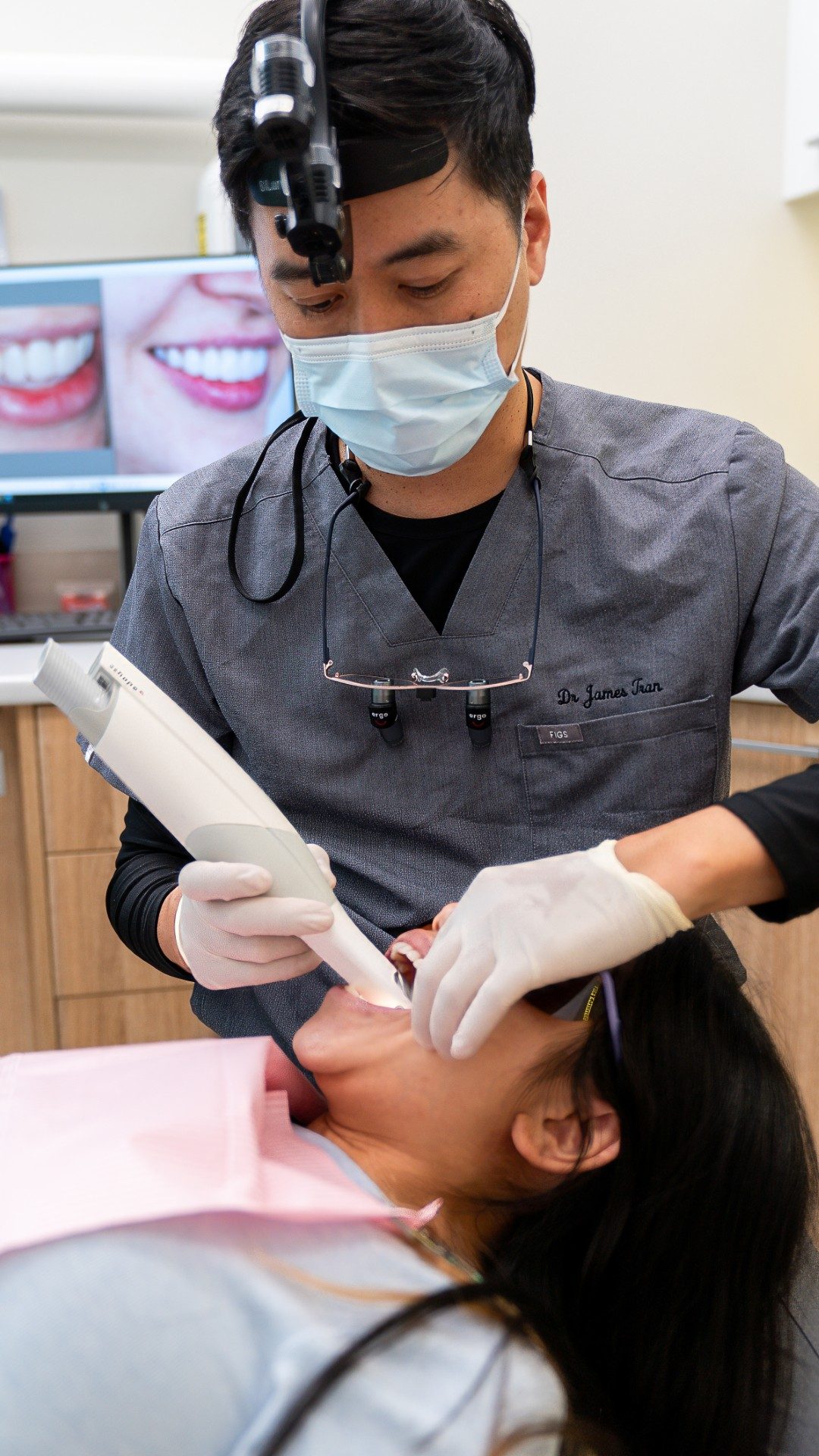
Periodontal charting, a note of thick or thin gum on each front tooth, and photographs of the gum margins as a baseline. A 3D intraoral scan records the gum line precisely, and where the lower front teeth are crowded or thin, a 3D X-ray shows how much bone covers each root so the movements stay inside it. Any gum disease is treated first.
During treatment
A soft brush at the gum line in small circles with the trays out, and interdental brushes or floss once a day. At each review the gum margins are compared with the baseline photographs, and a sore edge, bleeding or new sensitivity is reported straight away. If a lower incisor is drifting outward on the scan, the plan is adjusted, usually with interproximal reduction rather than more flaring.
After treatment
Retention is where the studies found the most change. A bonded retainer needs floss threaders and a check that it is not loose or trapping plaque; a removable retainer needs to be clean and worn as instructed. Keep the hygiene visits going, because a yearly measurement is how a half-millimetre change is caught early.

If recession appears anyway
In my experience most recession seen during or after orthodontics is minor and stays that way once the cause is addressed, so the first step is to measure it, photograph it and remove the irritant rather than rush to surgery. Sensitivity usually settles with a desensitising toothpaste or fluoride varnish. Where a root is clearly outside the bone, or the defect is deepening, a gum graft can cover the root and thicken the tissue; our guide to gum graft surgery explains what is involved, and Lumi Dental refers grafting to a registered periodontist.
How we approach this at Lumi Dental
Clear aligner treatment at Lumi Dental in Melrose Park is planned by a dentist from a 3D intraoral scan, with 3D X-ray taken in house where root position or thin bone is a concern, and the hygiene team of oral health therapists does the gum therapy and maintenance cleans through treatment and retention. Gum measurements are recorded before the first tray and checked at reviews, and complex cases are referred to registered specialists. Read more about clear aligners at Lumi Dental.
Questions patients ask
Do clear aligners make your gums recede?
Not by themselves. Recession during aligner treatment comes from moving a root beyond thin bone, pre-existing gum disease, hard brushing or a tray edge rubbing the gum, and a review found aligners neither better nor worse than braces on current evidence.
Can aligners fix gum recession?
Sometimes moving a flared tooth back into the bone improves the look of a mild recession, but the studies are small and it is not something to count on. Recession from gum disease or brushing needs those causes treated first.
Why do my gums hurt with my aligners?
Usually the tray edge is sitting on the gum or has a rough spot, or plaque is collecting around an attachment. Both are easy to fix early, so contact the practice rather than waiting for the next review.
Will my gums grow back after aligner treatment?
Lost gum does not regrow on its own, but minor recession usually stays stable once the cause is removed, and grafting can rebuild tissue. Our article on whether receding gums can grow back sets out what is realistic.
Should I stop wearing my aligners if my gum is receding?
Not without advice, because teeth drift within days and the next tray may not fit. Photograph the area, keep wearing the current tray, and ask for an earlier review.
Worried about your gums during aligner treatment? Complimentary aligner consult in Melrose Park
If you are in Melrose Park, Ryde, Parramatta, Ermington, Rydalmere or nearby and want your gums measured before you start aligner treatment, or checked partway through, book a complimentary aligner consultation or read more about clear aligners at Lumi Dental.
Sources
- PubMed Central: Incidence of gingival recessions in adolescent orthodontic patients treated with fixed appliances and lingual retainer
- PubMed Central: Evaluation of the effect of periodontal health and orthodontic treatment on gingival recession, a cross-sectional study
- PubMed Central: Assessment of the periodontal health status and gingival recession during orthodontic treatment with clear aligners and fixed appliances, a systematic review and meta-analysis
- Better Health Channel: Gum disease
About the author

Dr James Tran is a general dentist at Lumi Dental in Melrose Park. He holds a BDent from the University of Sydney and a Graduate Diploma in Oral Implants, and is a Member of the International Congress of Oral Implantologists (MICOI).
This article is general information only and is not a substitute for an examination and individual advice from a registered dental practitioner. Suitability for any treatment varies from person to person.








