
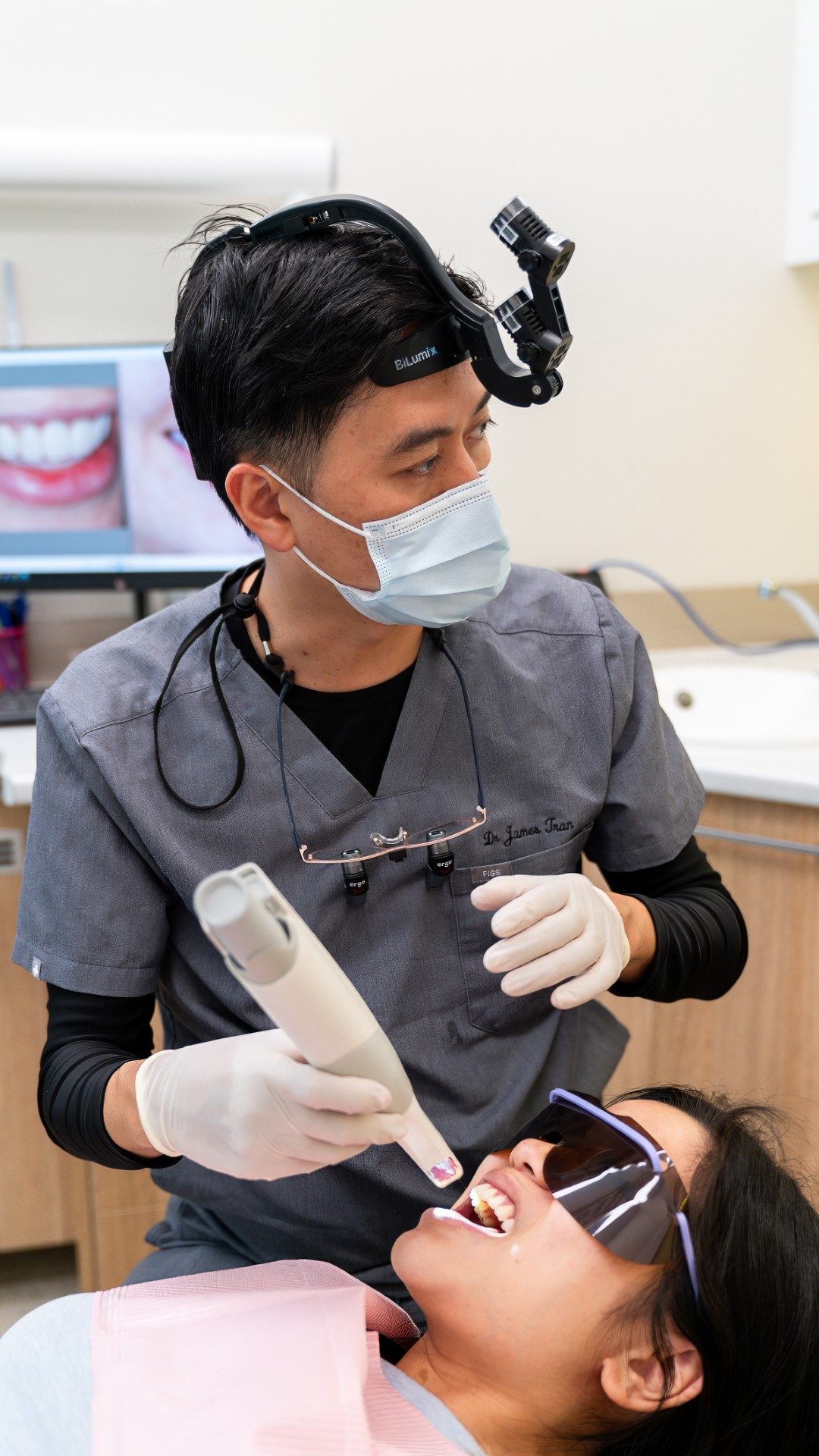

No, a dental implant cannot get a cavity: the titanium post and the porcelain or zirconia crown contain no enamel or dentine for bacteria to dissolve, but the gum and bone around the implant can become inflamed, and the natural teeth beside it can still decay. So the answer to "can dental implants get cavities" is no, while the mouth around them is not safe. A large systematic review has reported inflamed gum around implants (peri-implant mucositis) in around 46% of implant patients and bone-level disease (peri-implantitis) in around 21%, with wide variation between studies. In my experience the patients who run into trouble are the ones who assumed a tooth that cannot decay needs no cleaning.
Written by Dr James Tran, BDent (University of Sydney), MICOI, GradDip (Oral Implants), general dentist at Lumi Dental in Melrose Park.
The short version
- Titanium, zirconia and porcelain do not dissolve in acid, so the implant and its crown cannot get a cavity.
- The gum around an implant can become inflamed (mucositis) and, if that is left, bone can be lost (peri-implantitis); plaque is the cause of both.
- The natural tooth next to an implant can still decay, especially on the root surface where food packs against the crown.
- Cement left under a cemented crown, a loose screw and chipped porcelain are the other problems to know about.
- Cleaning is the same as for a natural tooth, plus something to clean under the crown; see our guide to dental implant aftercare and maintenance.
- If the gum around an implant bleeds when you clean it, book a check; at that stage it is reversible.
Why an implant cannot decay, and why that is not the whole story
A cavity is a hole made by acid. Bacteria in plaque feed on sugar and produce acid that dissolves the minerals in enamel and dentine. healthdirect describes a dental implant as a metal screw, usually titanium, fixed into the jawbone in place of a missing root, with a crown attached on top. None of those parts contain mineral that acid can draw out: the acid that softens enamel leaves titanium, zirconia and porcelain untouched. That is why a natural tooth under a crown can still rot at the edge of the crown while an implant crown cannot; our article on whether you can get a cavity under a crown explains the difference.
Plaque collects at the gum line of an implant crown as it does on a tooth, the gum responds the same way, and the bone underneath is ordinary bone. healthdirect's advice once an implant has healed is to care for it as you care for your other teeth.

What can and cannot go wrong around a dental implant
| Problem | Can it happen? | What you might notice | What helps |
|---|---|---|---|
| Cavity in the implant or its crown | No | Nothing; the materials do not decay | Nothing needed |
| Cavity in the tooth next to the implant | Yes | Food packing, sensitivity, a dark edge beside the crown | Fluoride toothpaste, cleaning the contact point, X-rays at check-ups |
| Peri-implant mucositis (inflamed gum, no bone loss) | Yes, common | Bleeding when brushing or flossing, redness, puffiness | Better home cleaning and a maintenance clean; reversible |
| Peri-implantitis (inflammation plus bone loss) | Yes | Bleeding or pus, deeper pockets, gum shrinking, sometimes no pain | Examination, X-ray, gum therapy around the implant, sometimes surgery |
| Cement left under a cemented crown | Yes, with cemented crowns | Bleeding or discomfort that starts after the crown is fitted | Finding and removing the cement |
| Loose screw or chipped porcelain | Yes | Crown rocks, clicks, feels high, or a chip appears | Retightening or repair; a night guard if you grind |
| Gum receding around the crown | Yes | Grey metal showing at the gum line, a longer-looking crown | Assessment of the cause first |
| Staining of the crown | Surface stain yes, internal colour change no | Darkening at the edges from tea, coffee or smoking | Professional polish; the crown itself does not bleach |
Peri-implant mucositis and peri-implantitis: the gum disease version
The consensus report from the World Workshop on the Classification of Periodontal and Peri-Implant Diseases sets out three states. Peri-implant health means no redness, bleeding on probing, swelling or pus. Peri-implant mucositis is marked mainly by bleeding on gentle probing, and the report says there is strong evidence that plaque is its cause. Peri-implantitis is a plaque-associated condition with inflammation of the gum and progressive loss of the supporting bone, seen as bleeding or pus, deeper pockets, a receding gum and bone loss on X-ray. The practical difference is that mucositis is reversible with cleaning, while lost bone does not grow back on its own.
How common is it? A systematic review in the Journal of Periodontology pooled 102 studies and around 13,000 patients and reported patient-level prevalence of about 46% for mucositis and 21% for peri-implantitis, with incidence over 20 years of use of about 53% and 22%. Variation between studies was very high, so these are rough guides rather than a forecast for any one person. The same review identified a history of gum disease, smoking, diabetes and alcohol consumption as risk indicators for peri-implantitis, and gum disease, obesity and smoking for mucositis. Our guide to peri-implantitis treatment covers what happens once bone has been lost.
The neighbouring teeth can still decay
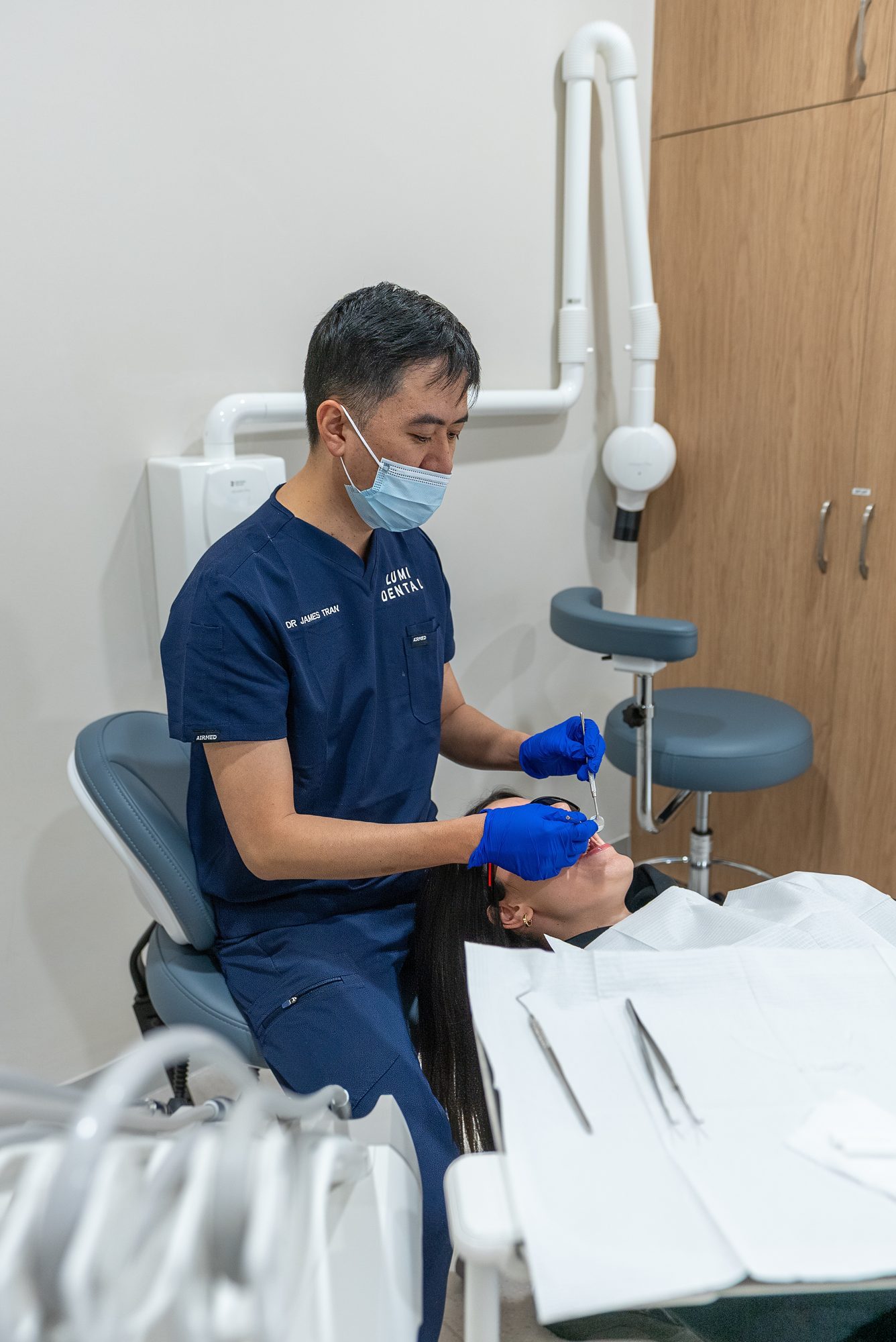
An implant crown is a fixed object next to a tooth that can still move and wear, and over time the contact point between them can open slightly so that food packs there after every meal. The root surface of the neighbouring tooth, which has no enamel, then sits in fermenting food. Patients I see with a decayed tooth beside an implant usually have no decay anywhere else. Fluoride does nothing for titanium but it does protect that neighbouring root, which is why fluoride toothpaste stays in the routine. Mention regular food catching at your next visit; an open contact is easier to fix early.
Cement, screws and porcelain: the hardware problems
An implant crown is either screwed directly to the implant or cemented onto an abutment. With cemented crowns a small amount of cement can be pushed under the gum during fitting, where it behaves like a permanent lump of rough plaque. In an endoscopic study of patients who already had peri-implant disease, cement residue was found under the gum in around 80% of them, and in those with peri-implantitis the cement sat deeper than in those with mucositis. Screws can loosen and porcelain can chip, especially with grinding; neither is decay, and both are repairable.

The single rule: if the gum around an implant bleeds when you clean it, book a check
Bleeding is the earliest sign of mucositis, and at that stage the fix is cleaning, not surgery. Day to day, healthdirect's advice is to brush teeth and gums twice a day, clean between the implant and the other teeth every day with floss, interdental brushes or a water flosser, keep up regular check-ups, and have any swelling or inflammation of the gum or bone looked at. In practice that means a soft brush angled into the gum line, an interdental brush sized to the gap, and floss or spongy "super floss" drawn under the crown, because the underside of an implant crown is wider than a tooth root and plaque hides there. Most people with implants have a maintenance clean every three to six months, where the hygiene team measures the gum so bleeding is caught before bone is involved. Our step-by-step guide to cleaning dental implants at home shows the tools.
How we approach this at Lumi Dental
At Lumi Dental in Melrose Park an implant is checked by a dentist at each examination, with an X-ray from the in-house 3D imaging when bone levels need to be measured rather than guessed. The oral health therapists carry out the maintenance cleans and gum therapy around implants, check the contact with the neighbouring tooth, and go through home cleaning with the tools that fit your gap. Anyone with a history of gum disease is placed on a shorter recall. Read more about dental implants at Lumi Dental and about general dentistry and hygiene visits at the practice.
Questions patients ask
Can a dental implant get a cavity?
No. Decay needs enamel or dentine for acid to dissolve, and an implant is titanium with a ceramic crown. What can happen is inflammation of the gum and bone around it, a form of gum disease rather than decay.
Can the tooth next to my implant get a cavity?
Yes, and it is one of the commoner problems I see. Food packing between the crown and the neighbouring tooth leaves the root surface bathed in acid; our article on root decay in older adults explains why roots decay faster and how fluoride helps.
Is peri-implantitis the same as a cavity?
No. A cavity is lost tooth structure; peri-implantitis is inflammation of the gum around an implant with loss of the bone that holds it, driven by plaque, smoking and a history of periodontitis rather than by sugar.
Why does my implant bleed when I floss?
Bleeding on cleaning is the main sign of peri-implant mucositis, which is reversible with better cleaning and a maintenance visit. Bleeding that comes with a bad taste or swelling deserves a prompt check; see bad breath or a bad taste around a dental implant.
Do I still need fluoride toothpaste if I have an implant?
Yes. Fluoride does nothing for the implant but protects the natural teeth beside it, and the neighbouring root is the surface most likely to decay. Abrasive whitening pastes can scratch the crown surface.
Looking after an implant, or thinking about one? Complimentary implant consult in Melrose Park
If your implant bleeds when you clean it or food keeps catching beside the crown, the team at Lumi Dental in Melrose Park can examine the gum and bone around it and set up a maintenance plan. Contact Lumi Dental to book, or read about dental implants at the practice. Patients visit from Ryde, Parramatta, Ermington, Rydalmere and nearby suburbs.
Sources
- healthdirect: Dental implant procedure
- PubMed (Journal of Clinical Periodontology): Peri-implant diseases and conditions, consensus report of workgroup 4 of the World Workshop on the Classification of Periodontal and Peri-Implant Diseases and Conditions
- PMC (Journal of Periodontology): Prevalence, incidence, systemic, behavioral, and patient-related risk factors and indicators for peri-implant diseases, a systematic review and meta-analysis
- PMC (Journal of Periodontology): Excess cement and peri-implant disease, a cross-sectional clinical endoscopic study
About the author

Dr James Tran is a general dentist at Lumi Dental in Melrose Park. He holds a BDent from the University of Sydney and a Graduate Diploma in Oral Implants, and is a Member of the International Congress of Oral Implantologists (MICOI).
This article is general information only and is not a substitute for an examination and individual advice from a registered dental practitioner. Suitability for any treatment varies from person to person.








