

Thirty-two people in a 2025 study whitened their upper and lower teeth at the same time with take-home trays, and the lower front teeth lightened about as well as the upper ones. That matters if you are thinking of whitening only your top teeth, because it means the bottom row can usually be done later if you change your mind. Treating one arch on its own is entirely possible. The more useful question is how much of your lower teeth people see when you talk.
Written by Dr James Tran, BDent (University of Sydney), MICOI, GradDip (Oral Implants), general dentist at Lumi Dental in Melrose Park.
Trays and in-chair gel can both be limited to one arch
Take-home whitening uses a separate custom tray for each arch, so a dentist can make only the upper tray. The Australian Dental Association's patient site, teeth.org.au, explains that the dentist tells you how much gel to use and how long to wear the trays each day. Our guide to custom whitening trays describes how they are made.
Home gels are usually carbamide peroxide, which releases hydrogen peroxide in the mouth. CHOICE notes that 10% carbamide peroxide releases about 3.5% hydrogen peroxide, and that products with more than 6% hydrogen peroxide (18% carbamide peroxide) are restricted to registered dental practitioners.
In-chair whitening can also be confined to the upper teeth, since the gums are protected and the gel is applied directly to the chosen teeth. Our article on in-chair whitening walks through an appointment. A 2024 systematic review in Bioengineering (Butera and colleagues) found that in-chair, take-home and combined whitening all changed tooth colour, that take-home trays with carbamide peroxide showed less relapse in studies that compared them, and that sensitivity seemed to be higher with in-chair and combined treatment.
Talking shows more of your lower teeth than smiling does
A posed smile for a photo mostly shows the upper teeth, which is why yellowing on the top row is what people notice first. Conversation is different. Many sounds pull the lower lip down, and a real laugh often shows the lower front teeth clearly.
Age shifts the balance too. In a well-known 1978 study in The Journal of Prosthetic Dentistry, Vig and Brundo found that with the lips relaxed and slightly apart, the amount of upper front tooth on show gradually decreased with age while the lower front teeth showed more. For many adults, the lower row is a bigger part of the everyday smile than they assume.
A simple test helps. Ask someone to film you chatting for half a minute, then watch it back. If your lower teeth are visible for much of the clip, they are part of how your smile looks to others.

When upper-only makes sense, and when it can backfire
Whitening the top teeth alone tends to work well when your lower lip covers the bottom teeth while you speak and laugh, or when the lower teeth already look lighter than the uppers. It can also be sensible when the lower front teeth have crowns, veneers or large white fillings, because teeth.org.au notes that whitening does not change the colour of porcelain crowns, veneers or composite fillings. Some people with very sensitive lower teeth prefer to start with the upper arch and see how they go.
It is less likely to suit you if your lower teeth show in conversation and are as yellow as the uppers, or darker. Lightening only the top row then increases the contrast between the two, and people notice that step more in person than in photographs.
The lower arch can usually catch up
The 2025 study mentioned at the start, published in the Journal of Dentistry by Pereira-Lores and colleagues, used 16% carbamide peroxide for three weeks and measured colour each week with a spectrophotometer. The lower and upper incisors whitened to a similar degree. The upper canines did a little better than the lower canines by weeks two and three on two of the three colour scales used, but the authors judged the difference too small to notice clinically. They suggested that saliva from the glands under the tongue might seep into the lower tray and break the gel down faster, which could explain why the lower arch sometimes seems slower.
That study was small and observational, but it supports a sensible plan: whiten the top first, and add a lower tray later if needed. Lower front teeth are smaller and often start a little darker, so matching may take the whole course. Our article on why lower teeth look darker explains the reasons, the tooth shade matching guide covers how shades are recorded, and our piece on choosing a natural shade discusses where to stop.
Lower trays need a lighter hand with gel
Tooth sensitivity is a common side effect of whitening, and teeth.org.au notes it can sometimes be very severe. Gel that reaches the lips, gums or tongue can cause chemical burns that often turn into ulcers before they heal. CHOICE adds that custom trays need less gel and reduce gum sensitivity.
Both points matter more for the lower arch. A lower tray sits in saliva, and excess gel tends to drift onto the floor of the mouth, so a small amount per tooth and wiping away any overflow are important. If the lower teeth are your sensitive ones, a dentist may suggest shorter wear times when you add them. Our guide to wearing trays overnight or during the day covers scheduling.
Checks before either arch is whitened
For one arch or two, the starting point is an examination. The dentist looks for decay, gum problems and worn enamel, maps any fillings, crowns or veneers that will stay their current colour, and notes exposed roots, which do not lighten like enamel. CHOICE points out that a dentist can also look for underlying causes of discolouration that whitening will not fix. teeth.org.au advises against whitening during pregnancy or breastfeeding.
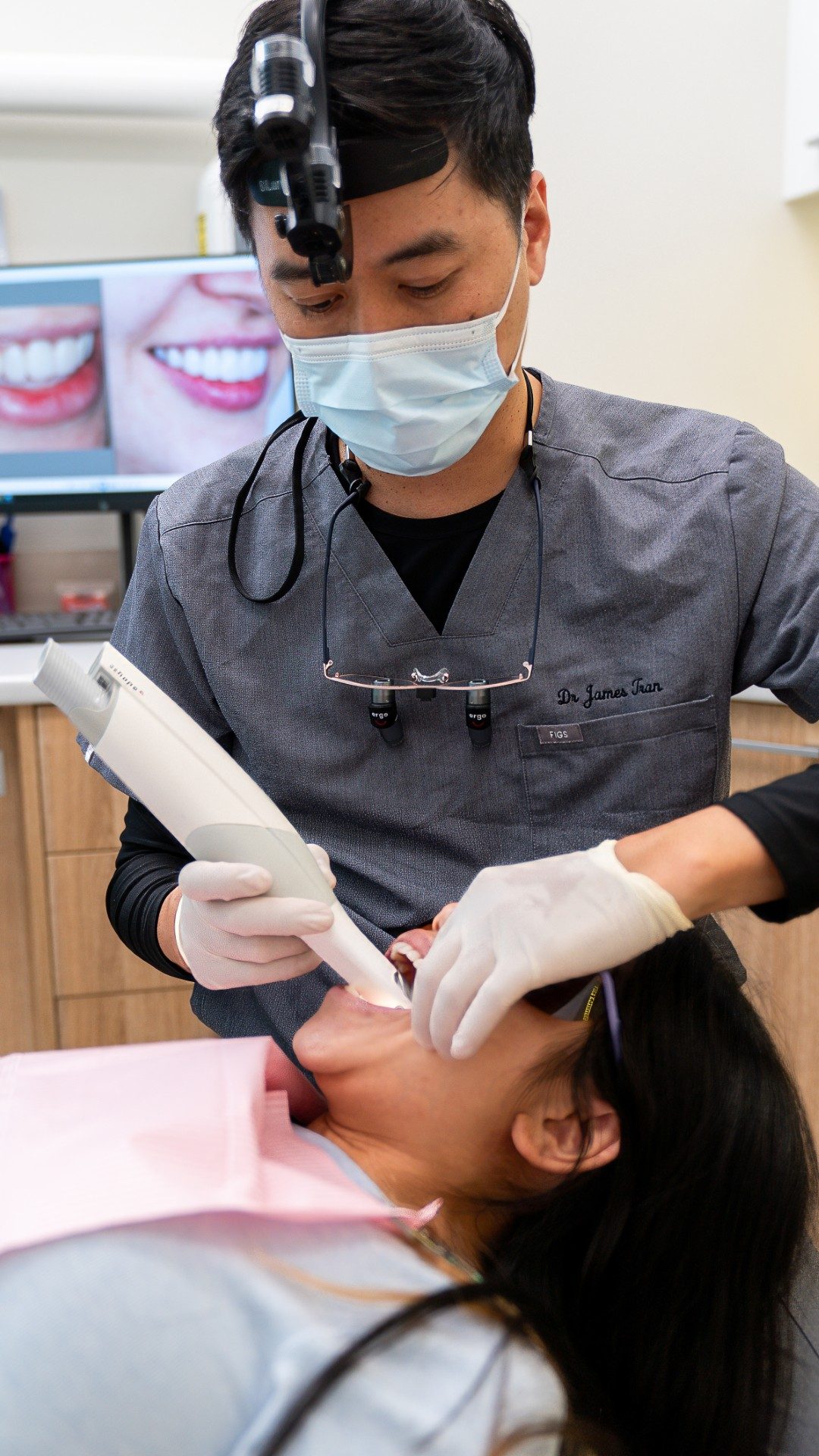
At Lumi Dental, clinical photographs record each arch before treatment, and a 3D intraoral scan is used to make the trays, so you can start with the upper tray alone. Our options are Lumi Home, Lumi Refresh and Lumi Radiance, and each includes Boutique take-home whitening. Results vary between people, so no particular shade is promised. The teeth whitening page explains how the options differ, and any current offers are listed on our deals page.
If you are deciding between one arch and both, a free cosmetic consult at Lumi Dental in Melrose Park is a chance to check how much of each row shows and to record your starting shades before anything is made.
Sources
- Pereira-Lores P and colleagues. Is at-home bleaching more effective on the upper arch than the lower arch? A prospective cohort study. Journal of Dentistry, 2025
- Butera A and colleagues. Evaluation of the effectiveness of different types of professional tooth whitening: a systematic review. Bioengineering, 2024
- Vig RG, Brundo GC. The kinetics of anterior tooth display. The Journal of Prosthetic Dentistry, 1978
- Australian Dental Association (teeth.org.au): Teeth whitening
- CHOICE: Teeth whitening treatments from dentists, dental care and other products
About the author

Dr James Tran is a general dentist at Lumi Dental in Melrose Park. He holds a BDent from the University of Sydney and a Graduate Diploma in Oral Implants, and is a Master of the International Congress of Oral Implantologists (MICOI).
This article is general information only and is not a substitute for an examination and individual advice from a registered dental practitioner. Suitability for any treatment varies from person to person.








