
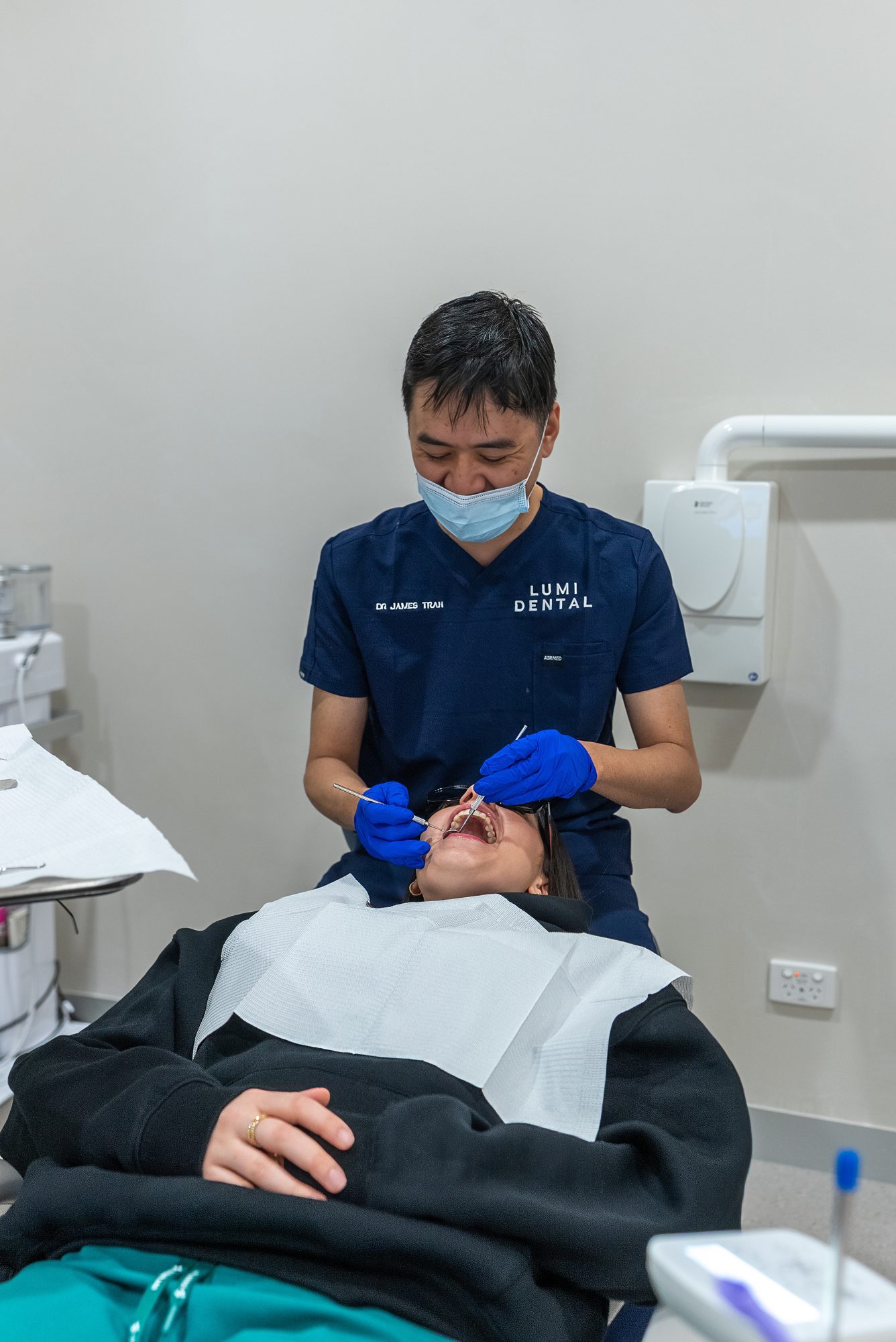

You can whiten worn teeth, but whitening lightens the enamel that is left rather than the exposed dentine at the edges, so a worn tooth often lightens unevenly and the short or see-through edges stay exactly the same length. The Australian Dental Association's teeth.org.au site puts it simply: whitening gel only lightens the colour of tooth enamel. Research has reported that enamel is only about 1.5 mm thick on the upper part of a tooth and about 0.5 mm near the gum, so once wear or acid has gone through it, the warmer dentine underneath is what you see. Here is what whitening can change on worn teeth, what it cannot, and the order that usually works best.
Written by Dr James Tran, BDent (University of Sydney), MICOI, GradDip (Oral Implants), general dentist at Lumi Dental in Melrose Park.
The short version
- Enamel is the only part of a tooth that whitens predictably. Exposed dentine is yellower and lightens less, so the contrast at a worn edge can become more obvious.
- Whitening changes colour, not shape. Short, flat or chipped edges do not grow back.
- Exposed dentine means open tubules, so sensitivity during whitening is more likely.
- The usual order is whiten first, wait about two weeks, then rebuild the edges with composite bonding matched to the new shade.
- An examination first sorts out what is grinding, what is acid and what is brushing. Our guide to attrition, erosion and abrasion explains the three types of wear.
- If the cause of the wear is not controlled, both the whitening and the repair are short-lived.
What a worn tooth is made of
A healthy tooth is a layer of enamel over a core of dentine. Enamel is hard, pale and slightly see-through. Dentine is softer and warmer in colour, and nerve endings run through it in tiny tubules. A review of erosive tooth wear in Clinical Oral Investigations describes how enamel thickens from about 0.5 mm in the lower third of the crown to about 1.5 mm in the upper third, and how exposed dentine is diagnosed by its colour and the way light passes through it.
Wear takes enamel away in three main ways. healthdirect defines dental erosion as acid wearing away some of the enamel surface of the teeth, with soft drinks, fruit acids and reflux the usual sources. Attrition is tooth-on-tooth wear from grinding and clenching, which flattens biting edges. Abrasion is wear from something else, most often a hard toothbrush. Once the enamel is gone, the same review notes that abrasive food and oral hygiene products tend to hollow out the softer dentine, so the wear speeds up. That is why a worn edge often looks yellow in the centre with a pale rim of enamel, and why very thin edges with no dentine behind them look grey or glassy. Our article on see-through teeth covers that second pattern.
What whitening does on enamel, dentine and edges
Peroxide gel does not stop at the enamel. A study in the Brazilian Dental Journal measured hydrogen peroxide inside the pulp chamber of extracted front teeth after in-chair whitening and found it in every tooth, with thinner teeth letting more through. So in an intact tooth the gel lightens the enamel and, to a degree, the dentine beneath it, which is why such teeth lighten evenly from gum to edge.
A worn tooth behaves differently. Where the edge is bare dentine, the gel acts on dentine directly, and dentine does lighten a little, but it never takes on the pale, bright quality of thick enamel. The enamel higher up does, so the gap between the two widens. In my experience, patients with moderate wear are pleased with the overall change but notice the worn edge more afterwards, not less. Where the edge is a thin shell of enamel with nothing behind it, whitening cannot add the dentine that would stop light passing through, so the edge can look greyer against a lighter tooth. None of this is a reason to avoid whitening; it is a reason to plan the edge repair at the same time.
Whitening also cannot add length. Flat, chipped or short edges are a shape problem, and shape is restored with composite bonding, porcelain veneers or crowns, depending on how much tooth is missing. Our article on restoring worn-down teeth compares those options.
Sensitivity: why worn teeth feel whitening more
Exposed dentine means open tubules leading towards the nerve, and the Brazilian study found that the thinner the wall of the tooth, the more peroxide reached the pulp. teeth.org.au warns that whitening can make teeth sensitive to cold, sometimes severely enough that breathing air hurts. Worn teeth sit at the sensitive end of that range, as do teeth with recession or notches at the gum line.
The practical answers are familiar: a lower-strength gel worn for a shorter time, whitening on alternate nights, a potassium nitrate or fluoride desensitising toothpaste for a couple of weeks before you start, and gel kept off the gum. Australian law restricts products above 6% hydrogen peroxide or 18% carbamide peroxide to registered dental practitioners, and that supervision is what a worn mouth needs, because the dentist can seal very sensitive exposed patches before the gel goes near them. Our article on whitening sensitivity covers the full list of options.
The single rule: whiten first, then rebuild the edges
If the edges are worn or see-through and you want a lighter colour and a better shape, whiten first, wait about two weeks, then rebuild the edges. Two facts drive that order. First, teeth.org.au notes that whitening does not change the colour of composite resin, so bonding placed before whitening will be too dark afterwards and would need redoing. Second, resin bonds less well to freshly bleached enamel. A laboratory study in Scientific Reports found the bond of orthodontic brackets to enamel bleached with 35% hydrogen peroxide was around 15% weaker than to untreated enamel, and noted that earlier work had waited anywhere from 24 hours to 4 weeks, with a one-week delay often enough for the bond to recover. A fortnight gives a margin and lets the shade settle, so the composite matches your real colour rather than the temporarily dehydrated one.
Done in that order, composite bonding can lengthen short edges, cover worn patches of dentine and mask thin grey edges in a single visit. Where the wear is deep or the bite is heavy, porcelain may last better, which is a conversation for the examination rather than a rule.
What whitening can and cannot change on a worn tooth
| Feature of a worn tooth | What whitening does | What usually helps |
|---|---|---|
| Yellow colour on intact enamel | Lightens well | Whitening alone |
| Exposed dentine at the edge or gum line | Lightens a little, stays warmer | Composite bonding after whitening |
| Short, flat or chipped edges | No change in length or shape | Bonding or veneers |
| Thin see-through edges | May look greyer by contrast | Bonding behind the edge |
| Cupped hollows on back teeth | No change | Fillings plus acid control |
| Sensitivity | Usually increases for a while | Lower strength, desensitising paste, sealing |
| Existing fillings or veneers | No change | Replace afterwards if they no longer match |
Control the cause before you spend on the result
Whitening and bonding both sit on top of whatever is wearing the teeth, so the first appointment is usually about finding that cause. Flat, polished edges that fit together like a jigsaw point to grinding, and a night guard protects both the enamel and any new composite. Scooped surfaces on the tongue side of the upper front teeth or cupping on the molars point to acid, and the questions turn to soft drinks, citrus, sparkling water, wine, and reflux. Notches at the gum line point to a hard brush and heavy technique. I usually spend more of a worn-teeth consult on these questions than on shade, because a repair that outlasts its cause is the only kind worth paying for.

How we approach this at Lumi Dental
Worn teeth at Lumi Dental start with an examination by a dentist, clinical photographs under consistent lighting and a 3D intraoral scan, so the wear and the exposed dentine are recorded before anything is lightened. The dentist diagnoses the type of wear, checks for sensitivity, decay and gum recession, then sets a whitening plan that suits the amount of exposed dentine. Our whitening options are Lumi Home, Lumi Refresh and Lumi Radiance, and the teeth whitening page explains them. Composite bonding of worn edges is done at Lumi Dental once the shade has settled, and the hygiene team, our oral health therapists, help with maintenance afterwards.
Questions patients ask
Does teeth whitening work on exposed dentine?
Only partly. Dentine lightens a little when peroxide reaches it, but it stays warmer and darker than the enamel around it, so a bare patch of dentine still looks like one after whitening. Composite matched to the new shade is what makes it disappear.
Will whitening make my worn edges look worse?
It can make them more noticeable, because the enamel lightens more than the dentine and the contrast grows. That is why whitening is usually planned together with bonding of the edges.
Can whitening damage worn enamel further?
Dentist-supervised whitening at the regulated strengths is not known to remove enamel, but it can increase sensitivity in teeth that are already thin. Our article on whether whitening damages enamel goes through the evidence.
Should I whiten before or after bonding my worn edges?
Before. Composite does not change colour once placed, and it bonds better to enamel that has had about two weeks to settle after whitening. Our comparison of composite bonding and veneers helps with the second decision.
Why are my worn teeth more sensitive to whitening than my friend's?
Thinner enamel and exposed dentine let more peroxide through to the nerve, which is what research measuring peroxide inside the pulp chamber has shown. A lower strength, shorter wear time and a desensitising toothpaste beforehand usually keep it manageable.
Worn or see-through edges? Complimentary cosmetic consult in Melrose Park
If your edges are short, yellow at the centre or glassy at the tips, the team at Lumi Dental can map the wear, find the cause and plan the whitening and bonding in the right order. Book a complimentary cosmetic consult at Melrose Central in Melrose Park, or read more about teeth whitening at Lumi Dental. Patients come to us from Ryde, Parramatta, Ermington and Rydalmere, with on-site parking.
Sources
- Australian Dental Association (teeth.org.au): Teeth whitening
- healthdirect: Dental erosion
- Holbrook WP, Ganss C. Is diagnosing exposed dentine a suitable tool for grading erosive loss? Clinical Oral Investigations (PMC)
- Mena-Serrano A and colleagues. Hydrogen peroxide in the pulp chamber and colour change in maxillary anterior teeth after in-office bleaching. Brazilian Dental Journal (PMC)
About the author

Dr James Tran is a general dentist at Lumi Dental in Melrose Park. He holds a BDent from the University of Sydney and a Graduate Diploma in Oral Implants, and is a Member of the International Congress of Oral Implantologists (MICOI).
This article is general information only and is not a substitute for an examination and individual advice from a registered dental practitioner. Suitability for any treatment varies from person to person.








