Book Online

All health funds accepted · Payment plans from $0 deposit · CDBS bulk billing

All health funds accepted · Payment plans from $0 deposit · CDBS bulk billing

Book Online

Changing dentists: how to transfer your records and X-rays

Changing dentists: how to transfer your records and X-rays

Dr James Tran, dentist at Lumi Dental Melrose Park

Dr James Tran

September 3, 2026 · Patient Education · 8 min read

When you are changing dentists, the practice keeps the file it created, but you own the information inside it, and Australian Privacy Principle 12 gives you a right to request access to your dental records and X-rays. That single distinction settles most of the confusion. You are not asking a practice to hand over its property. You are asking for access to information about you, which is a different thing, and it is usually supplied as copies. The most useful part of this guide is the list of what to ask for by name.

Key takeaways

  • Under the Privacy Act 1988, Australian Privacy Principle 12 gives you a right to request access to the personal information a private dental practice holds about you, including clinical notes and radiographs.
  • The file belongs to the practice that created it; the information belongs to you, so expect copies rather than the original.
  • A practice can charge for giving access, but the charge must be limited to the reasonable cost of retrieving and copying and must not become a barrier.
  • Asking for specific items by name, rather than asking for "my records", gets you a far more useful transfer.
  • A new dentist should reuse a recent, diagnostically adequate radiograph rather than retaking it automatically, because every X-ray has to be clinically justified.
  • In NSW, complaints go to different bodies depending on the issue, so match the complaint to the right regulator.

What the law actually gives you

Private practices and the Privacy Act

Private dental practices are organisations under the Privacy Act 1988, which means Australian Privacy Principle 12 applies. APP 12 gives an individual the right to request access to the personal information an organisation holds about them. Clinical notes, treatment records, radiographs and clinical photographs all sit within that.

The Office of the Australian Information Commissioner publishes guidelines on how APP 12 works in practice. Two points from those guidelines matter to patients. An organisation may charge a fee for giving access, but the fee must be limited to the reasonable cost of retrieval and copying, and it must not be set so high that it operates as a barrier to access. And a request should be answered within a reasonable period. The frequently quoted thirty day figure is an OAIC guidance benchmark for what is reasonable, not a fixed statutory deadline, so treat it as an expectation rather than a legal stopwatch.

NSW public services and the HRIP Act

In NSW, public sector and NSW Health linked dental services also sit under the Health Records and Information Privacy Act 2002, known as the HRIP Act, which is regulated by the NSW Information and Privacy Commission. Section 25 of that Act sets minimum retention periods for health records held by a health service provider: at least seven years from the date health information was last provided for an adult, and, where the information was collected while the patient was under 18, until that patient turns 25.

The two regimes create broadly similar rights of access but route complaints to different regulators. Whether the HRIP Act retention rule binds a particular private practice in NSW is a question worth confirming case by case rather than assuming, because the private sector sits primarily under the Commonwealth framework.

Exactly what to ask for, by name

This is where most transfers fall down. A request for "my records" often produces a one page summary letter, which is polite and nearly useless to the next clinician. Ask for the following items specifically:

  • Any panoramic radiograph, the OPG, with the date it was taken.
  • Bitewing radiographs, most recent set and any earlier sets available.
  • Periapical radiographs, particularly of any tooth that has had root canal treatment, a post, an implant or a history of trauma.
  • Periodontal charting, including pocket depths and bleeding scores if recorded.
  • Clinical and treatment notes covering the period you attended.
  • Clinical photographs, including intraoral series and any shade photographs.
  • Referral letters and specialist correspondence, including reports back from an endodontist, periodontist, oral surgeon or orthodontist.
  • Any laboratory documentation for existing crowns, dentures or appliances, and details of implant systems if you have implants.

That last one is easy to forget and awkward to work around later. If you have implants and nobody knows which system was used, a simple repair can become a small investigation.

Record typeWhat it showsTypically requested forFormat usually suppliedReuse by a new dentist
OPG panoramic X-rayA broad overview of both jaws, sinuses, joints and unerupted teethGeneral assessment, wisdom teeth, implant planning discussionsDigital image file, often JPEG or DICOMOften reusable for a period if recent and diagnostically adequate
Bitewing X-raysDecay between back teeth and the bone level between themRoutine decay checks and monitoring existing fillingsDigital image files, usually a set of two or fourReusable if recent, though these date faster than an OPG
Periapical X-raysThe whole tooth including the root tip and surrounding boneRoot canal history, trauma, implants, single tooth problemsDigital image file per tooth or regionVery useful as a baseline even when a new film is needed
Periodontal chartingGum pocket depths, recession and bleeding over timeGum disease monitoring and comparing changePrintout or exported chart from practice softwareUsed as a comparison point, not repeated unnecessarily
Treatment and clinical notesWhat was done, when, and what was discussedContinuity of care and understanding past decisionsPrinted or PDF copiesRead rather than reused, and often the most valuable item
Referral and specialist lettersSpecialist findings, diagnoses and recommendationsComplex or ongoing treatmentPrinted or PDF copiesPrevents repeating a specialist assessment already done
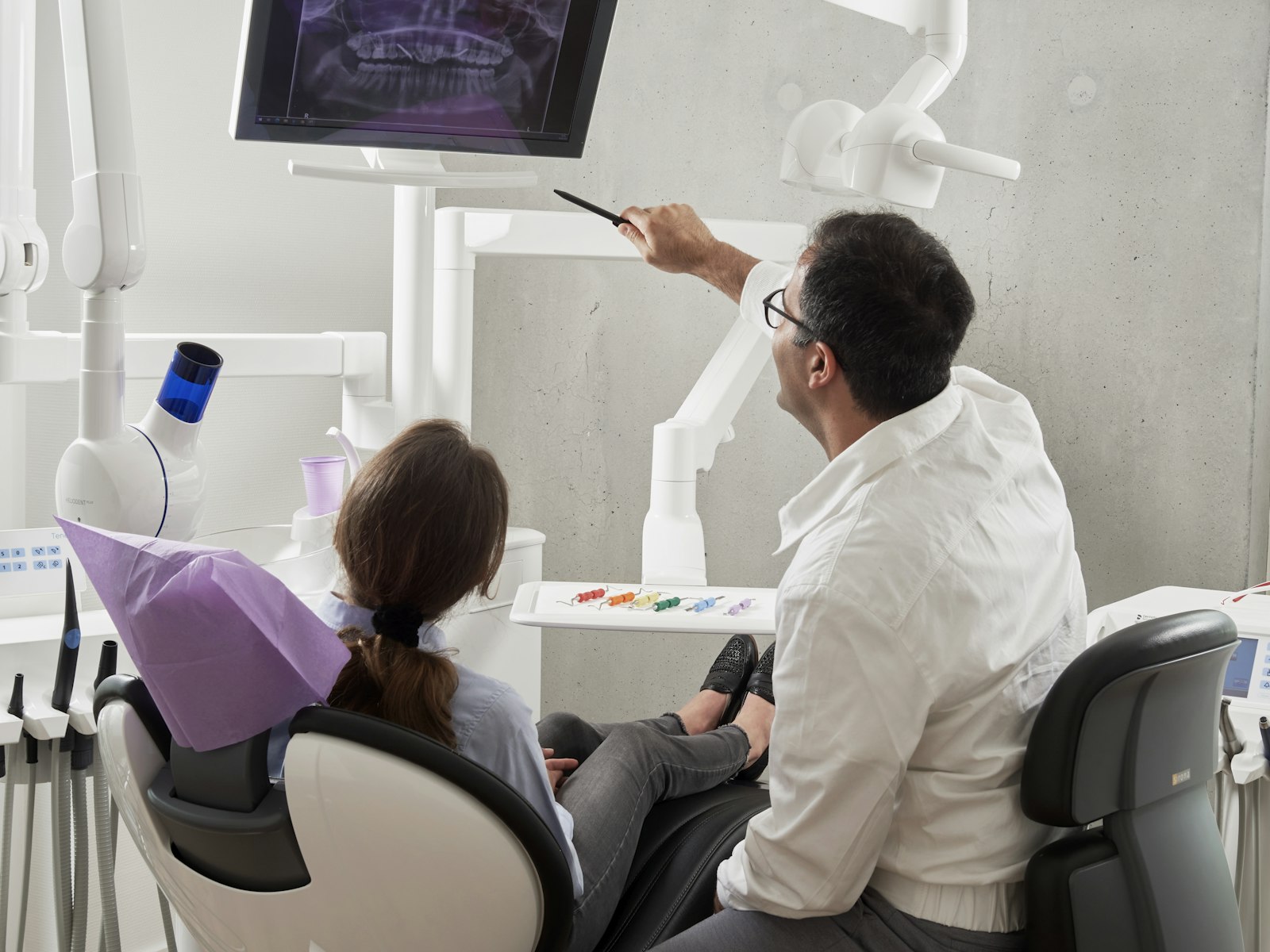
A dentist and patient reviewing images on a monitor after changing dentists and transferring records and X-rays
A recent radiograph from your previous practice can often be read straight off a screen.

Why a new dentist should reuse a recent X-ray

Radiographs use ionising radiation. The dose from routine dental imaging is low, but the governing principle is ALARA, as low as reasonably achievable, which means every image has to be clinically justified. The Australian Dental Association sets this out in its policy statement on radiation safety.

The practical translation is simple. If you had an OPG taken eight weeks ago and it is diagnostically adequate for the question in front of the dentist, retaking it for the convenience of a new practice's software is not a justification. Asking for the file is.

The honest counterweight is that reusing an old image is not automatically appropriate either. A bitewing from three years ago tells a clinician what your teeth looked like three years ago, and decay does not stand still. The decision rests on clinical currency, image quality and what is actually being investigated, and it belongs to the treating dentist rather than to a rule of thumb. If you want to understand what each film actually shows, our guide to bitewings, OPGs and periapicals goes through them one by one, and how often dental X-rays are taken and how safe they are covers the dose question.

How to make the request

There is no single mandatory method. Some practices accept a verbal request at the front desk, some have a written form, some use a patient portal, and many will accept an email. Any of those can be valid. Pick the one your previous practice prefers and put it in writing anyway, because a written request gives both sides a record of what was asked for and when.

Keep the request short and specific. Include your full name, date of birth, the approximate dates you attended, the list of items you want, where to send them, and the format you would prefer. Digital radiographs can generally be supplied as image files rather than printed film, which is more useful to the receiving practice. If you last attended some years ago, say so, because older files are sometimes archived off site and take longer to retrieve than a current patient's file.

You can also ask the new practice to request the records on your behalf, with your written consent. That often runs more smoothly, because the two practices speak the same language about what is needed. It is a common step before getting a second opinion as well, since a second opinion given without the previous imaging is working half blind.

A tooth model on a table representing the records and X-rays gathered when changing dentists in Sydney
Ask for items by name; a summary letter rarely carries enough clinical detail.

Fees, timing, and one common misconception

A practice can charge for providing access. The limit is that the charge must reflect the reasonable cost of retrieving and copying the material, and it must not be pitched so high that it stops you getting the information. If a quoted fee feels like a deterrent rather than a cost, that is worth questioning.

On timing, expect a reasonable period rather than a guaranteed number of business days. The OAIC's guidance points to about thirty days as a benchmark for reasonableness, and that is the figure to cite politely if a request has gone quiet.

Now the misconception, and it is a persistent one. A right of access under APP 12 is not conditional on your account being settled. An outstanding balance is a debt matter and is dealt with as a debt matter. It is not a lever for withholding health information from a patient, and treating it as one is risky for a practice. If you are told your records are being held until you pay, that is worth raising directly and, if it continues, escalating.

Retention, and what happens if a practice closes

The Dental Board of Australia retired its standalone Guidelines on dental records on 1 October 2020, on the basis that the Board's Code of Conduct already sets the national standard. Section 8.3 of that Code deals with health records and carries the same broad retention benchmark: seven years for adults, and until age 25 where the patient was treated as a minor.

Closure does not end the obligation. The Code expects a practitioner who is retiring or closing a practice to give patients reasonable notice and to arrange transfer of records or continued custodianship. Records still have to be stored securely. If a practice has closed and you cannot find where the files went, start with the practitioner's registration details through AHPRA, and ask whether a custodian was appointed.

If something goes wrong, who to contact

Match the complaint to the regulator, because these bodies are not interchangeable and sending it to the wrong one costs weeks.

  • The NSW Health Care Complaints Commission handles complaints about health services in NSW, including access to health information, quality of care and professional conduct. It can be reached on 1800 043 159 or through its online complaints portal.
  • The Office of the Australian Information Commissioner handles suspected breaches of the Privacy Act, including a refused or ignored APP 12 request by a private practice. It can be reached on 1300 363 992.
  • AHPRA and the Dental Council of NSW deal with conduct and registration concerns about an individual practitioner. AHPRA can be reached on 1300 419 495.

Most access problems are resolved before any of this, usually by a second, clearer, written request. Escalation is a last step, not a first one.

Common questions

How do I get my dental records from a previous dentist?

Contact the previous practice in writing with your name, date of birth, the dates you attended and a specific list of what you want. Ask for radiographs as digital image files. You can make the request yourself or ask your new practice to request them with your written consent.

Can a dentist refuse to give me my records?

A practice generally has to give you access to the information it holds about you under APP 12. There are limited exceptions in the Privacy Act, and where an exception applies the organisation is expected to explain the refusal and how to complain. An unpaid account is not one of those exceptions.

How long do dentists have to keep records in Australia?

The broad benchmark in the Dental Board's Code of Conduct is at least seven years for an adult from the date information was last provided, and until age 25 where the patient was under 18 at the time. Section 25 of the NSW HRIP Act sets equivalent minimums for health service providers covered by it.

Can I get copies of my dental X-rays?

Yes. Radiographs are part of your health information and are commonly stored digitally, so they can usually be supplied as image files by email, on a USB drive, or through a secure transfer link. Ask for the date each image was taken; a file without a date is much less useful.

Do I own my dental records?

You own the information; the practice generally owns the physical or digital file it created. In practice that means you have a right of access and a right to copies, not a right to walk out with the original file. It is a distinction that avoids a lot of unnecessary friction.

Can a new dentist use my old X-rays?

Often, if they are recent enough and diagnostically adequate for the question being asked. That judgement belongs to the treating dentist, because an image that is too old or of poor quality can mislead. Bringing your previous films is always worth doing, even where a new image turns out to be needed.

Starting somewhere new

Bringing your history with you makes the first appointment at any new practice better. The team at Lumi Dental in Melrose Park is happy to request records from a previous practice with your consent, and will review whatever arrives before recommending any new imaging. If you want to know how the first visit runs, what to expect at an adult first dental visit walks through it, and how to read a treatment plan covers what you get afterwards. Current options for new patients are on our current deals page.

This article is general information about record access in Australia and is not legal advice or a substitute for personal dental advice; please raise your own situation with the practice involved or the relevant regulator.


Dr James Tran — Lumi Dental, Melrose Park

Written by Dr James Tran

Dr James Tran (BDS, University of Sydney) is the founder of Lumi Dental in Melrose Park. He is committed to providing clear, evidence-based dental information to help patients make informed decisions about their care.

Ready to book your visit?

New patients welcome. Comprehensive first visit including exam, x-rays and treatment plan — just $149.

Book now