

Many people with a missing bottom front tooth are told the gap is too small for an implant, and sometimes that is true. Often, though, a narrower implant or a bonded bridge will fit, and the only way to know is to measure the bone and the neighbouring roots on a 3D X-ray. The gap you can see between the crowns is rarely the number that matters.
Written by Dr James Tran, BDent (University of Sydney), MICOI, GradDip (Oral Implants), general dentist at Lumi Dental in Melrose Park.
Three things make this area hard to work in
Lower incisors are the smallest teeth in the mouth, so the space one of them leaves behind is small as well. Their roots can also sit close together or lean towards each other below the gum, which means the room between two roots can be less than the room between the two crowns above them.
The third problem is the ridge itself. Once a tooth is lost, the bone that held it starts to shrink, and at the front of the lower jaw it is often thin from front to back to begin with. A clinical article in Perio-Implant Advisory describes exactly this pairing: limited room between the roots for a regular implant, and a lower front ridge that frequently wastes away.
That is why waiting matters. A lower incisor gap is easy to ignore because it shows less than an upper one, but the longer it is left, the less bone remains for any fixed option.
Narrow implants have a reasonable track record
Standard implants are made in widths that suit most back teeth and many upper front teeth. Narrow-diameter implants are slimmer versions designed for sites like this one, where a standard width would sit too close to a neighbouring root or leave too little bone on the tongue or lip side.
A 2021 systematic review and meta-analysis by González-Valls and colleagues in the journal Materials pooled 15 studies covering 773 patients and 1,245 narrow implants. At three years, survival was 97%, success 96.8%, and average bone loss around the neck of the implant about 0.8 mm. The authors judged these results comparable to standard-width implants and concluded that narrow implants are a predictable option.
Three years is not a lifetime, and the studies varied in design, so these figures are a guide rather than a promise. The crown on a narrow implant is also small and the connection is fine, so the bite on it needs to be checked carefully, especially for people who clench or grind.
Bone beside the implant protects the gum between the teeth
Implant planning leaves a margin of bone between the implant and each neighbouring root, and a layer of bone on the lip and tongue sides. Placing an implant too close to a natural tooth can lead to bone loss between them. That bone supports the small point of gum between the teeth (the papilla), so if it is lost the gum can flatten and leave a dark triangle near the gum line.
The exact clearance needed depends on the implant design and the site, which is why the measurement is taken from the 3D image at the depth where the implant will sit, not judged by eye.
When one implant can carry two teeth
Losing two neighbouring lower incisors is common, often after gum disease. The combined gap may be wide enough for one implant but not two with safe spacing. In selected cases, a single implant supports two joined crowns, one of which is a small cantilever. Where the width does allow two, narrow implants can be placed side by side and joined by a splinted restoration. Our article on two missing front teeth walks through the same decision for the upper jaw.
A bonded bridge is often the strongest alternative
A resin-bonded bridge (sometimes called a Maryland bridge) is a false tooth with a thin wing glued to the back of one or both neighbours. Little or no drilling is needed, there is no surgery, and it can suit younger adults or ridges too thin for an implant.
An integrative review by Mendes and colleagues in the European Journal of Dentistry (2021) looked at 23 clinical studies of front-tooth bonded bridges. Estimated five-year survival was 86.2% for metal frameworks, 87.9% for zirconia, 93.3% for alumina and 100% for glass-ceramic designs. Failure rates did not differ significantly between materials or between one-wing and two-wing designs, although the authors noted that a cantilever (one-wing) design reduces stress on the bond and described all-ceramic cantilever bridges as a definitive option, well suited to adolescents and young adults who are still growing.
A 2026 case report in Clinical Case Reports (Hariri and colleagues) described a single-wing glass-ceramic bridge replacing a missing lower central incisor, stable at 25 months. One case does not prove much, but it shows the approach in this exact site. See our guides to Maryland bridges and to one-wing and two-wing designs for more detail.
Other ways to fill the gap
A conventional bridge
This means trimming the neighbouring teeth to hold crowns. The Perio-Implant Advisory article points out that lower incisors make poor long-term supports, because they are small and thin. A conventional bridge works well in many parts of the mouth but is rarely first choice here.
Closing the space with orthodontics
When the lower front teeth are crowded as well, clear aligners or braces can sometimes close the gap while straightening the others, so no replacement tooth is needed. This depends on the bite and on how much space there is.
A removable partial denture
A small plate with a tooth on it is the least invasive option and often serves as a temporary while an implant heals. It can be lost or broken and does nothing to keep the ridge from shrinking.
| Option | Effect on neighbouring teeth | Surgery | Often suits |
|---|---|---|---|
| Narrow-diameter implant | None | Yes, minor | Enough bone on both sides and root clearance |
| One implant, two crowns | None | Yes, minor | Two adjacent incisors missing, room for one implant |
| Resin-bonded bridge | Minimal, bonded to the back | No | Younger adults, thin ridges, no surgery wanted |
| Conventional bridge | Both trimmed for crowns | No | Rarely first choice for lower incisors |
| Orthodontic closure | Moved into the space | No | Crowding as well as a gap |
| Partial denture | Clasps may rest on them | No | Temporary use, or when nothing else suits |
A 3D X-ray and scan settle the question
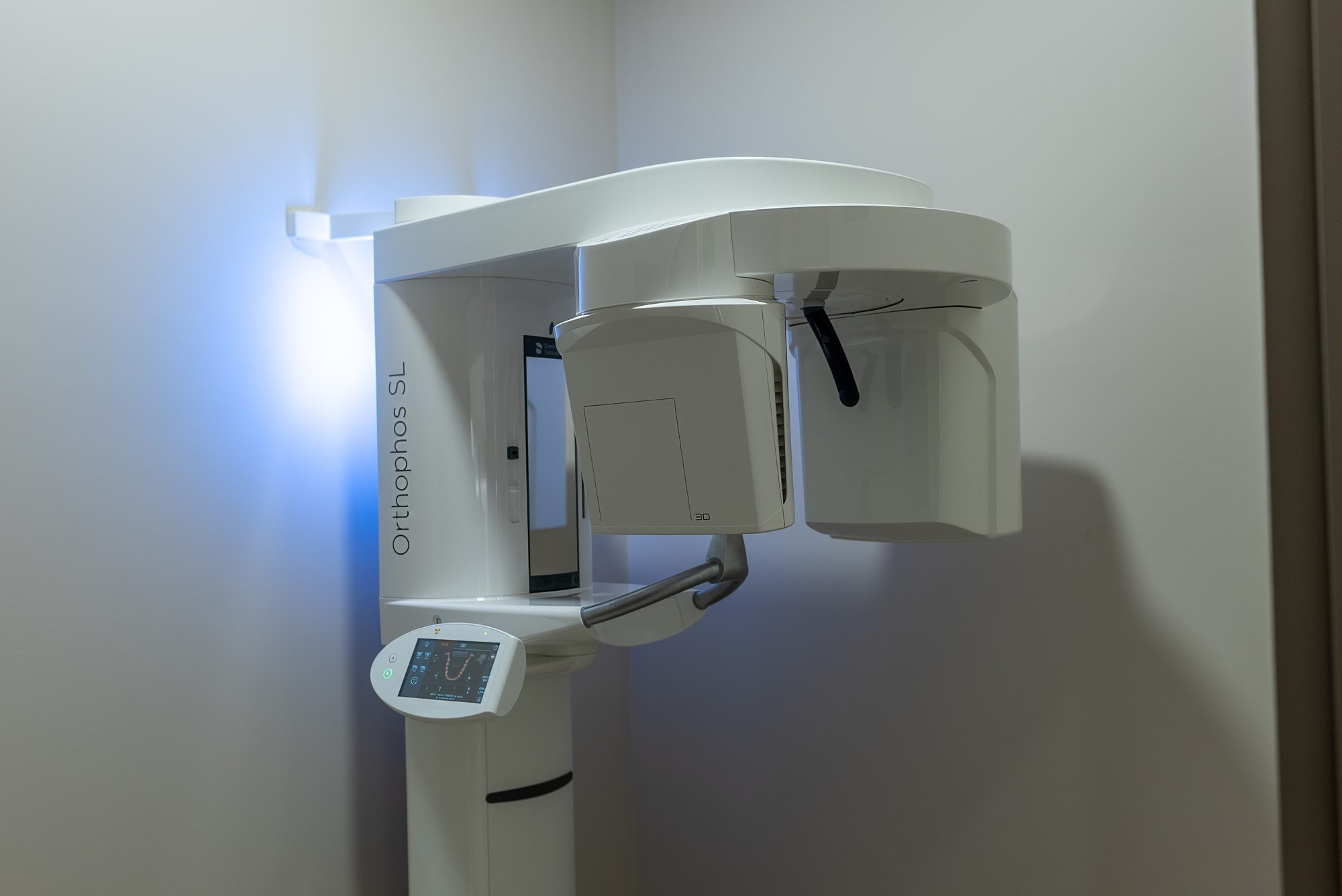
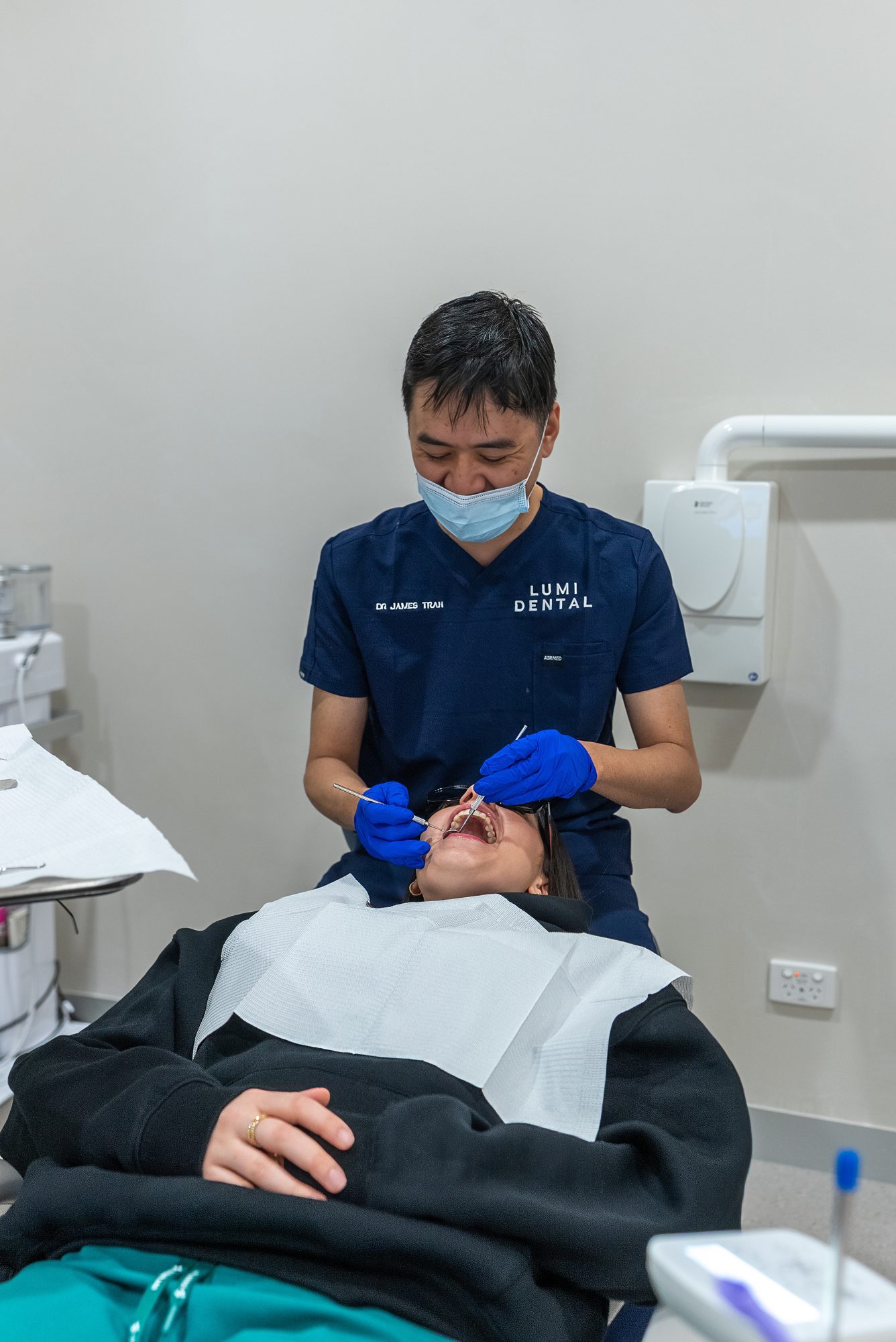
A flat X-ray shows the space between roots but not the thickness of the ridge, which is usually the real limit. A 3D X-ray (CBCT) shows the bone from front to back at the level where an implant would sit, how the neighbouring roots are angled, and the small nerves and vessels at the front of the lower jaw. Our guide to CBCT scans explains what these images show.
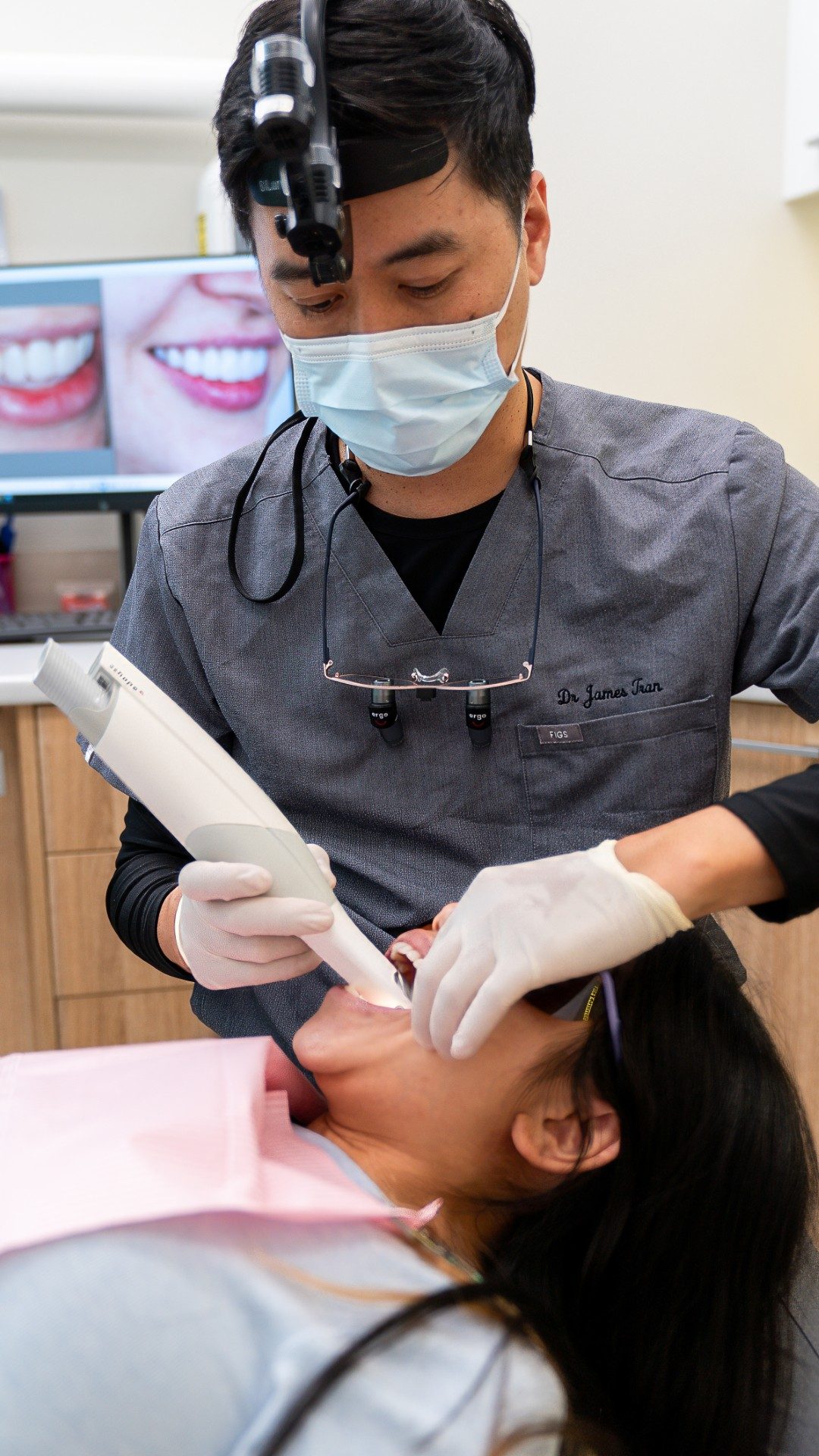
At Lumi Dental, the 3D X-ray and our intraoral scanner are both in house. The scan records the teeth and gums so the final crown can be designed first, and the two sets of images are combined to plan where an implant could go, or to show that a bonded bridge is the better fit. Where an implant suits, it is planned and placed at the practice; if extensive bone grafting would be needed, we may refer to a registered specialist.
Matching a small crown to worn neighbours
Lower incisors are often slightly worn or darker at the edges in adults, so a bright new crown can stand out. The shape and shade are matched to the teeth beside it, and the gum outline depends on the bone that was preserved during planning. Our article on matching an implant crown to your natural teeth covers the process.
Common questions
Can a bottom front tooth be replaced with an implant?
Often, yes, usually with a narrow-diameter implant. Whether it is suitable depends on the bone thickness and the clearance from neighbouring roots, both measured on a 3D X-ray.
Are narrow implants weaker than standard ones?
Pooled studies have reported survival of about 97% at three years, with results comparable to standard implants, although follow-up in these studies is still fairly short. They are chosen where a wider implant would not fit safely.
What happens if I leave the gap for a while?
The ridge tends to keep shrinking and nearby teeth can drift or tip, which can narrow the options later. Our article on leaving a missing tooth explains how this happens.
Find out what fits your gap
If you have been told a lower front tooth cannot take an implant, we can measure the space on a 3D X-ray and talk through each option with you. Free consults are available for implant treatment; see current offers, read about dental implants at Lumi Dental, or contact us to book at Melrose Park.
Sources
- González-Valls G, et al. Narrow diameter dental implants as an alternative treatment for atrophic alveolar ridges: systematic review and meta-analysis. Materials, 2021
- Perio-Implant Advisory: Narrow-diameter implants, a solution for replacing single missing lower incisors
- Mendes JM, et al. Survival rates of anterior-region resin-bonded fixed dental prostheses: an integrative review. European Journal of Dentistry, 2021
- Hariri I, et al. Single-retainer lithium disilicate resin-bonded bridge for mandibular central incisor replacement: a 25-month case report. Clinical Case Reports, 2026
About the author

Dr James Tran is a general dentist at Lumi Dental in Melrose Park. He holds a BDent from the University of Sydney and a Graduate Diploma in Oral Implants, and is a Master of the International Congress of Oral Implantologists (MICOI).
This article is general information only and is not a substitute for an examination and individual advice from a registered dental practitioner. Suitability for any treatment varies from person to person.








