

Two missing front teeth can be replaced with two separate implants, each carrying its own crown, or with an implant bridge, where fewer implants hold up a joined row of teeth. Patients searching for two missing front teeth implants often assume the answer is one implant per tooth, but the gum between the teeth, the thickness of the bone and your smile line all affect which option suits. Systematic reviews of single implant crowns have reported five-year implant survival of around 97 per cent, so the technology is not usually the limiting factor. Planning is.
Written by Dr James Tran, general dentist at Lumi Dental in Melrose Park (BDent, University of Sydney; Graduate Diploma in Oral Implants).
The short version
- Two implants with two crowns is the most common starting point, because each tooth is supported on its own and can be cleaned like a natural tooth.
- An implant bridge uses fewer implants than missing teeth, which can help when space or bone is limited, but the joined teeth are cleaned differently.
- The gum peak between two side-by-side implants is hard to rebuild at the front, so the order and spacing of treatment matter.
- A tooth-supported bridge or a resin-bonded bridge avoids surgery but relies on neighbouring teeth (see our implant, bridge and denture comparison).
- Bone usually needs around three months to bond to an implant, so a temporary tooth is part of the plan.
- A 3D scan and a written plan, with a quote, let you compare options before you commit.
What "Two Missing Front Teeth" Can Mean
The phrase covers several different situations, and each one changes the advice. Two central incisors, the large teeth at the very middle, sit side by side and carry most of the weight of a smile. Two lateral incisors, one on each side, are separated by the centrals and behave more like two single-tooth gaps. A central and a lateral next to each other sits somewhere in between.
The reason for the loss matters as well. A tooth lost to injury often leaves a thin plate of bone at the front. A tooth lost to gum disease or infection may have lost height of bone and gum with it. Teeth that never developed leave a narrow gap that may be tight for an implant. In my experience, patients are surprised by how much of the first appointment goes into looking at the gum and bone rather than the gap. Our article on what to expect with a front tooth implant covers the single-tooth version of this planning.
Option One: Two Implants, Two Crowns
Here each missing tooth gets its own titanium or ceramic post in the jawbone and its own crown. Nothing is joined together. If one crown chips or needs replacing, the other is not disturbed.
What it asks of the bone and gum
Implants placed side by side need enough room between them. When two implants sit very close, the small peak of gum between them, called the papilla, may not fill the space fully, which can leave a dark triangle. At the front of the smile that is visible. Planning from a 3D scan helps to position each implant so that the crowns can be shaped to support the gum. If the bone is thin, a graft may be suggested first, and our guide to bone grafts for dental implants explains what that involves.
When it tends to suit
Two implants may suit when the gap is wide enough for two teeth, the bone is reasonably healthy, and the neighbouring teeth are sound and best left untouched.
Option Two: The Implant Bridge
An implant bridge is a row of joined crowns supported by implants, with fewer implants than teeth. For two missing front teeth, a dentist might place implants at the edges of the gap or at one position and join the crowns so that a false tooth spans the space. Because the teeth are connected, the gum underneath the false tooth is not supported by an implant, and the shape of that section is designed to be easy to clean.
This can be useful when the space is narrow, when bone is thin in one spot, or when treatment needs to be kept simpler. The trade-offs are practical ones. A joined bridge has to be cleaned with floss threaders or interdental brushes, and if one part fails the whole structure is usually involved. A false tooth hanging off one implant, called a cantilever, puts extra load on that implant. We cover the mechanics in our article on the implant-supported bridge.
How the Options Compare
The table sets out the main choices for two adjacent front teeth. It describes general patterns, not a recommendation for any individual mouth.
| Option | Surgery | Neighbouring teeth | Cleaning | Points to weigh |
|---|---|---|---|---|
| Two implants, two crowns | Yes, two sites | Left untouched | Each tooth cleaned separately | Needs enough width and bone; gum peak between teeth is the challenge |
| Implant bridge | Yes, fewer sites | Left untouched | Floss threaders or interdental brushes under the joined section | Can suit narrow gaps; teeth are joined |
| Tooth-supported bridge | No | Teeth either side are reshaped to carry the bridge | Threaders under the false teeth | Best when those teeth already need crowns |
| Resin-bonded bridge | No | Small amount of enamel reshaped | Threaders under the false teeth | Less commonly used for two missing teeth |
| Partial denture | No | Clasps may rest on teeth | Removed daily | Often used as a temporary solution |
A Simple Rule for Choosing
If the gap is wide enough and the bone is healthy, start by discussing two implants. If the gap is narrow, the bone is thin or you would prefer fewer surgical sites, ask whether an implant bridge fits instead. If the neighbouring teeth already have large fillings or crowns, a tooth-supported bridge may be worth comparing too.
That rule is a starting point, not a verdict. I usually ask patients to smile as widely as they can at the first visit, because how much gum shows decides how much the gum work matters. A scan, a bite check and a look at your smile line are what turn it into a plan.

What the Research Reports
A systematic review of implant-supported single crowns reported survival of the implant at around 97.2 per cent after five years and 95.2 per cent after ten, with survival of the crowns themselves lower at 96.3 per cent and 89.4 per cent respectively. A separate review of implant-supported bridges reported implant survival of 95.6 per cent at five years and 93.1 per cent at ten, and noted that only around two-thirds of patients were free of any complication after five years. Chipping of the porcelain layer was the most frequent problem.
Those figures describe groups of patients, not you. They suggest that implants themselves tend to last well, while the visible crown or bridge may need maintenance or replacement over the years.
Gum, Bone and Temporary Teeth During Healing
Bone typically needs around three months to bond to an implant, according to the Australian Dental Association, although the exact timing depends on the site. A temporary tooth is therefore part of the plan, such as a removable partial denture (sometimes called a flipper) or a temporary bonded tooth. Whether something fixed can go on the implant on the day depends on how stable it is and how the bite meets it. Our guide to immediate versus delayed implant placement explains why timing differs.
Once the implants have bonded, the gum is shaped around temporary crowns, then final crowns are matched to your neighbouring teeth for shade and shape. Front teeth show every difference in colour, so this step takes time.
How We Approach This at Lumi Dental
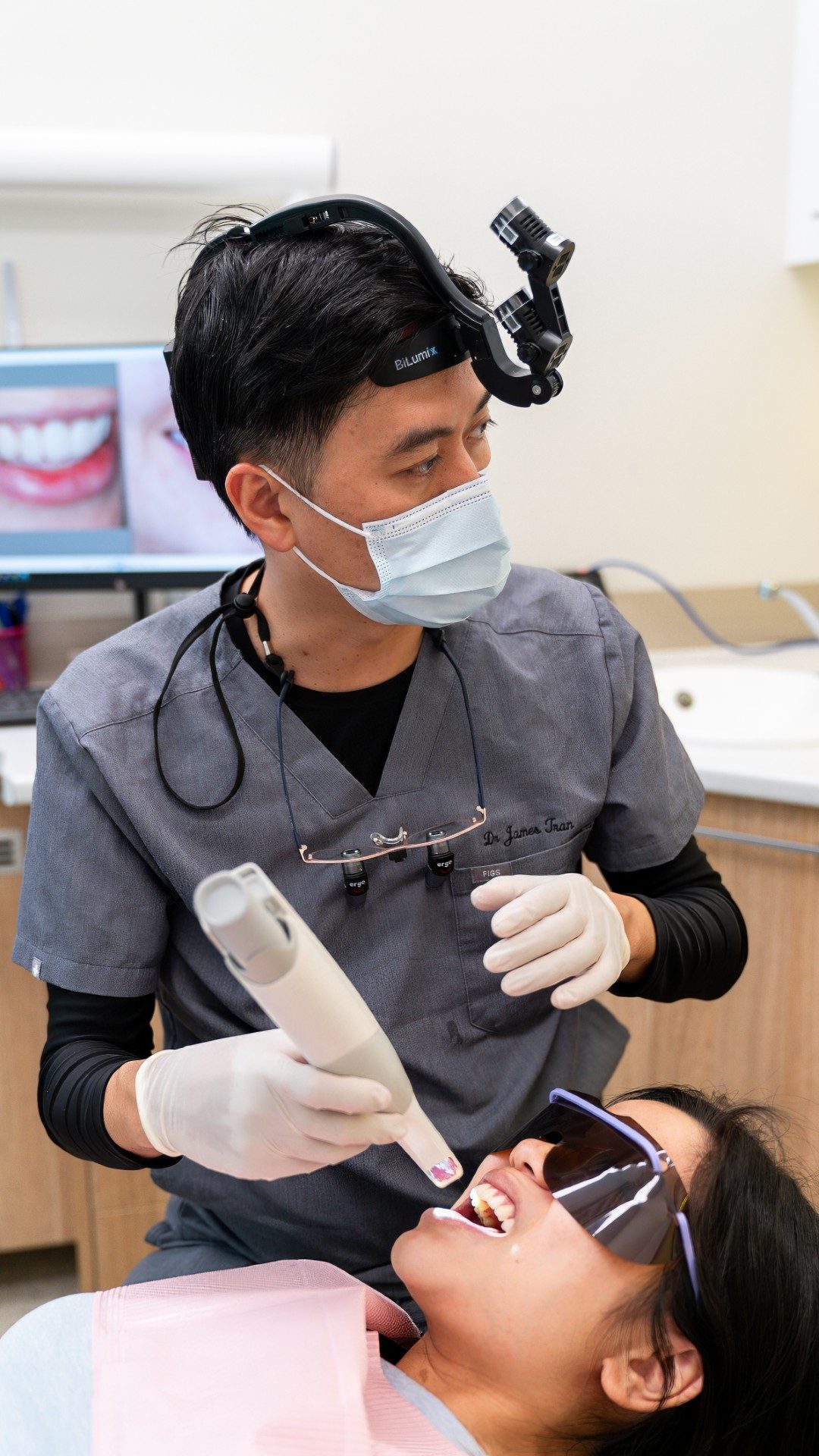
The team at Lumi Dental in Melrose Park offers single and full-arch dental implants as part of general dentistry. For missing front teeth, the first appointment is usually a check-up, a 3D intraoral scan and a conversation about what you want your smile to look like. The practice also scans and 3D prints in-house. If a case needs the input of a registered specialist, for example for complex bone work, the team refers it on. Lumi Dental does not list its own prices in articles, so you receive a written quote after your consult.
Questions Patients Ask
Is it better to have two implants or an implant bridge for two front teeth?
Neither is better in every mouth. Two implants are usually the starting point because each tooth stands alone, while an implant bridge can suit narrow gaps or thin bone. A scan and examination decide which fits.
How long does it take to replace two front teeth with implants?
Often several months in total. Bone typically needs around three months to bond to an implant, and shaping the gum and making the final crowns adds more time. A temporary tooth is usually provided meanwhile.
Will there be a gap or dark triangle between two implant crowns?
It can happen, because the gum peak between two adjacent implants is difficult to rebuild. Careful spacing, crown shape and gum planning reduce the chance but cannot guarantee the result.
Can I wear a temporary denture while the implants heal?
Yes, a removable partial denture is a common temporary option, and our comparison of bridges and partial dentures explains how it differs from a fixed bridge. Your dentist will advise whether something fixed is possible instead.
Do I need a bone graft for front teeth implants?
Not always. The bone at the front is often thin, particularly after an injury or long-standing tooth loss, so a graft is sometimes suggested. A 3D scan shows how much bone there is before any decision is made.
Talk Through Your Options at Lumi Dental
If you are comparing two implants with an implant bridge, the team at Lumi Dental can scan your mouth, explain what each option would involve and provide a written quote. Read about dental implants in Melrose Park, or book a consult. Patients visit from Ryde, Parramatta, Ermington, Rydalmere and nearby suburbs.
Sources
- Australian Dental Association: Dental implants
- PubMed: Systematic review of the survival rate and complications of single crowns on implants (Clinical Oral Implants Research)
- PubMed: Systematic review of the survival and complication rates of implant-supported fixed dental prostheses (Clinical Oral Implants Research)
About the author

Dr James Tran is a general dentist at Lumi Dental in Melrose Park. He holds a BDent from the University of Sydney and a Graduate Diploma in Oral Implants, is a MICOI member and is part of the General Dental Residency faculty.
This article is general information and is not a substitute for individual advice from a dentist who has examined you.







