


Losing most of your teeth before 50 is less common than people assume, which is part of why it can feel so isolating. In the last national adult oral health survey, about 1.1% of Australians aged 35 to 54 had no natural teeth left, and none of the 15 to 34 year olds surveyed did. A denture at this age is a sound way to get your smile and your chewing back, but it needs to be planned as the first stage of something that will last decades, not as the finish line.
Written by Dr James Tran, BDent (University of Sydney), MICOI, GradDip (Oral Implants), general dentist at Lumi Dental in Melrose Park.
How many teeth you are losing changes the advice
For one or two missing teeth, a removable partial denture is rarely the long-term answer for someone in their thirties or forties. It clips onto the neighbouring teeth, comes out at night and puts load on the teeth that hold it. A single implant or a bridge fills the same gap without any of that, and a small temporary plate can cover the space while an implant site heals.
When most or all of an arch is failing, the balance shifts. A full denture can be made quickly, it is usually the lowest-cost way to replace a whole arch, and an immediate denture can be fitted on the same day the teeth come out. What it cannot do is protect the bone underneath, which is why the denture conversation should always include a plan for the jaw.
What usually causes tooth loss at this age
The same survey, the National Study of Adult Oral Health 2017 to 2018, found that 33% of 35 to 54 year olds had moderate or severe periodontitis, the advanced form of gum disease that destroys the bone around teeth. It also found that adults eligible for public dental care were around nine times as likely to have lost all their teeth as adults who were not, a reminder that cost and access play a large part.
Gum disease and extensive decay are behind most early tooth loss. Others come from sport or accident injuries, root canal treated teeth that have cracked or become reinfected, and teeth that never developed. If teeth are missing from birth, our article on congenitally missing teeth covers that situation.
The cause matters for planning. Teeth lost to gum disease usually leave less bone behind, and the gums need to be stable before anything is built on them. Teeth lost to decay often leave reasonable bone. A front tooth knocked out of an otherwise healthy mouth is usually one of the more straightforward implant situations.
The jaw keeps changing for years under a denture
Once a tooth is removed, the bone that held it starts to remodel. A systematic review of ridge preservation, drawing on research by Schropp and colleagues, describes a loss of about 50% of the ridge width, 5 to 7 mm, within twelve months of an extraction, with around two thirds of that change in the first three months. A denture does not stop this process. Our guide to why the jaw shrinks after tooth loss explains it in more detail.
For a denture wearer, the practical effect is a fit that drifts. The Better Health Channel notes that a new denture may need adjusting and relining within a few months of extractions, and remaking if there has been a lot of shrinkage. Someone who starts wearing a full denture at 70 might go through a handful of relines. Someone who starts at 38 will go through many more, and a lower full denture in particular tends to become harder to keep steady as the ridge flattens.
Partial dentures have an extra cost. Clasps put sideways forces on the teeth they grip, and the plate holds plaque against the gum line. A cobalt chrome framework is thinner and rests on the teeth rather than the gums, which tends to be kinder to what remains, but it still relies on those teeth for support.
The main denture types, and the role each can play
The Australian Dental Association describes dentures as made of acrylic resin (plastic) alone or combined with a lightweight cobalt chrome metal, and as full, partial or implant-retained. Here is how each tends to fit a younger adult's plan.
| Type | How it works | Typical role in your 30s and 40s |
|---|---|---|
| Acrylic partial denture | Plastic plate and teeth with wire clasps | An interim option, or a temporary while implant sites heal |
| Cobalt chrome partial denture | Thin cast metal framework carrying plastic teeth | A longer-lasting partial when the remaining teeth are healthy |
| Immediate full denture | Made before extraction and fitted on the day | Covers the healing period; expect adjustments, a reline and often a remake |
| Conventional full denture | Made after the gums have healed, often two to three months later | A better starting fit, still relined as the bone changes |
| Implant-retained overdenture | A removable denture that clips onto a small number of implants | A common second stage once healing and budget allow |
| Full-arch implant bridge (All-on-X) | A fixed bridge on implants, removed only by the dentist | The fixed option at the end of the plan, for suitable bone and health |
A staged plan keeps implants on the table
For most people in this age group who are losing an arch, a three-stage approach makes sense.
The extractions come first and are done with the future in mind. Teeth worth keeping are kept, and sockets that may later receive an implant can sometimes be grafted at the time of removal. Next comes the denture, immediate or conventional, relined as the gums settle. Later, once healing is complete and the budget allows, implants can be placed. Depending on the bone, an existing denture can sometimes be modified to clip onto them, or a new implant-retained overdenture or fixed bridge is made. Our comparison of dentures and All-on-X sets those end points side by side.
Staging also spreads the cost over time, with the denture as the smaller first outlay. You will usually receive a written treatment plan after your examination, often by email, and our article on payment plans and affording treatment covers how people manage larger plans. Any current offers are on our current deals page.
Questions worth asking before you agree to a plan
- Which teeth could be saved, and how does the cost of saving them compare with removing them?
- If a partial denture is suggested, what will the clasps do to the teeth they hold onto over the years?
- Immediate or conventional denture, and when should I expect the first reline?
- Will any sockets be grafted when the teeth come out, and why or why not?
- If I want implants in two or five years, will this approach leave enough bone?
- Could this denture be adapted to clip onto implants later?
- What does a 3D X-ray show about the bone I have today?
Living with a denture at 40 is as much emotional as practical
The Better Health Channel notes that research has linked tooth loss with feelings of grief, denial, anger and depression. In your thirties or forties those feelings can be sharper, because few friends will have been through it. It is worth saying so at the consultation.
The practical side improves with time. Chewing and speech usually settle over the first weeks, and starting with softer foods and reading aloud can help. The ADA advises cleaning a denture with a non-abrasive agent such as liquid hand soap rather than toothpaste, and taking it out overnight so the gums can rest.
Planning dentures and implants together at Lumi
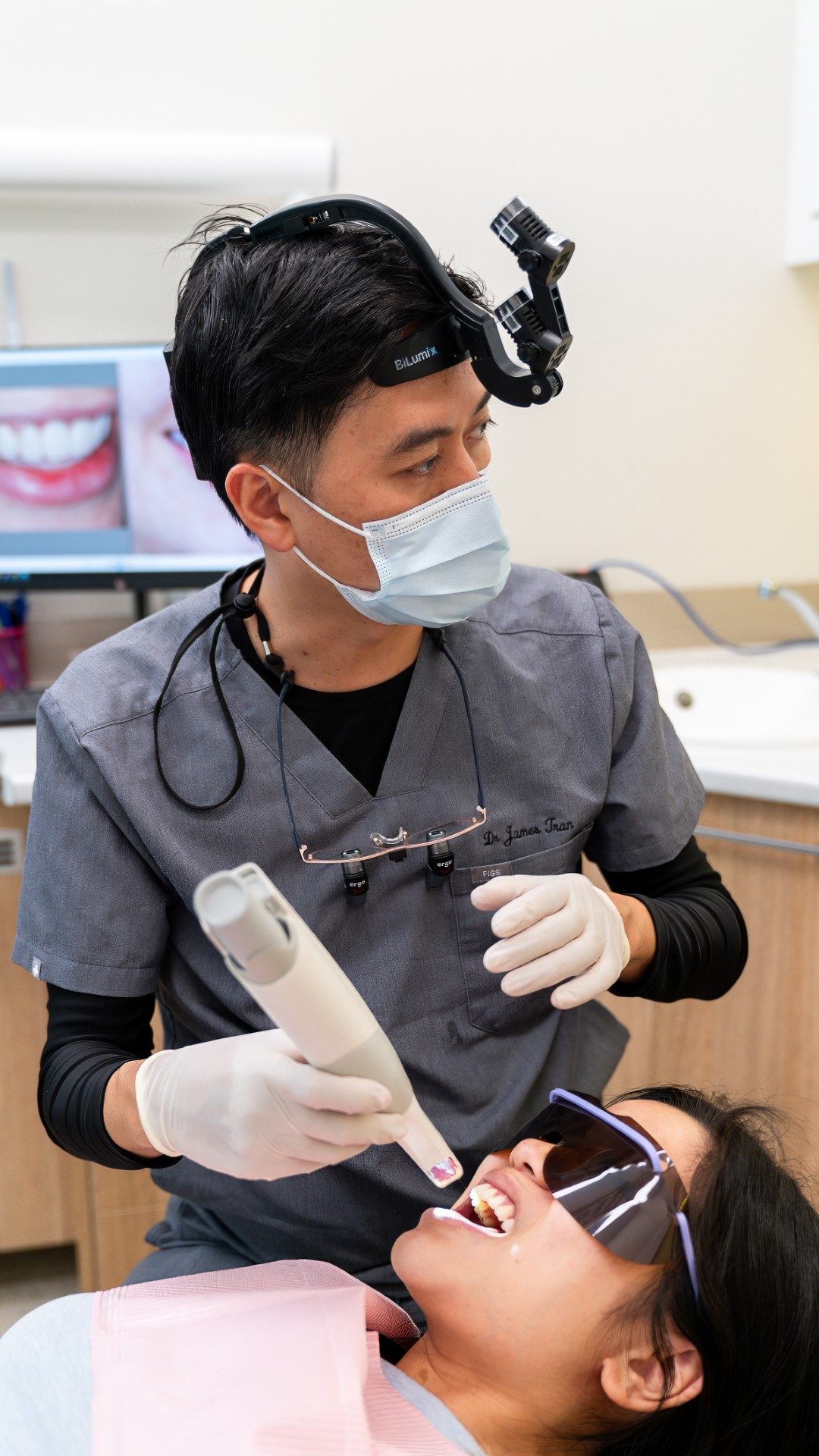
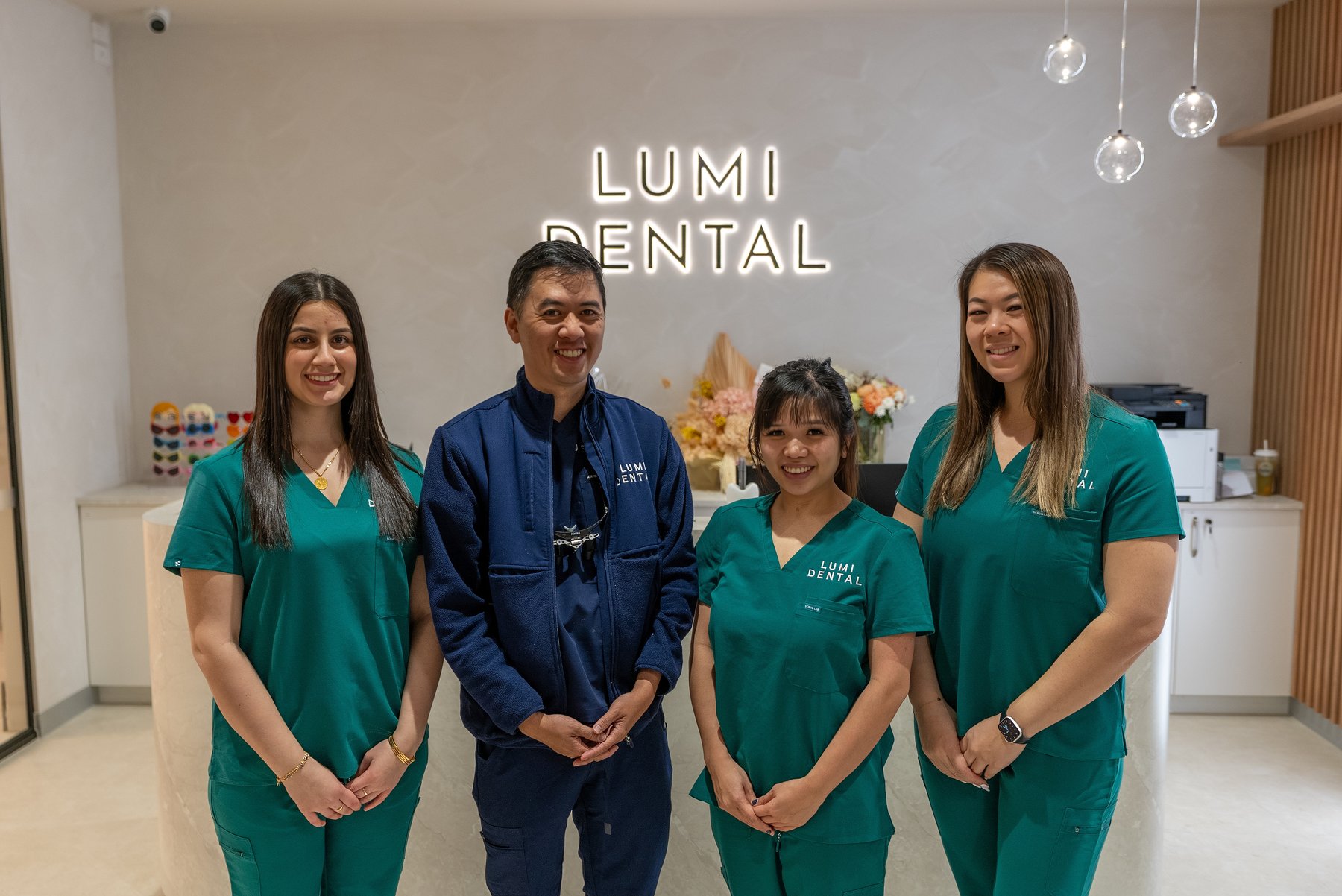
Planning at Lumi begins with an examination by a dentist, a 3D X-ray on our Orthophos unit and an intraoral scan, so the bone is measured before any recommendation is made. Where gum disease caused the tooth loss, our oral health therapists can help get the remaining gums stable first. We make dentures and carry out relines, and we place single implants, implant-retained overdentures and fixed full-arch bridges, so the plan can move from one stage to the next without starting again. You can read more about dental implants at Lumi.
Common questions
Am I too young for dentures?
No. Dentures are made for adults of any age. What changes at 35 or 40 is how far ahead the plan needs to look.
How long will my first denture fit well?
The denture itself may last some years, but the fit changes as the bone remodels. A reline within months of extractions is common, with further relines or a new denture later.
Does the denture cause the bone loss?
Most of the shrinkage comes from losing the teeth, and most of it happens in the first year. A denture that no longer fits well can add pressure on the ridge, which is one reason regular checks and relines matter.
Is it better to have an immediate denture or wait?
If going without teeth for a couple of months is not workable, an immediate denture is the usual choice, with more adjustments early on. If you can manage the gap, a conventional denture usually fits better from the start. Our guide to immediate dentures covers both paths.
Talk it through before any teeth come out
If you are facing the loss of several teeth, a consultation is the place to see the X-rays, understand which teeth can be kept and get a staged plan in writing. Lumi Dental is at Melrose Central in Melrose Park with free undercover parking. Get in touch to arrange a free consult, or read about full-arch implants at Lumi if you are already thinking about a fixed option.
Sources
- Australian Institute of Health and Welfare: Oral health and dental care in Australia, Healthy mouths
- Australian Dental Association (teeth.org.au): Dentures
- Better Health Channel: Dentures
- PMC (International Journal of Dentistry): Ridge preservation procedures after tooth extractions, a systematic review
About the author

Dr James Tran is a general dentist at Lumi Dental in Melrose Park. He holds a BDent from the University of Sydney and a Graduate Diploma in Oral Implants, and is a Master of the International Congress of Oral Implantologists (MICOI).
This article is general information only and is not a substitute for an examination and individual advice from a registered dental practitioner. Suitability for any treatment varies from person to person.








