
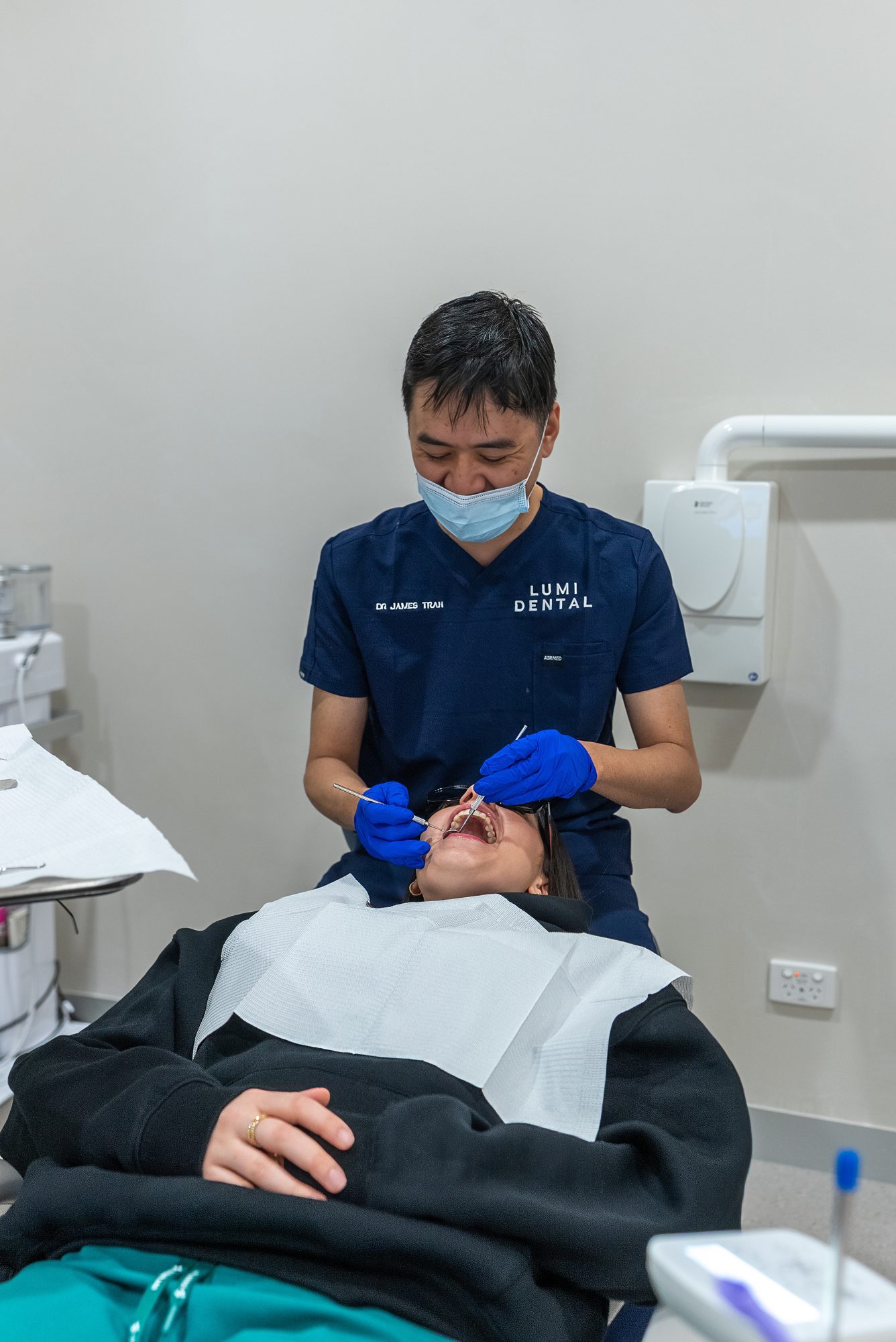

Whitening gel does not mix with your tablets the way two medicines can. It works on the teeth, from the outside. What a medicine can change is the mouth the gel is placed in: how much saliva you have, how your gums react, how your skin responds to light, and whether colour was laid down inside the teeth years ago. Those are the details your dentist needs before choosing a gel, a strength and a schedule.
Written by Dr James Tran, BDent (University of Sydney), MICOI, GradDip (Oral Implants), general dentist at Lumi Dental in Melrose Park.
Peroxide acts on the tooth, not in the bloodstream
Whitening gels contain hydrogen peroxide, or carbamide peroxide, which releases hydrogen peroxide as it breaks down. The peroxide moves through the enamel and breaks up coloured molecules in the dentine underneath. Because it is applied to the teeth rather than swallowed or injected, the questions about medicines are indirect ones, and each answer tends to shift a small decision: the gel strength, how long it is worn, whether an in-chair session suits you, and how far the colour is likely to move.
The Better Health Channel advises telling your dentist about every medicine you take. For whitening, that includes the items people tend to leave off the list because they were bought at the supermarket or chemist.
Drying medicines are the group that affects the most people
A long list of everyday medicines can reduce saliva. The Better Health Channel names antidepressants, diuretics, antihistamines and decongestants, as well as medicines for Parkinson's disease, beta-blocker blood pressure tablets and inhalers.
Saliva does several jobs during a whitening course. It neutralises acid and helps enamel recover between applications, it dilutes any gel that drifts onto the gums, and it keeps the teeth hydrated. With less of it, teeth can feel cold more sharply and the gum edge can become tender. When a drying medicine is on the list, a dentist may suggest a lower-strength gel, shorter wear times, whitening on alternate days, a smaller amount of gel in each tray, and a sensitivity toothpaste for a couple of weeks beforehand.
Our articles on whitening with a dry mouth, sensitivity during whitening and antihistamines and dry mouth cover these adjustments in more depth.
A sunlight warning on the leaflet is worth mentioning
Some medicines make the skin react more strongly to sunlight and ultraviolet light. Doxycycline is a common example. healthdirect notes that it can make skin more sensitive to sunlight or UV light and increase the risk of sunburn. It is used to control acne as well as to treat some infections.
Some in-chair whitening systems use a light over the gel. If you are taking a medicine with a sun warning, tell the dentist before an in-chair session is booked. They may suggest a session without a light, custom take-home trays, or waiting until the course has finished. This is a cautious habit rather than a response to a well-documented problem, but it costs nothing to raise.
Stain from medicines sits either on the tooth or inside it
Where a medicine has changed tooth colour, the type of stain decides what can be done.
Surface stain is removed by cleaning
Chlorhexidine mouthwash, often prescribed after gum treatment or oral surgery, can leave brown stain on the enamel and between the teeth. A review by Poppolo Deus and Ouanounou in the International Dental Journal (2022) found tooth staining was the adverse effect patients reported most, particularly with long-term use. This kind of stain comes off with a professional clean by a dentist or OHT, so the clean comes first and any whitening waits until the mouthwash course has ended.
Stain inside the tooth is harder to shift
Tetracycline antibiotics taken while the adult teeth were forming can leave yellow, brown or grey colour inside the dentine, often in bands. The American Dental Association's MouthHealthy site says yellow teeth tend to bleach well, brown teeth less so, and grey tones may not bleach at all, and that whitening is not effective when discolouration comes from medications. In practice, some medicine-related stain may lighten partly with a longer, carefully supervised take-home course, but the result is limited and hard to predict. MouthHealthy also notes that some antihistamines, antipsychotics and high blood pressure medicines can darken teeth as a side effect.
Our articles on tetracycline stains and grey teeth explain when bonding or veneers may be a better way to cover colour that whitening cannot reach.
How each medicine group can change the plan
| Medicine group | Examples | What it changes | Possible adjustment |
|---|---|---|---|
| Drying | Antihistamines, antidepressants, decongestants, diuretics, beta-blockers, inhalers | Less saliva, more sensitivity and gum irritation | Lower strength, shorter or alternate-day wear, sensitivity toothpaste first |
| Sun-sensitising | Doxycycline | Skin reacts more to sunlight and UV light | Session without a light, take-home trays, or waiting until the course ends |
| Surface-staining | Chlorhexidine mouthwash | Brown stain on the enamel | Professional clean first, whitening after the course |
| Staining from within | Tetracyclines taken while teeth were forming | Banding or colour in the dentine | Realistic expectations, longer course, or bonding or veneers |
| Gum-swelling | Some epilepsy and blood pressure medicines | Enlarged gums that gel can irritate | Gum care first, trays trimmed away from the gum line |
Never stop a medicine for the sake of whitening
No cosmetic treatment is a reason to stop, skip or change a prescribed medicine, and your dentist will not ask you to. The whitening plan is adjusted around the medicine instead. If something on your list raises a question, the dentist can check with your GP or prescriber.
Pregnancy and breastfeeding are the main times whitening is usually postponed rather than adjusted. Our article on whitening during pregnancy and breastfeeding explains why.
A checklist for your consultation
A photo of your medicine boxes is often easier than writing a list. Include:
- every prescription medicine, and any dose change in recent months
- over-the-counter and herbal products, such as antihistamines, decongestants, sleep aids, iron and St John's wort
- any antibiotic course you are on or have just finished, and any antibiotics you know you had as a young child
- mouthwashes you use regularly, especially chlorhexidine
- reflux or frequent heartburn, and any medicine you take for it
- a dry mouth, ulcers or gum swelling that started after a new medicine, and any pregnancy or breastfeeding
Kits bought online cannot make these adjustments
Over-the-counter and online kits assume normal saliva, healthy gums and no stain inside the teeth. Medicines are one of the most common reasons those assumptions do not hold. In Australia, higher-strength peroxide gels can only be supplied by dental practitioners, which is the setting where strength and wear time can be matched to your mouth.
At Lumi Dental, whitening starts with an examination by a dentist and a medical history that asks about every medicine, supplement and mouthwash, and clinical photographs record the starting colour. Surface stain and inflamed gums are treated first by a dentist or OHT. The options are Lumi Home, Lumi Refresh and Lumi Radiance, and all include custom trays with Boutique take-home gel. We do not promise a particular shade, because the result depends on your teeth. The teeth whitening page explains how the consult works, and any offers are on the current deals page.
Common questions
Can I whiten while I am on antibiotics?
Usually yes. If the antibiotic is doxycycline or another medicine with a sun warning, the dentist may suggest take-home trays or a session without a light, or waiting until the course finishes.
Can I whiten if I take antidepressants or blood pressure tablets?
In most cases, yes. Both groups commonly reduce saliva, so a gentler gel, shorter wear and a sensitivity toothpaste beforehand are often suggested. Some blood pressure medicines can also cause gum swelling, which is treated before trays are made.
Will whitening remove stain caused by a medicine?
Surface stain from chlorhexidine comes off with a professional clean. Colour inside the tooth from tetracyclines responds poorly to whitening and rarely disappears, so bonding or veneers are often discussed if it bothers you.
If your medicines have you unsure about whitening, book a free cosmetic consult at Lumi Dental in Melrose Park. The dentist will examine your teeth, go through your list with you and suggest an approach that suits your mouth, or read more about teeth whitening at Lumi first.
Sources
- Better Health Channel (Victorian Department of Health): Teeth and medication
- healthdirect: Doxycycline
- American Dental Association (MouthHealthy): Teeth Whitening
- Poppolo Deus F, Ouanounou A. Chlorhexidine in Dentistry: Pharmacology, Uses, and Adverse Effects. International Dental Journal, 2022
About the author

Dr James Tran is a general dentist at Lumi Dental in Melrose Park. He holds a BDent from the University of Sydney and a Graduate Diploma in Oral Implants, and is a Master of the International Congress of Oral Implantologists (MICOI).
This article is general information only and is not a substitute for an examination and individual advice from a registered dental practitioner. Suitability for any treatment varies from person to person.








