
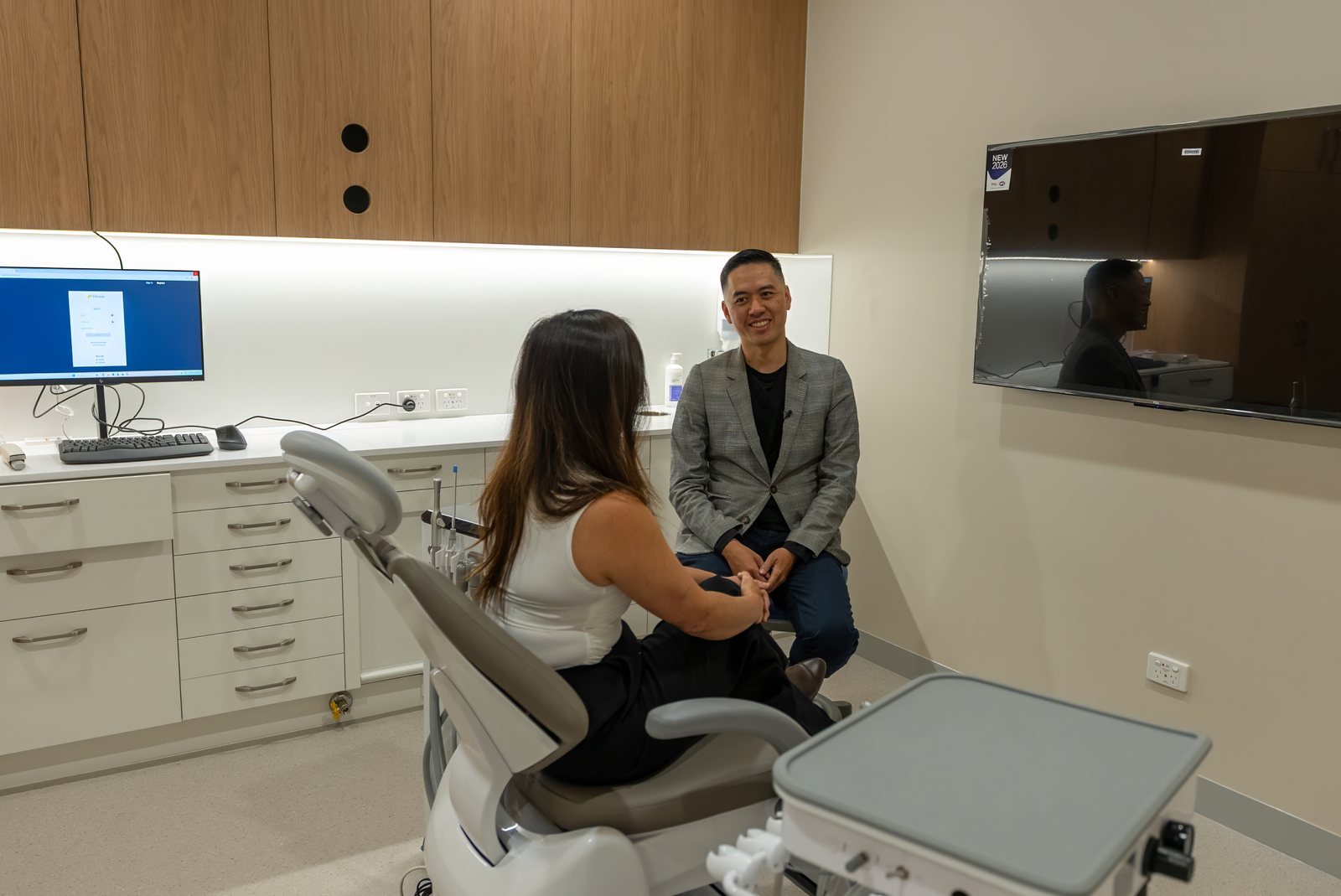

After a single dental implant under local anaesthetic, exercise, alcohol and flying after dental implant surgery follow a simple pattern: light activity from the next day, vigorous training held back for about a week, no alcohol for at least 24 hours and for as long as you take prescribed medicines, and flying after a few days. A bone graft or sinus lift pushes every one of those dates back. Guy's and St Thomas' NHS hospital tells its implant patients to avoid alcohol for 24 hours and that they can return to work the day after treatment, a fair picture of how routine the first days usually are. The questions I hear most before surgery are about a gym program, a wedding or a work trip already booked, so this guide sets out the usual timeframes and where waiting longer matters.
Written by Dr James Tran, BDent (University of Sydney), MICOI, GradDip (Oral Implants), general dentist at Lumi Dental in Melrose Park.
The short version
- For the first three days, avoid anything that raises your heart rate, blood pressure or face temperature.
- Exercise: walk from day one; gym, running and sport are commonly held back for about a week after a simple implant, longer after grafting.
- Alcohol: none for at least 24 hours, and none while taking prescribed pain relief or antibiotics.
- Flying: commonly quoted as 3 to 7 days after a simple implant and 1 to 2 weeks after a sinus lift. Distance from your dentist matters more than cabin pressure.
- Sinus lift: no nose blowing for two weeks, and sneeze with your mouth open.
- Our dental implant surgery recovery timeline sets out what each day usually looks like.
The single rule: nothing that makes your face flush for the first three days
A fresh implant site is a small surgical wound held closed by stitches, with a clot forming under the gum and bone beginning to knit to titanium. Anything that pushes blood pressure or heart rate up, or that heats and widens the vessels in your face, makes that wound ooze, swell and throb. Exercise does it, alcohol does it, a sauna does it, and so does lifting a heavy box. If an activity would make your cheeks flush, leave it for three days, then add things back gently.
Exercise after dental implant surgery
Days 0 to 3
Walking is fine and helps. Skip running, weights, swimming, team sport, hot yoga and saunas, and rest with your head higher than your heart. Guy's and St Thomas' advises painkillers for the first 48 hours and ice packs for 10 minutes each hour over the first 6 hours. If the site bleeds, bite firmly on a rolled clean handkerchief for at least 30 minutes; our guide on how to stop bleeding after an extraction applies to implant sites too.
Days 3 to 7
Light cardio is usually fine once swelling has started to recede. Avoid heavy lifts that involve holding your breath, because straining pushes pressure into the head and pulls on the stitches. If the site throbs or you taste blood, stop.
Week two onwards
Most people return to their normal routine once the gum has sealed and the stitches are out, which Guy's and St Thomas' puts at a review 7 to 14 days after treatment. Contact sport waits for that review and then needs a mouthguard, because a knock before bone has grown onto the implant can disturb it. After a graft or sinus lift, vigorous exercise is commonly held back for about two weeks.
Alcohol after dental implant surgery
Three reasons to wait, ending at different times.
Bleeding and swelling. Alcohol widens blood vessels, and in my experience a glass of wine on the first evening is one of the commonest reasons a site starts oozing again at bedtime. Guy's and St Thomas' sets 24 hours as the minimum; three to four days is commonly advised, which carries you past the peak of swelling.
Medicines. Healthdirect warns that combining alcohol with medicines that slow brain activity leads to drowsiness and a higher risk of accidents, naming opioids such as codeine, found in some stronger pain relievers. It also lists some antibiotics, including metronidazole, tinidazole and doxycycline, among medicines that interact with alcohol; metronidazole is a common choice after oral surgery. So: no alcohol while any prescribed medicine is being taken.
Healing. Research reviews report that alcohol dampens parts of the immune response and is associated with more infections. Alcohol-containing mouthwash stings a fresh wound, so use an alcohol-free rinse. Our article on alcohol and your oral health covers the longer-term picture.
| Activity | Earliest usual return, simple implant | Why the wait | Wait longer when |
|---|---|---|---|
| Gym, running, cycling | Commonly about a week; light cardio from day 3 or 4 | Heart rate and blood pressure restart bleeding | Graft, sinus lift, several implants |
| Contact sport | After the review, with a mouthguard | A knock can disturb an implant before bone grows onto it | Front implants, grafts |
| Swimming, sauna, hot yoga | About a week, once the gum has sealed | Heat widens vessels; pool water in an open wound | Graft membranes, sinus lift |
| Alcohol | At least 24 hours; commonly 3 to 4 days | Bleeding, swelling, medicine interactions | While any prescribed medicine is taken |
| Short flight | Commonly 3 to 7 days | Distance from your dentist if something bleeds | Sinus lift: commonly 1 to 2 weeks |
| Long flight | Commonly a week or more | Clot risk from long sitting; missed wound check | Previous clots, long surgery |
Flying after dental implant surgery
A titanium implant contains no air, so cabin pressure does not act on it the way it can on a tooth with an inflamed nerve. The real concerns are a wound a few days old and a long way from the person who placed it, dry cabin air, and managing bleeding in a seat. For a simple implant, flying is commonly quoted as reasonable after 3 to 7 days, with 48 to 72 hours the minimum some surgeons accept for a short domestic flight. I prefer patients to be past the review before a long trip, because that is when a loose stitch or an exposed healing cap gets picked up.
The upper back jaw is the exception. The sinus is an air-filled space, and after a sinus lift the pressure changes of a flight are felt there. One to two weeks is commonly advised, and the Cambridge leaflet notes the sinuses may feel full or blocked for some weeks.
Long flights raise a separate issue. Cambridge University Hospitals describes long-distance travel as a risk factor for blood clots on continuous trips of more than three hours and advises everyone to keep moving, flex the ankles, drink plenty of water and minimise alcohol and caffeine. Its higher-risk categories are built around general anaesthetic lasting more than 30 minutes, which does not describe a routine implant under local anaesthetic or IV sedation, but the general measures apply to anyone. Carry your dentist's number and a note of what was done and which medicines you take. Our guide to flying after wisdom teeth removal covers the extraction version of the same questions.
Bone grafts and sinus lifts: the exceptions
Add a graft and the timelines stretch, because a membrane and particulate bone now need to stay undisturbed while your own bone grows into them. The Cambridge sinus lift leaflet is a useful benchmark: swelling is worst after two days, stitches come out at about ten days, and most people feel normal after two to three weeks. It asks patients not to blow their nose for two weeks and lists sneezing and nose blowing as ways a graft can be dislodged, so sneeze with your mouth open and avoid straws. Exercise, alcohol and flying all wait roughly twice as long. Our article on bone grafts and sinus lifts explains why the graft is there.

When to ring the practice
- Bleeding that does not stop after 30 minutes of firm pressure, or that is bright red and continuous rather than a slow dark ooze.
- Swelling or pain that gets worse after day two instead of better.
- Fever or feeling generally unwell.
- A healing cap that feels loose or has come out.
- After a sinus lift, a sense that something shifted when you sneezed, or a nosebleed that persists.
Each is a reason to be seen before you board a plane or head to training.
How we approach this at Lumi Dental
At Lumi Dental in Melrose Park, implant planning starts with an examination, a 3D X-ray and a 3D intraoral scan, and the planning visit is the right time to say what is in your diary, because it is easier to move surgery than a flight. Single implants and All-on-X full-arch treatment are placed under local anaesthetic, with IV sedation available. Lumi Dental does not provide general anaesthetic itself and refers where it is needed, though IV sedation is available at the practice. For patients with medical conditions, the team at Lumi Dental writes to your GP or specialist before planning surgery.
Questions patients ask
How long after dental implant surgery can I exercise?
Walk from the first day, return to light cardio around day three or four, and leave the gym, running and sport for about a week after a simple implant. After a bone graft or sinus lift, two weeks is the common advice.
Can I drink alcohol after dental implant surgery?
Not for the first 24 hours at least, and not while taking prescribed pain relief or antibiotics. Three to four days is commonly advised because alcohol widens blood vessels and restarts bleeding.
How soon can I fly after getting a dental implant?
Commonly 3 to 7 days after a simple implant, with 48 to 72 hours the minimum some surgeons accept for a short flight. After a sinus lift, one to two weeks is commonly advised.
Will my dental implant set off airport security?
Not usually. A dental implant is a small titanium post and does not typically trigger metal detectors or body scanners, so no card or letter is needed.
Can I go back to work the day after implant surgery?
Often yes for desk work, as Guy's and St Thomas' tells its patients, if you had local anaesthetic only. After IV sedation you cannot drive that day. Our guide to time off work and driving after dental surgery has the detail.
Planning implant surgery around work, sport or travel? Complimentary implant consult in Melrose Park
If you are fitting implant surgery around a training block, a holiday or a busy stretch at work, the team at Lumi Dental in Melrose Park can map the dates out with you. Read about dental implants at Lumi Dental or book a complimentary implant consult through the contact page. Patients visit from Ryde, Parramatta, Ermington, Rydalmere and nearby suburbs.
Sources
- Guy's and St Thomas' NHS Foundation Trust: After having a dental implant
- Cambridge University Hospitals NHS: Sinus lift procedures
- Cambridge University Hospitals NHS: Travelling and thrombosis risk
- healthdirect: Medicines and alcohol
About the author

Dr James Tran is a general dentist at Lumi Dental in Melrose Park. He holds a BDent from the University of Sydney and a Graduate Diploma in Oral Implants, and is a Member of the International Congress of Oral Implantologists (MICOI).
This article is general information only and is not a substitute for an examination and individual advice from a registered dental practitioner. Suitability for any treatment varies from person to person.








