


The pink gum flap over a child's new molar is called the operculum, and it is a normal part of a six-year or twelve-year molar coming through; it only needs treatment when food and plaque trapped under it make the gum sore, swollen or smelly. That inflammation is called pericoronitis, the same problem that troubles wisdom teeth in adults, except that a child's molar is still erupting, so the flap usually shrinks back on its own. A published case report notes that paediatric dentists frequently see first-molar pericoronitis and that most episodes resolve without intervention. This guide covers how to clean it and when a sore gum behind your child's back teeth needs a dentist the same day.
Written by Dr James Tran, BDent (University of Sydney), MICOI, GradDip (Oral Implants), general dentist at Lumi Dental in Melrose Park.
The short version
- The operculum is the gum covering part of a partly erupted tooth. First permanent molars arrive at six to seven years, second molars at eleven to thirteen.
- It gets sore when food and plaque collect under it: pain around one back tooth, a puffy flap, a bad taste or smell, and a child who avoids chewing on that side.
- Most episodes settle with careful brushing, rinsing after meals, soft food and pain relief given as the pack directs.
- Facial swelling, fever, trouble swallowing or limited mouth opening need a dentist the same day; difficulty breathing means the emergency department.
- A dentist can confirm it is the operculum rather than decay or a stuck molar, and can flush under the flap.
- Six-year molars are easy to miss because no baby tooth falls out first; our guide to the six-year molars explains how to find them.
What the operculum is and why every new molar has one
The crown of a tooth rises over weeks to months, and for a while the back half sits under a collar of gum while the front half is already in the mouth. That collar is the operculum. The Scottish Dental Clinical Effectiveness Programme (SDCEP) defines pericoronitis as infection or inflammation of the operculum.
Molars are most affected because they come through behind the baby teeth, through gum that has never held a tooth. Better Health Channel puts the first molars at six to seven years and the second molars at eleven to thirteen, with timing that varies from child to child. In my experience the flap causes the most trouble in the last few weeks before the tooth clears, when there is enough pocket to trap food but not enough tooth to brush.
Why the flap gets sore: pericoronitis in children
The pocket between flap and tooth is warm, wet and almost impossible for a child's toothbrush to reach. Bread, biscuit and fruit fibre pack under it, plaque builds on the hidden crown, and the gum reddens, swells and bleeds. Once swollen, the flap sits higher and the tooth above bites on it; SDCEP lists trauma from the opposing tooth as one thing that keeps an operculum inflamed.
SDCEP's signs make a useful parent checklist: pain well localised around the partly erupted tooth; gum swelling that can extend to the face, especially with a lower molar; discomfort swallowing; limited mouth opening; an unpleasant taste or smell; and fever, nausea and fatigue in severe cases.
The rule: if the flap is sore, clean it and watch; if the face swells, ring the same day
A tender flap with no swelling outside the mouth, in a child who is eating and sleeping, is managed at home for a couple of days. Healthdirect's threshold for seeing a dentist is pain or gum swelling lasting more than two days or not improving with pain relief, or any fever over 38 degrees, trouble swallowing, bad taste or swelling in the cheek or jaw.
The urgent end is clear. SDCEP tells clinicians to check the airway first: difficulty breathing, high pitched breathing, difficulty swallowing, or a hoarse or muffled voice. Healthdirect's emergency list adds swelling around the eye or neck. Any of these means an emergency department, not a dental appointment.
Home care that helps, and what to skip
Brushing the back of the mouth
SDCEP's advice for children is soft tooth brushing around the affected area and rinsing the mouth after food. Use a small soft brush, come in from the cheek side and angle the bristles back to sweep under the edge of the flap. I usually ask a parent to do the night-time brush themselves for a week or two, because a sore molar is exactly the spot a child will skip.
Rinsing and food
A rinse after every meal moves out what the brush missed. Plain water is fine; a child who can rinse and spit without swallowing can use warm salt water, which SDCEP recommends for adults with the same condition; our guide to salt water rinses covers how to mix it.
Pain relief and what not to use
Healthdirect's advice is paracetamol or ibuprofen, following the packet and asking a pharmacist if unsure. Aspirin is not recommended for children, and Better Health Channel advises against teething gels containing choline salicylate or numbing agents. Do not pick at the flap with a fingernail or toothpick.
What the dentist does
The appointment starts with a look and a gentle probe to confirm the sore spot is an operculum and not decay in the baby molar in front or an abscess. The flap can be flushed with saline to lift out packed food; SDCEP describes irrigating under the tissue and removing any foreign body as the usual next step.
Antibiotics are the exception. SDCEP advises against them unless there is spreading infection, such as facial swelling or limited opening, or the whole body is involved. An X-ray is taken when swelling keeps returning: a case report describes a seven-year-old whose cheek swelling was treated as a skin abscess until a 3D scan showed a bone defect beside the erupting first molar. A child who is very unwell or cannot manage treatment awake is referred to a paediatric dentist or hospital service.
Is it the operculum or something else?
| What you notice | What it usually is | What to do |
|---|---|---|
| Pink flap over the back of a new molar, tender when chewing, no swelling outside the mouth | Operculum during normal eruption | Brush around it, rinse after food, watch for two days |
| Flap swollen and bleeding, bad taste or smell, perhaps a puffy cheek | Pericoronitis | Home care; dentist if no better in two days or the face swells |
| Blue-grey or clear bubble on the gum before the tooth appears | Eruption cyst | Usually goes when the tooth erupts; dentist checks |
| Chalky white, cream or brown patches on the new molar, sensitive to cold | Molar incisor hypomineralisation | Dentist protects the tooth early |
| Molar through on one side but not the other months later, or the baby molar in front loosens | Delayed or ectopic eruption | Dentist, with an X-ray to see where the molar is heading |
See our guides to molar incisor hypomineralisation and ectopic eruption of the first molar for the two that most often mimic a sore flap.
How a child's gum flap differs from a wisdom tooth problem
Most online advice about pericoronitis concerns wisdom teeth, and it does not transfer neatly. A wisdom tooth often has no room and never fully clears the gum, so its flap is permanent, episodes recur, and SDCEP lists extraction as an option after repeated bouts. A six-year or twelve-year molar normally has room and sheds its flap as the crown rises; removing it is almost never considered. For an adult with a sore wisdom tooth, see our article on pericoronitis around a wisdom tooth.
How we approach this at Lumi Dental
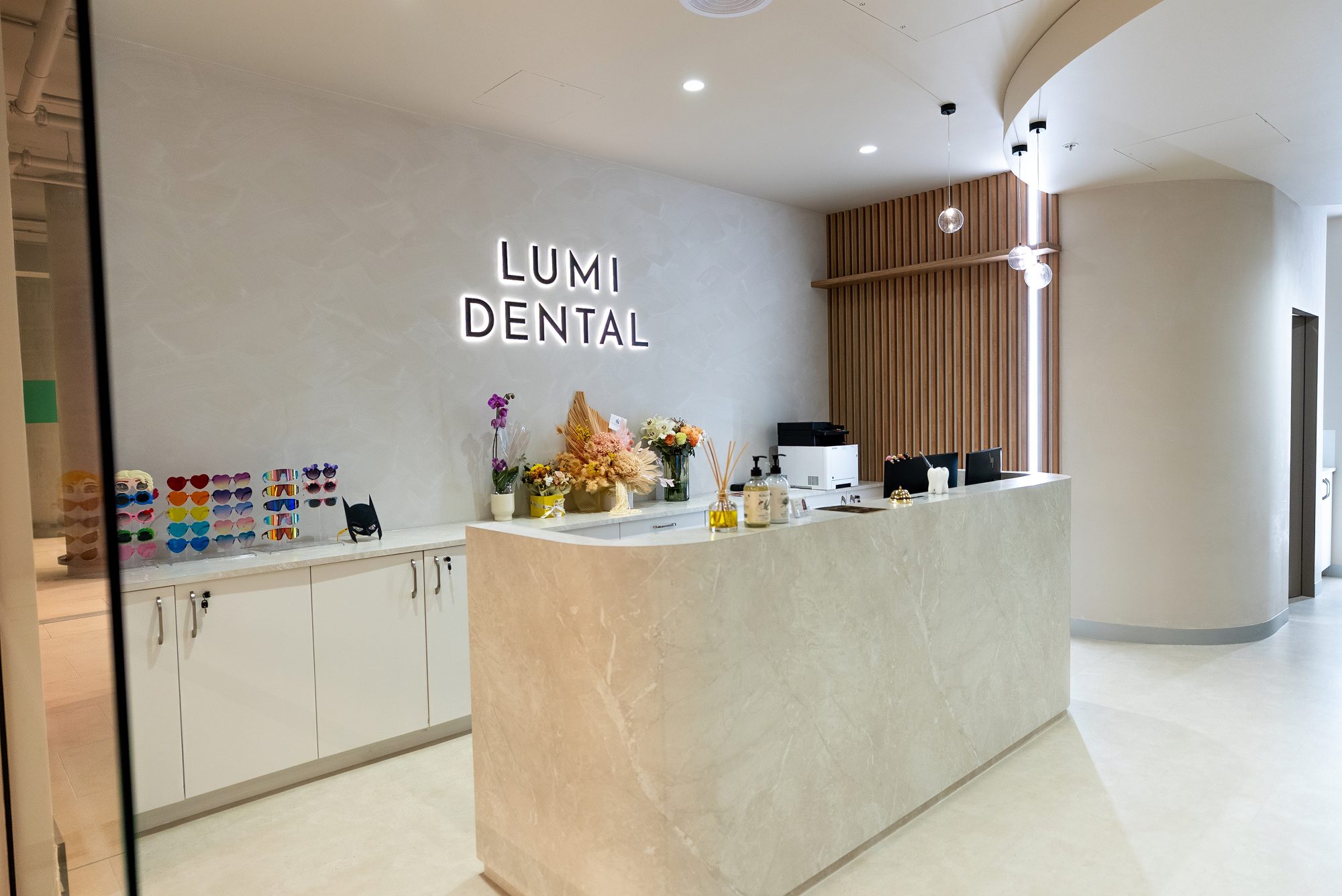
At Lumi Dental in Melrose Park a sore gum behind a child's back teeth is seen by a dentist first, because a flap, a stalled molar and early decay look alike to a parent. In-house 3D X-ray is used only when a molar seems stuck or swelling keeps returning. The flap is flushed where needed, and the oral health therapists on the hygiene team show the child and parent how to reach that spot at home. Lumi Dental accepts the Child Dental Benefits Schedule for eligible children, and the children's dentist team at Lumi Dental refers to a paediatric dentist or hospital service where a child needs care beyond what is comfortable in the chair.
Questions patients ask
How long does the gum flap over a new molar last?
Until the tooth has fully come through, which can take weeks to a few months. Soreness usually lasts a few days at a time and settles as the flap recedes; if the tooth has not moved for several months, ask a dentist to check it.
Should I cut or pull the gum flap off my child's tooth?
No. The flap is living gum, and tearing it causes bleeding and more swelling. In children it nearly always shrinks away as the molar rises; surgical removal is reserved for the rare flap that keeps getting infected.
Is a gum flap over a six-year molar an infection?
Not by itself. The operculum is normal tissue; pericoronitis is the inflammation that develops under it when food and plaque collect. A pink flap that is only tender is not infected; facial swelling or fever means spreading infection that needs a dentist that day.
What can I give my child for the pain of an erupting molar?
Paracetamol or ibuprofen, following the pack directions for your child's age and weight, is healthdirect's advice; a pharmacist can confirm what suits your child. Our guide on what to do about a child's toothache tonight covers the night-time plan.
Does my child need antibiotics for a swollen gum over a new tooth?
Usually not. SDCEP and healthdirect both reserve antibiotics for spreading or systemic infection, such as facial swelling, fever or difficulty opening the mouth. For an ordinary inflamed operculum, cleaning under the flap fixes the cause, which antibiotics cannot do.
Sore gum behind your child's back teeth? Children's dentist in Melrose Park, CDBS accepted
If your child has a tender or swollen gum over a new molar, the team at Lumi Dental in Melrose Park can examine the tooth, clean under the flap and show you how to keep it clear. Read more about the children's dentist at Lumi Dental, see our current offers, or contact the practice to book. Families visit from Ryde, Parramatta, Ermington, Rydalmere and nearby suburbs.
Sources
- SDCEP: Acute pericoronitis (including erupting teeth in children)
- PMC: Dentoalveolar abscess caused by pericoronitis of an erupting first molar
- Better Health Channel: Teeth development in children
- healthdirect: Toothache and gum swelling
About the author

Dr James Tran is a general dentist at Lumi Dental in Melrose Park. He holds a BDent from the University of Sydney and a Graduate Diploma in Oral Implants, and is a Member of the International Congress of Oral Implantologists (MICOI).
This article is general information only and is not a substitute for an examination and individual advice from a registered dental practitioner. Suitability for any treatment varies from person to person.








