

Your teeth do not change when a scarf or mask goes on, but the way other people look at your face does. Eye-tracking studies show that when the lower face is covered, viewers look at the eyes sooner and for longer, and they find expressions harder to read. Once the covering comes down, the smile appears to someone who has spent the conversation looking somewhere else.
This article is about perception: what people notice and remember. It is not about whether wearing a mask affects oral health, which is a separate question.
Covered faces send the gaze to the eyes
In a study by Prahm and colleagues in Acta Psychologica (2023), 71 people viewed faces with and without surgical masks while an eye tracker recorded where they looked. With a mask on, viewers fixated on the eye region more quickly and stayed there longer, and they looked at the lower face later and less often.
That makes sense. When the mouth and chin are hidden, the eyes are most of what is left to read, so they carry more of the job of conveying mood and intent. Scarves, high collars and winter layers do the same thing to a smaller degree.
Expressions become harder to read
A second line of research looks at emotion. Carbon, writing in Frontiers in Psychology (2020), showed people faces with and without masks and asked them to name the emotion. Accuracy dropped with masks, and happy, sad and angry faces were often read as neutral. A smile, in other words, does a lot of social work that the eyes cannot fully replace.
Masks also make it harder to tell faces apart. Carragher and Hancock reported in Cognitive Research: Principles and Implications (2020) that adding surgical masks to photos clearly reduced people's accuracy at judging whether two images showed the same person.
The moment the smile appears
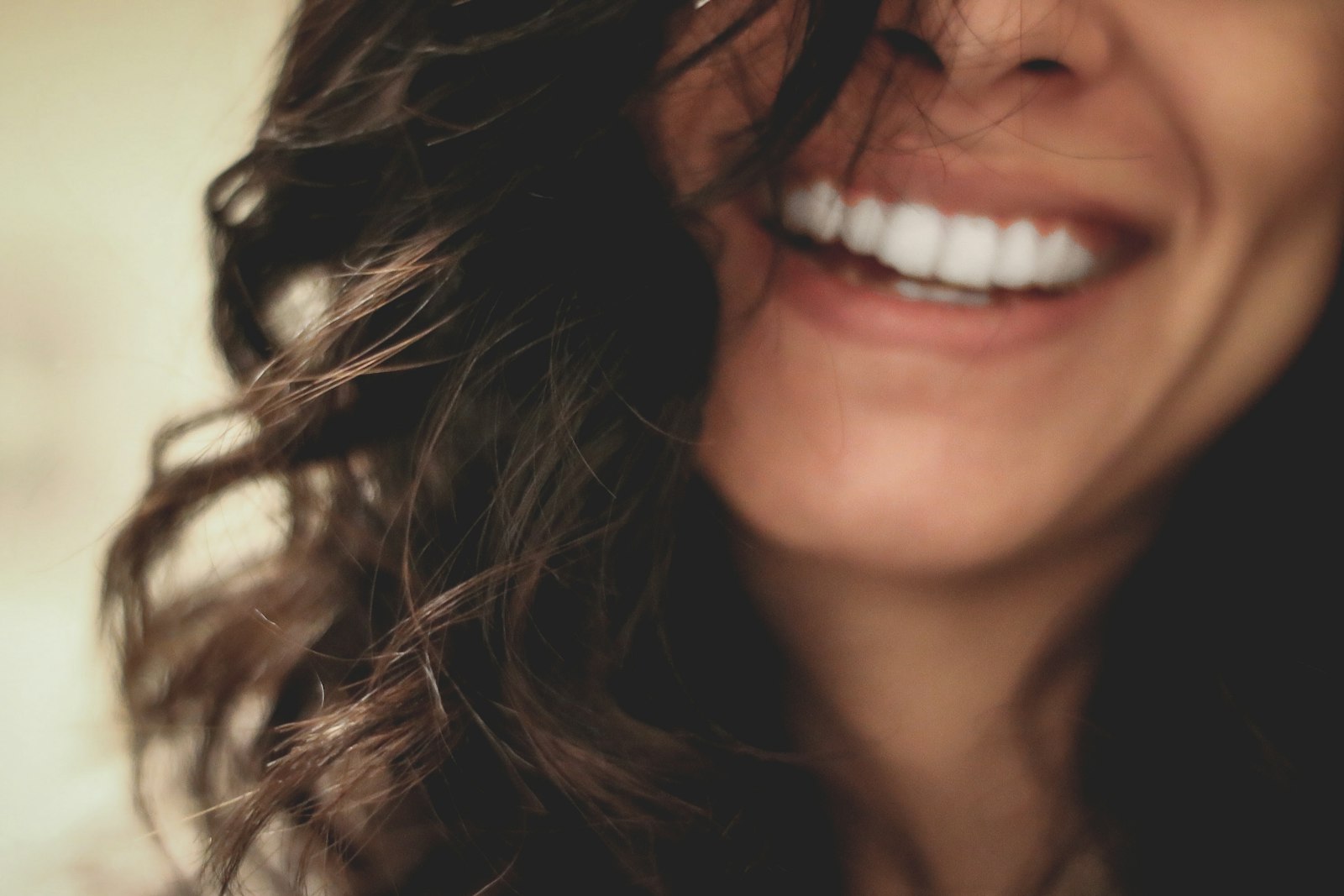
Put those findings together and the moment a scarf is pulled down or a mask is lowered becomes a little different from an ordinary smile. In an uncovered conversation, a viewer sees your smile many times, at different angles and in different light, and any single glimpse is one of dozens. With a covering, there may be only a brief view, arriving after the viewer has been attending to your eyes.
It seems reasonable that a short glimpse like that is judged on whatever reads fastest, and tooth colour and symmetry are among the quickest features to register. That idea has not been tested directly in research on smiles, so treat it as a plausible explanation rather than an established finding. A photograph works in a similar way, which is part of why teeth can look different on camera; our article on why teeth look different in photos explains the other reasons.
Related to colour contrast, but not the same thing
Our articles on whether lipstick makes teeth look whiter and how skin tone changes how white your teeth look deal with colour contrast: a tooth's shade is judged against the lips and skin around it. The mask and scarf effect is about attention instead. Both describe how a smile is perceived rather than any change to the teeth themselves.
Lighting adds another layer. Bathroom lights and the angle you look from change what you notice about your own smile day to day, as explained in why teeth look different in the mirror.
If a reveal moment has you thinking about your smile
None of this is a reason to change anything. It does help explain why some people become more aware of their smile in winter, in workplaces where masks are worn, or before photos.
If you do notice something you would like to change, the useful step is working out what you are seeing: surface staining that can be cleaned or whitened, a colour that comes from within the tooth, worn edges, or simply a moment of extra attention that would look the same any other day. That is a question for an examination in good light, ideally with clinical photographs.

Questions people ask about masks and smiles
Do people notice my smile more when I lower a scarf or mask?
Possibly. Research shows covered faces draw attention to the eyes and make expressions harder to read, so the smile becomes a more noticeable signal when it appears. How much more memorable it is has not been measured directly.
Is this the same as lipstick making teeth look whiter?
They are related but different. Lipstick and skin tone change how tooth colour is perceived through contrast. Face coverings change where people look and how much they rely on the eyes.
Should I whiten my teeth before winter?
Not because of this. Your teeth do not change colour with the seasons. If you are unhappy with their colour, an assessment of what is causing it is the sensible place to start.
If you would like a calm, unhurried opinion on your tooth colour or shape, the team at Lumi Dental offers a free cosmetic consultation, and current offers are listed on our current deals page. This article is general information only and is not a substitute for an in-person cosmetic assessment.