

Most people starting take-home whitening expect to see a difference after the first night, and are disappointed when they do not. With a low-strength gel in custom trays, the first change you can notice usually appears somewhere in the first week, and most of the lightening tends to happen over about two weeks. Teeth that start darker can keep improving for a further week or two.
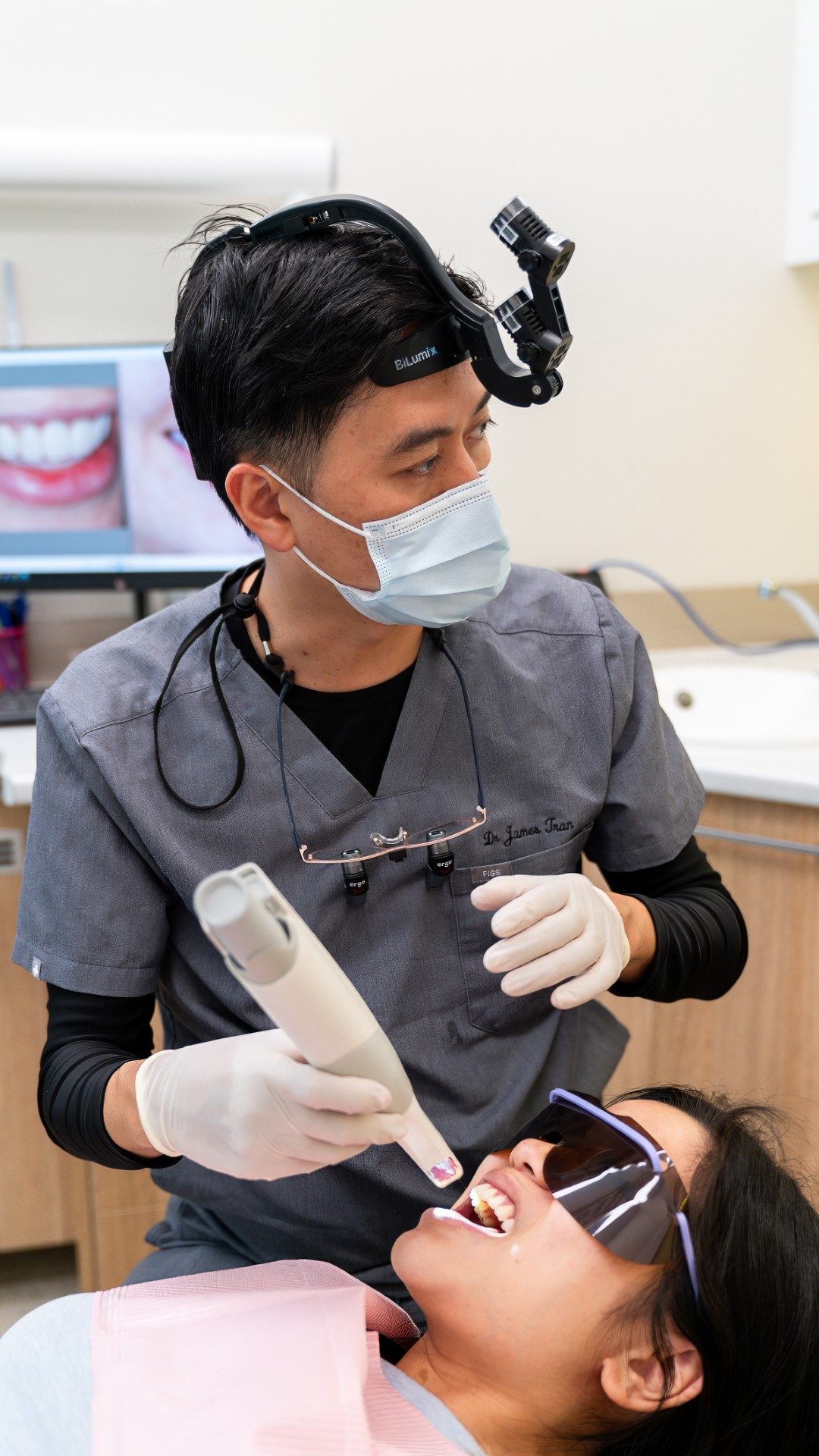
Written by Dr James Tran, BDent (University of Sydney), MICOI, GradDip (Oral Implants), general dentist at Lumi Dental in Melrose Park.
That slower pace is part of how the method works rather than a sign that it is failing. In a small trial in Operative Dentistry (da Costa and colleagues, 2010), five nights of 10% carbamide peroxide worn overnight produced the same shade guide change as one in-chair session with 25% hydrogen peroxide. Below is the usual sequence of what people notice, why the gel takes time, and the signs that mean you should take a break or call us.
Contact time matters more than gel strength
Carbamide peroxide slowly releases hydrogen peroxide once it is in the tray, at a much lower concentration than in-chair gels. The peroxide moves through the enamel into the dentine underneath, where it breaks down the large coloured molecules responsible for yellowing. Because it is working at low strength, the number of hours it spends against the teeth is what drives the result.
A randomised trial in the American Journal of Dentistry (López Darriba and colleagues, 2017) tested 10% carbamide peroxide and 7.5% hydrogen peroxide, each worn for one hour a day or overnight over 14 days. Overnight use whitened more than one hour a day, and the two concentrations gave similar results when worn for the same time. The authors described home bleaching as time dependent rather than concentration dependent. So squeezing extra gel into the tray does not speed things up; it mostly adds to the gel that escapes onto the gums.
That does not mean longer is always needed. A 2025 trial of 120 adults in the Journal of the American Dental Association (Terra and colleagues) found that wearing 10% carbamide peroxide for two or four hours a day was noninferior to eight hours a day when colour was measured one month after treatment, with similar sensitivity. Your dentist will match the daily wear time to the gel you are given. Our article on carbamide and hydrogen peroxide gels explains the difference between the two, and our guide to how custom whitening trays work covers how much gel to use.
The first three days often look like nothing is happening
Early on, the trays can feel bulky and the gel has a slight taste. Visible change is usually small or absent. Some people feel a brief, sharp twinge in one or two teeth with cold drinks, often near the gumline where the enamel is thinnest or a root surface is exposed. In the Operative Dentistry trial, fewer than 40% of participants reported sensitivity, and it was mild and short lived. Stick to the wear time you were given and resist adding more gel.
Around days four to seven, teeth look cleaner before they look whiter
Surface staining from tea, coffee and red wine, particularly in the gaps between teeth, tends to fade first. Many people find a partner or friend notices before they do. Day five or so is a reasonable first point to compare against the shade photo taken before you started, because that was the stage at which the home and in-chair results matched in the Operative Dentistry study. If sensitivity is going to appear, it often does so in this period and then settles.
The second week usually brings most of the change
For most people the bulk of the lightening happens between about day eight and day fourteen. This fits the Better Health Channel description of take-home trays being worn for around one to two weeks. The canines are naturally a little darker than the front teeth, so they can lag behind for a while and the smile may look slightly uneven mid-course. That usually evens out if you keep going as instructed rather than stopping early.
Darker teeth can take three to four weeks
Teeth that were darker to begin with, older teeth, and teeth with grey or banded discolouration (such as staining from certain antibiotics taken in childhood) often keep improving after two weeks, but each session adds less. Some reach a plateau sooner than hoped. In the JADA trial, participants could extend beyond 14 days if they were not satisfied, which reflects how much individual teeth vary. The Australian Dental Association's patient site, teeth.org.au, notes that your dentist tells you how many weeks to continue, and that is the finishing point to follow.
Check progress every few days, not every morning
Looking in the mirror each day under bathroom lighting makes small changes hard to see, and it is one reason people give up in the first week. Comparing against your starting photo every five days or so gives a fairer picture. The JADA trial measured colour at five-day intervals for the same reason.
Teeth also lose a little moisture inside the tray, and slightly dried enamel looks brighter for an hour or two after the trays come out. The shade later in the day is closer to the true result. Our article on whitening rebound explains why the colour settles after a course.
Things that stretch the timeline
The type of discolouration matters most. Surface stain shifts quickly, general yellowing from the dentine takes weeks, and grey or single dark teeth can respond slowly or stop improving early. A tooth that has darkened on its own may need to be checked before any whitening.
Existing dental work also changes how the result looks. As teeth.org.au points out, whitening will not change the colour of porcelain crowns, veneers or white fillings, so these can stand out as the natural teeth around them lighten. It is worth discussing this before you start, since restorations may need replacing afterwards to match.
Finally, missed nights and planned breaks simply move the finish date later. Wearing the trays four nights a week can still get you there, just more slowly.
Signs you should take a night off, stop, or call us
Better Health Channel notes that whitening commonly causes temporary tooth sensitivity. If a twinge lingers for more than an hour after the trays come out, or several teeth ache when you breathe in cold air, a night off is reasonable. A desensitising toothpaste with potassium nitrate can help, and your dentist may suggest placing a little in the clean tray for a short time. Missing a night delays the course by a day but does not undo progress. Our guide to whitening sensitivity and relief has more on what helps.
Stop when you reach the shade you agreed on with your dentist, or when two or three sessions in a row make no visible difference. If you run out of gel before then, ask the practice for more rather than switching to a product of unknown strength.
Call the practice if the edge of the gum turns white or sore after a session. Teeth.org.au warns that gel on the gums, lips or tongue can cause chemical burns that often become ulcers before healing. Also call if one tooth throbs or hurts with hot drinks, as this points to a problem such as a crack, decay or an inflamed nerve rather than the whitening itself. You can contact us without waiting for your review.
What a take-home course involves with us
A dentist examines your teeth and gums first, because decay, inflamed gums or cracks affect both the plan and how long whitening takes. Your trays are made from a 3D scan of your teeth, and a shade photograph is taken before the first session so later progress can be compared fairly. A scale and clean with a dentist or OHT beforehand removes surface deposits so the gel can reach the enamel evenly.
All three of our options, Lumi Home, Lumi Refresh and Lumi Radiance, include dentist-supplied Boutique take-home gel; Refresh and Radiance add an in-chair session. We do not promise a particular shade, because every set of teeth responds differently. The teeth whitening page explains each option and how the consult works.

Common questions
Can I keep going past two weeks?
Often, yes, if your dentist agrees and you are using gel supplied by the practice. Darker or banded teeth commonly need three to four weeks. Once several sessions stop producing change, carrying on tends to add sensitivity rather than colour. Our guide to how often you can whiten safely covers repeat courses.
Should I wear the trays overnight or for a couple of hours?
It depends on the gel. With 10% carbamide peroxide, one trial found overnight wear whitened more than one hour a day, while another found two or four hours a day was noninferior to eight hours. Some gels are designed only for short daytime wear, so follow the instructions you were given.
How long will the result last once I finish?
Better Health Channel states that whitening is not permanent. Brushing twice a day, flossing, avoiding smoking, cutting back on strongly coloured food and drinks, and a professional clean every 6 to 12 months help it last longer. Many people use their trays for an occasional top-up. Our article on how long teeth whitening lasts goes into maintenance.
Find out how your teeth are likely to respond
If you would like a realistic idea of how long whitening might take for your own teeth, we can examine them, take a shade photo and talk through the options at our Melrose Park practice. Book a complimentary cosmetic consult or read more about teeth whitening at Lumi Dental.
Sources
- Australian Dental Association (teeth.org.au): Teeth whitening
- Better Health Channel: Cosmetic dentistry and teeth whitening
- da Costa JB et al. Comparison of at-home and in-office tooth whitening using a novel shade guide. Operative Dentistry, 2010
- López Darriba I et al. Efficacy of different protocols for at-home bleaching: a randomized clinical trial. American Journal of Dentistry, 2017
- Terra RMO et al. Different daily times for at-home bleaching with 10% carbamide peroxide. Journal of the American Dental Association, 2025
About the author

Dr James Tran is a general dentist at Lumi Dental in Melrose Park. He holds a BDent from the University of Sydney and a Graduate Diploma in Oral Implants, and is a Master of the International Congress of Oral Implantologists (MICOI).
This article is general information only and is not a substitute for an examination and individual advice from a registered dental practitioner. Suitability for any treatment varies from person to person.








