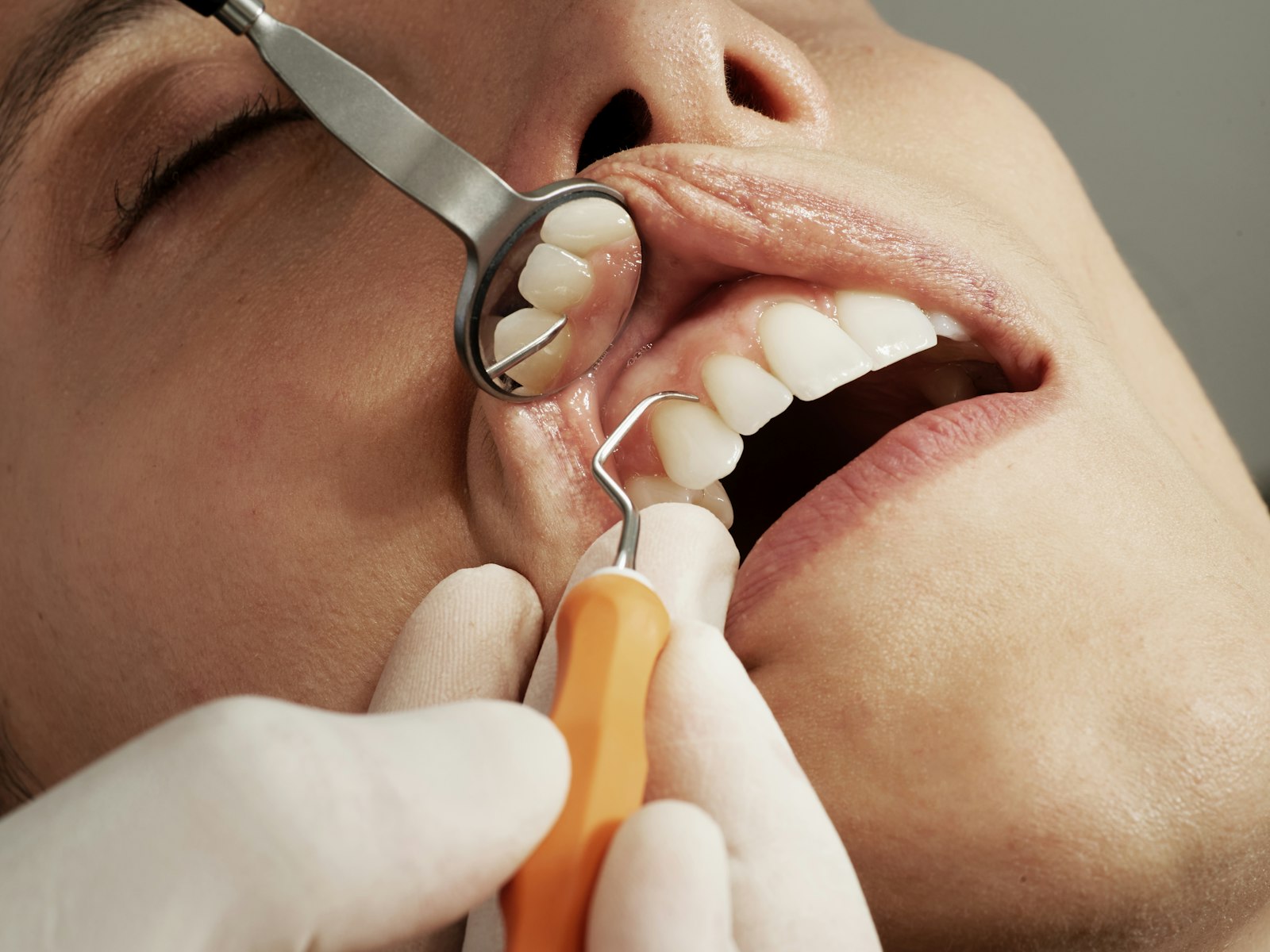

The periodontal charting numbers your dentist calls out are pocket depths in millimetres, measured between the tooth and the gum, and as a general rule 1 to 3 mm with no bleeding is consistent with health, 4 mm suggests early inflammation, 5 to 6 mm indicates moderate disease and 7 mm or more indicates advanced disease. That string of numbers being read to an assistant is not a code, and you are entitled to know what it says about your mouth.
Most people find the process slightly unnerving. There is a small metal instrument, a rhythm of numbers, and occasionally a pause when a higher one comes up. Nobody explains it, so patients either ignore it or assume the worst.
The numbers are worth understanding, because gum disease is largely silent until it is advanced, and this chart is the earliest reliable warning you will get.
Key takeaways
- Pocket depths are measured in millimetres at up to six points around every tooth.
- 1 to 3 mm without bleeding generally indicates health, 4 mm suggests early inflammation, 5 to 6 mm moderate disease, 7 mm and above advanced disease.
- Bleeding on probing is a separate finding and can flag a problem even when depths look normal.
- A single deep reading is not a diagnosis, the pattern across the mouth and the trend over time carry the meaning.
- Depths respond to plaque control, cleaning, smoking cessation and diabetes control, and do not respond to whitening, mouthwash alone or brushing harder.
- You can ask for a copy of your chart, and comparing it year to year is the most useful thing you can do with it.
What the probe is actually measuring
A periodontal probe is a blunt instrument with millimetre markings. It is walked gently into the crevice between the tooth and the gum until it meets resistance from the attached tissue at the base. The depth of that space is the pocket depth.
Healthy gum sits snugly against the tooth with a shallow crevice. When inflammation sets in, the tissue swells and detaches slightly, and the crevice deepens. If the disease progresses to periodontitis, the supporting bone is lost as well, and the pocket deepens further because there is less structure holding the gum against the tooth.
The probe is checked at up to six points per tooth, three from the cheek side and three from the tongue side, because disease is rarely even. That is why a full chart takes several minutes and produces a lot of numbers.
What each reading usually means
| Reading | What it usually indicates | What typically happens next |
|---|---|---|
| 1 to 3 mm, no bleeding | Generally consistent with health | Routine cleaning and normal recall interval |
| 1 to 3 mm with bleeding | Gingivitis, inflammation without attachment loss | Cleaning, technique coaching, review to confirm the bleeding settles |
| 4 mm | Early inflammation, sometimes early attachment loss | More thorough cleaning below the gum, closer monitoring, often a shorter recall |
| 5 to 6 mm | Moderate disease, generally where gingivitis has progressed to periodontitis | Radiographs to assess bone, staged deeper cleaning under local anaesthetic, structured review |
| 7 mm and above | Advanced disease with significant support lost | Comprehensive periodontal treatment, possible specialist referral, long term maintenance |
These are general patterns rather than fixed rules, and they are interpreted alongside bleeding, radiographs, recession and your medical history.
Why the same tooth gets six different numbers
Periodontal disease is site specific. A molar can be perfectly healthy on its cheek side and have a 6 mm pocket between its roots, because that is where plaque accumulates and where cleaning is hardest to reach.
The spaces between teeth are the usual trouble spots. They are difficult to brush and easy to skip with floss or interdental brushes, so deeper readings cluster there. Back teeth read deeper than front teeth for the same reason.
Pocket depth is not the same as recession
Recession is how far the gum has moved away from the crown of the tooth, measured from a fixed landmark. Pocket depth is how deep the crevice is from the current gum edge. They measure different things and can move in opposite directions.
Attachment loss combines both, and it is the number that best reflects how much support a tooth has lost. A tooth with 3 mm of recession and a 3 mm pocket has lost as much attachment as one with a 6 mm pocket and no recession, even though the second sounds worse when read aloud.
Bleeding on probing matters more than people expect
Healthy gums generally do not bleed when a probe is placed gently. So bleeding on probing is recorded as a separate finding from depth, and it can be the earliest sign of a problem even when every depth reads 1 to 3 mm.
It works in the other direction too. A 5 mm pocket that does not bleed at review is a much better sign than a 4 mm pocket that bleeds at every visit, because bleeding suggests the inflammation is still active. Absence of bleeding over time is one of the ways disease stability is described.
This is also why bleeding while brushing at home should not be dismissed as normal or as a sign you are brushing too hard. Our guide on why gums bleed when you brush covers the common causes and what usually settles them.
Staging and grading, the modern language
The 2018 classification of periodontal diseases removed the older terms chronic periodontitis and aggressive periodontitis. They were replaced with two separate descriptions.
Staging describes severity at the time you present, based mainly on bone levels and attachment loss. Grading describes how fast the disease appears to be progressing, taking into account factors such as smoking and diabetes control. Stability is then described separately using bleeding on probing and pocket depths.
The practical implication is often missed. Staging and grading do not by themselves determine whether you need treatment. Treatment need is based on current disease activity, pocket depths and bleeding. Someone can have a high stage from damage done years ago and a mouth that is currently stable and requires only maintenance.
What actually changes the numbers
Plaque control between teeth does most of the work. Floss or interdental brushes used properly once a day change depths in a way that no toothpaste can. Technique matters more than force, and brushing harder tends to cause recession rather than reduce pockets.
Professional cleaning below the gum line removes what you cannot reach, particularly hardened deposits on the root surface. Where pockets are deeper, this is usually done in stages under local anaesthetic rather than in a single routine appointment. Our guide to what a professional clean involves explains the difference between a routine clean and periodontal treatment.
Stopping smoking has a large effect, both on disease progression and on how well treatment works. Controlling diabetes matters for the same reason, and the relationship runs both ways, since gum inflammation can make glucose control harder.
What does not change the numbers: mouthwash used on its own, whitening, brushing harder, or switching toothpaste. These are not useless, they are simply not the mechanism.
What a number cannot tell you
A single deep reading is not a diagnosis, and this is where patients are most often unnecessarily alarmed.
Probing is a manual measurement. The reading varies with probe angle, with how inflamed the tissue is on the day, with how firmly the instrument is placed, and between operators. A 5 mm that reads 4 mm at the next visit may reflect genuine improvement, or it may reflect a slightly different angle. That is why one number in isolation means little.
What carries meaning is the pattern across the mouth and the trend over time. Six deep readings clustered around one molar suggests something local, such as a cracked root or a failing restoration. Deep readings scattered through every quadrant suggest generalised disease. The same numbers, read two ways.
A depth also cannot tell you whether disease is currently active. That requires bleeding on probing and radiographic context, because films show bone level in a way probing cannot. Our guide to the types of dental x-rays explains which views show bone around teeth.
Ask for a copy of your chart. Comparing this year with last year tells you far more than any single appointment, and it makes the conversation concrete rather than abstract.
Common questions
Is a 4 mm gum pocket bad?
A 4 mm reading generally indicates early inflammation rather than advanced disease. On its own it is a prompt for better cleaning between the teeth and closer monitoring, particularly if it bleeds. Isolated 4 mm readings that do not bleed are often stable and managed with routine care.
Can deep gum pockets be reversed?
Pocket depths can often reduce after treatment, particularly in the 4 to 6 mm range, because much of the depth comes from swollen inflamed tissue that shrinks once inflammation settles. Bone that has already been lost does not grow back on its own. The realistic goal is usually stability rather than a return to the original measurements.
Why do my gum numbers change between visits?
Some variation is genuine and some is measurement related. Probe angle, tissue inflammation on the day, and different operators all shift readings by a millimetre or so. This is why a trend across several visits is more informative than a change at one appointment.
Does bleeding when the dentist probes mean I have gum disease?
Bleeding on probing indicates inflammation, which is the earliest stage of gum disease, but it does not necessarily mean you have lost bone support. Where depths are still 1 to 3 mm, that is usually gingivitis, which frequently settles with improved cleaning between the teeth and a professional clean.
Who does the gum charting, the dentist or the hygienist?
Either may perform it, depending on the practice and the appointment. Both are trained to probe and record, and the findings become part of your record regardless of who takes them. Our explainer on the difference between a hygienist and a dentist covers the respective roles.
Ask for your chart
If you have never seen your periodontal chart, it is worth asking for one. The team at Lumi Dental in Melrose Park includes a full gum assessment as part of a comprehensive examination, and will go through the readings with you rather than around you. Read more about general dentistry at Lumi Dental or see current offers before booking.