
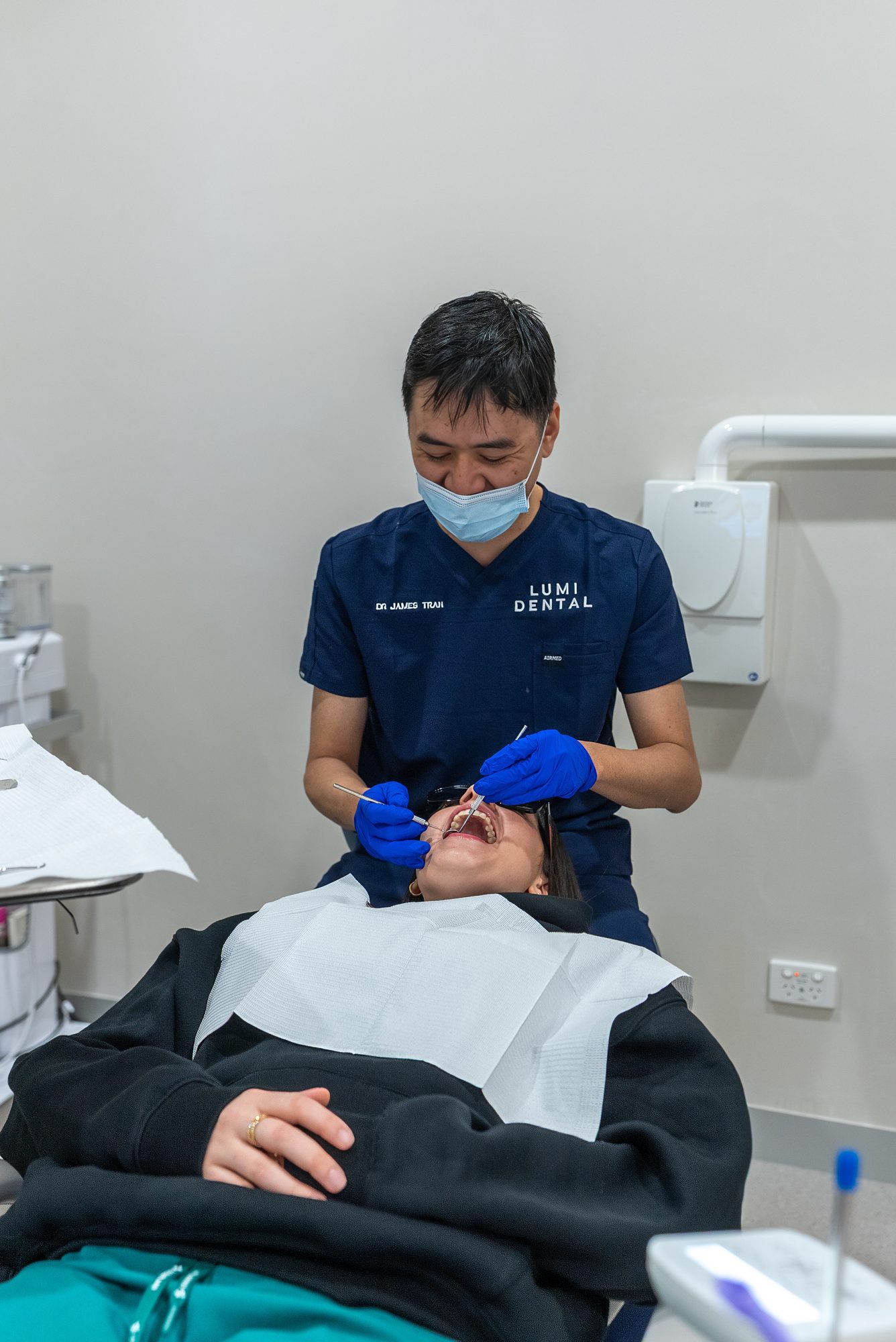

Stitches after dental implant surgery usually loosen and fall out on their own within about one to two weeks, and if your dentist used non-dissolving stitches they are taken out at a review appointment around the same time. The timing depends on the material and on whether a bone graft or membrane was placed. Hospital oral surgery units advise that resorbable sutures in the mouth dissolve after about 10 days to two weeks, and published reviews put some synthetic materials at three to four weeks. This guide to stitches after dental implant surgery covers how long each type lasts, how to care for them day by day, and when a loose stitch is worth a phone call.
Written by Dr James Tran, BDent (University of Sydney), MICOI, GradDip (Oral Implants), general dentist at Lumi Dental in Melrose Park.
The short version
- Most implant stitches are dissolvable and loosen between about day 7 and day 14. Some synthetic types last three to four weeks.
- Non-dissolving stitches (silk, polyester or PTFE) are chosen when the gum must be held shut for longer, often over a bone graft or membrane, and are removed at a review.
- Leave the stitches alone: no prodding, pulling or cutting. Brush the other teeth normally and start warm salt water rinses the day after surgery.
- A stitch that falls out early is usually harmless if the gum edges are still together. If the wound gapes, or you can see graft granules or a metal disc, ring the practice.
- The stitches matter most in the first week. The implant takes around three months to fuse with bone, which our guide to the dental implant recovery timeline explains.
What the stitches are doing after an implant
To place an implant, the gum is lifted back as a small flap, the implant goes into the bone, and the flap is stitched back down. The stitches hold the gum edges together under as little tension as possible so the wound heals by first intention. Suturing reviews describe the inflammatory phase of healing as lasting around 72 hours, so the stitches do their most important work in the first three or four days.
One-stage surgery: stitches around a healing cap
A small metal healing cap (healing abutment) is screwed onto the implant and pokes through the gum from day one. The stitches sit in a ring around it, so seeing metal is expected. Our comparison of one-stage and two-stage implant surgery explains when each is chosen.
Two-stage surgery: stitches sealing the gum over a cover screw
The implant is fitted with a flat cover screw and the gum is closed completely over it. The stitches hold the whole flap shut, so a stitch lost early can let the edges part and expose the screw, which is why two-stage sites are watched more closely in week one.
Grafts and membranes: when the gum must stay shut longer
When a bone graft or collagen membrane is placed, the gum must stay sealed over it while it heals. Suturing reviews note that flaps under tension are closed with a longer-lasting resorbable or a permanent suture, and that braided silk is avoided over implants and grafts because its weave can wick bacteria into the wound. If you have had a bone graft or sinus lift with your implants, expect longer-lasting stitches or removal by hand.
How long each type of stitch lasts
Dissolvable stitches are broken down either by the body's enzymes (natural gut) or by water in saliva (synthetic), each on a set schedule. The figures below are published durations for the mouth; yours may go sooner if disturbed.
| Stitch type | Material | Usual time in the mouth | Where it tends to be used |
|---|---|---|---|
| Fast resorbable, natural | Plain gut | About 3 to 5 days; loses half its strength within a day | Simple sites under no tension |
| Resorbable, natural | Chromic gut | Around 7 to 10 days; holds strength for up to about 5 days | Routine implant and extraction closures |
| Resorbable, synthetic braided | Polyglycolic acid | Around 21 to 28 days; strength kept for about three weeks | Grafts, membranes and flaps under tension |
| Non-resorbable | Silk, polyester, PTFE or nylon | Does not dissolve; removed at review, silk usually within about a week | Grafts and membranes; silk avoided over implants |
Ask which material was used before you leave, and write it down with the review date. In my experience most worried calls about stitches come from people who heard "dissolvable" and expected a few days, when their material was built to last three weeks.
The rule: leave the stitches alone and let the review decide
Do nothing to the stitches yourself: no pulling a loose end, no cutting a knot that annoys your tongue. A loose stitch still anchored at one end is doing no harm, and one that has come out completely has done its job if the gum edges are still touching. The review, usually between one and two weeks, is where the dentist decides whether anything needs trimming, replacing or removing.
Day-by-day care for implant stitches
The day of surgery
Do not rinse today; rinsing can dislodge the clot under the stitches and restart bleeding. Blood-stained saliva is normal. If bleeding is more than a trickle, bite firmly on folded gauze for 20 minutes. Avoid hot drinks and alcohol, eat cool soft food once the numbness has worn off, and brush your other teeth tonight, avoiding the site. Do not smoke; it slows wound healing and is linked with infection.
Days 1 to 3
From the morning after surgery, start warm salt water rinses: a teaspoon of salt in a cup of warm water, held gently over the area after meals and before bed, then allowed to fall out rather than spat forcefully. Our guide to salt water rinses for the mouth covers the detail. Use a medicated mouthwash only if you were given one. Soft food, chew on the other side, tongue off the knots.
Days 4 to 7
The stitches start to loosen. One NHS oral surgery unit advises gently brushing the sutures with a soft brush from day four to help them dissolve; I am comfortable with that provided the wound edges are closed and you are brushing, not scrubbing.
Week 2
Most natural dissolvable stitches have gone or are hanging by a thread. Non-dissolving stitches are removed at the review. Some dentists advise a mouthwash rather than a brush or floss on the site for two to three weeks, so follow the instructions you were given.
Week 3 onwards
A synthetic stitch still present at three weeks is behaving as designed. From here the bone is the issue, not the gum: it takes around three months to grow onto the implant before the crown is fitted.
When to ring the practice about a stitch
Most stitch questions can wait for the review. These should not:
- The gum edges have parted and you can see a gap, white graft granules or a grey metal disc.
- Bleeding that does not stop after 20 minutes of firm pressure; our guide to stopping bleeding after dental surgery has the steps.
- Pain getting worse from day three onwards rather than easing, a bad taste, or discharge from the site.
- Swelling that is hard and hot, or a fever.
- Numbness of the lip, chin or tongue still present the day after surgery.
If the practice that placed your implant is closed, an emergency dentist in Melrose Park can assess the wound.
How we approach this at Lumi Dental
At Lumi Dental in Melrose Park, implant surgery is planned on an in-house 3D X-ray and a 3D intraoral scan so the flap can be kept as small as the case allows. After surgery the dentist explains which stitch was used and books a review, where the gum seal is checked and any non-dissolving stitches come out. Once the gum has healed, the hygiene team of oral health therapists shows patients how to clean around a healing cap. IV sedation is available at the practice. You can read more about dental implants at Lumi Dental; a written plan follows every consultation.
Questions patients ask
How long do stitches stay in after a dental implant?
Dissolvable stitches usually loosen and fall out between about one and two weeks after implant surgery, and non-dissolving stitches are removed at a review in the same window. Synthetic dissolvable materials used over grafts can last three to four weeks.
What should I do if a stitch comes out after implant surgery?
Look at the gum edges. If they are still together and there is no fresh bleeding, nothing needs doing; carry on with salt water rinses and soft food. If the edges have parted, you can see graft material or metal, or bleeding restarts, ring the practice the same day.
Can I brush my teeth with implant stitches in?
Yes. Brush your other teeth from the first night, keep the brush off the site for the first few days, then gently brush over the stitches with a soft brush from around day four. Floss and interdental brushes stay away from the site until the dentist says otherwise.
Is it normal to see a metal cap in my gum after implant surgery?
Yes, if you had one-stage surgery. The metal is the healing abutment, which shapes the gum while the implant fuses to the bone, and the stitches sit around it. If your gum was closed completely and you can now see metal, the gum has opened over the cover screw and should be checked.
Are implant stitches the same as the stitches after wisdom teeth removal?
The materials are often the same, but the purpose differs. After a wisdom tooth is removed the stitches hold the gum over an empty socket, as our guide to wisdom teeth stitches explains. After an implant they protect a titanium fixture and sometimes a graft, so longer-lasting or non-dissolving stitches are chosen more often.
Questions about healing after implant surgery? Complimentary implant consult in Melrose Park
If you are planning an implant, or you have stitches now and something does not feel right, the team at Lumi Dental in Melrose Park can examine the site and give you a clear plan. Contact Lumi Dental to book, or read about dental implants at Lumi Dental first. Patients come to us from Ryde, Parramatta, Ermington, Rydalmere and nearby suburbs.
Sources
- Cambridge University Hospitals NHS: Surgery to the mouth and jaws, post-operative advice
- Hull University Teaching Hospitals NHS: Post-operative mouth care following oral surgery
- NCBI Bookshelf (StatPearls): Oral Surgery Suturing
- healthdirect: Dental implant procedure
About the author

Dr James Tran is a general dentist at Lumi Dental in Melrose Park. He holds a BDent from the University of Sydney and a Graduate Diploma in Oral Implants, and is a Member of the International Congress of Oral Implantologists (MICOI).
This article is general information only and is not a substitute for an examination and individual advice from a registered dental practitioner. Suitability for any treatment varies from person to person.








