
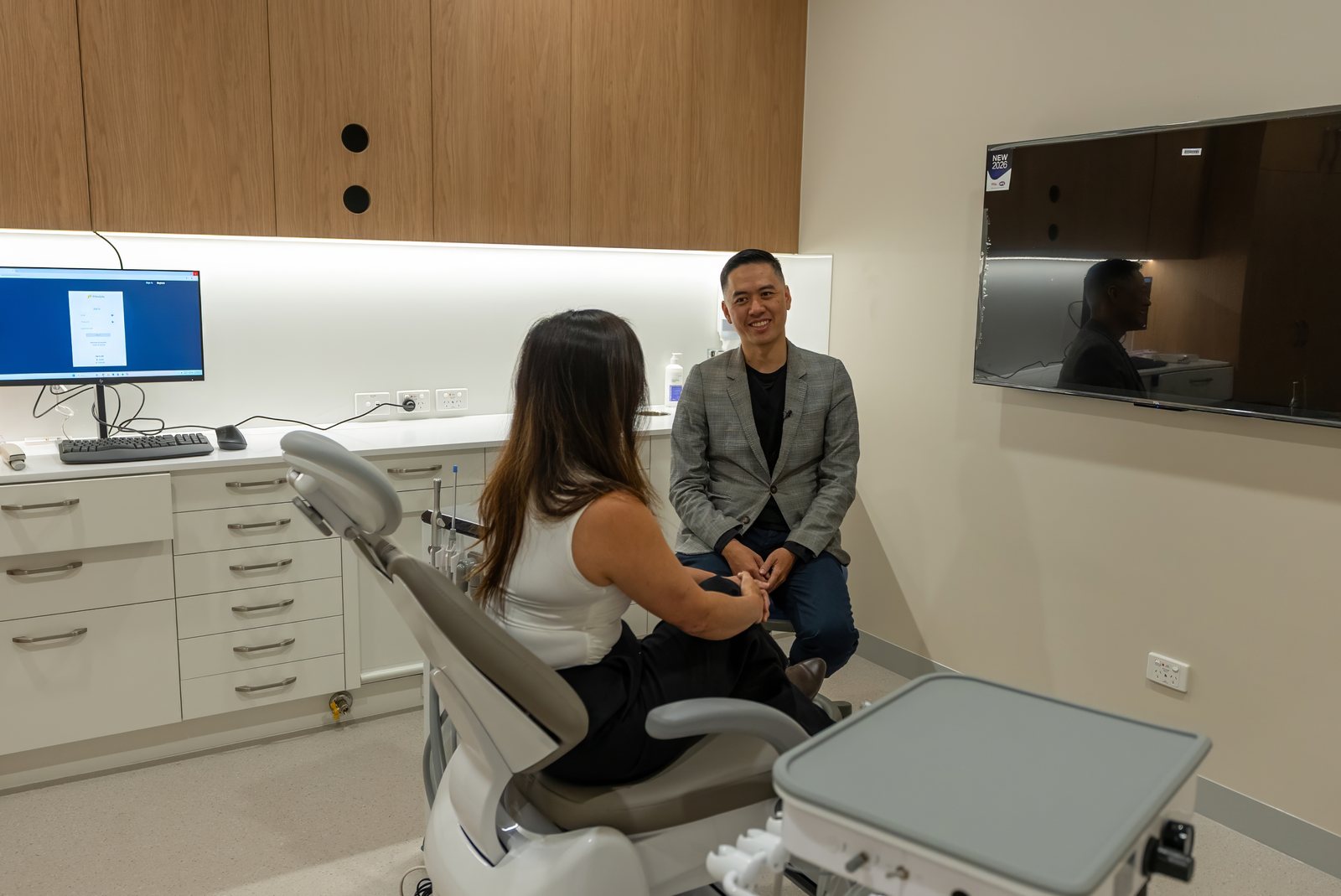

Psoriasis and psoriatic arthritis do not usually rule out teeth whitening; what shapes the plan is the state of your lips, tongue and gums on the day, and how easily your hands can manage trays. Whitening gel works on the tooth surface and is not known to change psoriasis itself, for better or worse. The practical questions are elsewhere. A review in Dentistry Journal notes that psoriatic arthritis affects approximately 30% of people with psoriasis, and stiff, swollen fingers can make a take-home course harder than it sounds.
Written by Dr James Tran, BDent (University of Sydney), MICOI, GradDip (Oral Implants), general dentist at Lumi Dental in Melrose Park.
The short version
- Psoriasis on its own is not a reason to avoid whitening. The skin around the mouth, the tongue and the gums are checked on the day.
- Our article on psoriasis and oral health covers the gum link, geographic tongue and medicines in general. This one is only about whitening.
- Plaques on or around the lips are kept away from gel, and an active flare in that area is a reason to wait.
- Geographic tongue is more common with psoriasis and can sting with peroxide or strong mint flavours.
- Mouth ulcers while on methotrexate need to heal first, and new ulcers are reported to the doctor who prescribes it. Nobody changes a dose for whitening.
- If your hands are stiff or sore, a short in-chair session may suit better than loading trays every night.
The single rule: the mouth on the day matters more than the diagnosis
Psoriasis itself is not a reason to avoid whitening. What changes the plan is how the lips, tongue and gums look on the day, and whether stiff or sore hands make loading trays hard, in which case an in-chair session may suit better. In my experience, most people with psoriasis who ask about whitening have quiet mouths and an ordinary course. The adjustments below are for when something is active.
| Situation | What may help |
|---|---|
| Plaques on the lips or skin around the mouth | Wait for a flare to settle, use a lip barrier, keep gel off the skin, and favour trays trimmed short of the gums |
| Geographic tongue | Use an unflavoured or milder gel if available, wipe away excess straight after seating trays, rinse with plain water |
| Mouth ulcers while on methotrexate | Let them heal before starting, tell your prescriber about new ulcers, and do not change any medicine for whitening |
| Stiff or swollen fingers | Consider an in-chair session, or set up trays with an easy-open case, a pre-measured syringe and a mirror on the bench |
| Jaw pain or limited opening | Shorter in-chair sessions with breaks, a smaller cheek retractor, or trays that do not need a wide opening |
Psoriasis on the lips and around the mouth
Psoriasis can occasionally affect the lips or the skin around them, and dry, cracked lips are common too. Peroxide gel on inflamed or split skin stings and can leave a pale, sore patch for a day or so.
The approach is simple. If the skin around your mouth is flaring, wait until it settles. Once it has, a thin layer of a plain barrier balm on the lips before treatment, trays trimmed so the gel stays on the teeth, and wiping off any excess straight away all help. Our guide to whitening with perioral dermatitis or eczema around the mouth explains barriers, patch testing and toothpaste ingredients in detail, and the same steps apply here. Keep using the creams your dermatologist has prescribed.
Geographic tongue and stinging
Geographic tongue shows as smooth red patches with pale borders that move around the tongue over days. A study of 348 people with psoriasis, published in The Scientific World Journal, found geographic tongue in 12% of them compared with 3% of a matched healthy group. It was more common in people with more severe skin disease.
Geographic tongue is usually painless, but the red patches can be tender with spicy, acidic or strongly flavoured food, and some people notice the same with a flavoured whitening gel. A few small habits help:
- Ask whether an unflavoured or milder gel is available.
- Wipe off any gel that squeezes out of the trays before it reaches the tongue.
- Rinse with plain water rather than a strong mouthwash after each session.
- Pause the course for a few days if a patch becomes sore, and restart once it settles.
Our article on geographic tongue explains what the condition is and when to have it checked.
Methotrexate, mouth ulcers and cold sores
Methotrexate is commonly prescribed for psoriasis and psoriatic arthritis. DermNet, the dermatology reference written by New Zealand dermatologists, notes that mouth ulcers or general soreness of the mouth lining are uncommon at the doses used in skin conditions, and that the more common side effects are nausea, loss of appetite and diarrhoea.
For whitening, this means two things. First, gel should not go near an open ulcer, so whitening waits until any ulcers have healed. Second, new or repeated ulcers are worth reporting to your dermatologist, rheumatologist or GP, because they may want to review things. The dentist does not stop or change methotrexate or any other medicine, and you should never adjust a dose because of a cosmetic treatment.
DermNet also notes that cold sores may be more severe in people taking methotrexate. A cold sore and whitening do not mix, and our article on whitening with a cold sore or mouth ulcer explains when to wait and what healed looks like.
Biologics and other immune medicines
Many people with moderate or severe psoriasis take a biologic or another medicine that acts on the immune system. Teeth whitening is not surgery: there is no cut, no needle and no bleeding when the gums are healthy. For most people on these medicines, whitening is likely to be a low-risk cosmetic treatment once the mouth has been checked.
Two things still matter. Bleeding, swollen gums are treated before any gel, because peroxide on inflamed gums stings and may slow settling. And if you are unwell, have an infection, or your dermatologist or rheumatologist has asked you to delay other procedures, it makes sense to wait. Bring an up-to-date medicines list to your consult. Your dermatologist or rheumatologist manages these medicines; the whitening plan fits around them.
Psoriatic arthritis: hands, trays and the jaw
The NHS lists pain, swelling and stiffness in one or more joints, swollen fingers or toes, and nail changes among the symptoms of psoriatic arthritis, and notes that symptoms can be worse first thing in the morning. That pattern matters for whitening, because loading and seating trays takes fine finger work, and many people do it at night or in the morning.
Making trays easier with stiff fingers
- Choose a tray case that opens easily, or keep the trays in a shallow dish with a lid.
- Ask about pre-filled or pre-measured syringes, which need less squeezing.
- Stand a mirror on the bench and rest your elbows, rather than holding the mirror.
- Use the trays at the time of day your hands work best.
Our guide to how much whitening gel to put in your trays shows how small the amount is and how to wipe off the excess. If hand symptoms are flaring, an in-chair session may suit better, because the team does all of the handling.
The jaw joint
The review in Dentistry Journal notes that psoriatic arthritis more commonly affects the hands, feet and spine than the jaw joint, but that jaw involvement can cause pain, swelling, clicking and difficulty opening the mouth fully. In-chair whitening means a long stretch with the mouth held open, so if your jaw is sore, mention it. Shorter sessions with breaks, or trays that only need a normal bite, are reasonable options.
How we approach this at Lumi Dental
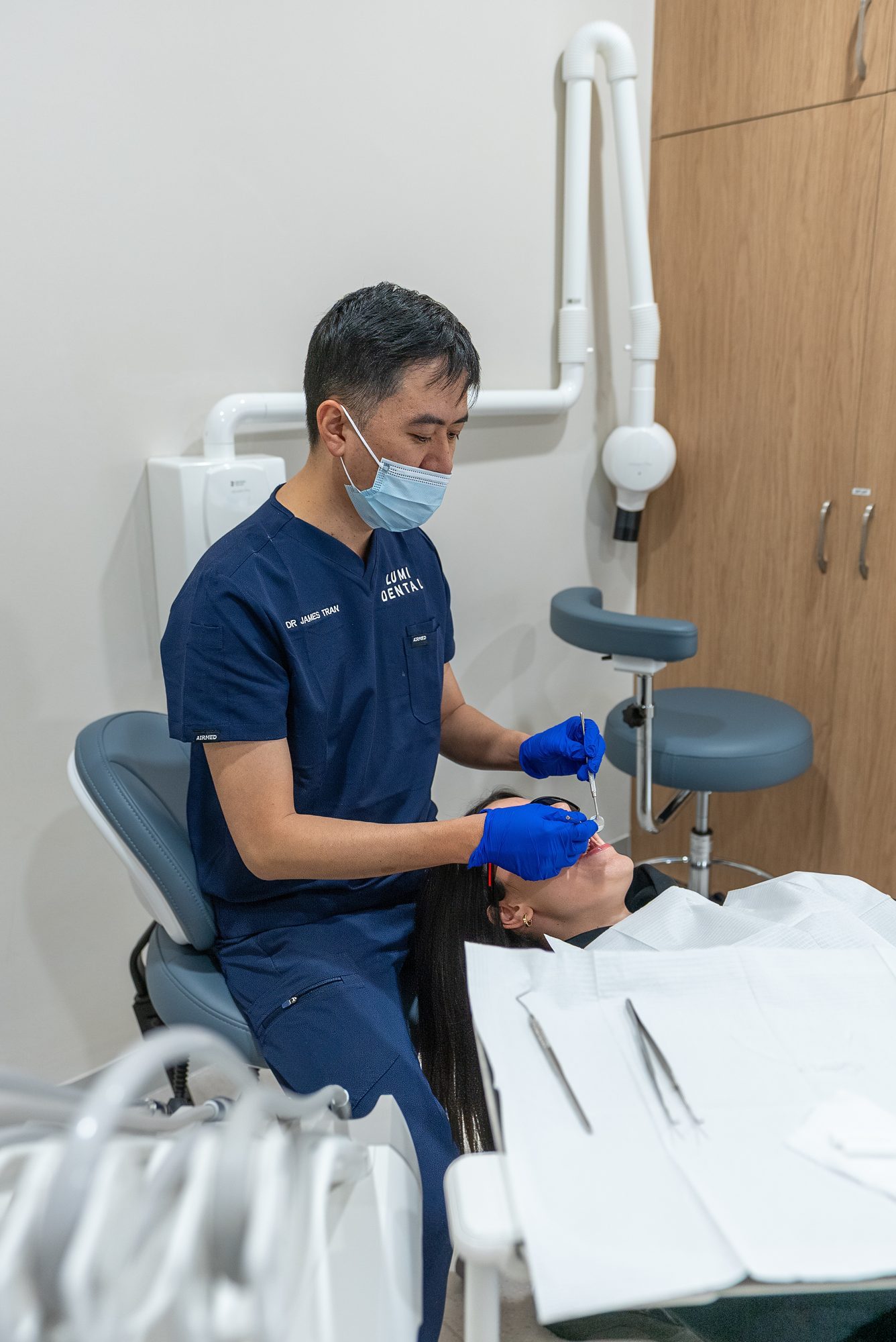
At Lumi Dental, whitening starts with an examination by a dentist, who checks the teeth for decay and worn areas, and looks closely at the lips, tongue, cheeks and gums before any gel is used. The dentist also asks about your medicines and how your hands and jaw are going. Where gums are inflamed, an oral health therapist (OHT) usually cleans and settles them first. The whitening options are named Lumi Home, Lumi Refresh and Lumi Radiance, and the dentist will explain which may suit you, including whether trays or an in-chair visit is easier for your hands. You can read more on the general dentistry page.
Questions patients ask
Can I whiten my teeth if I have psoriasis?
Usually yes. Psoriasis itself is not a reason to avoid whitening. The dentist checks for active plaques around the lips, sore patches on the tongue and gum inflammation first, and the plan is adjusted if any are present.
Will teeth whitening make my psoriasis worse?
There is no evidence that whitening gel affects psoriasis. Gel on inflamed skin around the mouth can sting and irritate that area, so it is kept on the teeth and the skin is protected.
Is teeth whitening safe on methotrexate or a biologic?
For most people it is a low-risk cosmetic treatment once the mouth has been checked, because it involves no surgery or bleeding. Ulcers need to heal first, and the doctor who prescribes the medicine manages it; it is never changed for whitening.
Why does whitening gel sting my tongue?
Geographic tongue, which is more common with psoriasis, can be tender to peroxide and strong mint flavours. Wiping off excess gel, using a milder or unflavoured gel and rinsing with plain water usually helps.
I have psoriatic arthritis in my hands. Are take-home trays a bad idea?
Not necessarily, but they need some setting up. An easy-open case, pre-measured syringes and a mirror on the bench help, and an in-chair session is an option during a flare. More detail is on our teeth whitening page.
Thinking about whitening? Complimentary cosmetic consult in Melrose Park
If you have psoriasis or psoriatic arthritis and would like a brighter smile, the team at Lumi Dental can check your mouth, talk through your medicines and hands, and suggest an approach that fits. Book a complimentary cosmetic consult at Melrose Central in Melrose Park, or read about teeth whitening options at Lumi Dental. Patients visit from Ryde, Parramatta, Ermington and Rydalmere, with on-site parking.
Sources
- PMC (The Scientific World Journal): Geographic tongue and fissured tongue in 348 patients with psoriasis
- DermNet: Methotrexate
- NHS: Psoriatic arthritis
- PMC (Dentistry Journal): Psoriatic arthritis involving the TMJ, a review
About the author

Dr James Tran is a general dentist at Lumi Dental in Melrose Park. He holds a BDent from the University of Sydney and a Graduate Diploma in Oral Implants, and is a Member of the International Congress of Oral Implantologists (MICOI).
This article is general information only and is not a substitute for an examination and individual advice from a registered dental practitioner. Suitability for any treatment varies from person to person.







