
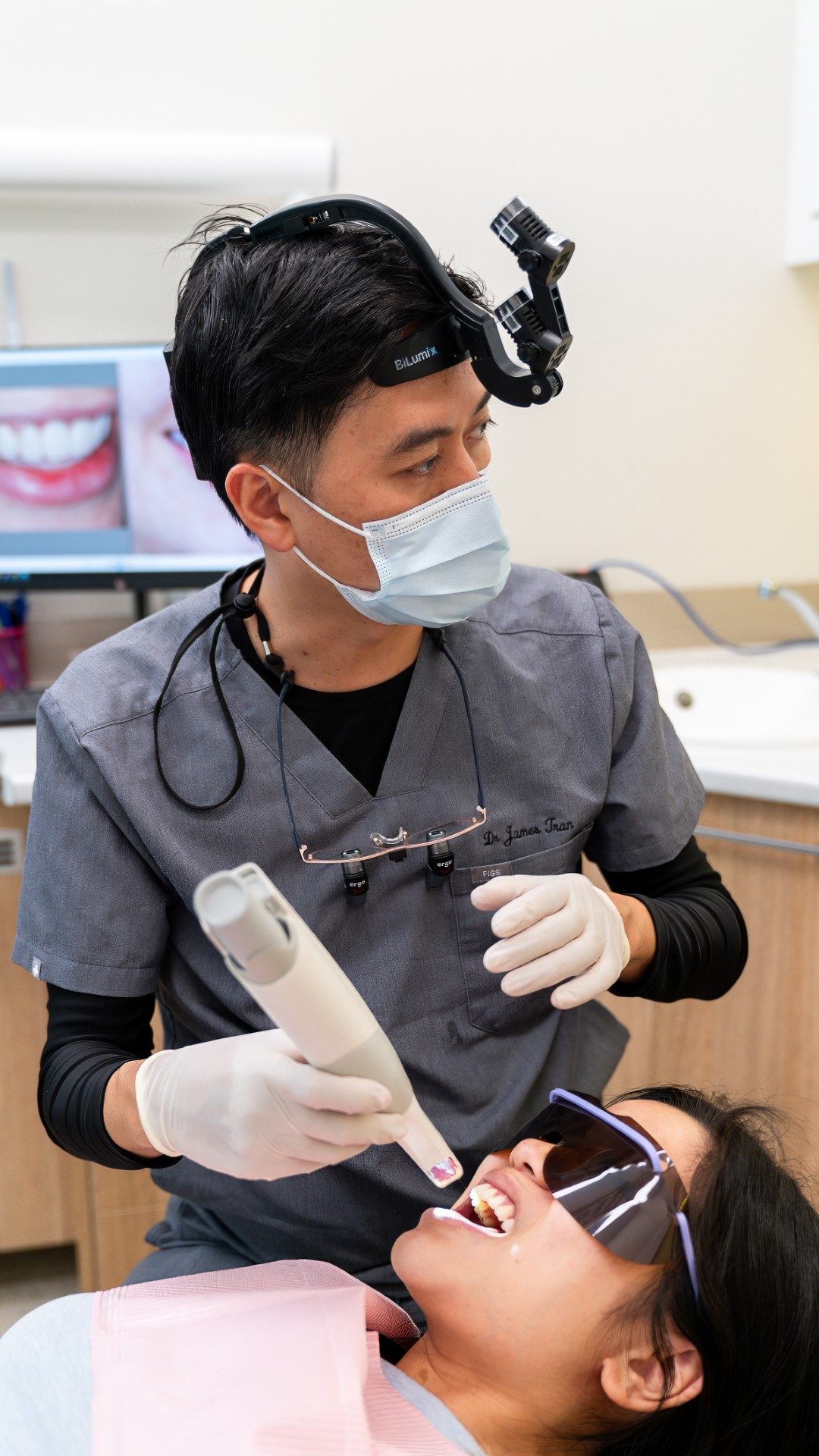

Because an implant cannot decay, it is easy to assume the crown on top of it will last forever. Ceramic crowns on implants do chip and wear, and it is one of the more common reasons people come back with an implant concern. The right fix, from smoothing to a patch to a new crown, depends mostly on how deep the damage goes and whether it has happened before.
Written by Dr James Tran, BDent (University of Sydney), MICOI, GradDip (Oral Implants), general dentist at Lumi Dental in Melrose Park.
Implant crowns take the full force of every bite
A natural tooth is held in its socket by a ligament that cushions chewing and feeds back to your brain how hard you are biting. An implant is joined directly to bone, with no ligament. The crown therefore meets every load without that cushioning or warning, which is part of why ceramic on implants can chip even when the neighbouring natural teeth are fine.
A retrospective study by Larsson and colleagues (Medicina, 2023) followed 358 single implant crowns in 278 patients. The commonest technical problems were crowns becoming loose and ceramic chipping, and chipping occurred even in monolithic zirconia. Chipping was more common in people with probable bruxism (grinding or clenching).
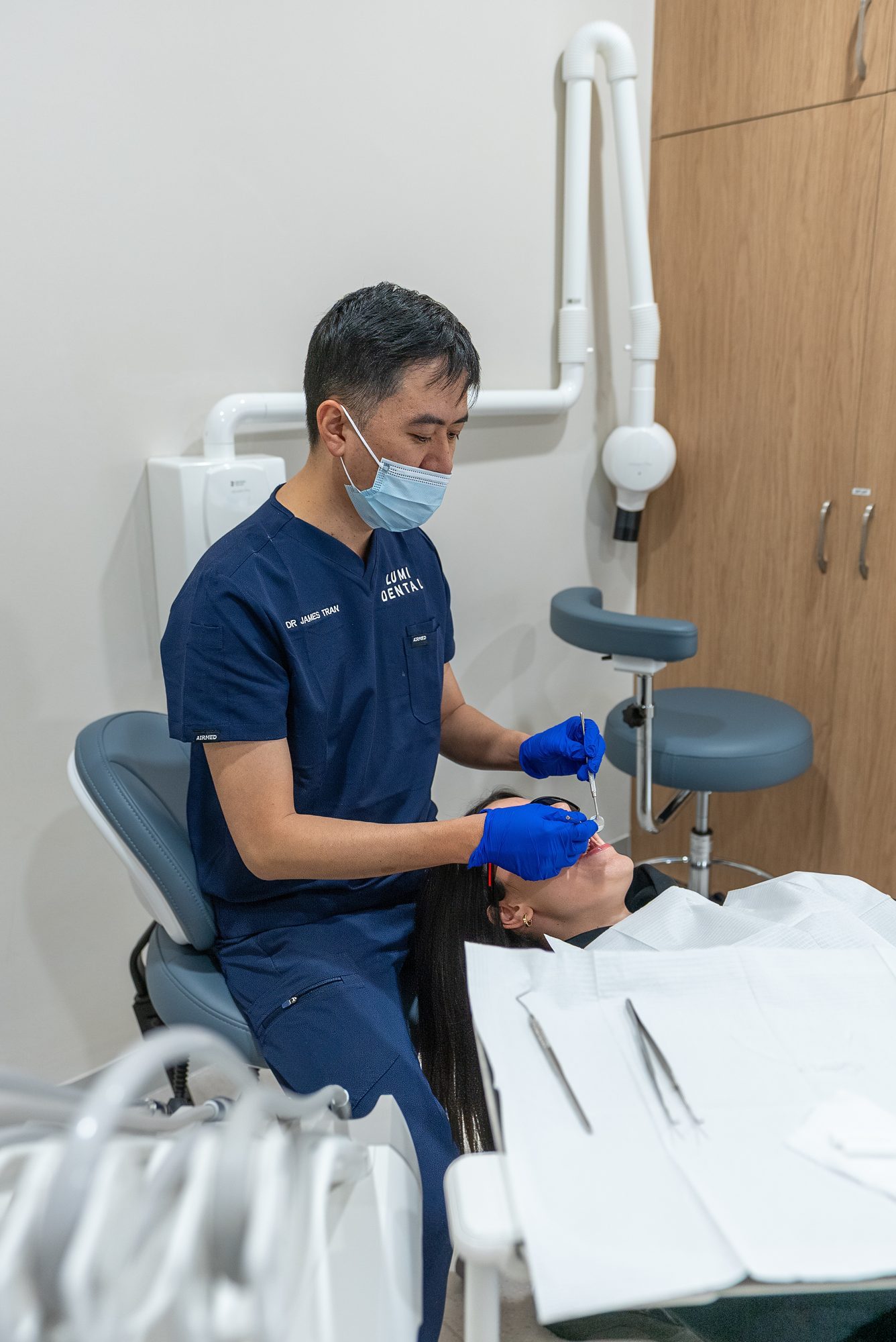
Layered crowns chip more often than solid ones
Many implant crowns have a strong core of metal, zirconia or glass-ceramic with a thinner outer layer of porcelain added for colour and translucency. That outer layer is the part that usually breaks away, because it is weaker than the core it sits on. Other crowns are monolithic, milled from a single block with no separate outer layer.
A meta-analysis by Pjetursson and colleagues (Clinical Oral Implants Research, 2021), which included 49 trials and prospective studies, reported annual ceramic chipping rates of about 1.65 percent for veneered (layered) single implant crowns and about 0.39 percent for monolithic ones. Whether the crown was at the front or back of the mouth made no difference, and overall survival did not differ significantly between the materials, apart from one resin-matrix ceramic group that did worse.
Layered porcelain can still give a more lifelike result on a front tooth, while monolithic zirconia tends to suit back teeth and people who grind. A zirconia surface that has been adjusted needs to be polished well so it is kinder to the opposing teeth. Our comparison of zirconia and porcelain fused to metal implant crowns explains the trade-offs.
Smooth, patch or remake
Smoothing and polishing
If only a small rough edge has broken off and no core is visible, the ceramic can be smoothed and polished and the bite checked with marking paper. This is usually quick and needs no anaesthetic.
A composite patch in the mouth
A moderate chip in the outer porcelain can be repaired by roughening and priming the surface, then building it up with tooth-coloured composite. The repair is usually not as durable as the original porcelain, and it can stain and wear faster than the porcelain around it. On a front crown under light load it may last well; on a back tooth that does heavy chewing it is more often a temporary solution.
A new crown
When the chip reaches the core, the crown has cracked through, an earlier repair has failed, or the crown has worn down noticeably, a replacement is usually the better option. The implant stays where it is, and the abutment often does too. A digital scan records the implant position and your current bite, and the new crown can be made in a different material if the old one was not suited to the forces on it. Our guide to how often implant crowns are replaced covers expected lifespan.
How the crown is attached changes the repair
A screw-retained crown has a small access hole on the biting surface, sealed with a filling material. The seal can be opened, the crown unscrewed and sent to the laboratory for repair or copying, and then screwed back on without disturbing the implant. A cement-retained crown is glued onto its abutment, so a laboratory repair usually means cutting the crown off and making a new one.
A 2025 meta-analysis in Cureus (Tomar and colleagues) of zirconia single implant crowns found that screw-retained crowns had a 46 percent lower risk of complications than cement-retained ones, with similar bone levels and gum health over the longer term. The pooled studies were small, so it is a guide rather than a final answer. Our article on screw-retained versus cement-retained implant crowns goes further.
A crown that moves, clicks or feels loose is usually a loosened screw rather than a chip and should be seen within the week; see our article on a loose dental implant crown.
A flattened crown points to grinding or a high bite
A chip is a single event. Wear builds up over months or years. If an implant crown has lost the points of its cusps, shows a flat shiny area, or sits lower than the teeth beside it, it has been rubbing against something repeatedly. According to the Better Health Channel, about half the population grinds their teeth from time to time and around 5 percent do it regularly, often during sleep, and broken teeth or restorations are among the possible consequences.
Before a worn crown is replaced, your dentist will check whether it was sitting high, whether the opposing tooth has also worn, and if you clench or grind. If grinding is likely, a night guard is usually advised to protect the new crown. Better Health notes that a splint helps with symptoms but does not stop the grinding itself. More on this is in our guide to dental implants if you grind your teeth.
| What you notice | The usual approach | Typical number of visits |
|---|---|---|
| A tiny rough edge, no core showing | Polish and check the bite | One short visit |
| A small chip in the outer porcelain | Composite repair, reviewed at check-ups | One |
| Core showing, or a repair that has failed | New crown; screw-retained crowns are removed and sent to the laboratory, cement-retained crowns are usually cut off | Two to three |
| Crown worn flat or shorter than its neighbours | Bite assessment and night guard, then a remake if needed | Two to four including the guard |
| Crown moving or clicking | Screw check rather than chip repair | Within the week |
What the assessment involves at Lumi Dental
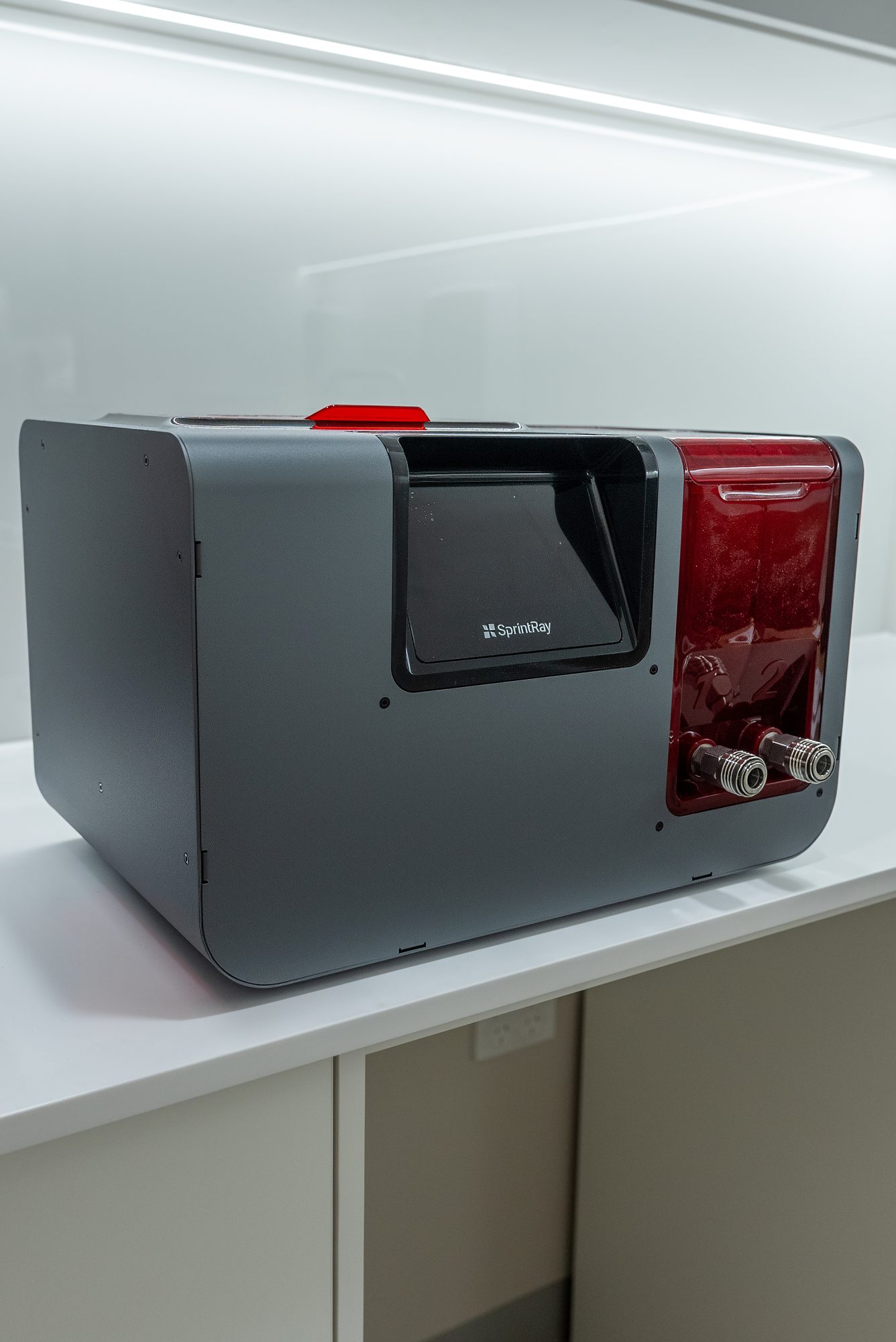
We start with an examination of the crown and your bite, an X-ray to confirm the screw and the surrounding bone are healthy, and an intraoral 3D scan that records the damage and how your teeth meet. If a remake is needed, the scan and implant position go to the laboratory, supported by our in-house scanning and 3D printing. The cost depends on how the crown is attached, the material and whether a night guard is part of the plan, so you will usually receive a written treatment plan after the examination, often by email.
Common questions
Does a chipped implant crown need fixing straight away?
Usually not, unless it is loose or the edge is sharp. A painless chip can wait for a normal appointment, but rough ceramic collects plaque and can catch the tongue, so it is better seen within a couple of weeks than left for months.
Why does my implant crown keep chipping?
Repeated chips usually point to the bite or to grinding. In the Larsson study, chipping was more common in probable bruxers. The answer is often a bite adjustment, a night guard and, on a back tooth, a remake in monolithic zirconia.
Is damage like this covered by a warranty?
That depends on the practice and the cause, and some warranties exclude damage from grinding when a guard was not worn. Our article on what warranty means in dentistry lists the questions worth asking.
Sources
- Pjetursson BE and colleagues. A systematic review and meta-analysis evaluating the survival, the failure, and the complication rates of veneered and monolithic all-ceramic implant-supported single crowns. Clinical Oral Implants Research, 2021.
- Larsson A, Manuh J, Chrcanovic BR. Risk factors associated with failure and technical complications of implant-supported single crowns: a retrospective study. Medicina, 2023.
- Tomar S and colleagues. Evaluating complications, success rate, and marginal bone loss in cement- versus screw-retained single implant-supported zirconia crowns: a systematic review and meta-analysis. Cureus, 2025.
- Better Health Channel (Victoria). Teeth grinding.
If an implant crown has chipped or looks shorter than it used to, we can examine it and explain whether polishing, a repair or a new crown makes sense. Contact Lumi Dental in Melrose Park to arrange a free implant consult (see current offers), or read more about dental implants at Lumi.
About the author

Dr James Tran is a general dentist at Lumi Dental in Melrose Park. He holds a BDent from the University of Sydney and a Graduate Diploma in Oral Implants, and is a Master of the International Congress of Oral Implantologists (MICOI).
This article is general information only and is not a substitute for an examination and individual advice from a registered dental practitioner. Suitability for any treatment varies from person to person.








