

Clear aligners can often straighten teeth that have drifted after gum disease, but only once the gum disease has been treated and is stable, with regular maintenance in place. Front teeth that fan out, develop gaps or drop lower after bone loss are a common sign of advanced periodontitis. A clinical review reports that this kind of drifting, called pathologic tooth migration, has been seen in about half of people with stage III periodontitis and in over 90% of people with stage IV.
Written by Dr James Tran, BDent (University of Sydney), MICOI, GradDip (Oral Implants), general dentist at Lumi Dental in Melrose Park.
The short version
- Teeth drift after gum disease because they have less bone holding them, and the lips, tongue and bite then push them out of place.
- The gums are treated first. Moving teeth through inflamed gum can speed up the loss of support. Our guide to the stages of gum disease explains where stage III and IV sit.
- Orthodontic movement usually starts a few months after gum therapy, once pocket depths and bleeding have settled.
- Teeth with reduced bone are generally moved with lighter forces, and gum maintenance continues throughout, often about every three months.
- Gaps at the gum line, often called black triangles, may show as overlapping teeth straighten.
- Retention after treatment is usually long term, often with a bonded wire behind the front teeth.
Why teeth drift after gum disease
A tooth stays in place because forces on it are balanced: the bone and ligament around the root, the contacts with neighbouring teeth, the bite, and the pressure of the lips, cheeks and tongue. Periodontitis removes some of that bone. With less support, forces that a healthy tooth would resist can slowly tip it forward, twist it or let it over-erupt.
A review of orthodontic care in periodontitis lists the common changes. In one study it cites, the most frequent were spacing (64%), extrusion, where a tooth drops lower than its neighbours (56%), and front teeth tipped outward (32%). The upper front teeth are often affected, as tongue pressure is no longer balanced by the lips.
The European Federation of Periodontology (EFP) notes that orthodontic therapy is usually required in stage IV periodontitis to manage drifted teeth and missing back-tooth support. In its guideline on stage IV periodontitis, it is one part of a combined plan with gum and restorative care, not a stand-alone fix.
The simple rule: gums first, then aligners
If your teeth have moved because of gum disease, the gum disease is treated and shown to be stable before any tooth is moved. Only then does the aligner scan happen.
The review describes the EFP guideline position like this: orthodontic treatment is deferred until the endpoints of gum therapy are reached, with no pockets deeper than 5 mm that bleed on probing and no pockets deeper than 6 mm at all. A pause of three to six months after gum therapy is commonly recommended to let inflammation resolve, although the review notes that the evidence for that exact interval is limited.
Our article on periodontal charting numbers explains what pocket depths and bleeding scores mean, so you can follow the measurements at each review. I usually show patients their chart before and after gum therapy, because the change in those numbers is what decides when aligners can start.

What happens first: gum therapy and a stable baseline
Assessment
The dentist records pocket depths, bleeding, gum recession and tooth mobility around every tooth, and takes X-rays to show how much bone remains. The EFP lists the parts of a stage IV assessment, including which teeth can be saved and the person's overall risk of the disease returning, with factors such as smoking and diabetes taken into account.
Gum therapy
Gum therapy cleans hardened deposits and bacteria from the root surfaces below the gum line, often over more than one visit. Some deeper sites may need a periodontist to consider surgery or regeneration before teeth are moved.
Re-evaluation
A few months later, the pockets are measured again. If they meet the targets, aligners can be planned. If some sites are still deep or bleeding, more treatment comes first. In my experience, this second round is common and is not a sign that aligners are off the table.
Maintenance from the start
Ongoing gum care is booked before the first aligner. In a systematic review of orthodontic treatment in patients with periodontitis, most of the included studies provided supportive gum care quarterly during orthodontic treatment. Our article on periodontal maintenance and a regular clean explains the difference.
What the aligner phase looks like
Teeth with less bone around them respond differently to force. The review notes that light forces are generally suggested during orthodontics in these patients, although forces are rarely measured. With aligners, that tends to mean smaller steps between trays and closer checks.
Why aligners may suit
Aligners come out for eating and brushing, so the teeth and gums can be cleaned without working around brackets and wires. The systematic review notes that aligner patients showed better plaque scores in comparison studies. The clinical review is more cautious: it says aligners may have a theoretical advantage for plaque and gum scores, and that both aligners and fixed braces can be compatible with gum health.
Where aligners have limits
Some movements are harder with aligners alone. The systematic review notes that larger bite corrections and extensive three-dimensional movements may still need fixed braces. A long-term study of 29 patients with stage IV periodontitis and drifted front teeth used fixed appliances after gum treatment and found probing depths stayed stable over a mean of about nine years of follow-up, with gum maintenance every three to four months. Those results came from fixed braces, so they cannot be assumed to apply to aligners.

Stage, sequence and retention at a glance
| Situation | What happens first | What the aligner phase looks like | Retention |
|---|---|---|---|
| Gum disease now treated, mild drifting or a small gap | Gum therapy, re-measure, maintenance booked | Light movements, regular gum reviews | Bonded wire and night-time retainer often advised |
| Front teeth fanned out or dropped lower after bone loss | Gum therapy, possibly periodontist review, then a settling period | Small steps, closer checks, maintenance about every three months | Long-term bonded wire, often with a removable retainer |
| Deep pockets remain after gum therapy | Further gum treatment or referral before any movement | Delayed until pockets meet the targets | Planned once movement is complete |
| Missing back teeth and a collapsing bite | Combined plan with gum, orthodontic and restorative input | May need fixed braces or a staged approach | Retainers plus replacement of missing teeth |
What to watch for as teeth straighten
Black triangles
When overlapping teeth are straightened, the space where gum used to fill the gap can show as a dark triangle near the gum line. Bone loss makes this more likely. The clinical review cites one study in which open gaps at the gum between the upper central incisors were more common after aligners than after fixed braces (35% against 18%). Our article on black triangles between teeth covers what can be done about them.
Gum recession
Moving a root towards thin bone can let the gum line creep down. Our guide to whether clear aligners can cause gum recession describes the warning signs and what helps.
Mobility and bleeding
Teeth feel looser while they move, but bleeding gums, pus or a tooth that keeps getting looser are reasons to stop and have the gums checked. The review recommends ongoing plaque and inflammation control during treatment, with six-monthly probing and annual X-rays.
Keeping the result: retention after aligners
Teeth with reduced bone tend to move back more readily. The clinical review suggests that a fixed and a removable retainer together may give more predictable retention, and the systematic review describes flexible bonded retainers as the usual standard for permanent retention in these patients. A bonded wire collects plaque, so cleaning under it with floss threaders or interdental brushes becomes part of daily care.
How we approach this at Lumi Dental
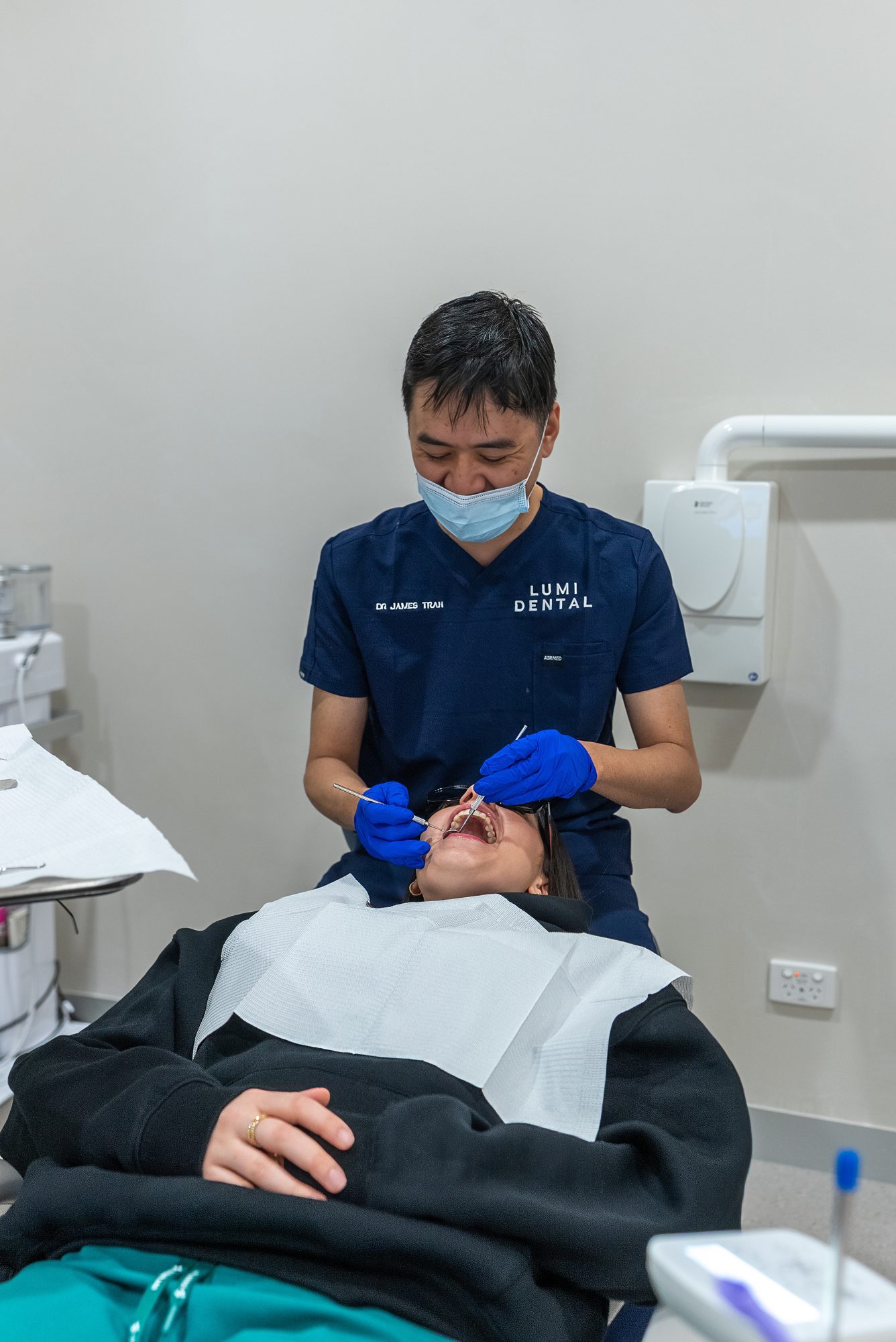
At Lumi Dental the dentist examines the teeth and gums, takes 3D X-rays where needed and confirms the diagnosis, and the oral health therapists provide gum therapy and maintenance. Clear aligners are planned from an in-house 3D intraoral scan only after the gum measurements show the disease is stable. Lumi Dental offers clear aligners, not fixed braces. Where a case needs a periodontist or an orthodontist, for example deep pockets that do not settle or movements that aligners are unlikely to achieve, the team refers to registered specialists and keeps up gum care alongside. Our page on general dentistry at Lumi Dental covers check-ups and gum care.
Questions patients ask
Can I get clear aligners if I have gum disease?
Not while it is active. The gums are treated first, and aligners are considered once pockets and bleeding have settled and maintenance is in place.
Will straightening my teeth make my gums worse?
It can if the gums are inflamed while teeth are moving. With stable gums, light forces and regular maintenance, studies of treated patients have generally reported that gum measurements stayed stable, although most of that evidence comes from fixed braces.
How long after gum treatment can I start aligners?
Often a few months. A pause of three to six months is commonly recommended, but the deciding factor is whether the re-measured pockets meet the targets, not the date.
Can teeth that moved because of bone loss be moved back?
Often, yes, at least partly. The EFP treats orthodontic therapy as a usual part of managing drifted teeth in stage IV periodontitis, though the result depends on how much bone remains.
Do I need a periodontist or an orthodontist?
Not always. Many people with treated gum disease are managed in general practice, with referral for deep pockets that do not settle or more complex tooth movement. Our article on a periodontist or a general dentist for gum disease explains how that decision is made.
Thinking about clear aligners? Free aligner consultation in Melrose Park
If your front teeth have spread or moved after gum disease, the first step is a gum check, and the second is a conversation about whether aligners suit. Book a free aligner consultation at Melrose Central in Melrose Park, or read more about clear aligners at Lumi Dental. Patients visit from Ryde, Parramatta, Ermington and Rydalmere, with on-site parking.
Sources
- European Federation of Periodontology: EFP guideline on stage IV periodontitis therapy has been published
- PMC: Periodontitis, orthodontic implications and management
- PMC: Orthodontic treatment in periodontally compromised patients, a systematic review
- PMC: Periodontal and orthodontic synergy in the management of stage IV periodontitis, challenges, indications and limits
About the author

Dr James Tran is a general dentist at Lumi Dental in Melrose Park. He holds a BDent from the University of Sydney and a Graduate Diploma in Oral Implants, and is a Member of the International Congress of Oral Implantologists (MICOI).
This article is general information only and is not a substitute for an examination and individual advice from a registered dental practitioner. Suitability for any treatment varies from person to person.








