

Clear aligners can move teeth that carry crowns or veneers in most cases, because the aligner moves the root and the restoration simply rides along; a dental implant cannot be moved at all, so the plan is built around it. Healthdirect describes an implant as a titanium screw attached to the jaw bone in place of a root, with bone growing around it over about three months to hold it in place, and bone does not let go the way a ligament does. This guide to clear aligners with crowns, veneers or implants explains what can move, where attachments will stick, what can go wrong, and the order to do things in.
Written by Dr James Tran, BDent (University of Sydney), MICOI, GradDip (Oral Implants), general dentist at Lumi Dental in Melrose Park.
The short version
- Crowned and veneered teeth still have a living root in a ligament, so aligners can move them. The restoration is a passenger.
- Attachments bond less reliably to porcelain and zirconia than to enamel. Research has reported that the ceramic must be roughened or etched first, and even then attachments can pop off during treatment.
- Implants are fused to bone and do not move. An existing implant becomes a fixed point the other teeth are arranged around; a planned implant is placed after alignment.
- Bridges join two or more teeth into one unit, so the teeth under a bridge cannot be moved individually.
- The general order is move first, restore second: aligning before veneers or crowns usually means less drilling and a better final shape.
- Missing teeth change the plan too; our guide to aligner candidacy with missing teeth covers the gap question.
The rule: move first, restore second, and treat an implant as a fixed post
Orthodontics Australia lists realignment of the teeth before veneers, crowns, implants or dentures as a common reason adults seek treatment, and that order is deliberate: teeth that are straight before they are restored need thinner veneers, less tooth reduction and fewer compromises in shape. The exception is an implant that is already in the mouth, because nothing will move it. In that case the aligner plan is designed around the implant crown, and the natural teeth are moved to meet it. If a tooth is missing and an implant is intended, the usual sequence is to align first, leave or create the right gap, then place the implant once the teeth have settled.
Crowns: the root moves, the crown rides along
A crowned tooth is still a tooth. Its root sits in bone inside a periodontal ligament, and that ligament is what orthodontics works on: pressure on one side, bone remodels, the root shifts. Whether the crown on top is porcelain, zirconia or gold makes no difference to the root, and a root-filled tooth under a crown also moves provided the root is sound.
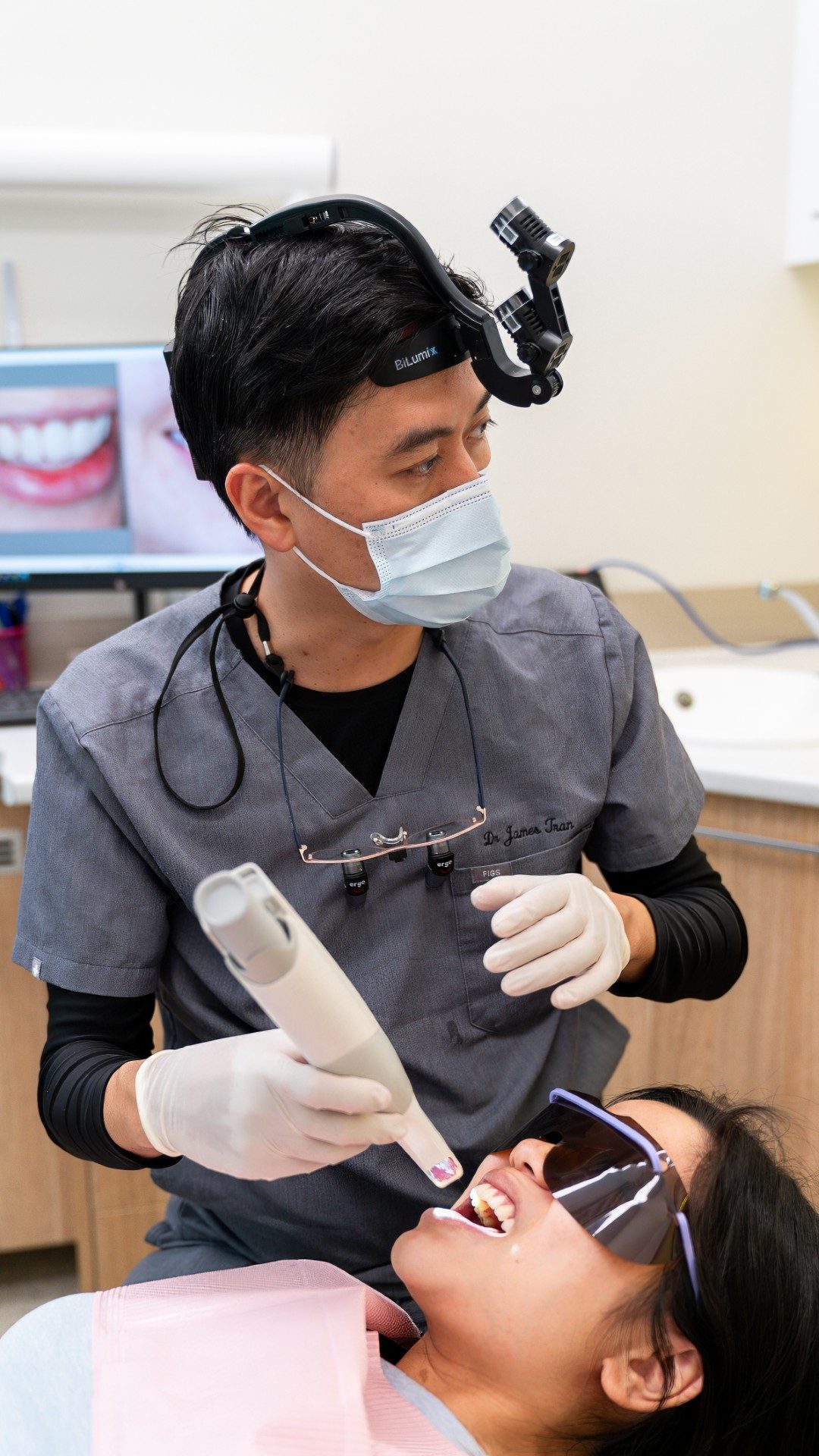
The practical problem is the attachment. Aligners rely on small composite bumps bonded to the tooth surface for grip, and composite bonds to enamel very well and to glazed ceramic poorly. A laboratory study of lithium disilicate found that the surface had to be roughened, by hydrofluoric acid etching or air abrasion, before attachments reached a useful bond strength, and that the bonding agent and composite chosen changed the result. A systematic review of such studies reached the same conclusion and noted that zirconia is harder still to bond to because it resists acid. In my experience an attachment on a crown is the one most likely to come off mid-treatment, so I plan for it: fewer attachments on crowns where the plan allows, careful surface preparation where it does not, and a warning that a replacement visit may be needed. Our article on attachments and interproximal reduction explains how they work on natural teeth.
One more point: a crown shaped to fit crooked neighbours may look wrong once the teeth are straight, which is why an old front crown is usually replaced after aligners rather than before.
Veneers: moving teeth you have already paid to perfect
Veneered teeth move the same way crowned teeth do, and the attachment problem is the same, with one added risk: removing a composite attachment from porcelain means grinding it off a thin glazed surface, and the glaze can be dulled or marked. Bonding to the tooth beside the veneer is sometimes possible instead. If a veneer is already chipped or due for replacement, the sensible path is to align first and remake it afterwards.
For someone who does not yet have veneers but is considering them for crooked front teeth, the order question is the whole decision. Aligning first often means the veneers can be thinner or fewer, and sometimes means they are not needed at all; our comparison of veneers versus aligners for crooked teeth works through it. Orthodontics Australia notes that aligners are usually worn 20 to 22 hours a day, so the commitment is real, but it is reversible in a way that enamel removal is not.
Bridges and implants: the parts that will not move
Bridges
A conventional bridge joins the crowns on two anchor teeth with a false tooth between them, so the span is one rigid unit and the anchor teeth cannot be moved independently. The options are to leave the bridge and move everything else around it, or to section it, align the teeth, and make a new bridge or implant once they have settled.
Implants
An implant has no ligament. Once bone has grown around it, it is part of the jaw, and no appliance will shift it. That is a limitation and an asset. The limitation is that neighbouring teeth can only be moved as far as the fixed implant crown allows, which can rule out closing a gap beside it. The asset is that the implant becomes an anchor that can be used to pull other teeth toward it without drifting itself. Where the implant has not yet been placed, the gap is held open during treatment, often with a tooth-coloured pontic built into the aligner, and the implant goes in once the final positions are confirmed. Leaving a gap unmanaged for years has its own consequences, described in what happens if you do not replace a missing tooth.
Restoration by restoration: what moves, what sticks, what can go wrong
| Restoration | Can aligners move it? | Will an attachment bond? | Main risk | Usual sequencing |
|---|---|---|---|---|
| Filling or composite bonding | Yes | Yes, to enamel or composite | Edges may need polishing after | Align first, refresh bonding after |
| Porcelain veneer | Yes | Only after surface preparation; may debond; removal can mark the glaze | Marked or chipped veneer | Align first, veneer after; old veneers often remade |
| Crown (porcelain, zirconia, metal) | Yes, the root moves | Unreliable; zirconia hardest | Attachment loss; margin may show | Align first; replace old crown after if needed |
| Tooth-supported bridge | Not as separate teeth | Can bond, but the unit will not move individually | Plan limited by the span | Work around it, or section and remake after |
| Implant crown | No | Not needed; implant acts as anchor | Limits movement of neighbours | Existing: plan around it. Planned: place after alignment |
| Full-arch implant bridge | No | No | Opposing arch only can be aligned | Aligners for the natural arch, if any |
Planning, refinements and keeping the result
Every plan of this kind starts with a 3D scan that records where the crowns, veneers and implants sit, because the software has to be told which teeth may move and which may not. Refinement aligners near the end are common when a restored tooth has lagged behind. After treatment, retention matters more when restorations are involved: a new veneer or crown made to fit straight teeth will not fit teeth that have drifted. Orthodontics Australia points out that teeth shift naturally with age and after treatment, which is why a retainer is part of every plan.
How we approach this at Lumi Dental
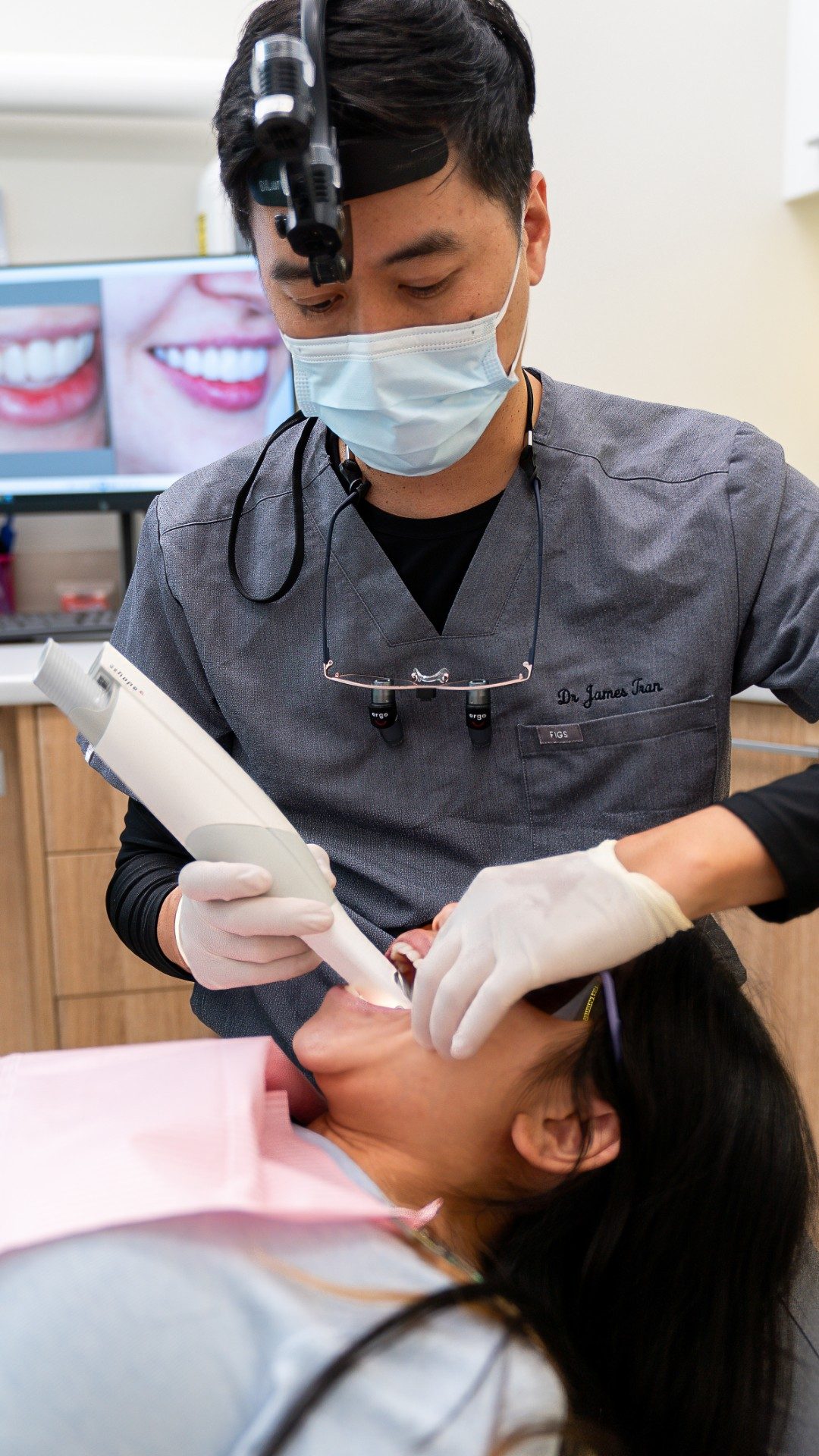
At Lumi Dental in Melrose Park the planning for aligners around existing dental work begins with an examination by a dentist, a 3D intraoral scan and clinical photographs, so that every crown, veneer, bridge and implant is mapped before any movement is designed. Clear aligners, porcelain veneers, crowns and dental implants at Lumi Dental are planned by the same team, which lets the order of treatment be decided once rather than passed between providers. Dr James Tran is a general dentist; cases that need complex movement, jaw surgery or specialist input are referred to a registered specialist orthodontist.
Questions patients ask
Can you have Invisalign or other clear aligners with crowns?
Usually yes. Clear aligners of any brand move the root, and a crowned tooth still has one. The compromise is that attachments bond less reliably to porcelain or zirconia, so the crown may need surface preparation and the attachment may need replacing.
Do aligners work on teeth with veneers?
Yes, the tooth under a veneer moves normally. The care point is the attachment: removing it can mark the porcelain, so the dentist may place attachments on neighbouring teeth instead or accept that an older veneer will be remade after alignment.
Can a dental implant be moved with aligners?
No. An implant is fused to bone with no ligament, so it stays where it was placed. The plan treats it as a fixed anchor and moves the natural teeth around it, which can limit how far the neighbours can go.
Should I get aligners before or after veneers?
Before, in most cases. Straight teeth need thinner veneers and less enamel removal, and sometimes alignment alone is enough. Our guide to bonding, veneers or a crown helps with the restoration choice once the teeth are in position.
Will my old crowns need replacing after aligners?
Not always, but often for front teeth. A crown shaped to fit crooked neighbours can look wrong once the arch is straight. Wearing the retainer matters here, because drifting teeth undo the fit of any new work; see can teeth shift without a retainer.
Crowns, veneers or an implant and thinking about aligners? Complimentary aligner consult in Melrose Park
If you have existing dental work and want to know whether aligners can move around it, the team at Lumi Dental in Melrose Park can scan your teeth, map your restorations and set out a sequence in writing. Book a complimentary aligner consultation or read more about clear aligners at Lumi Dental. Patients visit from Ryde, Parramatta, Ermington, Rydalmere and nearby suburbs.
Sources
- PMC: Bonding of clear aligner composite attachments to ceramic materials, an in vitro study
- PMC: Evaluation of bonding of clear aligner attachments on aesthetic crown materials, a systematic review
- Orthodontics Australia: What are the options when it comes to braces for adults?
- healthdirect: Dental implant
About the author

Dr James Tran is a general dentist at Lumi Dental in Melrose Park. He holds a BDent from the University of Sydney and a Graduate Diploma in Oral Implants, and is a Member of the International Congress of Oral Implantologists (MICOI).
This article is general information only and is not a substitute for an examination and individual advice from a registered dental practitioner. Suitability for any treatment varies from person to person.








