The differences between composite and ceramic onlays tend to show up over time: how the surface wears and holds its colour, how easily a chip can be fixed, and how many restorations are still working after many years. The clinical trials that compare the two materials directly are small and mostly short, so what the evidence can say is narrower than many people expect.
An onlay is a bonded restoration made outside the mouth that covers one or more cusps of a back tooth. If the term is new to you, start with our article on what a dental onlay is. This article is about the choice of material once an onlay has been suggested.
Two groups of materials go by these names
"Ceramic" onlays include glass-ceramics such as lithium disilicate (e.max is one brand) and feldspathic porcelain. They are made in a laboratory or milled from a block, then bonded to the tooth.
"Composite" onlays are made from tooth-coloured resin composite. Some are made in a laboratory, and others are milled from factory-made CAD/CAM blocks. A newer middle group, sometimes called resin matrix ceramics or hybrid ceramics, mixes a ceramic network or ceramic filler with resin. Studies group and name these materials in different ways, so results are not always directly comparable.
healthdirect's page on dental fillings explains that gold and porcelain fillings are made in a dental laboratory over two appointments, while composite resin is bonded to the tooth.
Direct comparisons are few and short
A 2013 systematic review in Dental Materials (Fron Chabouis and colleagues) searched for randomised trials comparing composite with ceramic inlays or onlays. It found only two trials, covering 138 inlays in 80 patients, both at high risk of bias, and no trial that had tested onlays at all. Over three years, ceramic inlays had a lower failure rate, but the difference was not statistically significant. The authors concluded the evidence that ceramic performs better was very limited and called for trials of onlays.
Two randomised trials have since been published, along with one older non-randomised study:
- A randomised split-mouth trial from Egypt (Hassan and colleagues, Odontology, 2024) placed a lithium disilicate onlay and a resin nano-ceramic onlay in each of 20 patients. After two years there was no significant difference between the two materials for any criterion assessed, and estimated survival was 90% for both.
- A randomised trial from Egypt in BMC Oral Health (Elmoselhy and colleagues, 2024) restored vital teeth that had at least two walls left, using onlay-style preparations, with either a CAD/CAM nano-hybrid composite or lithium disilicate. Forty-eight of the 50 participants completed two years. The groups differed in margin quality at six months but not at one or two years, and both performed acceptably.
- An older, non-randomised two-year study of inlays (not onlays) from Munich (Manhart and colleagues, Clinical Oral Investigations, 2000), with inlays placed by supervised students, rated all ceramic inlays and 90% of composite inlays as clinically excellent or acceptable. Ceramic scored better for surface form and integrity, and molars failed more often than premolars.
Two years is a short time for a restoration that may need to last a decade or more. These trials tell us both materials can work well early on. They cannot tell us which lasts longer.
The longest study favoured ceramic
The longest comparison read for this article is a retrospective study from the University of Pécs in Hungary (Lempel and colleagues, Dental Materials, 2023). It followed 91 patients with lithium disilicate or laboratory-made composite inlays, onlays and overlays for a mean of 7.8 years. Survival was 96.8% for lithium disilicate and 84.9% for composite, with annual failure rates of 0.2% and 1.0%. For the first six years both materials stayed above 98% survival, but by the fifteenth year the estimated survival of the composite restorations had fallen to 60%. Restoration material, oral hygiene and tooth grinding were each linked to more problems. Because patients were not randomly allocated, other differences between the groups may have contributed.
A 2023 meta-analysis in Clinical Oral Investigations (Bresser and colleagues) pooled 12 studies of 946 indirect restorations placed inside the tooth (inlay type, rather than onlays covering cusps). Lithium disilicate and indirect composite had comparable survival in the short term. Gold did better than indirect composite over five to seven years. The authors rated the evidence as medium quality and noted short follow-up and small samples.
For the hybrid materials, a 2025 systematic review of 21 clinical studies (Alghauli and colleagues, Journal of Esthetic and Restorative Dentistry) found that resin matrix ceramic restorations placed inside the tooth had complication rates similar to lithium disilicate inlays and onlays, while resin matrix ceramic full and partial crowns had more complications than ceramic ones. The authors called for long-term randomised trials.
Colour, wear and repair
Colour stability is one area where laboratory studies mostly agree. A 2023 systematic review of 19 laboratory studies (Paolone and colleagues, Polymers) found that composite CAD/CAM blocks soaked in coffee, tea, red wine or cola changed colour beyond the clinically acceptable threshold in 18 of the 19 studies. They stained less than conventional composites but more than ceramics. These were laboratory soaking tests, not restorations in people's mouths.
Repair is one argument made for composite. When a composite restoration fails, repair with new composite is often possible rather than replacement (Loomans and colleagues, Journal of Dentistry, 2017). In laboratory bond tests, how well repair composite bonded to indirect composites depended on the material, the surface treatment and ageing (Loomans and colleagues). Another laboratory study measured repair bonds to indirect composites, a hybrid ceramic and a feldspathic ceramic, and bond strength varied with the material, the adhesive used and storage time (Flury and colleagues, Dental Materials, 2019). These were bond tests on specimens, not repairs followed in patients.
What usually decides the choice
There is no single right answer for every tooth. Things a dentist may weigh include:
- Whether the tooth has had a root canal. A 2021 meta-analysis of six studies (Dioguardi and colleagues, Clinical Oral Investigations) found bonded inlays, onlays and overlays failed more often on root-filled teeth than on vital teeth.
- Grinding or clenching, which was a risk factor in the Pécs study.
- How long the restoration is expected to last, given that the one long-term study read for this article favoured lithium disilicate.
- Whether easy repair matters more than colour stability for that tooth.
Our separate articles cover table-top onlays for worn back teeth, gold crowns and onlays and what to do if an onlay comes off.

Onlays at Lumi
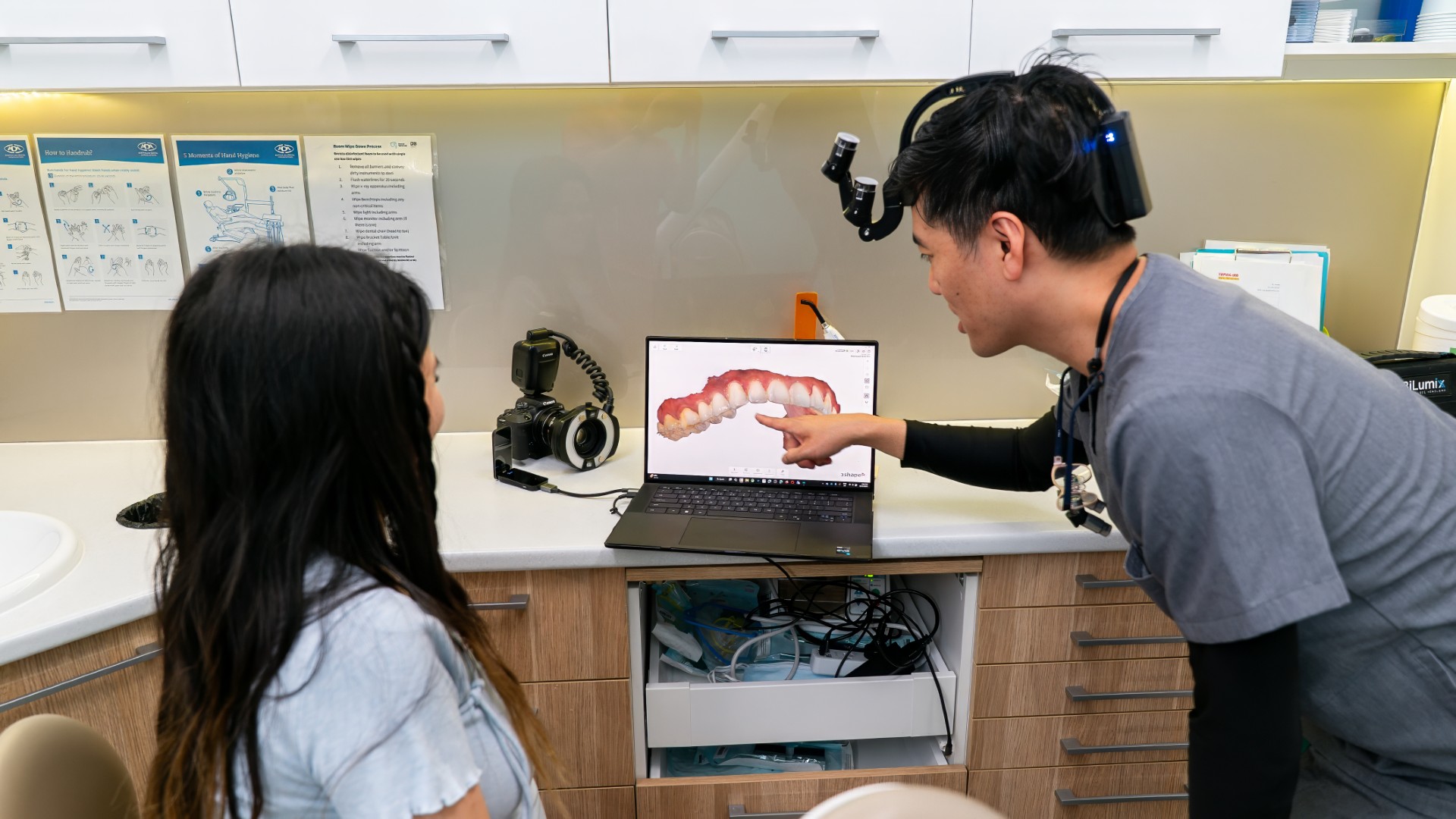
Lumi provides onlays and uses lithium disilicate (e.max), with zirconia also offered as a choice. The practice has a 3D intraoral scanner and an in-house lab with 3D printing. You will usually receive a written treatment plan, often by email.
For dentists: air abrade and use a resin primer on CAD/CAM composite
Factory-made CAD/CAM composite blocks have a high degree of conversion, which makes a reliable bond harder to achieve. In a laboratory study of four brands (Reymus and colleagues, Clinical Oral Investigations, 2019), air abrasion of the fitting surface raised tensile bond strength and lowered failure rates, and a resin primer containing methyl methacrylate outperformed a silane primer. With silane alone, all specimens of one brand that had not been air abraded debonded during ageing. The limits: this was an in vitro tensile test of luting composite on block material (15 specimens per group) after 24 hours of water storage and 5,000 thermal cycles, results varied by brand, and it has not been confirmed in clinical trials. Check the manufacturer's instructions for the specific block.
Questions about onlay materials
Is a composite onlay just a big filling?
No. A filling is placed and hardened in the tooth. A composite onlay is made outside the mouth, either in a lab or milled from a block, and then bonded on. The material is related, but the way it is made and fitted is different.
Which lasts longer?
In the longest study read for this article, survival was similar for about the first six years, after which composite restorations failed more often than lithium disilicate. That study was not randomised. Short randomised trials show both performing similarly over two years.
Talk to us about an onlay
If you have been told a back tooth needs an onlay, or you want to know whether one suits a cracked or heavily filled tooth, you can book an appointment at our Melrose Park practice or read more about crowns and partial coverage restorations at Lumi.
Sources
- Fron Chabouis H, Smail Faugeron V and Attal JP. Clinical efficacy of composite versus ceramic inlays and onlays: a systematic review. Dental Materials, 2013. PubMed 24119328
- Hassan A and colleagues. Clinical performance comparison between lithium disilicate and hybrid resin nano-ceramic CAD/CAM onlay restorations: a two-year randomized clinical split-mouth study. Odontology, 2024. PubMed 37542639
- Elmoselhy HAS and colleagues. Two-year clinical performance of indirect restorations fabricated from CAD/CAM nano hybrid composite versus lithium disilicate in mutilated vital teeth. BMC Oral Health, 2024. PubMed 38233771
- Manhart J and colleagues. A 2-year clinical study of composite and ceramic inlays. Clinical Oral Investigations, 2000. PubMed 11218488
- Lempel E and colleagues. Clinical evaluation of lithium disilicate versus indirect resin composite partial posterior restorations: a 7.8-year retrospective study. Dental Materials, 2023. PubMed 37821330
- Bresser RA and colleagues. Clinical longevity of intracoronal restorations made of gold, lithium disilicate, leucite, and indirect resin composite: a systematic review and meta-analysis. Clinical Oral Investigations, 2023. PubMed 37597003
- Alghauli MA and colleagues. Clinical complications and survival rate of resin matrix ceramic restorations: a systematic review and meta-analysis. Journal of Esthetic and Restorative Dentistry, 2025. PubMed 40186393
- Paolone G and colleagues. Color stability of polymer-based composite CAD/CAM blocks: a systematic review. Polymers, 2023. PubMed 36679343
- Loomans BA and colleagues. Effect of different surface treatment techniques on the repair strength of indirect composites. Journal of Dentistry, 2017. PubMed 28174053
- Flury S, Dulla FA and Peutzfeldt A. Repair bond strength of resin composite to restorative materials after short- and long-term storage. Dental Materials, 2019. PubMed 31146960
- Dioguardi M and colleagues. Clinical outcome of bonded partial indirect posterior restorations on vital and non-vital teeth: a systematic review and meta-analysis. Clinical Oral Investigations, 2021. PubMed 34628547
- Reymus M and colleagues. Bonding to new CAD/CAM resin composites: influence of air abrasion and conditioning agents as pretreatment strategy. Clinical Oral Investigations, 2019. PubMed 29704137
- healthdirect. Dental fillings. healthdirect.gov.au