When the chewing surfaces of back teeth wear flat, the sides of those teeth may still be in reasonable shape. A table-top onlay, also called an occlusal veneer, covers the biting surface and is bonded on, so the sides of the tooth usually do not need to be cut back the way they would for a crown. One laboratory study tested them at thicknesses from 0.5 to 1.5 mm.
They are one option among several for worn teeth, and they are best considered once the reason for the wear is understood. This article covers what the clinical studies show about how they last, how ceramic and composite versions compare, and where they tend to run into trouble.
Finding the cause comes before any rebuilding
A European consensus statement on severe tooth wear (Loomans and colleagues, Journal of Adhesive Dentistry, 2017) recommends diagnosis, prevention, counselling and monitoring, and states that restorative treatment is typically best delayed as long as possible. When treatment is needed, the panel recommends a conservative, minimally invasive approach alongside prevention.
Acid is a common contributor. A consensus report from the European Federation of Conservative Dentistry (Carvalho and colleagues, Clinical Oral Investigations, 2015) lists reflux, vomiting, eating and drinking habits, medicines and dietary supplements among the patient factors, and says restorations should only be used together with preventive steps. Grinding is the other common contributor. The Better Health Channel notes that around 5% of people grind their teeth regularly and that grinding can cause wear, cracked teeth and broken fillings; its page on teeth grinding is a useful starting point. Our article on attrition, erosion and abrasion explains how these patterns differ.
Dentists often record wear with the Basic Erosive Wear Examination (BEWE), a screening score. A 2026 update by Bartlett and colleagues (Journal of Dentistry) adds a new level 4 for more severe wear: 2 mm of lost crown height, or 2 mm of horizontal wear along the gum line.
How a table-top differs from an onlay or a crown
| Restoration | What it covers | How much tooth is usually removed |
|---|---|---|
| Table-top onlay (occlusal veneer) | The biting surface | Usually the least of the three |
| Onlay | One or more cusps | More, because the cusps being covered are reduced |
| Crown | The whole visible tooth | The most, all the way around |
Our article on what a dental onlay is covers onlays in more detail, and the guide to restoration options for worn-down teeth sets table-tops alongside composite build-ups and crowns.
What the clinical studies show
Most of the evidence comes from small groups of patients. The numbers below are useful, but they are not large or long enough to predict how one person's teeth will do.
| Study | Who and what | Result |
|---|---|---|
| Edelhoff and colleagues, Dental Materials, 2019 | 7 patients with severe wear, 103 lithium disilicate table-tops, followed for up to 11 years (median about 8) | None lost. Four, all in one patient, showed marginal staining and one a small crack at the margin; no debonding or decay. |
| Schlichting and colleagues, Journal of Prosthetic Dentistry, 2022 | 11 patients with severe erosion, 24 ceramic and 36 composite table-tops, randomly assigned, up to 3 years | None lost. Five composite table-tops chipped; the chips were rated restorable. Survival was 100% for ceramic and 84.7% for composite, a difference that was not statistically significant. Composite surfaces roughened more. |
| Bai and colleagues, Clinical Oral Investigations, 2026 | 51 patients, 60 cracked teeth restored with lithium disilicate table-tops, 2 to 4 years | 95% survived. Three fractured badly enough to be remade and six needed margin repairs. Second molars failed more often than other teeth. |
| Chen and colleagues, BMC Oral Health, 2026 | 3 patients, 46 lithium disilicate overlays on back teeth, about 5 years | None lost or fractured, but marginal staining was noted on 67.4% and surface wear on 34.8%. |
A 2025 meta-analysis of six randomised trials of partial-coverage restorations on back teeth (Prott and colleagues, Journal of Esthetic and Restorative Dentistry) found three-year survival of 93.7% for lithium disilicate and 89.3% for resin-matrix ceramic, with lithium disilicate slightly ahead on failures and loss of retention. Most of those trials tested onlays; only one tested table-tops. The certainty of that difference was low, and the authors described long-term performance as uncertain.
Ceramic or composite
Both are used. In the one randomised trial above, composite chipped more often, although the chips were rated restorable, while ceramic kept a smoother surface. Laboratory results do not always match clinical results, and they depend on how the test is set up:
- A 2024 review of six laboratory studies (Del Cisne Maldonado and colleagues, Dental and Medical Problems) found milled composite table-tops performed comparably to lithium disilicate in fatigue and fracture tests.
- In a 2023 laboratory study on extracted human molars (Mueller and colleagues, Dental Materials), sealing the exposed dentine straight after preparation improved the fatigue behaviour of composite table-tops but not of lithium disilicate ones.
- In a laboratory study, Prott and colleagues (Journal of Prosthodontic Research, 2026) found that lithium disilicate table-tops, including very thin (0.5 mm) ones, withstood higher loads than multilayered zirconia at every thickness tested, and half of the 0.5 mm zirconia specimens cracked during chewing simulation.
- Under a laboratory test designed to imitate grinding, Zamzam and colleagues (Journal of the Mechanical Behavior of Biomedical Materials, 2026) found translucent zirconia table-tops failed at higher sideways loads than lithium disilicate or hybrid ceramic.
For people with widespread wear, composite has its own clinical record. Mehta and colleagues (Journal of Dentistry, 2021) followed 1,269 direct composite restorations in 34 patients for a mean of about five years and found 2.3% had failed outright, with annual failure rates of 2.9% or less for back teeth when minor repairs were counted. Molars needed more maintenance. A similar study of milled composite restorations by Maier and colleagues (Dental Materials, 2024) also found higher failure rates on molars than on premolars and front teeth.
Molars carry the most risk
In the studies that compared tooth types, the teeth furthest back did worst: second molars in the cracked-tooth study, and molars in both composite studies. The studies did not establish why. If grinding is part of the picture, a dentist may talk about protecting restorations at night, and our guide to night guards for teeth grinding explains the options.
For dentists: second molars and ultrathin zirconia
Two findings may help when planning. In the Bai cohort of lithium disilicate table-tops on vital cracked teeth, second molars had a significantly higher failure risk than other teeth (univariate Cox model p = 0.024), and both Radboud-linked composite studies found more failures on molars. In the Prott laboratory study, ultrathin (0.5 mm) composition-gradient multilayered zirconia table-tops cracked in half of the specimens during thermomechanical fatigue, while lithium disilicate at the same thickness had the highest mean failure load of all groups. The limits matter: Bai's analysis rested on nine broadly defined failures and univariate tests, the Prott specimens were bonded to dentine-analogue dies rather than teeth, and the Zamzam grinding simulation, which used a different (translucent) zirconia, favoured zirconia under heavy lateral loads. These results may justify extra caution on second molars and with very thin multilayered zirconia, not a fixed rule.
Assessing worn back teeth at Lumi
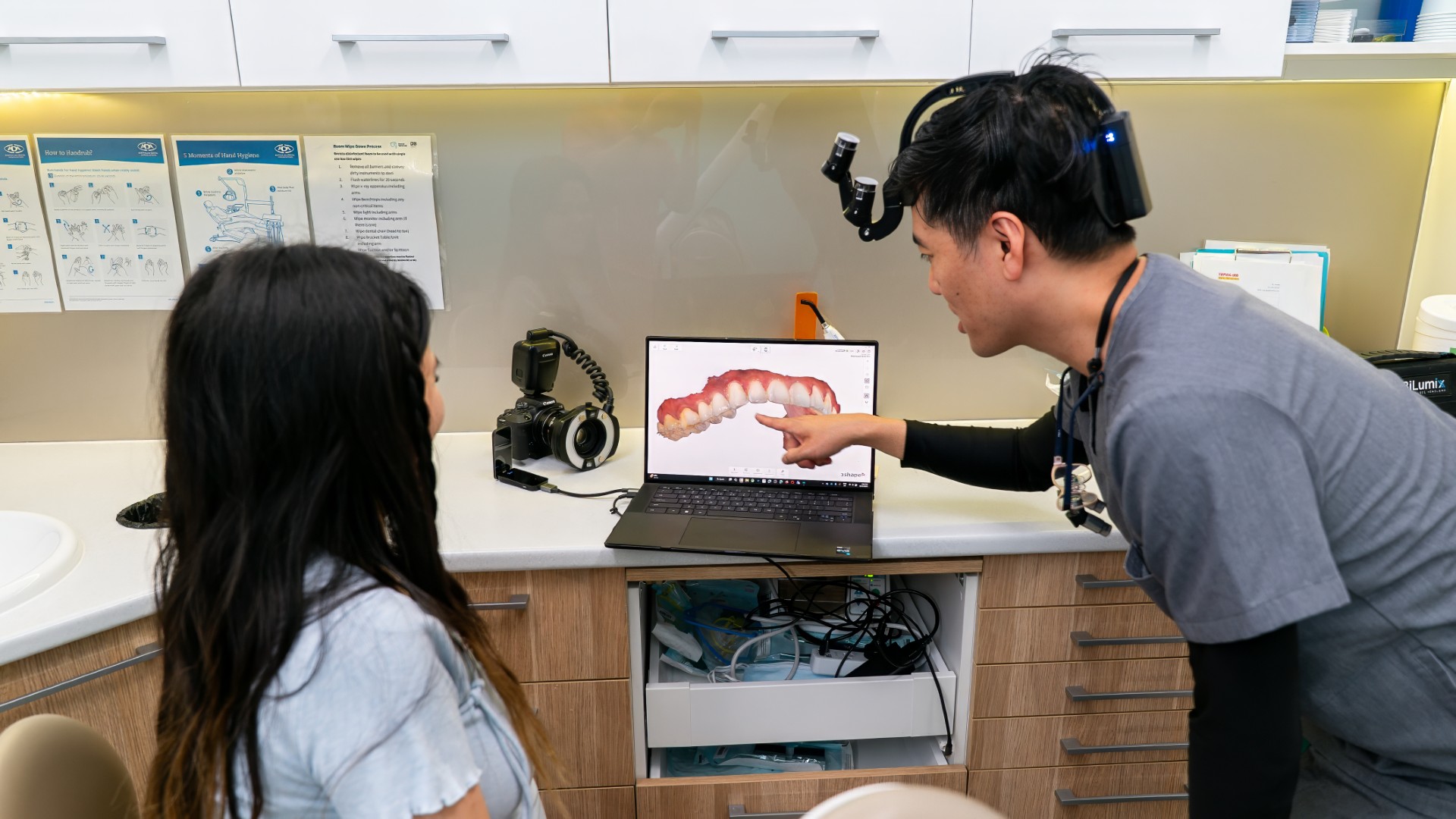
A dentist or OHT can record wear at a check-up and help look for the cause. Lumi has a 3D intraoral scanner, which records the shape of the teeth at a given visit, an in-house lab, and uses e.max (lithium disilicate) for ceramic restorations. Whether a worn tooth is better monitored, built up with composite or restored another way depends on the cause, how much tooth is left and how the bite works, and is discussed after an examination. More about restorative options is on our crowns and bridges page.
Questions about table-top onlays
Is a table-top onlay the same as a veneer on a front tooth?
It is a similar idea, a thin bonded layer, but it covers the biting surface of a back tooth rather than the front surface of a front tooth. That is why it is also called an occlusal veneer.
Can a chipped table-top be repaired?
Sometimes. In the Schlichting trial, the chips in composite table-tops were rated restorable, and in the Bai study six ceramic table-tops had margin defects that were repaired rather than remade. Larger fractures may mean replacing the restoration.
Do table-tops stop the wear from continuing?
They cover the surface they are bonded to, but they do not remove the cause, and the restorations themselves can wear over time. The consensus statements above stress that any restoration should go together with prevention.
Sources
- Loomans B and colleagues. Severe tooth wear: European consensus statement on management guidelines. Journal of Adhesive Dentistry, 2017. PubMed 28439579
- Carvalho TS and colleagues. Consensus report of the European Federation of Conservative Dentistry: erosive tooth wear, diagnosis and management. Clinical Oral Investigations, 2015. PubMed 26121968
- Bartlett D and colleagues. BEWE 2.0: basic erosive tooth wear examination revisited. Journal of Dentistry, 2026. PubMed 41565150
- Edelhoff D and colleagues. Clinical performance of occlusal onlays made of lithium disilicate ceramic in patients with severe tooth wear up to 11 years. Dental Materials, 2019. PubMed 31256912
- Schlichting LH and colleagues. Ultrathin CAD-CAM glass-ceramic and composite resin occlusal veneers for the treatment of severe dental erosion: an up to 3-year randomized clinical trial. Journal of Prosthetic Dentistry, 2022. PubMed 35750501
- Bai XS and colleagues. Clinical performance of lithium disilicate ceramic occlusal veneers for restoring cracked teeth: a 2- to 4-year prospective cohort study. Clinical Oral Investigations, 2026. PubMed 42521893
- Chen C and colleagues. Outcomes of lithium disilicate veneers and overlays in full-mouth rehabilitation for patients with extensive tooth wear: a non-randomized case series of three patients. BMC Oral Health, 2026. PubMed 42972313
- Prott LS and colleagues. Survival and complications of partial coverage restorations on posterior teeth: a systematic review and meta-analysis. Journal of Esthetic and Restorative Dentistry, 2025. PubMed 39558793
- Del Cisne Maldonado K and colleagues. Resistance of CAD/CAM composite resin and ceramic occlusal veneers to fatigue and fracture in worn posterior teeth: a systematic review. Dental and Medical Problems, 2024. PubMed 38888224
- Mueller B and colleagues. Effect of immediate dentin sealing on load-bearing capacity under accelerated fatigue of thin occlusal veneers. Dental Materials, 2023. PubMed 36922258
- Prott LS and colleagues. Fatigue performance and failure load of minimally-invasive occlusal veneers made of lithium disilicate and composition-gradient multilayered zirconia. Journal of Prosthodontic Research, 2026. PubMed 40903282
- Zamzam H and colleagues. Accelerated bruxism-simulating fatigue test of occlusal veneers. Journal of the Mechanical Behavior of Biomedical Materials, 2026. PubMed 41151461
- Mehta SB and colleagues. Clinical performance of direct composite resin restorations in a full mouth rehabilitation for patients with severe tooth wear: 5.5-year results. Journal of Dentistry, 2021. PubMed 34229000
- Maier E and colleagues. 5.5-year survival of CAD/CAM resin-based composite restorations in severe tooth wear patients. Dental Materials, 2024. PubMed 38458918
- Better Health Channel. Teeth grinding. betterhealth.vic.gov.au
If your back teeth look flatter than they used to, or feel more sensitive, you can book a check-up at our Melrose Park practice to have the wear and its cause assessed.
This article is general information only and is not a substitute for an in-person assessment by a dental professional.