

If you use CPAP and have no natural teeth in one or both jaws, whether a denture stays in at night is a decision for your sleep physician or sleep team, and the dental team's job is to keep the denture well fitting, clean and kind to the gum either way. The research does not settle the question: a review of 20 studies in people without teeth found no consensus on whether wearing dentures overnight helps or worsens sleep apnoea. A fixed full-arch implant bridge changes the picture, because it stays in day and night.
Written by Dr James Tran, BDent (University of Sydney), MICOI, GradDip (Oral Implants), general dentist at Lumi Dental in Melrose Park.
The short version
- Without teeth or a denture, the lips and cheeks fall inwards, which can change how a CPAP mask sits and seals.
- Studies on sleeping with dentures in disagree, and most looked at breathing without CPAP rather than at mask leak.
- The single rule: your sleep team decides on mask type and overnight denture use. Your dentist looks after fit, cleanliness and gum health.
- A denture worn overnight on medical advice needs more careful cleaning, a daily break at another time and regular checks. General advice is in our article on whether you should sleep with dentures in.
- An implant overdenture still comes out at night. A fixed full-arch bridge does not.
Why losing teeth changes how a CPAP mask sits
Teeth, and the bone that held them, support the lips and cheeks from the inside. Once every tooth in a jaw has gone, the bone slowly shrinks and the lips tend to fold inwards.
A CPAP mask has to seal against that face. The Sleep Health Foundation describes masks that cover the nostrils, the nose, or the nose and mouth, and says the mask should fit comfortably without any leak apart from the small exit port. A leak can be noisy and blow air into your eyes.
A mask covering the nose and mouth rests on the cheeks and around the lips, so less support means more hollows for air to escape. A mask that seals only at the nose depends less on the lower face, but if the mouth drops open, air rushes out through it. The foundation calls this mouth leakage.
In my experience the question comes up most when a denture is new, or when an old one has loosened.
What the research shows about dentures and sleep apnoea
A review from the University of Amsterdam, published in Sleep and Breathing, gathered 20 studies on sleep apnoea in people without teeth. The results point in different directions:
- The first report, in six people, found breathing and oxygen levels were better with complete dentures in overnight. A study of 48 people found the same.
- A study of 23 people found breathing events increased with dentures in, most clearly in mild sleep apnoea and when lying on the back.
- In a group of 27 older adults, 19 did better with dentures in and 8 did worse.
A larger randomised trial assigned 77 older adults without teeth, all with untreated sleep apnoea, to a month of sleeping with dentures in and a month without. The difference in breathing events was small, about 1 event an hour, and not statistically meaningful. Arousals were slightly higher with dentures in. The authors concluded that their results give some support to the usual advice to take dentures out at night.
These studies were small, and almost none involved people using CPAP, so they tell us about the airway rather than mask seal. The review also notes that between 29% and 83% of people stop using CPAP, with mask discomfort among the reasons.

The single rule: the sleep team decides, the dental team supports either plan
If you use CPAP and have no teeth in a jaw, start with your sleep physician or CPAP provider on mask type and overnight denture use. Then ask your dentist to check that the denture and your gums suit whichever plan they recommend.
- At a mask fitting, mention your denture and ask whether to try the mask with it in and out.
- If a new denture or a reline changes how the mask feels, tell your CPAP provider.
- Leave machine settings to your sleep team. A dentist does not change CPAP pressure or mask prescriptions.
Lumi Dental does not perform sleep studies or supply CPAP equipment, but the team at Lumi Dental can write to your GP or sleep physician where the two overlap.
If your denture stays in overnight on medical advice
The NHS advises against wearing dentures overnight unless your dentist recommends it, because trapped food raises the risk of gum infection and there is a risk of choking. A denture left in during sleep also sits on warm, poorly rinsed gum for hours, which favours denture stomatitis, a red inflamed patch in the outline of the plate.
A Japanese study of 524 adults aged 85 or over found that those who slept in their dentures had about 2.3 times the risk of pneumonia over three years. That is an association in a frail age group, not proof of cause.
Cleaning, a daily break and checks
The NHS suggests brushing dentures with soft soap or washing up liquid every morning and evening, not toothpaste, and brushing your gums and tongue twice a day. The gum still needs several hours without the plate, so take that break during the day while you are at home. Redness under the plate, sore spots or a denture that rocks are reasons to be seen sooner; a loose denture can also shift under the mask.
Comparing the options at night
| Situation at night | Mask fit | Gum and mouth | Cleaning notes |
|---|---|---|---|
| No teeth, denture out | Lips and cheeks less supported; mouth may fall open | Gum rests overnight, the usual advice | Clean and store the denture as advised |
| Complete denture in | Face shape closer to daytime; a loose denture can shift | Higher risk of stomatitis and plaque | Thorough evening clean, daily break at another time, regular checks |
| Implant overdenture | Clips on firmly by day; usually out at night | Gum still needs its rest | Clean the attachments and check the inserts |
| Fixed full-arch bridge | Stays in, so lip support is the same night and day | No plate on the palate; gum around implants needs care | Clean under the bridge each evening before the mask goes on |
Implant overdentures and fixed full-arch bridges
An overdenture that clips onto implants is still removable, and the gum beneath it needs the same nightly rest. Our article on implant-retained overdentures explains the attachments.
A fixed full-arch bridge is screwed to implants and only a dentist removes it, so you sleep with it in. At Lumi Dental this treatment is called All-on-X. Because the teeth never come out, the lips and cheeks have the same support at night as by day. I would expect that to make mask fit more predictable for some people, but I have not found studies that measured it, so treat it as a possibility rather than a promise.
The trade-off is cleaning under the bridge every day, which matters more when CPAP dries the mouth. Our guide on how to clean a full-arch implant bridge at home sets out a routine, and dentures versus All-on-X full-arch implants compares the two more broadly.
If you are planning implant surgery, tell the team you use CPAP; the Sleep Health Foundation advises people having surgery to discuss their CPAP with the surgeon and anaesthetist.
CPAP, dry mouth and denture grip
A full upper denture is held on largely by a film of saliva, so a dry mouth can loosen it. The Sleep Health Foundation lists a chin strap, a mask covering the nose and mouth, or a humidifier for mouth leakage and dryness; those are decisions for your CPAP provider or sleep team.
Dry mouth can also make the gum under a plate sore. Our article on CPAP and dry mouth covers what helps.
How we approach this at Lumi Dental
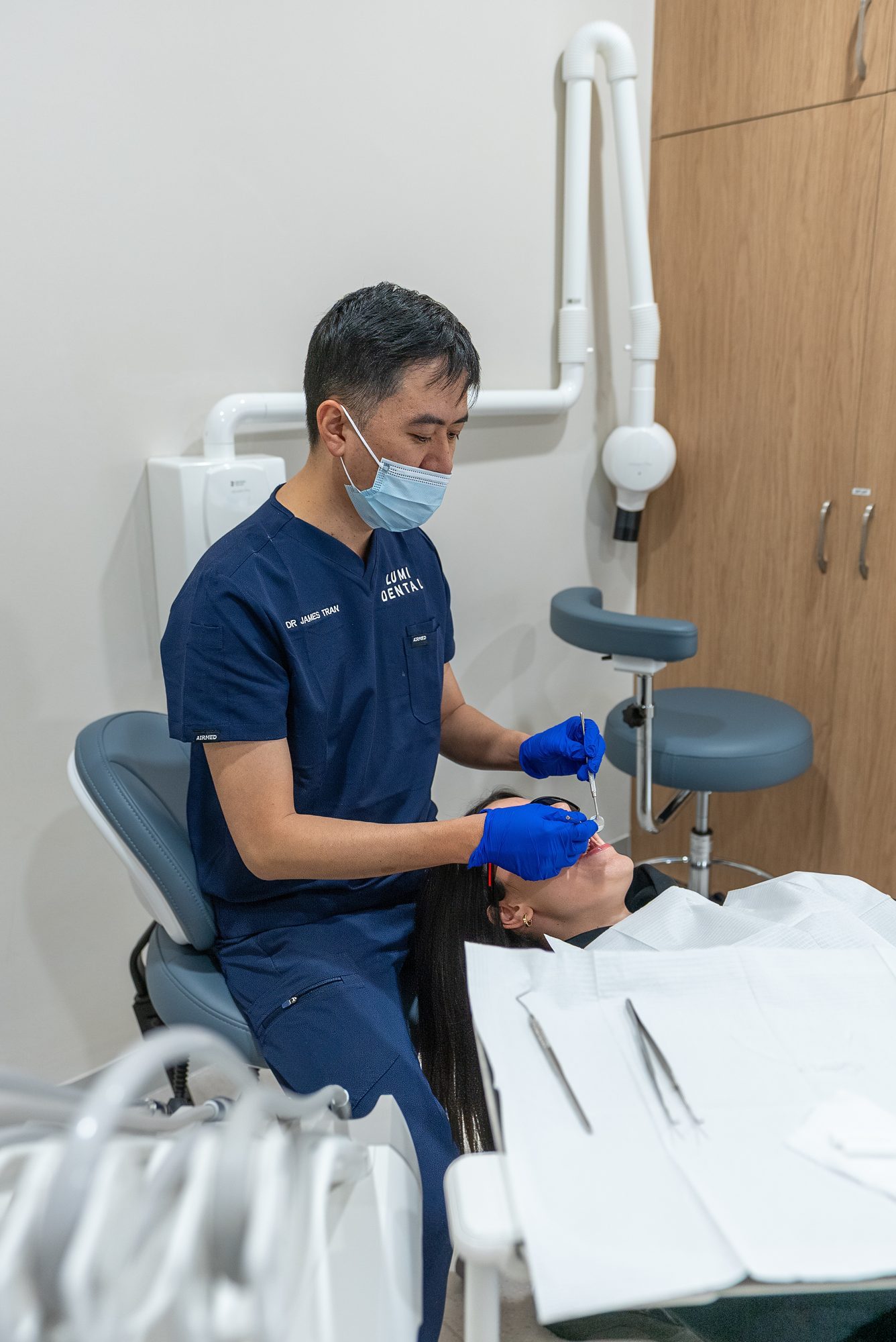
At Lumi Dental in Melrose Park, a dentist asks how many hours a day your denture is in, examines the gum under it and checks the fit. A loose denture may need a reline or replacement. For implants, an in-house 3D X-ray shows the available bone, and the oral health therapists help with cleaning routines. Mask and pressure questions go back to your sleep physician or CPAP provider. Complex cases are referred to a registered specialist. Read more about general dentistry and denture reviews at Lumi Dental.
Questions patients ask
Should I wear my dentures with my CPAP mask?
Ask your sleep physician or CPAP provider, because the research is mixed. Either way, keep the denture clean and the gum checked.
Can I use a full face mask without my dentures?
Many people do, though a mask that fitted before may leak once the cheeks lose support. Your CPAP provider can help you try other styles and sizes.
Will CPAP make my dentures loose?
CPAP does not change the denture itself, but a dry mouth can reduce the suction that holds a full denture in place. A denture that has loosened because the gum has shrunk may need a reline.
Can I have a sleep apnoea mouth appliance if I have no teeth?
Usually not a standard one, because these appliances need teeth to hold onto. The Amsterdam review describes appliances attached to dentures or held by implants in selected cases. Our article on sleep apnoea oral appliances explains how they fit alongside CPAP.
Do I take a full-arch implant bridge out at night?
No. A fixed bridge stays in and only a dentist removes it. Clean under it each evening and keep your regular maintenance visits.
Considering full-arch implants or new dentures? Complimentary implant consult in Melrose Park
If your dentures are loose, sore or affecting how your CPAP mask sits, the team at Lumi Dental can check the fit and talk through dentures, overdentures and a fixed bridge. Contact Lumi Dental to book a complimentary implant consult, or read more about All-on-X full-arch implants in Melrose Park. Patients visit from Ryde, Parramatta, Ermington and Rydalmere, with on-site parking at Melrose Central.
Sources
- Sleep Health Foundation: CPAP, Continuous Positive Airway Pressure
- Sleep and Breathing (Heidsieck DSP and colleagues): Management of obstructive sleep apnea in edentulous patients, an overview of the literature (PMC)
- Sleep (Emami E and colleagues): Effects of nocturnal wearing of dentures on the quality of sleep in edentate elders with untreated sleep apnea, a randomized cross-over trial (PMC)
- Journal of Dental Research (Iinuma T and colleagues): Denture wearing during sleep doubles the risk of pneumonia in the very elderly (PMC)
About the author

Dr James Tran is a general dentist at Lumi Dental in Melrose Park. He holds a BDent from the University of Sydney and a Graduate Diploma in Oral Implants, and is a Member of the International Congress of Oral Implantologists (MICOI).
This article is general information only and is not a substitute for an examination and individual advice from a registered dental practitioner. Suitability for any treatment varies from person to person.








