

Swelling on day two after implant surgery is expected. Swelling that is bigger on day five than it was on day three is not. In the first fortnight, the most useful thing to watch is which way the site is heading: normal healing improves a little each day once the first two or three days have passed, while an infection gets worse, flares up again after settling, or brings something new such as pus, a foul taste or a fever.
Written by Dr James Tran, BDent (University of Sydney), MICOI, GradDip (Oral Implants), general dentist at Lumi Dental in Melrose Park.
Pain peaks early and swelling a day or two later
A Spanish study of 41 patients who had 131 implants placed under local anaesthetic (González-Santana and colleagues, Medicina Oral, 2005) found that most people who had pain described it as slight. Where pain peaked, it was most often about six hours after surgery. Swelling was usually moderate and, in about half of cases, was at its worst at 48 hours. Swelling was greater in older patients, after more than four implants, at the back of the mouth, and where a sinus lift or bone graft was part of the procedure.
Patient advice from Guy's and St Thomas' NHS Foundation Trust in London matches that pattern. It says pain is usually worse for the first two to three days and then starts to improve, and swelling appears within the first 48 hours and usually lasts five to seven days before getting better. Cambridge University Hospitals tells implant patients that the site is unlikely to be very sore, that there is relatively little swelling, and that regular paracetamol and ibuprofen are advised.
So a puffy, tender site for several days, especially after grafting, can be entirely normal as long as it is slowly getting better.
How infection was defined in a recent trial
A 2025 randomised trial in the journal Dentistry (Bravo-Olmedo and colleagues) compared a single antibiotic dose before implant surgery with a placebo in 100 healthy patients. It defined infection as severe pain after the first 48 to 72 hours, swelling still present from day seven, a fever over 38 degrees, warmth, discharge or a small draining spot on the gum, or redness. In the placebo group, two thirds of infections were found at the one-week check, and the rest at two weeks or later.
Guy's and St Thomas' gives patients a similar rule of thumb: with an infection, pain and swelling usually get worse about four to six days after surgery.
A day-by-day guide
| Days after surgery | Usually normal | Ring the practice if |
|---|---|---|
| Day of surgery | Numbness for a few hours, a little blood in the saliva, an ache as the anaesthetic wears off | Bleeding keeps soaking gauze despite firm pressure; swelling affects swallowing or breathing |
| Day 1 | Mild to moderate ache managed with regular pain relief; swelling starting | Pain that regular pain relief does not help |
| Days 2 and 3 | Swelling at its most; stiff jaw; possible bruising; a white or yellow film over the wound | A fever over 38 degrees; a foul taste; anything that looks like pus |
| Days 4 to 6 | Swelling smaller each day; pain easing | Pain or swelling increasing again after it had eased; heat, redness or throbbing |
| Days 7 to 10 | Stitches loosening or dissolved; mild tenderness; bruising fading | Swelling still there or growing; discharge; a pimple on the gum |
| Days 11 to 14 | Gum closing over; little or no discomfort | Any new swelling, pain, pus or fever; a loose healing cap; numbness getting worse |
Swelling that spreads towards the eye, under the jaw or into the neck, or any difficulty swallowing or breathing, needs urgent care the same day. Our article on spreading facial swelling explains why.
Fibrin, bruising and numbness are not infection
Three things worry people most in the first two weeks, and none of them is usually a sign of infection.
The first is the pale white or yellowish layer that forms over the wound in the first few days. That is fibrin, part of normal healing. Pus is thicker and cloudier, and it usually comes with a foul taste or smell that rinsing does not clear.
The second is bruising. It can appear a few days after surgery and drift down the cheek or jaw, and on fair skin it can look dramatic, but it is blood under the skin and fades on its own. Our guide to bruising after implant surgery covers it.
The third is tingling or numbness in the lip, chin or tongue after a lower implant. Cambridge University Hospitals explains that this comes from a nearby nerve being affected, that it usually recovers over a few months and is rarely permanent. It should always be reported, but it is a nerve problem rather than an infection. See our article on numbness after implant surgery.
A metal healing cap showing through the gum is also normal, unless it is loose or sore.
Why an early infection matters for the implant
In the first weeks the implant has not yet bonded firmly to the bone, so an infection around it can interfere with that process. In the 2025 trial, 3 of the 11 implants that became infected later failed, all of them with infection noticed at the one-week check. The authors also noted that most earlier placebo-controlled studies reported early failure rates of 1.3% to 5.1%, lower than the 7.9% in their own trial.
That is why the first fortnight is watched closely, and why a phone call about something doubtful is always better than waiting.
Early infection is a different problem from peri-implantitis, which is gum and bone disease around an implant that has been in use for months or years, driven mainly by plaque. Our guide to peri-implantitis treatment covers that.
What happens if you ring about a worrying site
The dentist looks at the gum, presses gently to check for tenderness or discharge, makes sure any healing cap is tight, and asks about taste, temperature and sleep. If something is uncertain, an X-ray can be compared with the one taken at surgery. A confirmed infection is usually cleaned and treated with antibiotics, which in the 2025 trial meant a seven-day course. A site that is simply sore and slow to settle does not need antibiotics, because they do nothing for ordinary swelling. Whether a dose before surgery is worthwhile is a separate question, covered in our article on antibiotics for dental implant surgery.
Occasionally an infected or loose implant has to be removed early. In many cases a new implant can be planned once the bone has healed.
Simple habits that lower the risk
Guy's and St Thomas' advises not rinsing on the day of surgery. From the next day, rinse with a teaspoon of salt in a glass of warm water four times a day for four to five days. It also advises avoiding hot food and drinks for two days and avoiding exercise for a few days. Brush your other teeth as usual and keep to soft food at first. Smoking slows healing, so avoiding it during recovery helps. Taking pain relief regularly for the first couple of days, as directed, usually works better than waiting for pain to build.
If you take medicines or have a condition that affects healing, tell us before surgery. Our team checks with your GP or prescriber where needed, and you should never stop or change a medicine such as a blood thinner on your own.
How implant healing is followed at Lumi
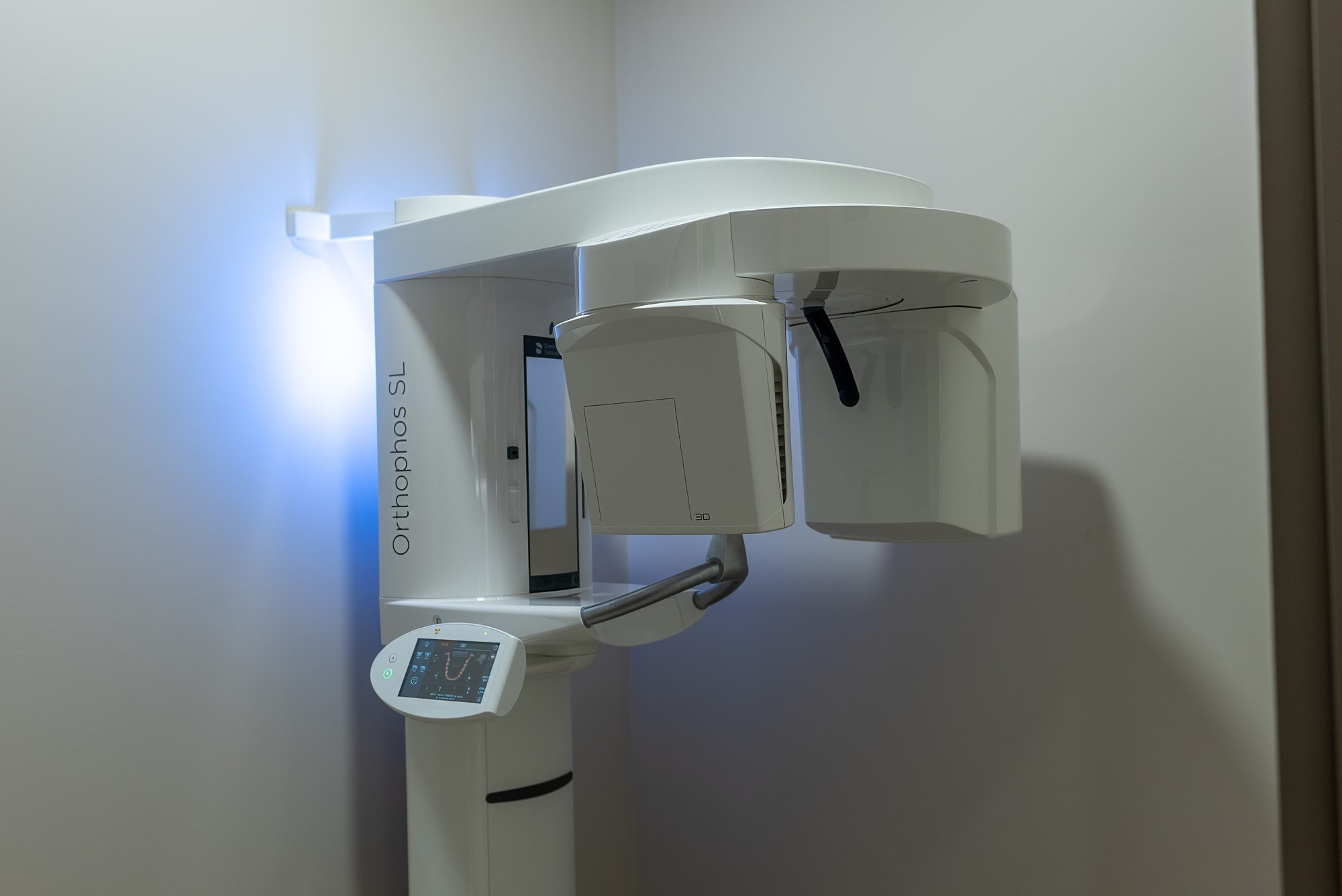
Implant surgery at Lumi is planned from a 3D X-ray and an intraoral scan. You go home with written aftercare instructions and the practice phone number, and a review is usually booked within the first two weeks, or sooner if anything in the table above appears. Because the 3D X-ray is in the practice, a site can be checked on the day if needed. Our technology page explains the equipment.
What patients ask about healing after implant surgery
How can I tell if my implant is infected or just healing?
Look at the trend. Healing gets slowly better each day after the first two or three days. Infection gets worse after that point, comes back after settling, or brings pus, a foul taste, heat or a fever over 38 degrees. If you are not sure, ring and describe it.
Is swelling a week after implant surgery normal?
Mild swelling that is clearly going down can be, especially after a bone graft, sinus lift or several implants. Swelling that is the same size or bigger at day seven should be checked.
Can an infected implant be saved?
Often, if it is found early and the implant is still stable. In the 2025 trial, about a quarter of infected implants went on to fail, which is why early review matters. Our guide to dental implant failure signs has more.
Will I need antibiotics after surgery?
Not routinely for a healthy person having a straightforward implant. Antibiotics are used when there are signs of infection, and sometimes as a single dose beforehand for grafts or medically complex cases.
Talk through the healing before you start
If you are considering an implant and want the first two weeks explained before you decide, our team can walk you through the healing timeline and review plan at our Melrose Park practice. Contact Lumi Dental, see our free implant consult on current offers, or read about dental implants at Lumi.
Sources
- González-Santana H, et al. Pain and inflammation in 41 patients following the placement of 131 dental implants. Medicina Oral, Patología Oral y Cirugía Bucal, 2005 (PubMed)
- Bravo-Olmedo F, et al. Effect of antibiotic prophylaxis in dental implant surgery: a randomized controlled clinical trial. Dentistry Journal, 2025 (PubMed Central)
- Cambridge University Hospitals NHS: Insertion of dental implants
- Guy's and St Thomas' NHS Foundation Trust: Dental surgery and recovery
About the author

Dr James Tran is a general dentist at Lumi Dental in Melrose Park. He holds a BDent from the University of Sydney and a Graduate Diploma in Oral Implants, and is a Master of the International Congress of Oral Implantologists (MICOI).
This article is general information only and is not a substitute for an examination and individual advice from a registered dental practitioner. Suitability for any treatment varies from person to person.








